being a teacher

The Sound of My Name

White, Black,  Free Image

For the past thirty years, my own name has sounded foreign to me.  Mangled by tongues who mean well.  Pronounced quickly, with no melody, no cadence.  No history behind it.  No home.

My name, Pernille, a name that is so common in my home nation of Denmark that I had two others who shared my name just in my grade level, doesn’t flow well off of American tongues.  The “r” gets lost, the lightness of its letter blends, and with its changed weight so does the sense of familiarity that comes with being called something that your mother chose for you.

My name carries history.  It was the only name my biological parents agreed on, only because at the point of my birth they knew they would split up.  My mother had already decided on Pernille, a name her mother loved dearly, no discussion needed, four and a half months later she left him.

When I was six, we moved to San Francisco, it was my first introduction to America.  We tried to have people pronounce it correctly, but no matter their attempts, it slowed them down, they had to think about it, it didn’t just roll off their tongues.  So it morphed into how it is pronounced now, Pur-neal, a mask I wear as an immigrated American.  A name that I respond to, but will never really fit.

I think of my name and the emotions that it carries as I reach the milestone of twenty years as an immigrant in this country.  Twenty years of living between two societies.  Twenty years of not feeling completely at home in either.  Of feeling homeless, rootless, despite the life filled with love that I get to have.  I never knew I would grow up to be an American and my name reminds me of that.  When I go home to Denmark, to those who knew me before, it is the sound of my name pronounced correctly that makes me feel like I belong.  It is the ease with which they pronounce it.  How they don’t tell me how they have never heard that name before.  How I am not asked to “Say it first.”  How they can spell it without hesitation.  How I don’t have to say “That’s okay” when somebody bungles it within their well-meaning intentions.

How it rolls off their tongues and embraces me to be who I am, rather than what I am supposed to be.

Pernille….Home….

As we look at our incoming students and the names that they carry, I feel the importance of the correct pronunciation.  How their names carry their history.  How their names carry the hopes that their parents grew as they blessed their new baby with a way to be known to the world.  How because I gave up on correcting people, I will forever be known as something that my mother didn’t intend.  How even when my husband tells me he loves me my name is not completely correct.  How my own children don’t know how to say it the right way because their American tongues get in the way.   And I chose to live with that.  Too late to make a difference now.

But for our students, they shouldn’t have to make that decision.  They should not be forced to give up, to be fine with their name not being pronounced correctly.  That they should see the care with which we hold their names, much like those who dreamt of the name intended.

I wish I could go back to tell six-year-old Pernille to speak up.  To continue to insist on the right pronunciation, on the right sounds, no matter how many failed attempts came before.  To fight for her right to be welcomed in the way she was intended to be.

Perhaps this Pernille, the one who has lived in America for more than twenty years, would not be reminded then every single time someone says her name just how much she doesn’t belong here.  How no matter what, America will never fully be home.  How even her name had to change to be a true part of this great nation.  Because it was simply easier to give up than fight.  That is what I learned when I was six years old.

PS:  To see how Pernille is meant to be pronounced, go here 


being a teacher, picture books

Contest Closed – Win A Copy of All Are Welcome

With more than 400 entries, I pulled 5 random entries to win a copy.  Congratulations to the following five winners

Courtney Sears,  Kristy – literacy coach for Fort Mill Schools,  Kayla Bains, Rebekah Underwood, and Ashley Brown


One of the picture books that has been traveling the most with me this summer is All Are Welcome written by Alexandra Penfold and illustrated by Suzanne Kaufman.  Within its pages is a simple, yet powerful story, of a community where every child is welcomed no matter their heritage, religion, or life story.  What an important message to read aloud to all of your students as you set the tone for the year ahead.

Well, did you know that there is a kit that comes along with the book?  It can be requested right here to help you use the book.  But in even better news; I get to give five copies away!   The giveaway ends Sunday evening, is only for US addresses (sorry!), and I will pull five winners at random.  All you have to do is enter on this form to be in the running for this book.

being a teacher, Literacy, Reading, Reading Identity

7th Grade Reading Challenge

So much of the work we do in room 235D comes down to students discovering new facets of their reading identity.  Whether it means the books they like to read, when they read, or even if they read, all of the work that comes with being a reader is part of what we do.

I believe in meaningful goal setting with kids, but I also know that much like us, adults, kids are great at setting goals and then doing nothing to pursue them.  They are great at having us set goals for them, relinquishing ownership so that they don’t really need to do anything to work toward them.  And so our work has been centered on developing their reading identities through personal goal setting and it starts with the introduction of the 7th-grade reading challenge.   What used to be a quantity based challenge is no longer “just” that but now asks students to really think of the reader they are right now and how they would like to grow as they move through 7th grade.

The challenge starts with self-reflection.  I need to know more about them as readers, but I also need to know how well they know themselves in order to support them well.  We do this with a simple survey about their reading habits which they start to fill out on the first or second day of school.

After that, we unveil the actual challenge:  Set a goal to begin the year, while you are expected to read at least 25 books this year if this is not a stretch for you, then set a different goal.  That goal can be a quantity goal or a habit goal.  They can choose whatever books they want to read, I will recommend many different types of books but not force them to read different genres.  We will, instead, read different genres as mentor texts in our work.

Once the survey is filled out and the challenge has been revealed, we meet one on one.  I ask questions based on their answers and together we craft a meaningful reading goal for them.  This can be anything from reaching 100 books in a year to a goal of simply finding a book they would like to actually read.  Because I teach so many different readers, their goals will always be different.  And there needs to be room for all of them, as much as I want every child to read many, many books, sometimes where we start is simply by helping them want to read and that needs to be celebrated as an accomplishment as well.  They write the goal down on this sheet and we glue it into their reader’s notebook, that way it is accessible when I meet with them again.

A few of the questions that I ask to help them uncover or further dissect their reading identity are:

Who are you as a reader?  This question is the baseline of all of the work we do.  Often times kids who have negative experiences with reading will not know what to write, which tells me that they are not aware of the facest of being a reader.  This then becomes a question that tells me throughout the year how they are developing.

  • Where do you read?
  • When do you read?
  • What do you read?
  • How do you read?
  • How do you choose books?
  • How do you abandon books?
  • When do you abandon books?
  • Who are your reading people?
  • What do you do when you finish a book?

And then we start with independent reading time, every day, every class, every kid.  And I will check in with them as quickly as I can to see how they are doing.  They reflect at least quarterly on their goal, if not more.  We reflect together and with peers.  We celebrate all accomplishments so that all kids can see themselves as accomplished.  And we continue to work on what it means for them to be a reader.  One text at a time, one conversation at a time, one child at a time.

If you like what you read here, consider reading my newest book, Passionate Readers – The Art of Reaching and Engaging Every Child.  This book focuses on the five keys we can implement into any reading community to strengthen student reading experiences, even within the 45 minute English block.  If you are looking for solutions and ideas for how to re-engage all of your students consider reading my very first book  Passionate Learners – How to Engage and Empower Your Students.      Also, if you are wondering where I will be in the coming year or would like to have me speak, please see this page.


Be the change, being a teacher

Lessons from the “Bad” Kids

White, Black, Yellow, Red,  Free Image

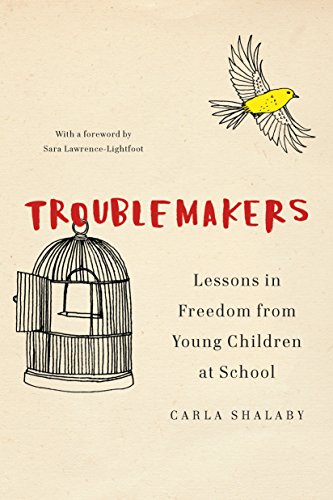
“I think of the children who make trouble at school as miner’s canaries.  I want us to imagine their behaviors – which are admittedly disruptive, hypervisible, and problematic – as both the loud sound of their suffering and a signal cry to the rest of us that there is poison in our shared air…”

These words from Carla Shalaby’s phenomenal book Troublemakers have haunted me since I read them.  I think I have shared these words with other educators more than anything I have ever shared from a book.  This book is a book that will influence my teaching for years to come.

The image of these kids that so desperately need school to work for them as the canaries is one that I cannot get past.  Is one that we all need to unpack.  What if we saw their behavior as an alert to how our schools are not working, rather than think that they do not work in our schools?  What if we treated each high flyer, each challenging kid, as what they are – spotlights on what we are actually asking kids to do all day; sit still, comply, listen, only do what we tell them to and then realize that just perhaps this is not what every child needs.

What if we unpack our own values and not the ones we claim we have, after all, I have yet to meet an educator who says that making children hate school is part of their job description, but the ones that our actions show us we have.  Who do we listen to?  Who do we praise?  Who do we give positive attention to?  Who do we highlight as valued members of our classroom?  And who do we not?  These actions speak louder than the things we say we value.

And I speak from my own history; for several years, I wielded exclusion and public shaming as my primary tool of control.  So what if other students saw kids move their sticks or put their name on the board, after all, they had been there to witness the behaviors.  So what if the same kids were sent out of the room; to think, to take a break, to go to the principal’s office.  So what if the same kids were “otherized” every time they failed.  Every time they screwed up.  Every time they weren’t “good” students.  They would just have to learn how to adapt, how to fit the mold of school, how to fit “our” classroom and not the other way around.

A few years in, I realized what I was doing.  How I was part of the problem of schools failing kids, how public shame has no place within our classrooms, how exclusion is often the worst long-term solution because it isn’t really a solution at all.  How relationship, giving students power and giving them a way to speak their truths was what I needed to pursue instead, even if it meant more time, more work, and yes, more frustration at not having a quick answer.

Within that revelation I had to uncover a hard truth; that I was the reason that some kids were otherized.  As I was writing Passionate Learners, a book focused on how we change the way we teach to give control back to our students, I asked my students, “How do you know who the “bad” kids are?”  Their answer shook me to the core.

“The teachers tell us…”

So simple and yet so hard to digest.

We, the adults in the room, are the arrows that point out the bad kids.  Are the magnifying lenses.  Are the ones that show that it is okay to exclude others.  That it is okay to police others who step out of line.  That there is such a thing as “good” kids and “bad” kids.

And that is something that needs to change.  We can do better.  We must do better.

So as I prepare for our students to come to school, I think of what I need to do to ensure there are no “bad” kids in our room.  That all kids are truly valued.  That all kids get what they need.  Lofty?  Sure, but it shouldn’t be.  It should be the right of every child to be seen as a valued member of our schools, even if they make their presence known loudly.

being a teacher, new year

We Should Teach

White, Fuchsia,  Free Image

I asked, “If you were to create a genuine bill of promises for each child you will teach this year, what would it include?”

And while the responses were beautiful, they shone of promise, of high hopes for every child, of a community for all, not just those that fit what we have decided school should be like, I cannot help but wonder what happens to those promises when the day gets hard?

What happens when a child pushes our buttons?

When a child refuses to sit down, sit still, be quiet?  When they refuse to fit into the box we have created?

Because in that moment how we act says more about the classroom community we are building than any dream or promise we may have made.

The first time a child pushes our limits tells us more about how we define success than what we may have written down in our idea books.

So we should teach the way we would want our own children to be treated; with dignity, with respect, and with love – not just in words, but in action.

We should teach as if we are the determination between that child’s success and that child’s failure because sometimes we are.

We should teach as we would have wanted to have been taught when we were young.

And when a child inevitably doesn’t like us whether it is for a moment, a day, or a year, we don’t blame the child, jump to anger and punishment, but instead step back and try to see what they are really telling us.  What their actions are really pointing to.  Recognize how we are a part of the situation and the system that is causing this child’s pain.  And we should ask ourselves; what kind of future do we want? One filled with success only for those who fit into the boxes of school or success for all, even if they blast the boxes?

So this year we should teach with urgency, not just the curriculum, but the love, and realize that we truly hold the destiny of our nation in our hands every day.

But more importantly than that, we teach the children, and the children need us to see them for everything they are; wondrous, challenging, and deserving of our love, even on the tough days.

That’s my promise for the year.


Be the change, being a teacher, Literacy, Reading, Reading Identity

On Tier 1 and 2 and 3

4867979838488576.png

For years, I couldn’t understand why my own students weren’t growing as readers.  Why the same names showed up at our data meetings as kids who were failing to progress.  Why some kids made the yearly growth and others sat stagnantly.   I was trying, using the framework of balanced literacy, yet I didn’t see how my own lack of knowledge, my own lack of tools, was directly leading to them not growing.  How, although I had the components in place, there was so much more I could be doing for all of the kids. Instead, I looked outward hoping that surely someone else; special ed, reading specialists, ESL support, someone must know how to reach these kids.  How to teach these kids.

I am a classroom teacher. Every day, I am responsible for not just the literacy lives, but also the well being of more than 100 students.  Every day, I am expected to provide the very best instruction that I can to every child that walks through our door.

Despite their mood.  Despite their situation.  Despite their past interactions with our educational system.  Despite their life circumstances that may or may not stand in their way.

I am the facilitator of what is meant to be meaningful literacy experiences that will suit all of their needs.  Every day.  Every class. Every child.

My job is no different than so many others.  This is what I became a teacher to do, I am supposed to provide my students with what we know works within literacy instruction: time to engage with meaningful reading and writing, including time to read and write, supported and explicit instruction, personalization to meet their needs through one-on-one conferring or small group instruction.  Utilizing an inclusive classroom library filled with books that I have read, coupled with visits to the school library (with a certified librarian).  I am supposed to develop my skills so that every child has a chance to not just survive but succeed within our classroom.  That’s my job.  That’s our job.

And yet, in many classrooms, kids are not getting these foundations of literacy.  They are not getting time to read.  They are not surrounded by books.  They are not being provided personalized instruction to suit their needs.  Instead, they are forced to sit in front of computers who quiz them on their skills, read through basal texts that allow for little to no personalization, told that only books that fit their level is allowed reading material.  Taught by teachers who are trying so hard yet are meeting resistance every step of their way, whether from the systems, the decisionmakers, or even their own lack of training.

And then we wonder why so many kids end up in tier 2 or tier 3 interventions?

So this year, I will continue to examine my own practices as the teacher of Tier 1.  I will make sure that the instruction I am providing is effective, focused, and research-based.  I will make sure that my foundations are in order and also well-taught so that kids have a chance to grow in our classroom.  I will disseminate my own practice before I look outwards.  And I encourage other teachers, other decisionmakers, other schools to do the same.  If too many kids are in intervention, then foundations are missing in our classrooms.  If too many kids are not making growth, then we look at what is happening with us first.  And we look at it from a systems place.  Are systems in place to support kids on their reading journey?  Are systems in place to helps kids develop their reading identity?  Are systems in place to teach the joy of reading and not just the skills?  Which systems stand in their way of success?  Which systems harm rather than help?

And that’s where we start. Not with pull-out, but with better in class instruction.  Not with intervention, but with reexamination.    With a commitment to the best classroom instruction, we can provide, supported by the administrative decisions that are being made.  Perhaps a lofty dream, but a dream worth pursuing nonetheless.

If you like what you read here, consider reading my newest book, Passionate Readers – The Art of Reaching and Engaging Every Child.  This book focuses on the five keys we can implement into any reading community to strengthen student reading experiences, even within the 45 minute English block.  If you are looking for solutions and ideas for how to re-engage all of your students consider reading my very first book  Passionate Learners – How to Engage and Empower Your Students.      Also, if you are wondering where I will be in the coming year or would like to have me speak, please see this page.