being a teacher, Literacy, Reading, Reading Identity

Make Room For Both Types of Independent Reading

90 minutes.  This glorious amount of time awaits my students and me next year for our English classes. No more trying to cram everything into 45 minutes, no more rushing, no more skipping things.  90 whole minutes, and I cannot help but think of all we can become.

As I plan for these minutes, I realize that once again one of our central tenets will be the right to choose a book and to read it freely every single day.  With no post-its, no jots, no interruptions.  Just reading for the love of reading, every day, every child, no exceptions.  Because if we listen to Louise Rosenblatt, and I don’t know why we shouldn’t, she reminded us back in 1978 that children need to be taught that there are two types of reading.  Aesthetic reading which focuses on the love of reading, on living within texts so that we can create a relationship with the text.  On being with the text so that we can see ourselves as readers.  And also efferent reading, reading for skill, reading to work on reading.  The things we do with what we read.

For many years, it appears that we have focused mostly on the later.  The joy of reading has simply not been something we have made room for in our schools as we rush to utilize every single minute for instruction, for skill, for doing something.  And we see the direct results now.  The PEW Research Center reports that 24% of adults have not read a book in the last 12 months.  Scholastic reminds us that fewer and fewer children read a book for fun every day.  And we see it in our classrooms as students roll their eyes and tell us that books serve no purpose in their lives.  We see it when teachers tell us that they simply don’t have time for students to read in class because they have too much to cover.

We have lost our way when it comes to one of the basic premises of what teaching reading is really all about; reading for the love of it.  Reading to become a reader who reads without the threat of a grade or the promise of a reward.

We must do better than that.

And so next year, I will start once again with 20 minutes of uninterrupted reading time.  20 minutes where we simply work on loving reading.  Where we work on falling into the pages of a book and then staying there.  Nothing to do but read.  Then a mini-lesson and then we shift focus to the skills of reading.  There will be discussion, strategic lessons, small groups, and everything we love about the workshop model.  Students will know that they are now working on a different skill than before because it is within this knowledge they can see the difference.  They need to know there is a difference.

For too long we have lost too many kids in reading.  They have turned away from books because books meant more work.  More things to do.  More interruptions.  More accountability.  And while we need students who can apply the skills of reading, we more so need kids who will like reading once they leave us.  Who will not become a part of the 24% as we slide toward a more alliterate nation, a more alliterate world.  And it starts with the very decisions that we make every single day.  Where we look at the precious time we are given and get our priorities straight.  It was never about just making sure kids could pass tests, it was always about them becoming more than what they started as.  So we have to make room for both types of independent reading.  The one where kids “just” read and the one where they work while they read.  Otherwise, we will lose them.

It starts with the decisions we are making now as we reflect on the year ahead.  Make room for both because we cannot do the work if we don’t.  And if you don’t have the time, make the time.  Ask yourself what are you doing with the time?  how much time is lost simply in transitions?  In bell work?  In us teachers talking too much?  If we say we want students to become readers then that starts in our classrooms, not when they go home.

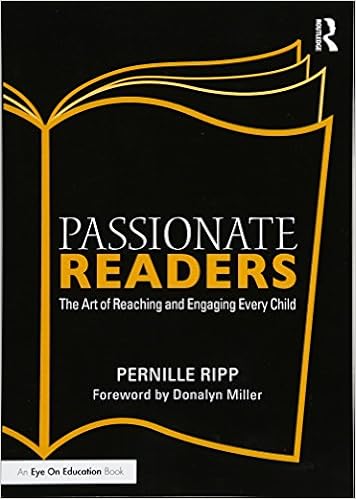
If you like what you read here, consider reading my newest book, Passionate Readers – The Art of Reaching and Engaging Every Child  Also consider joining our book club study of it, kicking off June 17th.  This book focuses on the five keys we can implement into any reading community to strengthen student reading experiences, even within the 45 minute English block.  If you are looking for solutions and ideas for how to re-engage all of your students consider reading my very first book  Passionate Learners – How to Engage and Empower Your Students.      Also, if you are wondering where I will be in the coming year or would like to have me speak, please see this page.
being a teacher, books, Reading, Reading Identity

How We Gave Every Student a Book on the Last Day of School

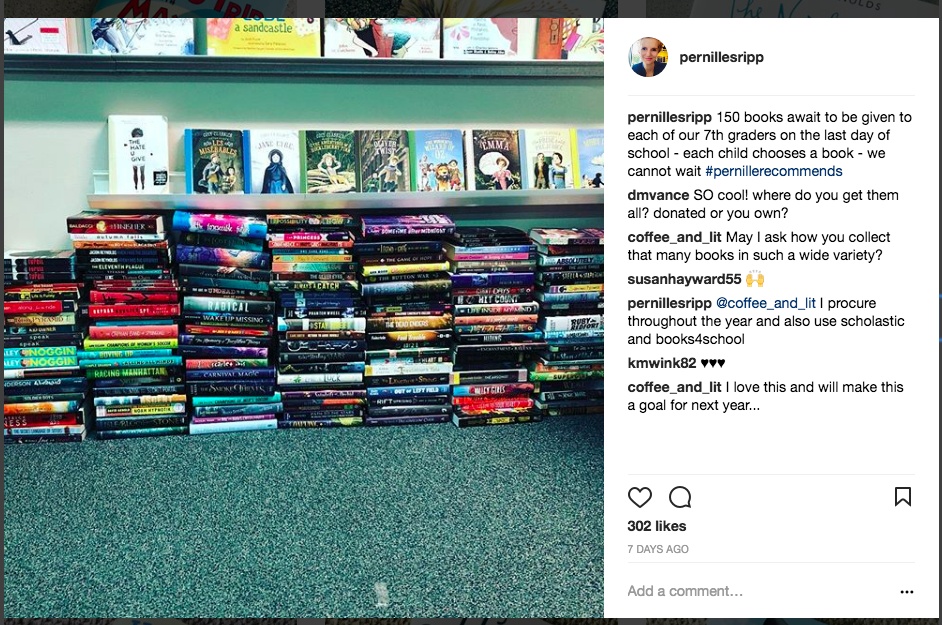
If you follow me on social media, you may have seen this post…I know many have and many had questions.  So this is my attempt to answer those questions.5366394032750592.jpeg

A while back, I realized that if I started collecting books, perhaps, just perhaps, I could give every single one of my literature studies students a book to keep on the last day of school.  But that would require 76 individual books.  As I pondered the idea, I realized the injustice.  Summer slide can happen to any child.  Every child we teach on our 7th-grade team could use a book, even if they already live in a book flood.  What if we were able to gather up 150 books, one for each student, for the last day of school?  Would my team be up for it?

I shouldn’t even have wondered, of course, they were because one of the things I love about working at Oregon Middle School is the dedication of all to joyful literacy experiences.  Is the dedication of all staff to help students become or remain readers who like reading.  And so we realized that we now needed 150 books.  And not old, worn out copies.  Not books that no one would want to read, but instead books that would entice.  Books that would actually be a possibility for a child to want to read, without a nagging teacher around, with the competition of everything summer holds.

So we started to collect books.  I am in the lucky position that some publishers send me books and so I knew I could use a few books from there.  But, it wouldn’t be enough.  We needed books that would work, not just any old book.  My next stop was Scholastic.  We knew I would be able to use my bonus points to get more books for the kids.  I also spent my own money to add it up to receive bonus books and get more points.  Slowly the collection started to grow.  Finally, I asked our team for money.  Could we take money out of our team fund for this endeavor?  Once again, they were onboard and excited for the idea.

6587422096490496.jpeg

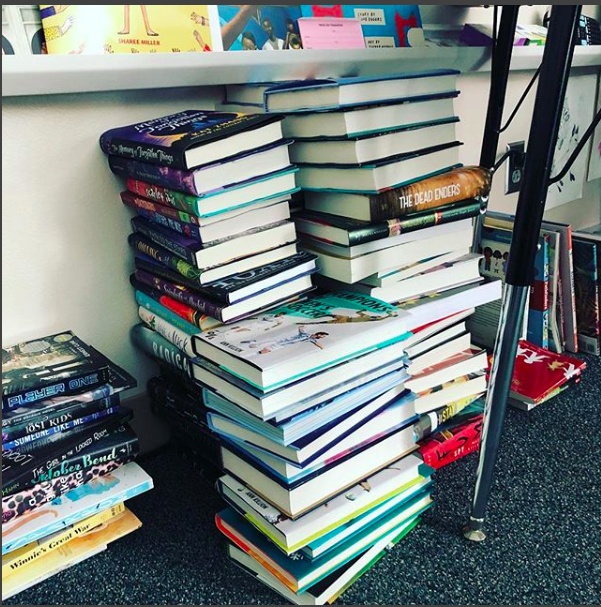
And so we went to Books4School – a warehouse here in Madison, whose owner’s sole mission is to get high-quality books in the hands of children for cheap.  He buys up overstock from publishers and then sells them to the public and online for less than $2.  Yup, less than $2.  Because he is not in it to make a huge profit but instead to ensure that more children have books in their hands.  So armed with our team funds, I bookshopped.  Filled an entire cart with titles like Speak, Noggin’, Day of Tears, Sunrise over Fallujah, Backlash, and See You at Harry’s.  Filled it with books that I knew represented a diverse wide of readers.  Books we had loved this year.  Books we had loved in the past.

As the pile grew in our classroom, the students were curious.  Why may we not bookshop those?  What are those for?  We held our tongues until the very last day when we gathered them all around for our final team meeting.

Surrounded by books each equipped with a hand-drawn bookmark from Kevin Sylvester, who writes one of our very favorite book series Minrs, we told the students just how thankful we were for them.  Just how proud we were.  How we would miss them.  How we wanted to thank them and we knew just the way.

We then told them to look around because in a moment they were going to have a chance to select whichever book they wanted to keep.  To stand up and browse all of the tables and then o please find a great book and read it this summer.  That is was the very least we could do.

And then something surprising happened.  The students cheered.  These sometimes too cool to read kids actually cheered.  And there was a mad rush to grab the book they had noticed.  There was a mad rush to find just the book they wanted to read.  Kids walking around with each other sharing ideas.  Pointing out favorites.  One child telling me that she grabbed a book she had already read because she knew it was so good she had to read it again.  Another child telling me that he had wanted to read this book all year but never had the chance.  Almost every single child leaving with a book in their hands.

At the end of the day, I wondered if the students actually cared about the books or whether it was just one more thing we had tried that didn’t really make an impact, yet as I looked around our team area, I only found three books left behind.  Three books out of 150.  Three books that someone had forgotten.  These kids that sometimes could not remeber to bring a pencil a class actually brought their books home.

This morning, I received an email from a parent thanking us for the year.  She wrote about the change she had sene in her child this year.  How “…he even told me yesterday that before the kids were allowed to pick out their free book, that he purposely sat close to the book he wanted to make sure to get, so he could read it this summer.”  This from a child who was not sure that reading was something he cared about before this year.

The mission for us at Oregon Middle School is to create opportunities for kids to love reading, or at the very least like it.  Handing them all a book on the last day of school was the very best thing we could have done.  It showed our commitment to their future lives as readers.  And who knows, perhaps that book will be THE book for that child one day?  May every child be given a book on the last day of school.

If you like what you read here, consider reading my newest book, Passionate Readers – The Art of Reaching and Engaging Every Child  Also consider joining our book club study of it, kicking off June 17th.  This book focuses on the five keys we can implement into any reading community to strengthen student reading experiences, even within the 45 minute English block.  If you are looking for solutions and ideas for how to re-engage all of your students consider reading my very first book  Passionate Learners – How to Engage and Empower Your Students.      Also, if you are wondering where I will be in the coming year or would like to have me speak, please see this page.
Be the change, being a teacher

What We Can Give

Today, we gave our 141 students a brand new book.  As a way to entice them away from the dreaded summer slide.  As a way for them to relax. As a way to thank them.  Thank them for all they gave us this year, for all that they brought to us.  While we gave them just a book, there is so much more that we, as educators, can give our students every year.

We can give them our time.  Always when they want it and sometimes when they don’t.

We can give them our respect.  Always when they earn it and even when they don’t.  Apologize when we need to and set high expectations for all.

We can give them our trust.  Always when they prove it and sometimes when they don’t.

We can them give room to grow, to try, to not succeed at first and to stretch themselves into the bigger version that they hoped to be.  Give them space to be challenged, let them in on the process, and then listen to them as they give us their feedback so that we can grow right alongside them.

We can give them our love.  Even those who swear that they will never want to willfully be a part of our classroom, sometimes, we love them just a little bit more loudly.

And we can give them all the benefit of our doubt.  A clean slate for the next class, for the next day, and for the new year.  Sure, give us tips about the incoming students, but don’t tell us what they can’t do.  Tell us what they can.  Tell us how they have grown, their strength and what they are still working on.  Don’t tell us, “Good luck…” or “Good riddance…”

We can give them our very best, even when it is hard, even when they are hard.  Becuase didn’t we all become teachers to do just that?  Be better than what we were before?  What better way to prove it than to grow.

If you like what you read here, consider reading my newest book, Passionate Readers – The Art of Reaching and Engaging Every Child  Also consider joining our book club study of it, kicking off June 17th.  This book focuses on the five keys we can implement into any reading community to strengthen student reading experiences, even within the 45 minute English block.  If you are looking for solutions and ideas for how to re-engage all of your students consider reading my very first book  Passionate Learners – How to Engage and Empower Your Students.      Also, if you are wondering where I will be in the coming year or would like to have me speak, please see this page.


Be the change, being a teacher, being me

Lessons From Ten Years of Trying….

first year.jpg
The night before my very first day as a teacher.  This is what terrified looks like.

Ten years ago, I said thank you to my very first class of 4th graders.  Thank you for their dedication.  Thank you for their persistence.  Thank you for their love.  I know I cried as I hugged each and every one of them, thanking them for our year.

Today, I will hug as many 7th graders as I can.  I will thank them for a year filled with laughs.  With challenges.  With growth.  With love.  Teaching is by far the best thing I can do with my professional time.  When I look back on ten years of teaching, I cannot help but think of all the things I have learned.  Of how I have grown.  Of how I am still growing.  There is so much to learn, still.

But ten years has also taught me a lot about what it means to be a teacher.  What it means to get up every morning and do this job.  Not just because you have to, but because you can.  And as always, the kids I have had the privilege of teaching are the ones who have taught me the biggest lessons.  The ones who have made me who I am today.  They taught me…

That’s it’s not about me.  That the needs of the students should always be my focus.  That when I am wondering what I need to change, they are where I start.  That my assumptions, while sometimes on point, will never be as accurate as what they will actually tell me.  That their advice, if we only take it, will transform our teaching for the better.

…but sometimes it is.  Sometimes I am the problem.  Sometimes I am the reason a child hates school.  Sometimes my decisions, even if made with the best of intentions, will harm rather than build.  It is my job to make sure that I know that.  That I realize the immense power that we have over the future of the very children we teach.  That I ask the hard questions in order for me to grow and to create an experience that works for every child as much as humanly possible.

They have taught me…

That a smile will always go further than a well-developed lesson plan.  That my attitude when it comes to the very kids I get to teach is a choice.  That saying hello, that smiling, that telling them how much I love this job, how much I love them, will make a difference.  Even to those who push the hardest.

….but sometimes a well-developed lesson plan can move mountains.  When students plan lessons with us, offer up their ideas, and invest their energy, we are already further than we could be without them.  That lessons need choice, relevance, and challenge.  That every child deserves to be held to high expectations, and every child needs a second chance when something doesn’t work.

That those who push you the hardest, leave the biggest marks.  That often those kids who see no value in school, no value in you, are the ones you will fight the hardest for.  That it is not your job to save them from their lives, themselves, or their circumstances, but that you are there to love, to offer up ways to navigate their lives, and to remind them that they have worth.  That in this world, they matter.

…but sometimes they don’t want you to be in their corner.  And that’s ok, too.  We can try to connect with every child we teach, knowing that for some we may be exactly the type of teacher they do not want.  The biggest gift we then can offer up is, besides not giving up, to help them forger connections with others.  To help them have someone they connect with, so they know that they are not alone.

They have taught me…

That I don’t know it all.  Especially the more I teach, I realize how little I know.  Ten years ago I didn’t think about my privilege.  I didn’t think about how marginalization hurt the very kids I taught.  How inequitable our school system is.  How white skewed my classroom library was.  How I didn’t know everything.  But I grew, and I will continue to grow.  I will continue to admit when I screw up, and it happens a lot, and I will continue to apologize, to use the power I have been given to fight for others and with others.

…but I do know some things.  I know that love matters.  That research matters.  That conviction matters.  That sometimes being the sole voice for change is scary, but necessary.  That we grow best through kindness, but sometimes kindness will not tear down walls.  That what we believe in directly influences how we teach, but that our bigger job is not to give students our opinion, but instead make space for them to develop their own.  That every day I get to work with kids is a better day.  That there is hope.  That this new generation of kids we are raising are changing the world.  That I would rather be a part of the fight, then safe on the sidelines.

I became a teacher because I hoped to make a difference.  I hoped to create a classroom where every child felt safe, where every child felt loved.  I don’t know if I have succeeded, but I do know that teaching has changed me.  That I would not be the person I am without the influence of the many incredible children I have taught and who have taught me.

I came into this profession to make a difference but in the end, it was the kids that made the biggest difference to me.

If you like what you read here, consider reading my newest book, Passionate Readers – The Art of Reaching and Engaging Every Child  Also consider joining our book club study of it, kicking off June 17th.  This book focuses on the five keys we can implement into any reading community to strengthen student reading experiences, even within the 45 minute English block.  If you are looking for solutions and ideas for how to re-engage all of your students consider reading my very first book  Passionate Learners – How to Engage and Empower Your Students.      Also, if you are wondering where I will be in the coming year or would like to have me speak, please see this page.


being a teacher, Book Clubs, books, Literacy

Join the Passionate Readers Summer Book Club Study

While summer is definitely a time to unwind without guilt for me, it is also a time where I want to grow as an educator.  Where I want to think of new ideas, come up with a plan, and maybe even make a few connections.  And I am not alone.  When I asked the educators in our Passionate Readers Facebook group what their plans were for re-energizing themselves over the summer, every person who answered had some sort of professional learning they wanted to do.

So in order to start a conversation.  In order to help each other grow.  In order to renew, refresh, and reinvigorate, I invite you to join us for an informal four-week book club centered around Passionate Readers.  We will discuss teacher reading identity, student reading identity, classroom libraries and of course, share must-read, must-add titles for you to consider adding to your classroom.

The book club is free, all you need is your own copy of Passionate Readers and to join our Facebook group where the questions and discussion will happen.

Once a week, I will join do a Facebook live conversation where I can answer questions, highlight books, and share ideas.

The book club will kick off June 17th and run for four weeks wrapping up July 8th.

1st-week focus – Teacher reading identity and how our habits influence our teaching.

2nd-week focus – Classroom library and must add book titles for the year.

3rd-week focus – Student reading identity – choice, goals, and independence.

4th-week focus – Conferring, lessons, and getting ready for the year ahead.

So if you would like to join, get your copy of Passionate Readers ready, join the Facebook club, and get ready to share.


Be the change, being a teacher, end of year

7 Must Do’s at the End of the Year

With just a few precious days left with the kids I have gotten to call mine for the year, my body is bone-tired.  I think we all are.  Yet, my mind is eager, I am excited to send these kids off for summer, and yes, I am also excited for the next group of kids coming our way.

So within these last few days lies an incredible opportunity to grow.  To prepare for the next year even if this year is not quite over.  I have seen some great posts on things to reflect on as the year ends for so many of us and thought I would share what I plan on doing.  Perhaps, you could use a few ideas yourself?

I plan on surveying my students.  While our school does both a home and student survey, I also need to know what I can work on.  Every year, the words of my students help me shape the experience to come.  Every year, the words of my students help me grow as an educator.  Don’t let the kids leave without helping you grow.

I plan on keeping certain experiences.  Looking through the year and reflecting on what really worked, whether it was a lesson, an idea, or simply a moment, helps me think of the year to come.  Don’t let this year end without you realizing what worked.  Whether you go through lesson plans or simply write a bullet list, take note so that when the time comes for your ideas to come back, you have a place to start.

I plan on getting rid of certain lessons.  While our experience inevitably changes year after year, there are also certain things that despite our best intentions simply didn’t work.  So I am getting rid of them both physically and mentally.  goodbye curation project!  Goodbye identity journals!  Goodbye to you so that I can make room for better things.

I plan on freshening up the room.  In fact, I already did that.  Last week, my husband and I moved all of our bookshelves so that I could reclaim the front of the room as part of our teaching area.  It has made a huge difference to the feel of the room, how welcoming it looks.  Why wait until next year?  Try it out now and see how it feels.

I plan a focus.  This summer, I get to both teach others and learn from others and so I need a focus.  Where does my craft need to grow?  Writing is what comes to mind, as well as the hard work of equity and social justice.  And so I go to conferences with a few goals in mind.  I read PD books with these goals in mind.  I reflect, invent, and write down ideas with these few goals in mind.  In the past, when I have had a broad focus, I feel I have learned little, but when I have a few questions in mind, such as how will I continue to help students understand their role in the world or how we will we create more joyful writing experiences, then I leave summer with a few tangible ideas that shape our experience together.

I plan a challenge.  Every summer, I try to discover the work of new amazing leaders in education.  One year it was educators like Val Brown, Dana Stachoviak, and Cornelius Minor, another it was diving into the work of We Need Diverse Books and figuring out how to work through my own biases and change the way I taught.  Every year, I pick a challenge that will push my thinking, make me realize my own mistakes, and also help me become a better educator.  It can be hard at times, but it is definitely worth taking the time to realize the gaping holes you have and then actually doing something about it.

I plan a break.  Teaching is amazing, it is my favorite thing to do as far as work., but it is also exhausting, heartbreaking at times, and hard.  So summer is time for a break, and not a kind of break where I still work, but one where I feel no guilt for not checking my email.  Where I feel no guilt for reading whatever I want even if it is slightly trashy.  Where I feel no guilt for not checking in, creating something, or coming up with new ideas.  But you have to plan for it or it won’t happen.  We know how consuming teaching can be, how it can spill into every part of summer, but don’t let it.  Allow yourself to detach completely so that you can get excited.  So that you can let ideas marinate in the back of your mind.  So that you can remember what it means to have a life, if even for a little bit, outside of teaching.  Because if you never leave, then you cannot get ready to come back.

Summer is a break.  A much-needed one for many.  But it is also an incredible time to become something more than what we ended as.  To remember why we entered teaching.  To get excited, to catch up on sleep, and to become the very best version that we can be of ourselves so that when September rolls around, or whenever our students come back, we can say, “I am so glad you are here,” and truly mean it.

If you like what you read here, consider reading my newest book, Passionate Readers – The Art of Reaching and Engaging Every Child.  This book focuses on the five keys we can implement into any reading community to strengthen student reading experiences, even within the 45 minute English block.  If you are looking for solutions and ideas for how to re-engage all of your students consider reading my very first book  Passionate Learners – How to Engage and Empower Your Students.      Also, if you are wondering where I will be in the coming year or would like to have me speak, please see this page.