being a teacher, Literacy, Passion, Reading, student choice, student voice

Stop Feeding the Beast – The Reading Myths We Pass on As Truth

“This is not a “girl” book even if the cover makes you think it is, boys can love it too…”And I stop myself.  And I cringe inwardly.  And I want to rewind time for just 10 seconds and tell myself to stop.  A “girl” book?  What in the world is that?  And since when did I label our classroom books by gender?

The stereotypes of reading seems to be a beast in itself.  We feed the beast whenever we pass on hearsay as fact.  We feed the beast whenever we fall victim to one of these stereotypical sayings without actually questioning it.  Through our casual conversation we teach our students that there are books for girls and books for boys.  We teach our students that a strong reader looks one way, while a struggling reader (God, I hate that term) is something else.  We say these things as if they are the truth and then are surprised when our students adopt the very identities we create.

So what are the biggest myths that I know I have fed in my classroom?
11232142_10153492591360196_439666777097332585_o
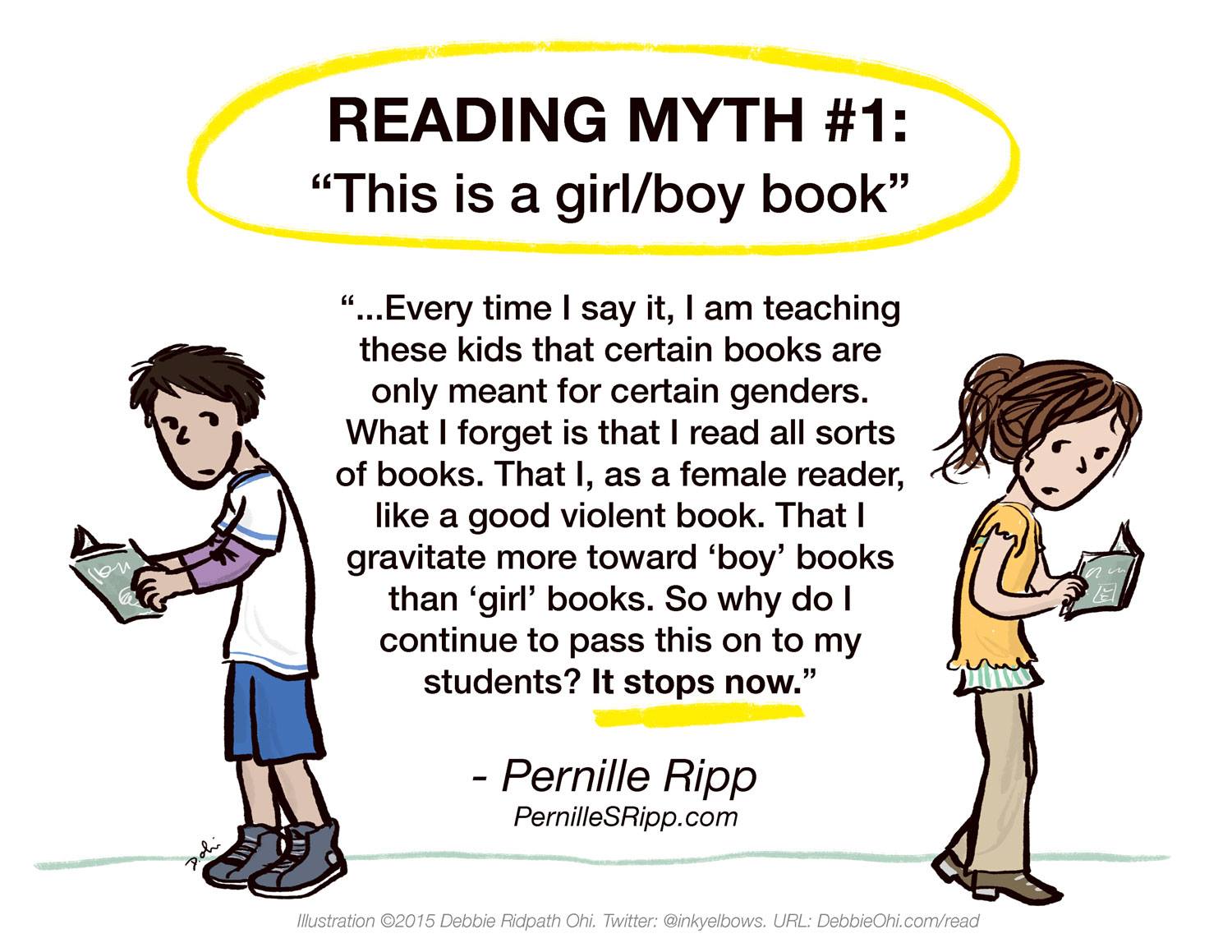
Thank you Debbie Ridpath Ohi for this image

“This is a girl/boy book.”  I have said this many times as I try to book talk a book.  I say it when I think the boys, in particular, will not give a book a fair chance because of its cover.  I say it when I think the girls will find a book to be too violent, to have too much action.  And every time I say it, I am teaching these kids that certain books are only meant for certain genders.  What I forget is that I read all sorts of books.  That I, as a female reader, like a good violent book.  That I gravitate more toward “boy” books than “girl” books.  So why do I continue to pass this on to my students?  It stops now.

“This is an easy read.”  Another common statement I have made while book talking.  What I mean by it is that for most students the text will not prove difficult to understand, yet I know now that ease of reading looks very different from student to student.  That what I may think is easy, even when I pretend to be a 7th grader, is not easy at all.  That even if a book is short does not make it easy.  Even if a book has a manageable story line does not make it easy.  That “easy” means different things to different readers and therefore does not provide a good explanation to anyone.  It stops now.

“He/she is a low or high reader.”  Our obsession with classifying students based on their data does not help our students, it only helps the adults when we are discussing them.  There is an urge in education to group kids according to data points so that rather than take the time to discuss each student, we can discuss them as a group.  Yet the terms “low” or “high” make no sense when discussing readers.  They make sense when we are discussing data points, but is that really all our students are?  How many of us have taught students who were amazing readers, yet scored low on a test?  What would we call them?  We need to discuss students using their names and their actual qualities, not these shortened quantifiable terms that only box them in further.  It stops now.

“Most boys don’t really like to read.”  I don’t know how many years of teaching boys I need to finally stop saying this.  Many boys like to read – period – but when we say that most don’t, we are telling them that what they love is not a masculine thing to do.  That boys loving reading is something strange and different.  If we want this to come true, we should just keep repeating this over and over.  Our male readers will soon enough get the message that reading is for girls.  It stops now.

“The older they get, the less they love books.”  I used to believe this, until I started teaching middle school.  Then I realized that it is not because students want to read less as they get older, they read less because we have less time for independent reading, and we dictate more of their reading life.  Homework builds up as do other responsibilities outside of school.  Compare a 5th grader who has 30 minutes of independent reading most days to my 7th graders that get a luxurious 10 minutes – who do you think reads more in a year?  Also, I wonder if anyone would want to keep reading if they did not get time for it in school or had choice over what they read for several years?  Sometimes I think it nearly a miracle that students’ love of reading can survive what we do to them in some educational settings.  It stops now.

“But they are not really reading…”  I used to be the hawk of independent reading, watching every kid and making sure that for the entire time their eyes were on the text.  If they stopped I was there quickly to redirect.  Independent reading time was for independent reading and by golly would I make sure that they used every single second of it.  Yet I don’t read like that myself.  When I love a book, I pause and wonder.  When I love a book, I often look up to take a break, to settle my thoughts.  When I love a book, my mind does not wander but I still fidget.  That doesn’t need a redirection, that doesn’t need a conversation, that simply needs to be allowed to happen so I can get back to reading.  Our students are not robots, we should not treat them as such.  Re-direct when a child really needs it, not the moment they come up for air.  It stops now.

“They are too old for read alouds…picture books…choral reading…Diary of Wimpy Kid…”  Or whatever other thing we think our students are too old for.  No child is too old for a read aloud.  No child is too old for picture books.  No child is too old for choral reading.  No child is too old for books like Diary Of A Wimpy Kid.  Perhaps if we spent more time showcasing how much fun reading really is, kids would actually believe us.  It stops now.

The myths we allow ourselves to believe about reading will continue to shape the reading lives of those we teach.  We have to stop ourselves from harming the reading experience.  We have to take control of what we say, what we do, and what we think because our students are the ones being affected.  We have a tremendous power to destroy the very reading identity we say we want to develop.  It stops now.  It stops with us.

If you like what you read here, consider reading my book Passionate Learners – How to Engage and Empower Your Students.  The 2nd edition and actual book-book (not just e-book!) comes out September 22nd from Routledge.  
being a teacher, books, Literacy, Reading, student voice

Books Are A Chance To See the World They Do Not Live In

recite-j7nids

My classroom library is a large mix of reads.  Several thousands of books greet my 7th graders when they enter and are free to leave the room in their hands.  Over the last year I have tried to expand it as much as I can afford to make sure that it represents the world we live in, that it represents their experiences, that they can find themselves within our library and use that knowledge to boost their own lives.  My students need to see themselves in our books.

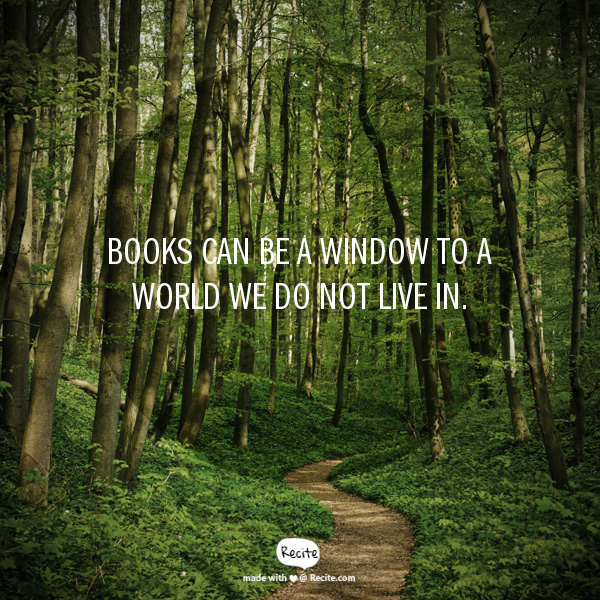
Yet, after a conversation with a great friend, I realized that it is not so much the need to find themselves within our library that I should be focused on because let’s face it, most of the world surrounding them is filled with images that look just like them, sound just like them, and share many of their same experiences.  They are used to turning on the TV and seeing kids that are like them.  They are used to picking up books and seeing like them in the pages.  To  many of my students seeing something other than white is uncommon.  For my mostly white, rural population of readers it is important that they find the rest of the world in the pages.  That through our library they can experience the world that they do not live in.  That their emotions can be stretched to encompass events that they will most likely never have to encounter.  That the library provides them with a window to things that they most likely will never have to live through such as racism, extreme poverty, no access to education, civil war, religious intolerance and a myriad of other issues that exists in only small ways in most of their lives.

So when we rally the cry for diverse books, it is not just so that our kids can find themselves within our pages and find books that mirror their experience.  It is so they can see the world they do not live in.  It is so they can see a world that may not make sense to them and start to make sense of it.  It is so they can start to develop empathy, interest, and community with other parts of the world, other societies, other experiences that do not mirror their own.

Most of my students have plenty of books that they can find themselves in.  My job is to provide them with ones they can’t.

I am a passionate teacher in Oregon, Wisconsin, USA but originally from Denmark,  who has taught 4th, 5th, and 7th grade.  Proud techy geek, and mass consumer of incredible books. Creator of the Global Read Aloud Project, Co-founder of EdCamp MadWI, and believer in all children.  The second edition of my first book Passionate Learners – How to Engage and Empower Your Students” is available for pre-order now.   Second book“Empowered Schools, Empowered Students – Creating Connected and Invested Learners” is out now from Corwin Press.  Join our Passionate Learners community on Facebook and follow me on Twitter @PernilleRipp.

being a teacher, being me

I Didn’t Become A Teacher

recite-k4vgo6

I didn’t become a teacher so I could test my students into submission.  So I could talk about them as data points and chart their growth on a spreadsheet.

I didn’t become a teacher so that I could make students cry.  Or make them smile on command, make them sit still, make them schedule their breaks to my own benefit.  Punish them into submission while I wondered why they seemed so disengaged.

I didn’t become a teacher so I could tell children which books they couldn’t read, where they couldn’t sit, and who they couldn’t work with.

I became a teacher so that I could help students make their voice louder.  Help students believe more in themselves.  Help students grow, learn, and thrive.

I became a teacher to help students find the guts to say, “This is what I need, this is what I want.”

I became a teacher not to kill a child’s love of learning, but to protect it.

And that is the reason why I am still a teacher to this day.  I don’t want to forget that.

I am a passionate teacher in Oregon, Wisconsin, USA but originally from Denmark,  who has taught 4th, 5th, and 7th grade.  Proud techy geek, and mass consumer of incredible books. Creator of the Global Read Aloud Project, Co-founder of EdCamp MadWI, and believer in all children.  The second edition of my first book Passionate Learners – How to Engage and Empower Your Students” is available for pre-order now.   Second book“Empowered Schools, Empowered Students – Creating Connected and Invested Learners” is out now from Corwin Press.  Join our Passionate Learners community on Facebook and follow me on Twitter @PernilleRipp.

Be the change, being a teacher, new year

As We Start Another Year

There are journeys we start where that path is laid out, the route determined, the destination clear.  While hard at times, they follow a set course and we plod along, knowing where we will end up.  Knowing where our hearts will be once we finally get there.  Then there are those journeys that start when something ends, when something abruptly happens and we have a moment of clarity and we realize that now another direction is needed.  Sometimes these journeys start without us knowing and we don’t discover them until we are far on our path.  Confused we wonder how we get here, where we are going, and why we didn’t know we were traveling anew.  Those are the journeys that can change us the most.

We are travelers in education.  Always searching for a path, always searching for a way.  Tirelessly plodding along, sometimes pushing our students ahead of us, other times dragging them along.  Our journey changes often, seemingly from year to year is a guarantee by now.  We notice as the years pass, as summer inches closer and then ends.  We notice when a crop of new students show up and then leave us.  We notice seasons, months, and sometimes even weeks as we plan for our hopes and dreams.

Yet the daily journeys we take, the journey we begin and end within the span of 8 hours is often viewed as minor or insignificant, not worthy of our daily ponderings, not quite worthy of our dreams.  After all, a day is simply a step, not a destination by any means.  Yet, it is these journeys, the ones that happen every single day in our rooms that can matter the most to our students.  To those children that travel along with us.  A single day can change their course for many years to come.  A single decision made by a teacher can change their path forever.  We forget about that responsibility, probably a wise move in some ways, lest we drive ourselves crazy with the knowledge that even our small movements can cause oceans of change for others. Yet those journeys are the ones we should be watching.

Every day we have a choice to make; do I teach my students or do we learn together?  Do we explore or do we wait for knowledge to find us?  Do we stay on our path or do we change course?  Do we support or do we hinder?  Do we encourage or do we fault when missteps happen and our path gets rumpled?  Do we always take the lead or can students show us the way?  Do we listen to their voices when they tell us to change course or do we stubbornly stick to the path because we know best?

The day-to-day wrapped up in it mundanity offers us the perfect opportunity to make a change.  Change doesn’t seem scary when you think of it as trying something for just one day.  You can go one day without punishing.  You can go one day without homework.  You can try for one day to ask students what they want.  You can try for one day to stop talking so much.  One day does not seem like much, but it can be the seed to bigger change.

We have a choice of whether or not we notice the day-to-day or if we continue to plan as if we have unlimited time to reach every child.  We don’t.  We don’t know when the students we teach will no longer be ours.  We don’t know when a child has moved beyond our grasp.  So as we plan for the long, focus in on the short.  Yes, keep the destination in mind, but don’t forget about the journey.  What you do today has an incredible impact on what you will do tomorrow.  Make each step count, make each step worthy of your time, and don’t forget that it is ok to get lost once in a while, as long as you bring your students with you as you try to find your way.

I am a passionate teacher in Oregon, Wisconsin, USA but originally from Denmark,  who has taught 4th, 5th, and 7th grade.  Proud techy geek, and mass consumer of incredible books. Creator of the Global Read Aloud Project, Co-founder of EdCamp MadWI, and believer in all children.  The second edition of my first book Passionate Learners – How to Engage and Empower Your Students” is available for pre-order now.   Second book“Empowered Schools, Empowered Students – Creating Connected and Invested Learners” is out now from Corwin Press.  Join our Passionate Learners community on Facebook and follow me on Twitter @PernilleRipp.

aha moment, being a teacher, first day, new year

3 Non-Ice Breaker Things to Do the First Week of School

I always wonder how students felt about doing the ice breaker activities I had planned for them.  How I asked them on the very first day to let loose, lighten up, and live a little.  How some of them seemed to light up while some barely went through the motions, no amount of coaching from me helping them. And some just stood there mortified.  I figured a little embarrassment didn’t hurt them that much.

Then I was asked to do ice breakers myself.  To share something I had never told someone else.  To take part in a scavenger hunt where I had to do things I didn’t feel comfortable with.  I didn’t feel like I knew people, I was mortified.  That night I swore to myself never to do anymore ice breakers, at least not in the traditional sense.

Yet we still have to break the ice.  We still have to plant the seeds of community.  So while I have discussed what I will be doing on the first day of school already here, here are three more ideas for forming a community with your students.

How We Are Connected Web

I wish I could remember who taught me this one, but I cannot.  You take a large piece of paper (bulletin board paper will do nicely) and then every students gets a sharpie.  All students and you sit around the piece of paper and then write their name down in front of them.  A students will then share something they like or dislike, if you agree with their statement you draw line from your name to their name.  You then go around the paper until everyone has shared.  In the end you will have a spiderweb image on your paper showing just how many things you have in common with each other.

Find A Picture Book

It is no secret that I am obsessed with picture books, so I love this way to get a hint at their personality.  All this requires is a lot of different picture books spread out.  Tell the students that they should find a picture book that speaks to them in some way, perhaps the cover reminds them of something, perhaps they remember it from their childhood, perhaps the story connects to them?  Once everyone has found a book, have them gather in groups and share why they selected the book they chose.  Students get a chance to speak about themselves and it is a great way for them to get excited about the books they will have access to.

The Circle

This is taken straight from our restorative circle program at school, an incredibly powerful program.  All members sit in a circle and one person holds the talking piece.  A question is asked such as; what is your favorite memory or something else non-threatening, and students take turns sharing and more importantly listening to each other.  We use circles all throughout the year and the way they build community is extraordinary.  Students learn to be a part of a protected environment where they can share whatever they need to share and know that their words are private within the circle.

Building community and getting to know students should not be something that embarrasses kids or leaves them riddled with anxiety.  It should be a positive experience that sows the seeds for the community you will build the rest of the year.  So be mindful of all of the students, not just those that you know will love the games.  Make sure they all feel accepted or you may be causing more rifts than building connections.

Jenn Gonzales from Cult of Pedagogy just published “Icebreakers That Rock” – check out her post too for more inspiration.

I am a passionate teacher in Oregon, Wisconsin, USA but originally from Denmark,  who has taught 4th, 5th, and 7th grade.  Proud techy geek, and mass consumer of incredible books. Creator of the Global Read Aloud Project, Co-founder of EdCamp MadWI, and believer in all children.  The second edition of my first book Passionate Learners – How to Engage and Empower Your Students” is available for pre-order now.   Second book“Empowered Schools, Empowered Students – Creating Connected and Invested Learners” is out now from Corwin Press.  Join our Passionate Learners community on Facebook and follow me on Twitter @PernilleRipp.

being a teacher, first day, new year, reflection, Student

On the First Day of School

recite-bjldbu

Today I was reminded of the stark reality that is the 45 minutes blocks of time that I teach in every day.  As I sat and planned my first quarter, or at the very least wrote down some of the ideas I have, I kept glancing at that first day; the one that seems so magical.  I have so many ideas.  So many things I would like to do on that very first day.  Yet, the 45 minutes really stifles a lot of creativity.  The 45 minutes really forces me to see what is most important.

On the first day of school I don’t want to do activities.  I don’t want to play games.  Nor do I want to fake my enthusiasm.

On the first day of school I don’t want to force student into awkward ice breakers, while they hope the teacher will forget it is their turn next.  I will not force them to bare their soul, nor to share their dreams.

On the first day of school, we will not have many things planned.  We will not spend precious time listening to me drone on.  We will not run around hectically trying to figure it all out.

Instead, on the first day of school we will sit quietly and listen to a book read aloud.  We will have the time to speak to one another.  We will cautiously start to feel each other out, find our friends, glance at the new people.

We will ask the questions about 7th grade that we have, not because we have to but because we will take the time if needed.  Students will set the rules of the classroom, as always, and it will take as much time as it needs.

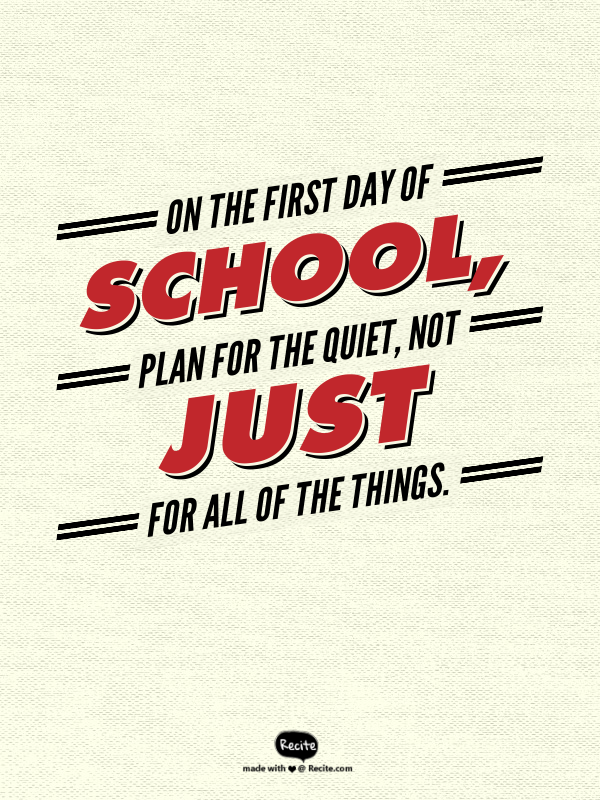
The first day of school is meant to be a great experience, but that does not mean we cram it full of things to do.  That doesn’t mean that we put on our entertainer hat and try to juggle as many balls as we possibly can.  Instead, it means that we take the very first step to get to know these students that have been thrust into our lives.  That they take the very first step in trusting us and trusting the community.  That can only happen in a genuine way if we take things slow.  If we allow time to just be, to just sit, to just talk.  So as you plan for the very first day of school, plan for the quiet, for the reflection, for the conversation.  Don’t spend so much time planning for all of the things.  Because this isn’t about how to prove how fun you will be this year, it is about showing the kids that you care.

I am a passionate teacher in Oregon, Wisconsin, USA but originally from Denmark,  who has taught 4th, 5th, and 7th grade.  Proud techy geek, and mass consumer of incredible books. Creator of the Global Read Aloud Project, Co-founder of EdCamp MadWI, and believer in all children.  The second edition of my first book Passionate Learners – How to Engage and Empower Your Students” is available for pre-order now.   Second book“Empowered Schools, Empowered Students – Creating Connected and Invested Learners” is out now from Corwin Press.  Join our Passionate Learners community on Facebook and follow me on Twitter @PernilleRipp.