being me, global, MIEExpert15, mystery skype, student voice

A Few Ideas for Using Skype in the Classroom

There are technology tools that come along and make your day easier, that make your day better.  There are technology tools that integrate themselves so seamlessly into your lessons that you soon forget what life was like before.  There are tools that you know you can rely on whenever you need them.  And then there are tools that encompass all that and oh so much more.  Tools that elevate your teaching ideas to places you never thought they could have gone.  That’s how I feel about Skype.  Skype and I have been faithful friends for the past 16 years, ever since I moved to America, but our relationship really deepened 5 years ago when I brought it into the classroom.

So why has Skype been such a central piece of my classroom?  Because it is free, efficient, easy to use, and opens up a world of possibility that I never could physically bring into my classroom, yet through its power and immense network I can.  Skype simply makes what we are doing better.  It gives us audiences, authors, experts.  It connects us with places around the world and gives my students a way to change the world.

So what are some of our best ideas?
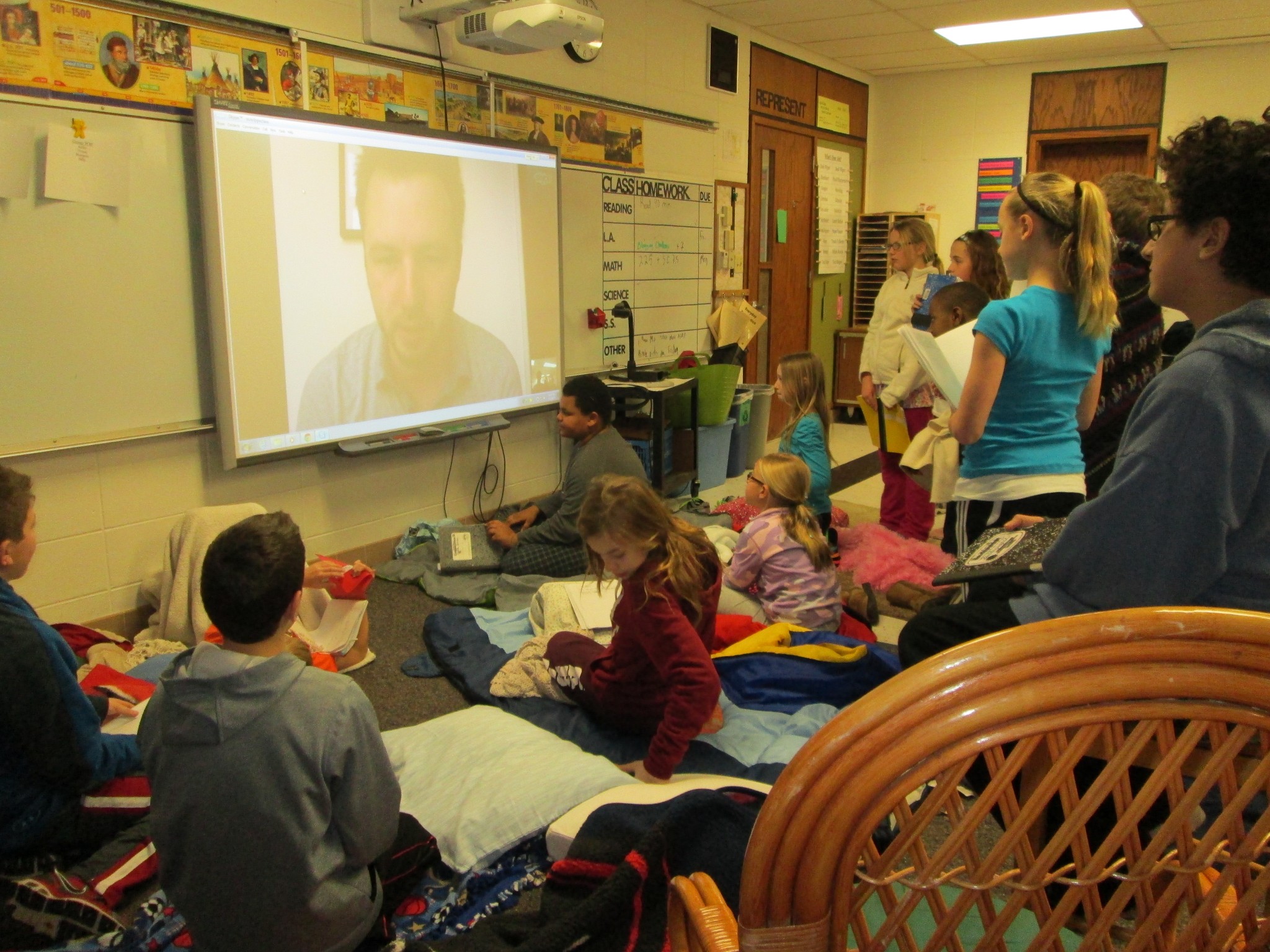
Students speak to author Adam Gidwitz

How about using Skype to do market research?  We did just that in our epic nonfiction picture book project where the students had to write a book catered to a K and 1st grade audience.  So voila, through the magic of Skype we spoke to several classrooms throughout North America and learned what we need to learn to make our books so much better.

How about speaking with an author?  This has always been one of my favorite ways to use Skype since so many authors speak to classrooms either completely free or for very cheap.  It is powerful for students to see the genius behind their most favorite books and only heightens their experience with the book.  Did you know that the incredible Kate Messner has a list of authors who Skype for free?

How about working on geography skills while building community?  That is exactly what playing Mystery Skype has done for my students.  If you have never tried this simple guessing game, please make sure you plan one this year.  They are so easy to plan and incredible to be a part of. This is always one of the most favorite things my students do throughout the year.

How about having students teach others how to do something?  My students have used Skype to teach others how to blog and how to play Mystery Skype.  They have been teachers for other classes and other teachers.  Think of the power in that!

How about using it to share book recommendations?  As summer nears, my students are adding books to their “Plan to read” lists and a great way to get more suggestions is by scheduling Skype calls with other students eager to recommend great books.  This is a great way to get new suggestions both for my students and for my own classroom library and it seems to hold more power when it is a student-to-student recommendation rather than just me book-talking.

How about bringing an audience to you?  It would cost a lot of money for my students to visit an elementary school to perform or speak, but via Skype our audience can come to us.  So whenever the chance exists, I try to bring in a live audience through the camera.  Having the live audience ups my students’ performance and gives us a way to connect with others.

How about learning about other cultures?  I think we often think that every call has to be planned out and structured but sometimes just giving students tim e to  speak to other students can be exciting within itself.  One of my classes spoke to a school in inner-city New York, something I did not think would mean much to them because it was not out of the country, but the experience rattled them.  They could not believe how different their school and community was from theirs.  That call cemented something that I had been telling them all year but that they didn’t quite believe; America is a very diverse nation indeed.

How about to raise awareness?  My students have used Skype calls to raise awareness about the “R” words, bullying, and other issues near and dear to their heart.  Again, by providing them with a platform to spread their message that extends beyond our classroom walls, they see the significance that their words may carry.

And finally, how about to learn something more?  With the massive network of experts that Skype In the Classroom provides it has never been easier to bring in someone who knows more than me to help the students learn.  All I have to do is search for what I need and I can almost always find someone who matches that.  I love showcasing new fields of information to the students, and they love getting to ask even the weirdest questions.

I am a passionate teacher in Oregon, Wisconsin, USA but originally from Denmark,  who has taught 4th, 5th, and 7th grade.  Proud techy geek, and mass consumer of incredible books. Creator of the Global Read Aloud Project, Co-founder of EdCamp MadWI, and believer in all children.  The second edition of my first book Passionate Learners – How to Engage and Empower Your Students” is available for pre-order now.   Second book“Empowered Schools, Empowered Students – Creating Connected and Invested Learners” is out now from Corwin Press.  Join ourPassionate Learners community on Facebook and follow me on Twitter @PernilleRipp.

being a teacher, classroom management, classroom setup, MIEExpert15, our classroom, Reading, writing

12 Tips for An Organized Book Loving Classroom

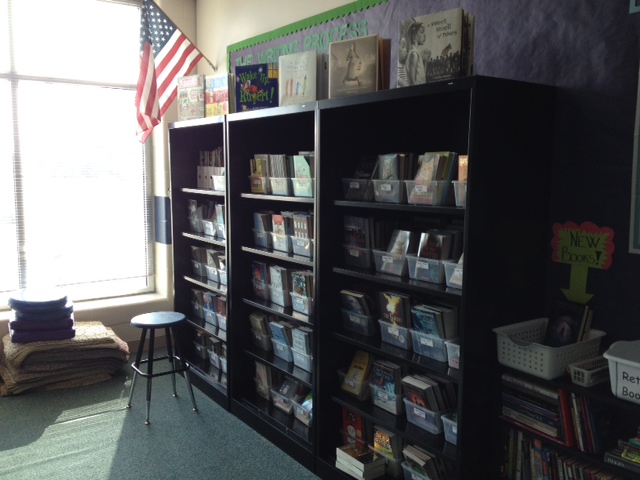
Anyone who enters our classroom immediately notices all of the books we have.  It’s hard not to, they seem to be everywhere.  While I have always believed in having as many books as possible in the classroom, I was not always sure on how to best organize it for optimal student access and interest.  Now, seven years into having a library, there are a few things that have made my life easier.

No check out system

I have tried so many different check out systems, from a catalog system, to student librarians, to an electronic version, and all of them turned out the same; a ton of work for me and I still lost a lot of books.  So a few years ago I abandoned the check out system.  Now students know they can grab any book as long as they promise to return it.  It is amazing to see the look on a students’ face when they hear that.  Yet, I am not sure this is still the best way, I do lose a lot of books but for now replacing books is easier than spending all of that time checking them out.

“Return Your Books Here” Bin

I used to have students shelve the returned books but I always ended up having to remind them and then re-teach them how to get them in the right bin even though everything was marked.  I now have a plastic tub with a “Return your books here” sign taped to it right by all of our bookshelves.  Once a day I take the time myself to shelve all of the returned books because it gives me a way to see what is popular, look for books other students are wanting, and check on the conditions of some of our most beloved books.  It takes me less than five minutes and all the books are in the right bin.

Bins for every genre and then some

I have loved having book bins for many years.  While they cost money and give you less shelf space, it has proven to be the easiest way for us to categorize books.  Bins are grouped by genre and some by popular authors.  Students suggest bins as well as they see a certain collection grow.  Two such examples are our newly formed Cassandra Clare bins and military history bins when students pointed out that we had a collection now.

This Book Belongs to Mrs. Ripp Stamp

This inexpensive stamp purchased from Amazon several years ago has saved me so much time.  All new books get stamped with “This book belongs to Mrs. Ripp.  Please return when finished” on the inside cover and then the genre abbreviation (or author if they are in an author bin) is handwritten below it in black sharpie.  I cannot tell you how many books are left behind in other classrooms around our school and this little inexpensive stamp means they all come back to me.

The Hardcover Post-It

The only exception I have to my no book check out system is that if a student is borrowing a hardcover book, I ask them to give me the book jacket and put their name on it with a post-it.  I then save them all in a bin and ask students for them periodically.  This has saved many hardcover books from disappearing as students see their name and then remember that they probably left in that one place.  It also gives me a way to track a book down if someone else is looking for it.

The Gutter Picture Book Organizer

Someone long ago hung gutters all around my room under the white boards and I could not be more happy.  Gutters make a perfect display rail for any amazing picture books we may have and ensure that all of the new ones get read right away as well.  A very inexpensive way to get more display space indeed.

Beginning of the year book shleves

Printed and Laminated Bookmarks

We use Kylene Beers’ book Notice and Note throughout the year to give us a shared reading language, so it was natural for me to make some printed bookmarks reminding students of the strategies as they read.  Bookmarks are i the same place next to post-its, which some kids prefer to use.  They don’t have to ask for one, they take them as needed, and return them when they don’t if they feel like it.

“Our Favorite Books” Spinning Wire Rack

For a long time I had a wire rack where I placed all of my favorite books on for students to browse.  Yet, it was not being used very much even though it was in a prime location.  After inspiration by Nancie Atwell, I hung a sign above it declaring it a rack for the students to share their favorite books and then took all of my books off.  I told the students its new purpose and have since watched it fill up with their favorite reads.  This spinning rack has now become the first stop whenever they need a new book.

A Separate Book Case (Or Two) For Picture Books

While we have many of our favorite picture books out on display in the classroom (it’s amazing how many time students gravitate toward them in a day when they have a few minutes), I also have an entire book case just designated to picture books.  I used to organize them and group them together and then realized it didn’t make the slightest difference to the students.  They looked through a lot of books anyway whether they were organized or not.  Since I don’t have these in bins, I gave up on organizing them and haven’t looked back since.

The Readers’ Notebook That Doesn’t Leave

I used to ask students to carry their readers’ notebook back and forth for some reason, which meant many days they left it in their locker, or at home, or didn’t know where it was.  I also had to ask them to specifically leave them behind whenever I needed to assess them which meant the pressure was on to get them assessed so I could hand them back.  Now I ask the students to leave all of their readers notebooks in the classroom.  I have a bin for each class, I don’t care what name order they are in and at the start of each class all I have to do is grab the right bin off of my shelf and put it out for the students to grab.  This is also how I do attendance these days, by seeing whose notebook has not been picked up.

Pre-printed Standard Comments Sheets

I assess my students readers notebooks every two weeks and while I often take the time to write in specific comments to them, I have also learned to pre-print address labels stickers with certain broad comments such as “Remember to use text evidence to support your thinking” or “Why do you think the author did this?.”  Not only has it saved me a lot of time when I need to assess 120 readers notebooks, but it also allows me to focus on the comments they really need while covering all bases.  The students do not mind (I have asked them) since they know it allows me to support them more often with my thoughts.

Learning to Let Go

This has been my biggest take away in having a classroom filled with books and readers.  Sometimes you don’t have to have a perfect system for it to feel perfectly fine.  The students make our book loving classroom their own so they change the organization of books, the shelving of them, and even how we read them.  I don’t mind, I just have to let go sometimes and trust the students.

I am a passionate teacher in Oregon, Wisconsin, USA but originally from Denmark,  who has taught 4th, 5th, and 7th grade.  Proud techy geek, and mass consumer of incredible books. Creator of the Global Read Aloud Project, Co-founder of EdCamp MadWI, and believer in all children.  The second edition of my first book Passionate Learners – How to Engage and Empower Your Students” is available for pre-order now.   Second book“Empowered Schools, Empowered Students – Creating Connected and Invested Learners” is out now from Corwin Press.  Join our Passionate Learners community on Facebook and follow me on Twitter @PernilleRipp.
aha moment, assessment, being a teacher, being me, MIEExpert15, Passion, Personalized Learning, student choice, student voice, testing

So It Turns Out I Am a Terrible Teacher

It turns out I owe everyone an apology.  Or at least a great big “I am sorry” to all of the people who have ever been inspired by this blog to change the way they teach.  It turns out I don’t know what I am doing, at least not if you look at our test scores.  You see, my students took our district standardized test, the one they take three times a year, and it turns out that at least for some all of my crazy ideas have apparently ruined their English skills.  It wasn’t that their scores dropped just a touch, no, some lost hundreds of points in their comprehension skills; whole grade level disseminated by this terrible teacher.  And there is no one to blame but me, after all, I am the one responsible for all of the teaching.

These tests are a funny thing really, they have a way of messing with even the most stoic of teachers.  We say we don’t care what the test scores are and yet we cannot help but feel fully responsible for the negative scores.   The positive ones, the ones that gained hundreds of points since January; those cannot possible be my doing, because I am teaching all of these kids.  And not all of these kids are improving by leaps and bounds.  So those great scores, they have to be a fluke, but those kids with the big fat minus next to their number, yup, I did that.

As I wrestle with my own feelings of ineptitude tonight, I have realized that who ever thought that teachers could be evaluated by scores that change so dramatically over a year, has never been a teacher.  I could re-test my students tomorrow and guarantee you that all of them would have different scores.  How a test like that can help me plan instruction is beyond me.  How a test like that can be used to evaluate teachers in some states is even further out of my understanding.  And yet it does, and we take it ever so personal because we care.  We think if we had just tried a little harder, worked a little more then maybe we could have reached all of our kids, and not just the “easy” ones.

So I am sorry for ever thinking I could help change education from within.  I am sorry that I have told others to give the classroom back to students, to create passionate learning environments where students not only have a choice, but they also have a voice.  The test told me today that I am doing something wrong for these kids, because there is no way a 34 question test can be wrong, right?  All I can say is that I am thankful to work in an incredible district with an amazing administration that sees beyond the test scores.  That has faith in us and in all we do.  That knows we are bigger than the test scores our students get, because if I didn’t, according to this test, I don’t have any business teaching some of them, or blogging about what I do.

I am a passionate teacher in Oregon, Wisconsin, USA but originally from Denmark,  who has taught 4th, 5th, and 7th grade.  Proud techy geek, and mass consumer of incredible books. Creator of the Global Read Aloud Project, Co-founder of EdCamp MadWI, and believer in all children.  The second edition of my first book Passionate Learners – How to Engage and Empower Your Students” is available for pre-order now.   Second book“Empowered Schools, Empowered Students – Creating Connected and Invested Learners” is out now from Corwin Press.  Join our Passionate Learners community on Facebook and follow me on Twitter @PernilleRipp.

being a teacher, being me, lessons learned, MIEExpert15, Passion

To the One Teacher Who Shaped Me the Most

It is national teacher appreciation week here in the United States. and all through the blog world I have seen the incredible letters of appreciation being shared.  I have seen the words that praise, the words that show once again just how much of an influence a great teacher can have.  And I am grateful because I too have had amazing teachers in my life, who believed that I had worth and who believed that I could make the world a better place.  Great teachers are not in short supply, how grateful am I of that as my own children go to school.

Yet, when I think of the most influential teacher in my life, I don’t think of warmth, nor do I think back with kindness.  The one teacher that shaped me the most was a terrible one.  For five years, because in Denmark you are assigned a classroom teacher that follows you throughout the years, she made my school day awful.  She went out of her way to make me feel different for all of the wrong reasons.  One that I would not wish upon any other child.  And yet, for her I am grateful because she taught me so many things that shape me today.

The worst teacher I ever had taught me that no teacher should ever be allowed to make a child feel bad.  That no teacher should ever be allowed to teach if they don’t really like all children.

The worst teacher I ever had taught me that sometimes emotions can cloud our judgments and we no longer see a child in front of us but only see a problem.  And it is up to us to change that not let it rule our actions.

She taught me that principals do not always know what happens behind closed doors, nor do they always believe parents.  She taught me the importance of a principal who pays attention and a principal who asks questions, even the hard ones.

The worst teacher I ever had showed me what power we have over the acceptance of children in our classrooms and how we must always be a force of good, not a force of pain.

She taught me that sometimes friendships cannot be broken even under the influence of a powerful adult.  She taught me that we as teachers have the power to plant ideas in the heads of students, and we choose whether those ideas are empowering or damaging.

The worst teacher I ever had taught me how we can build community or we can break it.  We can protect the students in our classrooms or we can give bullies more reasons to pounce.  We can single out, we can alienate, we can do everything in our power to make a child feel hopeless, or we can do everything in our power to make a child feel like they matter.

So while I have had many great teachers, it is to her, that I dedicate this post.  To the woman who 20 years after I left her classroom still wondered why anyone could love me; thank you.  You taught me exactly what kind of teacher I would never be.  You taught me what real teachers do; they love every kid, no matter what.  They protect the very children they teach.  They embrace the differences, not make them weapons of destruction.  So to the worst teacher I ever had, you were right; I was different and it is because of those differences I now get to change the world, one kid at a time.  Bet you would have never seen that coming.

I am a passionate teacher in Oregon, Wisconsin, USA but originally from Denmark,  who has taught 4th, 5th, and 7th grade.  Proud techy geek, and mass consumer of incredible books. Creator of the Global Read Aloud Project, Co-founder of EdCamp MadWI, and believer in all children.  The second edition of my first book Passionate Learners – How to Engage and Empower Your Students” is available for pre-order now.   Second book“Empowered Schools, Empowered Students – Creating Connected and Invested Learners” is out now from Corwin Press.  Join our Passionate Learners community on Facebook and follow me on Twitter @PernilleRipp.

aha moment, being a teacher, being me, MIEExpert15, Passion, word choice

Five Words For You

For five weeks, I have tried to find just the right words to preface the following message.  For five weeks, I have carried a tattered post-it around, waiting for just the right angle to present it to the world.  For the past 35 days, I have waited for inspiration to strike, for the moment to come where I could finally unleash the words and let them resonate with others as they have resonated within me.  For 35 days I have waited for an opportunity but that opportunity has not come.  So the words have finally told me that they do not need a story, nor a set up.  They just need to be said.

We must practice being brave.

There I said them.  Now let them sit with with you for a while and see what they do for you.

I am a passionate teacher in Oregon, Wisconsin, USA but originally from Denmark,  who has taught 4th, 5th, and 7th grade.  Proud techy geek, and mass consumer of incredible books. Creator of the Global Read Aloud Project, Co-founder of EdCamp MadWI, and believer in all children.  The second edition of my first book Passionate Learners – How to Engage and Empower Your Students” is available for pre-order now.   Second book“Empowered Schools, Empowered Students – Creating Connected and Invested Learners” is out now from Corwin Press.  Join our Passionate Learners community on Facebook and follow me on Twitter @PernilleRipp.

aha moment, assumptions, being me, MIEExpert15, Passion, student voice

Why Do We Hold Students to Higher Expectations Than Adults?

I told one class today that I was not there for their sheer entertainment.  I didn’t raise my voice, nor did I yell.  I simply stated it and asked them to step it up, to show engagement, to show me that what we were doing mattered to them because I could tell they were checked out and it made me unhappy.  And then we continued on with what we were doing.  Just another moment teaching 7th grade.

Yet, as it popped back into my mind, a seemingly insignificant moment from my day, I now see what a missed opportunity it was.  Not for another lecture, but instead to realize that these are kids that I am teaching.  Kids that we hold to insanely high expectations every single day.  Every single day, we expect full commitment in every subject matter.  We expect passion.  We expect interest.  We expect a willingness to try, to create, to experience   We expect them to pay attention, to shut everything out except for what’s in front of them.  We expect total compliance with all of our rules.  At.  All. Times.  No Excuse.

Yet as adults those same expectations don’t apply to us.  Go to any staff meeting or professional development opportunity and you will see adults not paying attention all of the time, not trying all of the time, not tuning in all of the time.  Not because we don’t want to.  Not because we don’t find it engaging, but because we can’t.  No one can.  Our brains need a break, and we know it. So we allow ourselves to fidget, to whisper, to slouch, to shift our attention for a moment, because we know we need it.

So why do we forget this fundamental truth when we create our learning environments?  Why do we forget that in the very place where we are trying to fire up as many brain cells as possible, that those same brain cells needs a moment to recover, to regroup, to make new connections?  That kids need a moment.  That these kids are trying.  That these kids do want to learn and most days are giving us the best they have. And yes, I get why we have to have high expectations, we are teaching them to be better humans, but at some point we also need to give them a break, because they are human beings first not just learners.

So tomorrow, I will remember that when my students start to slouch, when they start to whisper, when they start to drift, it’s not a reflection always on what we are doing, but more that they are in school and have been working for x amount of hours before they got to me.  It’s not always that they don’t care, it’s not always that they don’t want to learn, it’s not always that they are bored.  Sometimes they are just full and it is up to us to help them through.

I am a passionate teacher in Oregon, Wisconsin, USA but originally from Denmark,  who has taught 4th, 5th, and 7th grade.  Proud techy geek, and mass consumer of incredible books. Creator of the Global Read Aloud Project, Co-founder of EdCamp MadWI, and believer in all children. I have no awards or accolades except for the lightbulbs that go off in my students’ heads every day.  The second edition of my first book “Passionate Learners – Giving Our Classrooms Back to Our Students” will be published by Routledge in the fall.   Second book“Empowered Schools, Empowered Students – Creating Connected and Invested Learners” is out now from Corwin Press.  Join our Passionate Learners community on Facebook and follow me on Twitter @PernilleRipp.