aha moment, MIEExpert15, principals, student voice

Why I Asked My Principal to Observe My Craziest Class

I gave up putting on a dog and pony show for my observations several years ago.  I had reached the pinnacle of coaching, asking my students to please be on their best behavior as I was being observed, bribing them with treats if they would just be great when my principal walked in.  After that observation, where I received nothing but accolades for my classroom management – yeah for bribing – I realized that I had to change.  My attitude had to change, at least when it came to being observed.

Yesterday, I invited my phenomenal principal into my craziest class.  Not as a stop by visit, but as my second official observation for the craziness that is Educator Effectiveness, or the way my teaching quality will be known here in Wisconsin.  I invited her in to see how I am trying to harness the energy of these students, how I am trying to wok with their behaviors, tap into their quirks, rather than smother them by yelling.  And yet, I wanted throw up before she came into the room.

Even after 7 years and some months of teaching, having a principal in my room makes me so nervous.  I thought of calling in sick.  I thought of changing the time of the observation so she would see that one class where all of the kids need little direction, that one class where every plan always works out.  That class that makes you look like an incredible teacher even though you know that it is not really because of what you are doing but because the kids are so well-behaved.  That’s the class I would have been observed in a few years ago.  And I know exactly how that observation would have gone; great praise, little feedback on what to work on because everything was so wonderful, meaning no growth for me.

But I didn’t, I forced myself to follow through with my plan, hoping that things would work out alright.  Hoping that my students would at least attempt what we were doing not just give up, settle in after only about 5 minutes, and perhaps even have a great discussion.  I held my breath the entire time.  Yet, as I sat teaching the mini-lesson, noticing how a kid that should have been writing was instead tapping his pencil playing songs, another kid had their head down, and another kid would not stop talking, inwardly cringing as I saw my principal noticing too.  I realized something; all the other students were working.  The 5 that sat in front me coming up with such great ideas.  The 2 that sat and whispered together pointing to their paper.  The kid with the pencil listening in to what I said in my mini-lesson and yelling out “Now I get it!” and then started to write.  I noticed those moments too.  I noticed our classroom functioning in its typical way, and I noticed that for those kids, the tapping, the whispering, the staring blankly; it works.

So the next time I am observed, I will invite once again to the class that hangs by a thread.  To the class that I know pushes me the hardest.  To the class that keeps me up at night.  My principal is here to support me, to guide me on my journey, not to just clap her hands and tell me “Great job!”  If I don’t invite her into the class where I need her ideas, then I will not grow, and growing is what we all need to do every day, every opportunity. Never will I go back to bribing a class.  Never will I prep a class beforehand.  Never will I ask a class to please behave because I am getting observed.  I will instead teach my heart out and wait for the feedback, hoping that among the chaos,  my principal sees the greatness that I see, and can help me further my teaching.  Will you?

PS:  I was worried my students thought they had to put on a show until a kid asked me if he could please continue to work on the science project he had been working on instead of reading.  Nope!  They hadn’t changed even though the principal was there.

I am a passionate teacher in Oregon, Wisconsin, USA but originally from Denmark,  who has taught 4th, 5th, and 7th grade.  Proud techy geek, and mass consumer of incredible books. Creator of the Global Read Aloud Project, Co-founder of EdCamp MadWI, and believer in all children. I have no awards or accolades except for the lightbulbs that go off in my students’ heads every day.  The second edition of my first book “Passionate Learners – Giving Our Classrooms Back to Our Students” will be published by Routledge in the fall.   Second book“Empowered Schools, Empowered Students – Creating Connected and Invested Learners” is out now from Corwin Press.  Join our Passionate Learners community on Facebook and follow me on Twitter @PernilleRipp.
being a teacher, education reform, MIEExpert15, no homework, student voice, students choice

Before You Assign That Homework – What Students Wish You Knew

FullSizeRender

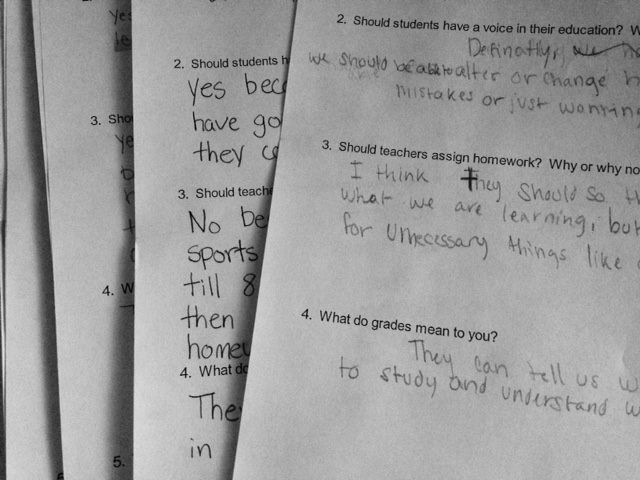
“Should teachers assign homework?” was the question I asked my students today.  I thought I knew the answer, a resounding no I was sure, and yet, once again my 7th graders surprised me.

While some pleaded for no more homework, many said they understood the purpose of it, that it was a necessary component of school and then wrote a paragraph asking for change.  Asking for their thoughts to be considered.  Asking for teachers to think before they assign.  So what my students wish teachers knew before homework is assigned is now written here for the world to see.

They wish teachers knew just how busy they are.  That we ask them to live balanced lives that involve sports, family, friends, and sleeping, yet assign hours of work that pushes their bedtime later and later.  They cannot fit everything in, even though they try.

They wish teachers knew just how stressed they are.  That they feel like our expectations are through the roof at all times, but sometimes they are bound to mess up, and can we make that okay as well?  Can it be okay to forget once in a while or to not get it all right?

They wish teachers knew that they don’t always need the practice.  That homework should be for those kids that don’t quite get it, not assume a need for everyone, and that those that really don’t get it won’t get it after they do the homework.  That they need help in school instead.

They wish teachers knew how much we all assign.  That we spoke to one another more so that we see that our class may not assign a lot but when you add each class together, it is now hours of work, not just a little bit of time.

They wish teachers knew that they have worked really hard in school and wish they could have a break.  That homework on some days is okay but it doesn’t need to be every day. Nor does it need to be over the holidays.  That tehy get we have a lot to cover but can they promise us to work hard in school in exchange for time off from school?

Finally, they wish teachers actually did their own homework.  That they tried the assignments so they could see how difficult or confusing they may be.  That they worked through it with kids, not in a pretend way, but really, and then shared their own learning with students.  That teachers truly felt what it means to live the life of a student, along with the pressure of homework,  to understand why homework continues to be a problem for some.

Once again, my students thoughts push my own thinking.  I quit assigning homework years ago but still run into my old ways once in a while; there always seems to be so much to cover, so much to do.  Now, I only assign reading every night, but even that adds up with everything else.  So I wonder; if we all asked our students, what would they say about homework?  And what would we do about it?  How would their answers change education?

I am a passionate teacher in Oregon, Wisconsin, USA but originally from Denmark,  who has taught 4th, 5th, and 7th grade.  Proud techy geek, and mass consumer of incredible books. Creator of the Global Read Aloud Project, Co-founder of EdCamp MadWI, and believer in all children. I have no awards or accolades except for the lightbulbs that go off in my students’ heads every day.  The second edition of my first book “Passionate Learners – Giving Our Classrooms Back to Our Students” will be published by Routledge in the fall.   Second book“Empowered Schools, Empowered Students – Creating Connected and Invested Learners” is out now from Corwin Press.  Join our Passionate Learners community on Facebook and follow me on Twitter @PernilleRipp.

assessment, being a teacher, grades, MIEExpert15, Personalized Learning, student voice

“What Are You Proud Of?” – Using Letter Grades For Good

I was exhausted to say the least.  Voice raw, thoughts muddled, and a lead brain.  I felt like I had worked days without sleep as I dragged myself home.  All day Thursday, I conferred with almost all of my students.  100+ kids and I sat down, one on one, and spoke about scores, grades,  goals, growth and most importantly what they are proud of.  And I was exhausted.

I hadn’t intended to have a day of conferring.  I had thought we would have a read-in party, I would hand them back their grade slips with my grades for them, the ones they had first decided and I then had added my input to.  After all, most of us agreed on the letter grade that somehow would define their progress in English.  Yet, as I looked at the slips of paper in my hand, I realized that this was not a paper conversation.  That every child deserved to have a moment, even if only for a few minutes, to discuss why that grade somehow represented them and more importantly a moment to carve their own path forward.

So one by one I called them up, showed them their slip of paper and then we talked.  What did I notice, what did they know?  How had they been doing?  How had they felt about being in English?  What could change?  What were my hopes as we moved forward?  What did they hope for?  What did they need?  The conversations changed depending on the student, yet every single one ended with; what are you proud of?

What came from them were almost never their scores.  Nor the grade they were getting.  Instead, child upon child told me how they were actually reading now.  How they had become better readers.  How some didn’t hate writing as much.  How English was getting easier for them.  How they felt they had something to say.  They spoke of insecurities.  They spoke of being unsure.  They spoke of trying.  Of growing.  Of wanting to become better people.  Every child opened up and spke of their journey and together we spoke of the future.

One child summed up the day perfectly for me when he said; “I am not sure what I am most proud of.  I have grown, I don’t know how, but I am now better.”  And I thought, so am I.  I am better teacher because I know my students better.  I am a better teacher because I cannot wait to see what they do next.  I am a better teacher because the students are starting to really trust me.  I am a better teacher because my students push me forward every day, and I let them.

I did not intend to spend a day speaking to my students and doing nothing else, but now I know; it was the best way I could have spent a day.  It was the best way to help my students know that they are more than a grade. More than a score.  More than a letter.

I am a passionate teacher in Oregon, Wisconsin, USA,  who has taught 4th, 5th, and 7th grade.  Proud techy geek, and mass consumer of incredible books. Creator of the Global Read Aloud Project, Co-founder of EdCamp MadWI, and believer in all children. I have no awards or accolades except for the lightbulbs that go off in my students’ heads every day.  First book “Passionate Learners – Giving Our Classrooms Back to Our Students” can be purchased now.   Second book“Empowered Schools, Empowered Students – Creating Connected and Invested Learners” is out now from Corwin Press.  Follow me on Twitter @PernilleRipp.

being a teacher, being me, books, MIEExpert15, Passion, Personalized Learning, Reading, student choice, student voice

Why Book Clubs Suck And We Need to Talk About It

image from icanread

I had meticulously made my lists.  I had thoughts of habits, tastes, personalities, reading preferences, pace and yes, even their assessment data.  I had scoured the book room, gone book shopping spending my own money and used most of my Scholastic points.  More than 50 choices awaited my students, I couldn’t wait to start book clubs.

So when I announced that today was the day they would know their book club groups, I had not planned for the groan of disapproval that met me.  The disgusted stares and the change in body language; slumped shoulders, heads down.  Clearly, they were not as excited as I was.  And so I did what I always do; I asked why.  Or more specifically, I mimicked what a student said, which was that book clubs suck, and I asked “Tell me all of the reason why book clubs suck…”

And boy did they ever.

“We hate being forced to read certain books.  Sometimes we have read them before, sometimes they are boring, sometimes we cannot relate to them no matter how hard we try.  We want choice, we want things that we want to read, we can decide by ourselves.

We hate being told when to read, how many pages, and what we should discuss.  Sometimes we want to read only a few pages because we know we are busy, other times we want to read a lot.  We want to come up with our own questions and we don’t want a teacher to facilitate.  Let us try to navigate it ourselves.  Let us try to lead the conversations.  Help us when we need it but don’t assume we need it all of the time.

We hate having a book take weeks and weeks to finish.  Sometimes we just want to read because it is so good, and what is wrong with that.  When it drags on we lose interest.  When it drags on we forget what is happening.

We hate being stuck with a book even if we chose it.  We hate being placed in groups with students we have nothing in common with.  We hate having to keep logs, write reports, and do group work when all we want to do is read and discuss.  Don’t you see, we hate book clubs.”

So I listened, and I answered their questions whether they wanted me to or not.  Carefully explained my vision for the next few weeks and why.  Would there be writing – no, just the thoughts they felt they needed to jot down to facilitate a discussion.  Would there be choice – of course, the books were waiting patiently for them and if they found none here then we have a library to go to.  They kept asking and I kept explaining, and as we went on their faces changed and the shoulders came back up.

Every class I taught that day went through the same process.  I didn’t expect to have those conversation 5 times in a row but that is exactly what happened.  Every time I mentioned book clubs, the groan came at me like a wave.  And yet, as we discussed I once again learned more about my students and their reading habits.  I learned how they want to be independent readers and thinkers, how they want to be able to have choice in everything so that they can invest themselves fully.  How it is okay that I put them into groups as long as I explain why those groups were made and that it wasn’t just based on one thing.

I could have ignored their groans, a few years ago I would have, I would have told them to “Suck it up, deal with it and make the best of it.”  Yet, I know from experience that if we want book clubs or anything that has to do with reading to work then we have to have these hard conversations.  We have to discuss, tear apart, and work through the demons that students carry, those preconceived notions of what is going to happen in the next few weeks, before we ever get an authentic buy-in; a reading experience that matters.

The day after the conversation, I had them book shop.  Every group went from choice to choice and debated the merits of the books laid out before them.  Every group weighed their options, and only one group  out of about 30 needed my guidance in book choice.  Yesterday, as I revealed the books they were going to read, most groups cheered.  Some kids asked if they could start right away?  Please, because the book looks really good and we are so excited.

Had I not stopped and listened to my students.  Had I not stopped the plan of what I was going to do.  Had I forged ahead, gone on with our day, there would have been few cheers and instead the next few weeks would have been filled with the passive resignation that middle schoolers do so well.  Yeah book clubs suck, but they don’t have to.  We have to find a way to talk about it and change the way they are done. And the first place we start is by asking out students why they suck or any other word that may describe their feelings toward them.

I am a passionate teacher in Oregon, Wisconsin, USA,  who has taught 4th, 5th, and 7th grade.  Proud techy geek, and mass consumer of incredible books. Creator of the Global Read Aloud Project, Co-founder of EdCamp MadWI, and believer in all children. I have no awards or accolades except for the lightbulbs that go off in my students’ heads every day.  First book “Passionate Learners – Giving Our Classrooms Back to Our Students” can be purchased now.   Second book“Empowered Schools, Empowered Students – Creating Connected and Invested Learners” is out now from Corwin Press.  Follow me on Twitter @PernilleRipp.

assumptions, authentic learning, Be the change, classroom expectations, collaboration, Critical thinking, MIEExpert15, Passion, Personalized Learning

9 Barriers to Personalized Learning And How We May Work Around Them

image from icanread

I didn’t know I was doing personalized learning when I first changed the way I taught.  It wasn’t until I wrote about it in a blog post and someone gave me the name and description that it clicked.  It made sense really; I wanted students to have a voice, have choice, and to be re-ignited passionate learners within my classroom, all tenets of the personalized learning philosophy.  For me it was a no brainer; why not teach in a such a way that students would want to be part of the learning?  Why not teach in such a way that students became experts and have a place alongside the teacher?  Yet, wherever I go resistance remains for personalized learning.  In fact, some educators or districts are quite against it, but for many different reasons.  I cannot be alone in seeing this resistance, so I thought a discussion of what those barriers may be and how you can approach a discussion to work around them would be in order.

Barrier:  It’s one more thing to do.  We are faced with seemingly more tasks every single year as teachers, from major ones  forced upon us to the little ones we cannot wait to do because we were inspired.   When will we ever find the time to do personalized learning as well?

Discussion Point:  Personalized Learning should not be an add-on but a replacement.  So if you are already doing something, change it with a lens of personalized learning.  Can you add choice into a pre-existing project?   Can students show mastery in a multitude of ways?  Embrace personalized learning as a way to become a better educator by sharing more control with the students, keep it manageable for you and integrate in a natural way to alleviate the feeling of one more thing being added to the to-do list.

Barrier:  It is overwhelming.  It is easy to see why personalized learning can be viewed as overwhelming.  Often those who discuss its merits have been doing it for years and has framed their whole classroom around it.  Their personalized learning initiatives is a long list of to-done’s.

Discussion Point:  One small step at a time.   When discussing personalized learning focus on how to start, what to do in the beginning, and the small changes that can make a big difference.  Certainly keep the end-point in mind, but don’t worry about it yet.  Worry about where you are right now and how you will start your journey, not when you are going to get to the end.

Barrier:  It will be chaotic.  We often envision chaos when we stop doing a one path to the learning  format for students and that when students are given choice they will not know what to do.

Discussion Point:  Personalized learning does not mean giving up control, but rather that control is shared with the students.  It also means multiple paths to mastery, but these are planned out either by yourself or in conjunction with your students.  Yet, you know yourself best; what can you give up control of and what can you not.  You are also a member of this learning community so if there are certain things that need to stay in order, such as an assignment being done a certain way, or students sitting in a particular way, it is okay to hold onto that.  Find the things that you can let go of, invite student input into the process, and grow together.

Barrier:  My subject matter won’t work.  Personalized learning means hands-on and project based; how do you do  that in English, Spanish or any other class?

Discussion Point:  Personalized learning can be implemented into any classroom, the lens just has to switch.  I had a lot easier time giving choice in social studies and science because a lot of our learning was hands-on, project based.  So when I switched to just teaching English, I had to change my way of thinking.  Personalized Learning in my English class means students have choice in how they show mastery (different project choices), when they show mastery (timeline), and often how they work within the classroom (classroom setup/management).

Barrier:  It will be replaced with another idea soon.  Education is a long list of new ideas and change is the one constant we have.

Discussion Point:  Personalized Learning really just means great teaching and great teaching will not be replaced with a new idea.  So while new initiatives are bound to come, the ideas of personalized learning helping you be a better teacher remain because it speaks to student autonomy and re-igniting a passion for learning.

Barrier:  I don’t want to  integrate more technology or don’t have access.  Technology inequity is a real problem.  So is technology fear.   Some teachers want to feel comfortable with the technology they bring in before students use it, and others will never be able to get the things they wish they could.

Discussion Point: Personalized learning is not about the technology.  Personalized learning is about creating an education process that takes into account the needs and desires of each child, while still working through the set curriculum.  Technology is a tool that can be used in this process but not a central tenet.  I started out with 4 computers in my room for 26 students.  We naturally did not incorporate a lot of technology and we didn’t need to.  Choices involved the things we did have and students bringing in things from home if they wanted to.  We made it work with what we had.

Barrier:  I won’t be a good teacher.  It is hard to change the way we teach because we may already be teaching really well.

Discussion Point:  Change is hard for all of us, but modeling risks for students is instrumental in their learning journey.  I am uncomfortable every time I make a big decision about the way I teach or something we will do, but I think the discomfort makes me a more thoughtful practitioner.  By sharing and modeling this for students, I am showing them that I take risks and that sometimes those risks pay off and other times they don’t.  We have to grow to evolve and sometimes that means even leaving behind things that were just fine.  Besides, our students change every year, so should we.

Barrier:  I have to do the same as all the other teachers in my subject or grade level.  We don’t want students to be a part of an educational lottery where the quality of their education hinges on which teacher they get, so sometimes uniformity and in turn, conformity, is preached above all else.

Discussion Point:  Have what other teachers do as one of the choices for students.  This brilliant idea was shared at the task force meeting I was a part of in my district.  Instead of dismissing what other teachers are doing, simply make it on e of the paths that students can take.  That way you are also catering to the myriad of ways that students learn.  You may learn best in a hands-on project based environment, whereas others may learn best with a read/reflect/discuss with a test at the end pathway.  make room for all of your learners and include the ways of other teachers in your room.

Barrier:  Parents/administrators/community will be upset.  When we are faced with unknowns our first instinct may be to revolt.

Discussion Point:  School should look different than when we were students.  Yet communication, understanding and examples are vital when integrating more personalized learning into your classroom our school.  Any change is hard for parents who want to try to help their children, so make sure you are communicating the why and the how behind your changes whatever they may be.  If administration is wary bring them in to see the change, show them other classrooms, and explain your motivation.  Tell them you will do a trial period and you can discuss and evaluate.  Just like you are asking others to be open to change, be open to frank discussion yourself.

Moving toward personalized learning has been one of the most significant changes I ever did in my educational journey, but it wasn’t always smooth.  I have faced many of these barrier myself but now love being in a district that has it as part of its vision.  Wherever you are in your journey, or even if you haven’t started, don’t be discouraged by the barriers that may face you.  Reach out, connect with others who are on the same journey, and find the support you need to be successful.  I am here to help if you need it.

If you want to see 6 things you can change to start your personalized learning journey, read this.

I am a passionate teacher in Oregon, Wisconsin, USA,  who has taught 4th, 5th, and 7th grade.  Proud techy geek, and mass consumer of incredible books. Creator of the Global Read Aloud Project, Co-founder of EdCamp MadWI, and believer in all children. I have no awards or accolades except for the lightbulbs that go off in my students’ heads every day.  First book “Passionate Learners – Giving Our Classrooms Back to Our Students” can be purchased now.   Second book“Empowered Schools, Empowered Students – Creating Connected and Invested Learners” is out now from Corwin Press.  Follow me on Twitter @PernilleRipp.

being a teacher, education, MIEExpert15, Passion

5 Ideas For Diffusing A Negative Mindset

We have all been in the situation it seems; surrounded by negative people whose only joy in life seems to be finding something to complain about.  Those teachers that cannot wait to share how terribly a child did, those teachers that cannot wait to discuss how awful a new initiative will be, or even just how overwhelmed they feel.  And you know what, at some point we have probably all been one of those teachers, I know I was!  And we usually don’t even know it.

So what can we do if we find ourselves surrounded by the negative?  How do you move beyond it, inspire change, but not look like you are complaining yourself?

First idea is to reflect; are you adding to the negative?  Are you getting sucked into the conversations?  Are you adding fuel to the fire?  Misery loves company and it is so easy to get wrapped up in a juicy story about a demanding parent or how there was another stupid idea proposed.  If you are even a little bit guilty of participating in these conversations, stop.  Catch yourself in the act and change your own direction.  Change your narrative and share the positive.  This doesn’t mean you cannot discuss hard situations, just change the way you phrase them.

Second idea; change the immediate conversation.  So if someone starts to complain, see if you can spin it in a positive way.  If a child is being discussed, highlight something positive.  If you see a conversation turning into something that will not benefit you and you cannot change it, you also have the right to walk away.  Even if you like the person speaking, nothing says you have to be a part of it.  Sometimes our actions speak louder than words.

Third idea; acknowledge the negative and then try to problem-solve.  If the negative continues to surround you, acknowledge it because sometimes people don’t even know they are doing it.  This doesn’t mean calling them out in an uncomfortable way, but just acknowledging that what they are saying seems to be bothering them and if they are looking for someone to problem-solve with.   We all have days where we need to release some of the energy that seems to be haunting us and sometimes discussing it is our way of reaching out to work through it.  So offer to be that person, withhold judgment, and try to alleviate the negative.

Fourth idea, look for the positive.  Sometimes our own perception makes a person seem much more negative than they really are.  Are you seeing them as a whole person or just someone who complains?  Make sure your own thoughts aren’t clouding a situation.

Fifth idea, get to know them more.  We don’t always know what is going on in someones life and sometimes when they are complaining about little things it may be an indicator that their life outside of school is stressful right now.  I know I have a much lower tolerance for anything when I am too busy outside of work or not sleeping well because of stress.  So if someone seems to take a turn toward the worse, see if you can find out what is going on.  Express your concern, be there as a friend, and remember to see them as a human being.  We all have bad days.  We all have moments where we are at our lowest.

No one comes to work meaning to be the negative force, no one walks into a social situation hoping to change it into a vent fest.  Sometimes it just happens, sometimes life gets the better of us and we don’t know that we are “that” person.  When all else fails, you just have to shrug it off.  Continue to be a positive force for good, continue to keep yourself in check, continue to be aware of what you put out in the world.  We are not able to change other people, but we can change the environment we teach in in small ways.  What do you do to diffuse the negative?

I am a passionate teacher in Oregon, Wisconsin, USA,  who has taught 4th, 5th, and 7th grade.  Proud techy geek, and mass consumer of incredible books. Creator of the Global Read Aloud Project, Co-founder of EdCamp MadWI, and believer in all children. I have no awards or accolades except for the lightbulbs that go off in my students’ heads every day.  First book “Passionate Learners – Giving Our Classrooms Back to Our Students” can be purchased now.   Second book“Empowered Schools, Empowered Students – Creating Connected and Invested Learners” is out now from Corwin Press.  Follow me on Twitter @PernilleRipp.