aha moment, assumptions, Be the change, being me, Passion

5 Things I Learned to Say That Changed the Way I Taught

I-no-longer-strive-for

There are many things that we can change as educators.  We can all embark on major journeys toward bettering our lives, the lives of our students, and the effect we have on others.  Often those big journeys start when we hit frustration, mine certainly did.  And yet those big journey of change are not the only journeys we can take.  Every day we make a choice as to how we effect those that surround us.  We make a choice as to how we will teach, how we will react.  There are many changes that will change our lives, these are some of my simplest and most important.

I learned to say, “I’m sorry.”  Apologizing to students, and not just for the big things changed my relationship with them.  Now when I accidentally call out a wrong kid, I apologize rather than make an excuse.  When I screw up, I admit it.  When I inadvertently hurt a child’s feeling, which does happen, I apologize.  I don’t try to explain my way out of it, a quick statement is all it takes, but the power of “I’m sorry” cannot be underestimated.  Those words share the story of how we view our students.  They are human beings that deserve respect.

I learned to say, “Let me check.”  I used to know I was right.  I used to know that whatever a child said about already turned in homework, sent emails, or other obligations was a lie.  Until I realized that I was in the wrong and that even if I think I am right, it is better to check first.  Check the pile of paper.  Check my email.  Check my file.  Whatever it may, they check and I check, no lost pride, no hurt relationship.

I learned to laugh at myself.  When you teach you will make stupid mistakes that make you look like a fool.  You are bound to trip and fall, you are bound to  say things that can be misunderstood, you are bound to do something that you would giggle at if it happened to others.  Laughing at yourself with the students is powerful.  Showing students my inner dork, which I tried to suppress at all cost for so many years, has allowed them to fly their flags.  They know when I am serious, but they also know how much I love to laugh, even at myself.

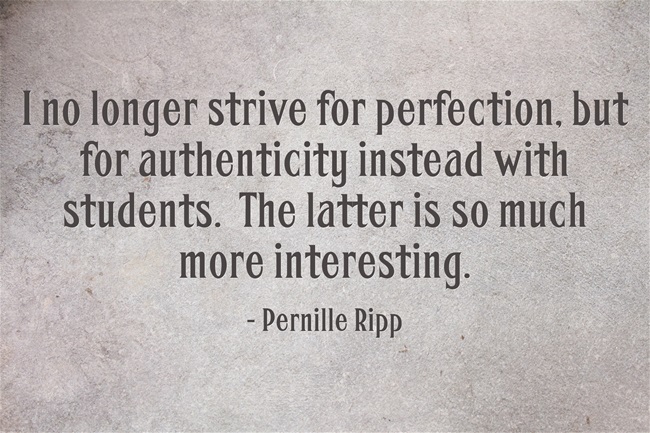
I learned to say, “Ok.”  Ok to sit there, ok to turn it in that way, ok to explore this, ok to read that book, ok to have that conversation.  OK to try, ok to fail.  I learned to say ok to new adventures and epic attempts.  I learned to say when I realized I couldn’t say yes to anything more, and ok when I could.  I learned to say ok when a lesson failed, I learned to say ok when a child told me they tried.  This simple word, these two letters, have allowed me to let go of so much.  I no longer strive for perfection, but for authenticity.  The latter is so much more interesting.  “Ok” taught me that.

I learned to say, “You matter,” but more importantly I learned to show it.  I learned to look at my students when they speak to me, to stop what I am doing and listen.  I learned to read between the lines, to dig a little deeper.  I learned to say yes to lunch, to stop and talk, I learned to tell stupid jokes to break the ice.  I learned the language of my students, whether spoken or unspoken, and I learned to teach with my whole heart, with all of me.

What have you learned to say that changed you?

I am a passionate teacher in Oregon, Wisconsin, USA,  who has taught 4th, 5th, and 7th grade.  Proud techy geek, and mass consumer of incredible books. Creator of the Global Read Aloud Project, Co-founder of EdCamp MadWI, and believer in all children. I have no awards or accolades except for the lightbulbs that go off in my students’ heads every day.  First book “Passionate Learners – Giving Our Classrooms Back to Our Students” can be purchased now from Powerful Learning Press.   Second book“Empowered Schools, Empowered Students – Creating Connected and Invested Learners” is out now from Corwin Press.  Follow me on Twitter @PernilleRipp.

Be the change, Passion, student choice, student voice

6 Changes Toward Personalized Learning

Say personalized learning to most people and it conjures up classrooms where every child is doing their own thing and the teacher is furiously trying to maintain order and overview in an otherwise rule-free classroom.  Yet, this is not exactly what it is.    Instead, personalized learning to me means student voice and choice, where student input is used to create a personalized learning path that allows students room to explore their passions while exposing them to new things.  Sounds great but where do you even begin on this path?  Or even better, what are you already doing that would count as a step toward personalized learning?

Change the way they sit.  I ask my students to sit wherever they want as long as they can work.  Only once in awhile do I have to interfere as to their seating choice and I have much happier students.  Why?  Because they got to have a say in their classroom environment, they were given control.

Change the way they work.  I ask my students to discover how they work best; do they like to hand-write things, type, dictate?  Are they kids that love to write papers rather than make a movie?  How do they want to read?  How do they want to think?  If students are to discover how they work best we have to give them choice and room for exploration.  This doesn’t mean that every single thing has to be open for anything, but simply providing choice in some things is a step in the right direction.

Change the knowledge they have.  One push-back against personalized learning has been that students don’t necessarily know what they need to know, and I agree.  That is why personalized learning also has to include exposing students to various topics, such as the materials we have to cover due to standards.  However, there are many ways to expose students to these topics, so don’t do the same thing over and over; change it up and allow for student ideas in the way material is covered.

Change the expectations for all.  We tend to teach the way we learn best but that is not always the way our students learn best.  So rather than plan by yourself, plan with your students.  Their ideas are often much better than ours anyway.  This also allows us to move out of our comfort zone rather than use the same type of format, or go with just your own thinking.  So ask the students HOW they would like to learn something and then heed their advice.  You don’t have to go with every single idea but try a few of them at least.

Change the timeline.  I used to think all students had to gain mastery of something at the same time because I had taught it to them all at the same time, until I had my twins.  Kids, even born at roughly the same time from the same mother, do not learn things at the same time so why do we expect our students to?  My students will now show me mastery of the standards when they feel they are ready within the quarter.  Sure, it will require a more lucid timeline but it really doesn’t add more work to me, all I need is a more flexible mindset.

Change the conversation.  I used to be the queen of all answers and solutions.  If a student had a problem, I fixed it.  If a student needed help, I helped them.  I used to think that was one of my main components of being a teacher; the helper/fixer/teacher role.  Now I know that students need support so they can help themselves and figure things out themselves and my language reflects that.  Rather than giving an answer, I ask a question back.  Rather than affirming an answer, I ask them to explain it.  I ask for their input, I ask them to reflect, I ask them to provide solutions and to teach others what they know.  This classroom is no longer about what I need them to do or know, but what they need to do or know, and that carries power.  So change the way you speak, include the students in the conversation, and stick with it.

Starting a journey toward personalized learning can be a terrifying endeavor, but have faith; every step you take toward giving your classroom back to your students matter.  Every idea you have that gives the students more power matters.  We have to create environments where students are passionate learners, that want to take control of their learning journeys.  I wrote my first book on how I did my journey, hoping to inspire others, and still my journey continues.  I am not done changing the way I teach because every year I have new students to grow with.  It is not just the students that need to be exposed to personalized learning, it is us the adults as well.

Be the change, being a teacher, being me, Passion

All the Small Words

image from icanread

Last night, it was back to school night.  My first one as a 7th grade English teacher.  Now speaking in front of students, no problem, even speaking in front of large groups of people is ok.  But parents?  Terrifying!  Not because I think they don’t like me.  Not because I don’t think they are open-minded.  Not because I think they are critical, over-involved, or demanding.  Quite the opposite indeed.  They terrify me because they care.  because they entrust with their child every day.  Because they hope that I will protect the curiosity of their kid every single day.  Taht i will damage, but rather enhance the child that comes to me every day.  I do not take that responsibility lightly.

When it was over, a few hung around to introduce themselves.  Many had kind words, telling me how their child is already loving English.  How they saw their child read and actually like it for the first time in a long time.  How they cannot wait to see how their child grows this year.  Thank you and whatever you’re doing, keep doing it.

As I drove home, those words echoed within me, wrapped my head in thought as I woke up at 12:30 unable to sleep.  I don’t think these parents know what those words mean to me.  I don’t think these parents have any idea of what effect small words can have on a teacher.  How big of an impact a greeting and a few sentences can have.  Whether they be kind or inquisitive, harsh, or probing.  The words we pass on to our child’s teachers matter, sometimes more than our actions do.  

I get to teach children every day.  I get to help them grow.  I get to help shape their dreams.  I get to help them decide whether reading is something they are good at or bad at.  Whether they are a writer or not.  I may be trying to change the world, but what happens within my classroom is what matters most.  What I do with kids and to kids is what matters most.  So those parents who stopped by just to say hi and thanks; those small words make a big difference, those small moments make a big impression.  When was the last time you made a difference in another teachers life?

I am a passionate  teacher in Wisconsin, USA,  who has taught 4, 5th, and 7th grade.  Proud techy geek, and mass consumer of incredible books. Creator of the Global Read Aloud Project, Co-founder of EdCamp MadWI, and believer in all children. I have no awards or accolades except for the lightbulbs that go off in my students’ heads every day.  First book “Passionate Learners – Giving Our Classrooms Back to Our Students” can be purchased now from Powerful Learning Press.   Second book“Empowered Schools, Empowered Students – Creating Connected and Invested Learners” can be pre-ordered from Corwin Press now.  Follow me on Twitter @PernilleRipp.


being me, Passion

5 Easy Things to Do to Cultivate Passion

I have been called many things, some wonderful some not so much , but passionate is one of the things I am most proud of.  And it is true, I am a passionate person.  I love my job, I love my kids, and the people that I surround myself with.  I passionately believe in student voice and active learning.  And yet passion in itself is not enough to change the world, we somehow need to pass it on.  So every day, I do these things to help my students stay passionate.

  1. We speak.  Without a relationship, they will never trust me enough to unleash their passion, so we take the time to cultivate one.
  2. I get excited and loud and really, really into it.  If I do not show my own passion, how can it spread?
  3. We disagree.  Knowing how to discuss is important for defending, articulating, and discovering ones passion, so we leave room for intense debates and pondering.  They must have time to think.
  4. They blog, they journal, they speak and they share.  This is where I see the seeds start to grow. 
  5. They discover new worlds with their hands, their eyes, and their brains.  Some students are passionate already, others are not so sure, but how will they ever find out what they are passionate about if we do not give them time to explore, break, build, and create?

What do you do share the passion?  To ignite it or to keep from distinguishing it?  Our classrooms should be passion cultivation areas; how do we get there?

To see how our room runs, and perhaps vote for us in the Great American Teach Off, please go to this website.  We have the chance to win $10,000 for our school which is sure to create some passionate debates.

being a teacher, education, Passion, Teacher

No Longer Mine

I can’t take their work off the walls.  With two days left my classroom still looks as if we have all the time in the world, but we don’t.  On Thursday our journey ends and a new one begins for these incredible 23 students that I have been lucky enough to call my kids.  When I am asked what I am passionate about, many people assume technology, or writing, or math.  Sure, I love all of those things, they are interesting, they even sometimes excite me.  But passions?  I am passionate about my students.

These children are given to me on loan and it is my job to make sure they still love school when I am done with them.  It is my job to ensure that they still love learning when this year is over and that they, in fact, have grown not just academically but personally as well.  I am passionate about them because they are the reason why teaching is the best job in the world and also the most heartbreaking.

We invest our hearts every year.  Our dreams, our hopes, our ideas.  And we hope to plant a tiny seed within our students knowing that they matter, that we care, that their sheer presence makes a difference for us and everyone else.  That passion consumes me.  When the end of the year arrives, I know I have to let go.  I know they are no longer ming but someone else’s.  It is someone else’s turn to become passionate about these kids and I get new ones to focus on.  Yet my heart grows wider after the sadness leaves and I know that these students will in some way always be mine, or at least their 4th grade version will be.

Enhanced by Zemanta
alfie kohn, exploration, Passion, questions, Student-centered

School: The Killer of Curiosity

“What is that?”  “Where does this go?”  “Can I do this?”  All questions overheard during my school’s recent kindergarten visitation day.  There they were: fresh, eager, curious, asking questions about everything; where does this go, what does this do?  I marvel at their spirit.  And then I think of later years of students, despondent, going through the motions, routine focused and mostly okay, but not asking all of the questions.  Where did the questions go?

As teachers we do not set out to kill the joy of learning, at least , not anyone I know does.  We state in our missions that we want to change students’ lives, motivate them, inspire them, and keep them eager to learn.  And yet our mission seems to be at odds with our school system.  Classrooms are set up all facing the teacher so that the “sage on the stage” can be the center of attention.  The whole day is rigidly structured so that subjects do not overlap, routines are taught and mastered and hardly ever broken.  Punishment goes hand in hand with rewards and grades become the ultimate reward in the end.  An A will always be better than a B no matter what the teacher says.  We divide our students into winners and losers and hope they all have a nice journey through school. And then we wonder why students lose interest, lose relevance.  By the time we get to high school, the eyes are on the prize; graduation, where they will break free of the rigidity of school  Students count down until summer vacation so that they can be free.  Free.

As Alfie Kohn has stated, “School is not an institution of learning, it is an institution of listening and memorization.” (Said in in a LeanBlog Podcast 2/24/09).   And this I believe is killing our school system.  Test-obsessed and score driven, we no longer let children develop their curiosity to provide them with a real stake in learning.  We no longer offer them choice because we have too much curriculum to cover.  Our homework is not set up for meaningful exploration but rather to teach time management and study skills.  Time management?   Like our over-scheduled students need more time management?  When students fail to hand in their homework we assume that it is either because they are too lazy or because they didn’t feel like it.  We do not assume that perhaps it was uninteresting, irrelevant or perhaps even too hard or meaningless.  We almost always assume we know best.  And even if we know within our hearts that the piece of homework assigned probably wasn’t all that engaging, we assign it anyway, because we have to assign something and we were forced to do inane homework when we went to school so why should our students be exempt.  But the system is broken, we know it, and we have to change it.

There are exceptions, of course, thankfully.  There are pockets of teachers and schools that are taking a different approach. That are actively combating this curiosity-killing school system.  Those that let their students explore, those that weigh their options, assign meaningful homework, that question their practices rather than go with the status quo.  They provide inspiration for some and shudders for other.  Perhaps they are just too different for some to even recognize them as schools.  Yet they are part of the answer.  We must bring back exploration, we must give teachers time to fully engage their students.  We must spark teachers’ curiosity as well so that we all can love learning again.  They say that curiosity killed the cat, let’s not have the lack of curiosity kill our schools.