being a teacher, Reading

What’s In Our Reader’s Notebook

A frequent question I get while speaking to other educators is what does your reader’s notebook look like?  I usually don’t have a good answer because much like for many others it is a work in progress, every single year.  This year, however, it feels a little more solid as the year gets underway and we use the tools we have used previously with a few small tweaks added as we need them.

So what can you find in a student’s reader’s notebook this year?  In order, you will find…

Our To-Be-Read List

This is the very first page, hand-drawn by students, and used every single time we bookshop or have book talks.  Part of my check-in conferences means I peak at their to-be-read lists as well to say what they have on dock for their reading experiences.  All the list says is the title, author, and genre which just means where they can find the book. This is on page 1, 2, 3, and 4.

Our Who Are You as a Reader Quarter 1 Survey

This simple survey gets glued to page 5 as a way for me to see where they start the year as far as the relationship with reading.  As we re-take the survey throughout the year, the will be glued in after it (I screwed this up and did not leave pages for this so this year the rest will be glued in on the back pages).

Our Reading Challenge for the Year

On page 6 and 7 you will find our reading challenge documents as well as their personal reading goals for the year.  This is what we confer about for their first reading check-in.

Reading Rate Tracker

Inspired by Penny Kittle, we do a reading rate tracker once in a while to see how many pages a student should be reading every week or so if we ask them to read at least two hours outside of class.  This is glued in on page 8.  This helps us with the reading data we gather in class as students study their habits, set goals, and also increase their reading.

Books I have Finished

On page 9, we have another hand-written page simply titled “Books I have finished.”  This is where students write down any titles they finish.

Reading Response Pages

Then we have the rest of pages for reading response and anything else we need.  We did not want to tab out sections beforehand because we always get the section needs incorrect, which my smart colleague, Reidun reminded me of.  Instead, we plan on tabbing as we need to. I will say though that we do not write a lot of reading responses.  These are one of the top reasons students report hating to read, so we are very picky about when and what we have them write about to discuss their reading in their notebooks.

So there you have it.  Nothing too fancy, but it works for us for now.  We will add sections as we need them.


Be the change, being a teacher, Literacy, Passion, Reading, Reading Identity, student choice, Student dreams, student driven, Student Engagement, student voice

The Rights of Our Readers

Today was the second day of school.  the second day of trying to get to know these incredible kids that have been gifted to us.  The second day of trying to establish the seeds for the habits that will carry us through the year, hopefully leading us to a year where they leave feeling like this year was worth their time, that this year made a difference.

Today was the day of one of our big fundamental lessons; when reading is trash or magic.  I shared my past reading mistakes in teaching, we shared when reading sucks or when it is lit (student choice of words).  As the post-its crowded the whiteboard, the questions and statements inevitable came.  Will we have to read books you choose for us?  Will we have to write every time we read?  Will we have to do post-it notes?  All things that in the past, I would have answered yes to but now the answers are different.  You always choose your books, even in book clubs, you will have plenty of choices.  You will not always write after you read, sometimes you will, and because of the work of teachers before me, you will be better at it than ever before.  And post-its?  Sometimes, when it makes sense, but not every time and not at home.  Only here because at home I just want you to work on your relationship with reading, the skills teaching that will happen in class.

As we finished our conversation we merged into what their reading rights are this year.  the things that I will not take away.  The rights they have as individuals on a reading journey.  This is not my idea, nor something new, but once again the work of others who have paved the way for my better understanding of what developing student reading identity really looks like.  As we discussed what rights they would have and what they meant, I wrote an anchor chart, a reminder that will hang all year so we don’t forget just what we can do together.  What choices we may have.  As we went down the list, the relief was palpable, the excitement grew.  Even some of the kids who had not so gently told me how much they hated reading right away, looked less scared, less set in stone as we talked about what this year would like.

And so this is where we stand tonight…  Our very first anchor chart to remind us of what it means to be a reader that is honored within our community.  What it means to be a reader that already has a reading identity, that we will continue to develop together, honoring everyone wherever they are on their journey, rather than forcing our well-intended decisions down over the top of kids.  Perhaps, once again, this year kids will develop a better relationship with reading, will grow as readers, will grow as human beings.  What more could we hope for when it comes to teaching?

If you like what you read here, consider reading my newest book, Passionate Readers – The Art of Reaching and Engaging Every Child.  This book focuses on the five keys we can implement into any reading community to strengthen student reading experiences, even within the 45 minute English block.  If you are looking for solutions and ideas for how to re-engage all of your students consider reading my very first book  Passionate Learners – How to Engage and Empower Your Students.      Also, if you are wondering where I will be in the coming year or would like to have me speak, please see this page.

Be the change, being a teacher, Reading, Reading Identity

After Accelerated Reader

One of the questions, I am asked the most often is, “What do you do if you don’t have Accelerated Reader?” Or insert whatever computer program here.  It is a question filled with emotion, after all, change is hard, and for some kids, AR and programs like it seem to work.  For some teachers, it works.  And yet, it doesn’t work for all, it is expensive, and in my opinion, it is not worthy of the precious time we have with students every day.

Last night, as I sat surrounded by incredible passionate educators and leaders in the Imperial Valley in California, I was asked that question again, and here is how I answered it.

Giving up AR can be scary.  After all, it is a program that seems to tell us things we need to know; has this child read the book?  Have they understood it?  It is a program that allows us to chart progress, to reward growth.  To have an understanding of the complex process that is often hidden from view.  And yet, how much of AR is actually a true view?  How often are kids able to take the test without fully reading the book?  How often do they fail the test despite having read the book?  How often do we end up policing the testing, the book choice, the kids without actually doing meaningful work?

Our job as teachers is not to police reading, it is to support the love of reading.  There is a huge difference.

So we start by looking at the components already in place.  Every child deserves a classroom library, a school library staffed with a certified librarian.  Every child deserves a teacher who read children’s literature, who is knowledgeable and excited about reading.  Every child deserves time to read a self-selected book in a supportive reading environment.  Every child deserves to do meaningful work once they finish these books, building a reading community one book, one conversation, one connection at a time.

If we hold these components as rights, then the only thing AR really fulfills is the check off when it comes to whether a book has been read.  When we remove that, we must find other ways to see whether children are reading and whether they understand what they have read.

In my own classrooms, we have different methods to see whether kids are reading.  I have gone into more details about this here and also in Passionate Readers, but the first component is to simply kid watch.  How are they picking up books?  Are they picking up the same book day after day?  Are they making progress in the book?  We use Penny Kittle’s page tracker to help us see the page kids are on in class.  That way if a child is on the same page day after day, I know a conversation is waiting to happen.  Perhaps the book is boring, perhaps they don’t understand it, perhaps something is happening outside of class that is affecting them in class.  Either way, that small sheet of paper allows me to see if they are making progress.  I don’t need it as a reading log, I need it so that kids can take control over their own reading habits and see whether they are making true progress as they challenge themselves.  That way they have tangible data when we reflect at the end of every quarter.

We also set meaningful goals.  I recently wrote about what that looks like at the beginning of the year, but it is these goals that I discuss with kids.  While some may be quantity based, others are based on habit.  You may notice that so much of what we do is conversation based.  Not having a computer to tell me these things forces me to speak more to students, for them to actually reflect on their lives as readers, this is always a great thing.

When students finish a book, they often do what we adults do.  They recommend it.  They put it back on the shelf.  They hand it to someone to read it as well.  Sometimes they write about it in a reading response, but not often, because I have found that it is often all of the things we have kids do with their reading that actually makes them dislike reading.  This year, I will also have them do reading ladders, an idea created by Teri Lesene, explained here, so that students can ponder whether they are challenging themselves or simply reading at the same rung.  They also keep a list of books they have read, finished, or abandoned in their notebook and at any point, I can ask to see that.  This list is something we update in class so that the kids that forget also have a chance to do it.  For kids who are motivated by competition, I try to make it an internal one.   Can they beat last year’s numbers of books or some other goal?  I do not believe that reading should be rewarded with a prize because it tells kids that reading itself is not worthy of their time.  That it is something they are being bribed to do because it has no value on its own.  Reading is its own reward.

And finally, when it comes to the assessment of skills, I don’t need a test on a book to tell me whether they comprehend it.  I can either discuss the book with them even if I haven’t read it or I can use a common text, such as a short story, read aloud, or picture book to assess their skills of reading.  After all, all of the independent reading we do is for practice, for building the love, it is not to be graded, the skills we are developing are what we need to grade and that can happen with any text that we know together.

Getting rid of any component that has been a cornerstone of instruction is scary, it takes work, and it takes a change in practice.  But it is worth it for our students and the reading experiences they deserve.  I would recommend anyone who is looking to get rid of a computer program to really speak about the experiences that need to replace it.  How will that look on a day-to-day basis and also how it will help the students.

Teaching is hard work, it is easy to see how we can be persuaded to place children in front of computers to help us out.  To see the short-term gains sometimes from these programs.  And yet, what about the long-term?  At what point do children, and adults for that matter, need to internalize what reading really is?  A discovery of self?  A discovery of the world?  A transport into more understanding, more empathy, more imagination?  Removing AR is a process, but one that is worthy of our time, because kids deserve rich reading experiences at every level, and computers, no matter how well-tested their programs are, cannot provide the same meaningful interaction as we get from a conversation, real assessment, and building a community of readers.

To see more thoughts on AR please see Jen Robinson’s posts which showcase other work on it.  Donalyn Miller’s post on it and do take the time to read Stephen Krashen’s discussion of the research that AR uses as a selling point.

being a teacher, Literacy, Reading, Reading Identity

7th Grade Reading Challenge

So much of the work we do in room 235D comes down to students discovering new facets of their reading identity.  Whether it means the books they like to read, when they read, or even if they read, all of the work that comes with being a reader is part of what we do.

I believe in meaningful goal setting with kids, but I also know that much like us, adults, kids are great at setting goals and then doing nothing to pursue them.  They are great at having us set goals for them, relinquishing ownership so that they don’t really need to do anything to work toward them.  And so our work has been centered on developing their reading identities through personal goal setting and it starts with the introduction of the 7th-grade reading challenge.   What used to be a quantity based challenge is no longer “just” that but now asks students to really think of the reader they are right now and how they would like to grow as they move through 7th grade.

The challenge starts with self-reflection.  I need to know more about them as readers, but I also need to know how well they know themselves in order to support them well.  We do this with a simple survey about their reading habits which they start to fill out on the first or second day of school.

After that, we unveil the actual challenge:  Set a goal to begin the year, while you are expected to read at least 25 books this year if this is not a stretch for you, then set a different goal.  That goal can be a quantity goal or a habit goal.  They can choose whatever books they want to read, I will recommend many different types of books but not force them to read different genres.  We will, instead, read different genres as mentor texts in our work.

Once the survey is filled out and the challenge has been revealed, we meet one on one.  I ask questions based on their answers and together we craft a meaningful reading goal for them.  This can be anything from reaching 100 books in a year to a goal of simply finding a book they would like to actually read.  Because I teach so many different readers, their goals will always be different.  And there needs to be room for all of them, as much as I want every child to read many, many books, sometimes where we start is simply by helping them want to read and that needs to be celebrated as an accomplishment as well.  They write the goal down on this sheet and we glue it into their reader’s notebook, that way it is accessible when I meet with them again.

A few of the questions that I ask to help them uncover or further dissect their reading identity are:

Who are you as a reader?  This question is the baseline of all of the work we do.  Often times kids who have negative experiences with reading will not know what to write, which tells me that they are not aware of the facest of being a reader.  This then becomes a question that tells me throughout the year how they are developing.

  • Where do you read?
  • When do you read?
  • What do you read?
  • How do you read?
  • How do you choose books?
  • How do you abandon books?
  • When do you abandon books?
  • Who are your reading people?
  • What do you do when you finish a book?

And then we start with independent reading time, every day, every class, every kid.  And I will check in with them as quickly as I can to see how they are doing.  They reflect at least quarterly on their goal, if not more.  We reflect together and with peers.  We celebrate all accomplishments so that all kids can see themselves as accomplished.  And we continue to work on what it means for them to be a reader.  One text at a time, one conversation at a time, one child at a time.

If you like what you read here, consider reading my newest book, Passionate Readers – The Art of Reaching and Engaging Every Child.  This book focuses on the five keys we can implement into any reading community to strengthen student reading experiences, even within the 45 minute English block.  If you are looking for solutions and ideas for how to re-engage all of your students consider reading my very first book  Passionate Learners – How to Engage and Empower Your Students.      Also, if you are wondering where I will be in the coming year or would like to have me speak, please see this page.
 

Be the change, being a teacher, Literacy, Reading, Reading Identity

On Tier 1 and 2 and 3

4867979838488576.png

For years, I couldn’t understand why my own students weren’t growing as readers.  Why the same names showed up at our data meetings as kids who were failing to progress.  Why some kids made the yearly growth and others sat stagnantly.   I was trying, using the framework of balanced literacy, yet I didn’t see how my own lack of knowledge, my own lack of tools, was directly leading to them not growing.  How, although I had the components in place, there was so much more I could be doing for all of the kids. Instead, I looked outward hoping that surely someone else; special ed, reading specialists, ESL support, someone must know how to reach these kids.  How to teach these kids.

I am a classroom teacher. Every day, I am responsible for not just the literacy lives, but also the well being of more than 100 students.  Every day, I am expected to provide the very best instruction that I can to every child that walks through our door.

Despite their mood.  Despite their situation.  Despite their past interactions with our educational system.  Despite their life circumstances that may or may not stand in their way.

I am the facilitator of what is meant to be meaningful literacy experiences that will suit all of their needs.  Every day.  Every class. Every child.

My job is no different than so many others.  This is what I became a teacher to do, I am supposed to provide my students with what we know works within literacy instruction: time to engage with meaningful reading and writing, including time to read and write, supported and explicit instruction, personalization to meet their needs through one-on-one conferring or small group instruction.  Utilizing an inclusive classroom library filled with books that I have read, coupled with visits to the school library (with a certified librarian).  I am supposed to develop my skills so that every child has a chance to not just survive but succeed within our classroom.  That’s my job.  That’s our job.

And yet, in many classrooms, kids are not getting these foundations of literacy.  They are not getting time to read.  They are not surrounded by books.  They are not being provided personalized instruction to suit their needs.  Instead, they are forced to sit in front of computers who quiz them on their skills, read through basal texts that allow for little to no personalization, told that only books that fit their level is allowed reading material.  Taught by teachers who are trying so hard yet are meeting resistance every step of their way, whether from the systems, the decisionmakers, or even their own lack of training.

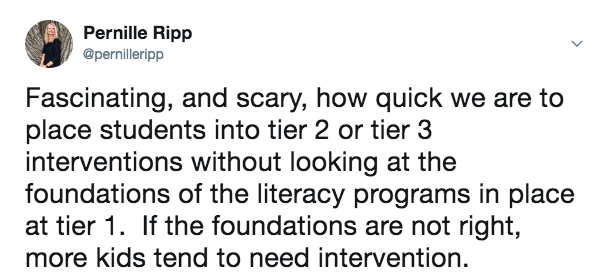
And then we wonder why so many kids end up in tier 2 or tier 3 interventions?

So this year, I will continue to examine my own practices as the teacher of Tier 1.  I will make sure that the instruction I am providing is effective, focused, and research-based.  I will make sure that my foundations are in order and also well-taught so that kids have a chance to grow in our classroom.  I will disseminate my own practice before I look outwards.  And I encourage other teachers, other decisionmakers, other schools to do the same.  If too many kids are in intervention, then foundations are missing in our classrooms.  If too many kids are not making growth, then we look at what is happening with us first.  And we look at it from a systems place.  Are systems in place to support kids on their reading journey?  Are systems in place to helps kids develop their reading identity?  Are systems in place to teach the joy of reading and not just the skills?  Which systems stand in their way of success?  Which systems harm rather than help?

And that’s where we start. Not with pull-out, but with better in class instruction.  Not with intervention, but with reexamination.    With a commitment to the best classroom instruction, we can provide, supported by the administrative decisions that are being made.  Perhaps a lofty dream, but a dream worth pursuing nonetheless.

If you like what you read here, consider reading my newest book, Passionate Readers – The Art of Reaching and Engaging Every Child.  This book focuses on the five keys we can implement into any reading community to strengthen student reading experiences, even within the 45 minute English block.  If you are looking for solutions and ideas for how to re-engage all of your students consider reading my very first book  Passionate Learners – How to Engage and Empower Your Students.      Also, if you are wondering where I will be in the coming year or would like to have me speak, please see this page.


being a teacher, Literacy, new year, Reading

Our ELA Curriculum Map for 7th Grade 90 Minute Block

As some of you may know, we are moving from a 45-minute block of ELA time to a 90-minute block.  I cannot tell you how excited I am for this to happen.  To actually have more time to dig in, to have fewer students so I can know them better, to be able to pull small groups more often and really support student growth – yes, please!  But with this change comes a lot of decisions.  We want to make sure students are engaged and challenged well within the 90 minutes.  We don’t want it to drag on, we don’t want it to be lecture.  So as the year starts to come closer, the ideas and aspirations we have had are starting to take shape and I thought it would be nice to share them here, in case others need some inspiration.

Last year we decided what we believe when it comes to our literacy work together and this is what grounds our decisions.  While the chart below is just the overarching theme, our original document discusses things much more in depth, such as the need for equitable practices and for creating opportunities for students as changemakers.

The overarching beliefs we function in are:

If middle school learners need… Then we will commit to…
Empowerment Giving them choice
Read/write every day Give them time
To have a voice Discussion/authorship/ownership
Developing/understanding their identity Reflection/guidance/exposure/structure
See connections to themselves and others Incorporate global/local topics and connect to other classes
Adult role models

Peer role models

Read/write/think/discuss with and in front of students

  • Opportunities for student learn with and from each other.
  • Teachers model/share their love of reading/writing in their own life.
  • Teacher is part of the classroom reading/writing community
  • Exposure to mentor texts
Visible/continuous growth Mini-lessons, explicit/targeted instruction etc., exposure to many genres and formats (balanced literacy), and goal setting.
Need personalized learning communities Small group instruction and conferring

My tentative schedule for our 90 minutes together looks like this:

  • 10 min = independent reading

  • 2-3 min = book talks

  • 15 min = mini-lesson (can be read aloud)

  • 20-25 min = work time (reading practice, conferring, small groups etc)

  • BELL BREAK – 3 minutes
  • 10 min = Grammar/mentor text work/free write

  • 15 min = mini lesson focused on writing or speaking

  • 20 min = work time (writing practice, conferring, small groups etc)

  • 5-10 min = read aloud/picture book read aloud/share/closing

Yesterday, I had the chance to sit down with colleagues and spend some time tentatively mapping out our literacy year.  Inspired by the maps in 180 Days by Penny Kittle and Kelly Gallagher, we thought providing ourselves with an overview of the year meant we would have a better feel for what to plan for.

This map is intended for 45-minute readers workshop followed by a 45-minute writers workshop.  We wanted to make sure that students had two different times to read within the 45 minutes, one chunk of time that was focused on reading for pleasure without any extra “work” attached to it, and one chunk of time where they would be working more on the skills of reading, most often within their own self-chosen texts, but sometimes in a text chosen by us.

We also wanted to make sure that students have time for meaningful embedded grammar instruction, as well as time to free write.

5239614768676864.png

6121185864318976.png

We are a standards-based district and so we have 9 separate ELA standards.  These are not assessed every quarter but are instead assessed at least twice throughout the year so that students can see their own growth.  Here are the standards we have 5327283641122816.png

The students have not started yet, so all of this is aspirational.  I will keep updating it as the year progresses but thought I would share.

There have been a few books that have really shaped my thinking for the upcoming year.  They are

Troublemakers: Lessons in Freedom from Young Children at School by [Shalaby, Carla]

Troublemakers by Carla Shalaby

180 Days by Kelly Gallagher and Penny Kittle

A Novel Approach by Kate Roberts

Being the Change by Sara K. Ahmed

Write Beside Them by Penny Kittle

Image result for mechanically inclined

Mechanically Inclined by Jeff Anderson

Notice and Note by Kylene Beers and Robert Probst

Passionate Readers by myself – weird to say your own book but this book holds my reading beliefs and also my ideas for how to reach our goals.

The Book Whisperer by Donalyn Miller

Book Love by Penny Kittle

The Reading Zone by Nancie Atwell and Anne Atwell Merkel

If you like what you read here, consider reading my newest book, Passionate Readers – The Art of Reaching and Engaging Every Child.  This book focuses on the five keys we can implement into any reading community to strengthen student reading experiences, even within the 45 minute English block.  If you are looking for solutions and ideas for how to re-engage all of your students consider reading my very first book  Passionate Learners – How to Engage and Empower Your Students.      Also, if you are wondering where I will be in the coming year or would like to have me speak, please see this page.