Lesson Planning, student driven, Student Engagement

A Few Things to Do Before the End of the Year

There is something about after spring break that feels like the end of the year is creeping up. As if the beginning of the last quarter is really the beginning of the end. As if, the days which were already rushing by are now flying so fast that it is hard to keep your wits about you. As the sun comes back – even as they call for more snow, as the days get longer, as the paperwork starts for the next year’s classes, we realize that the end of the year is coming whether we like it or not. Whether we are ready or not.

So as the year starts to slowly unwind and I realize just how deeply I will miss this group of kids again, I am thinking of what I would still like to do. After all, there is so much still to be tried, still to be explored, still be built together. There is still so much to try and now is a great time to do a few things that will often leave a lasting impression.

Now is a great time for another round of book clubs. We do two rounds in one year, more than that is overkill, less than that is a missed opportunity. These center around the theme of overcoming obstacles and allow us to channel the extra energy students bring in the lighter months into discussion. It also gives students a chance to sit with self-selected book people as they choose their next read together. I get to listen in on their conversations to see how they have grown and they get to show off their newfound knowledge as well as confidence when it comes to discussing texts. The last round finished in December so there has been a nice break between then and now. The choices in text they were given can be found here and if you would like to read more about book clubs, see this here.

Now is a great time for more picture books. With state testing and other more high pressure learning opportunities we have been taking the last ten minutes of class to relish picture books, particularly funny ones. As we dive into our “Overcoming Obstacles” book club, which tend to deal with heavy topics, the humor from our picture books provide a nice balance and offer a great way to end our 90 minute block together.

Now is a great time for surveys. I love tapping into the minds of students, after all that is pretty much the premise of all of the work I do, and right now they have some fantastic things to share if you only ask. And by fantastic I mean things that can help you grow. Now is a great time to ask whether they feel valued and respected, what their summer reading plans are, how you can better support them, and also what they would still like to learn. I recently did a beginning of the quarter survey and have been using their answers to guide my planning. In a few weeks, I will ask for their help in assessing the year; what should we have done more of, what should I never do again and such. The trust that we have hopefully built up really allows me to reflect on the past year and to have them help me think of the new one. These students are, after all, the best professional development I can receive.

Now is a great time to plan for summer reading. While I would never require my students to read over the summer, after all, that falls far outside of my rights as their former teacher, I do want to encourage it with all of my might. This is why we have been talking about summer reading all year but now it really becomes a starting point. I try to ramp up conferences with students in order to help them sort through their habits as well as ask them point blank how they will keep reading throughout the summer when there is no teacher there to nag them. With more than 1/3 of my students reporting that they didn’t read a single book last summer, I am really hoping to help a few kids onto a better path. This means book talks, book shopping, and continuing to work on our to-be-read list until it gets emailed home that last week of school.

Now is a great time to plan for a book giveaway on the last day of school. Last year, we planned a new event for the last day where we gave every single student on our team a brand new book. With the help of school funds and Books4school.com we were able to spend a few hundred dollars and provide 150+ kids with incredible choices for their summer reading. This was one more way we hoped to entice them to actually read over the summer and also meant as a parting gift for all of our students as a way to thank them for the year we had had together. However, pulling that many books together takes time and so now is a great time to start planning for that. Can you secure donations for books? Is there a way to get a brand new book into the hands of every child?

Now is a great time for another read aloud. As we wind down together, there is something special about settling in with one last shared book. The last three weeks of school, we will crack open the pages of a final read aloud together to see how far we have come in our comprehension of text, but also just to continue to build community. Contenders in our classroom right now include The Bridge Home and Drums, Girls, and Dangerous Pie but I will also be asking students for suggestions to see what mood they are in.

Now is a great plan to start thinking of summer check outs. I allow students to check out books from our classroom library every summer and so does our school library. For me it means checking out books and keeping track of them in the last week of school and then asking students to bring them back when school starts again. For our library it means having extended hours a few days for kids to check out, a few days open throughout summer, and then again asking them to bring back all books when the new year begins. While I inevitably lose a few books every summer, I also have a lot of students read more books because they finally get to check a great book out that they have been waiting for or can have an enticing pile to take home to hopefully tempt them . There is no reason for all of my books to just sit on my shelf all summer when they could be in the hands of readers.

Now is a great time for more free writing. Many of our students have been asking for more creative writing and so we have been making time for this as well. Using prompts from The Creativity Project, John Spencer, or student generated, students take 10 minutes most days to either write about the prompt or continue their own story. They then share with those they would like to share with. It has been a really wonderful way to reclaim the joy of writing as students continue to work on who they are as writers.

Now is a great time for more discussion. I don’t know about your students, but ours are chatty! And while I love a fun class, it can also be exhausting to constantly try to get them to settle into more quiet activities, instead we plan for more discussion-based explorations such as book clubs, as well as our heated topic debates. Rather than continue to fight their voices, we plan on channeling their voices for productive means, much like we have throughout the year.

Now is a great time to have some fun. Because the days are winding down, because the sun is coming back, because these kids won’t be ours much longer, now is a great time to just relax and have some fun. We teach the age group we teach because we love them (hopefully) and I don’t want to forget that. While 7th graders can be a challenge, they are an incredible challenge to have, and one that I wouldn’t trade for much in the world. why not embrace it? enjoy it? And have some fun these final days together.

If you like what you read here, consider reading my newest book, Passionate Readers – The Art of Reaching and Engaging Every Child.  This book focuses on the five keys we can implement into any reading community to strengthen student reading experiences, even within the 45 minute English block.  If you are looking for solutions and ideas for how to re-engage all of your students consider reading my very first book  Passionate Learners – How to Engage and Empower Your Students.      Also, if you are wondering where I will be in the coming year or would like to have me speak, please see this page.

Be the change, being a teacher, Literacy, Passion, Reading, Reading Identity, student choice, Student dreams, student driven, Student Engagement, student voice

The Rights of Our Readers

Today was the second day of school.  the second day of trying to get to know these incredible kids that have been gifted to us.  The second day of trying to establish the seeds for the habits that will carry us through the year, hopefully leading us to a year where they leave feeling like this year was worth their time, that this year made a difference.

Today was the day of one of our big fundamental lessons; when reading is trash or magic.  I shared my past reading mistakes in teaching, we shared when reading sucks or when it is lit (student choice of words).  As the post-its crowded the whiteboard, the questions and statements inevitable came.  Will we have to read books you choose for us?  Will we have to write every time we read?  Will we have to do post-it notes?  All things that in the past, I would have answered yes to but now the answers are different.  You always choose your books, even in book clubs, you will have plenty of choices.  You will not always write after you read, sometimes you will, and because of the work of teachers before me, you will be better at it than ever before.  And post-its?  Sometimes, when it makes sense, but not every time and not at home.  Only here because at home I just want you to work on your relationship with reading, the skills teaching that will happen in class.

As we finished our conversation we merged into what their reading rights are this year.  the things that I will not take away.  The rights they have as individuals on a reading journey.  This is not my idea, nor something new, but once again the work of others who have paved the way for my better understanding of what developing student reading identity really looks like.  As we discussed what rights they would have and what they meant, I wrote an anchor chart, a reminder that will hang all year so we don’t forget just what we can do together.  What choices we may have.  As we went down the list, the relief was palpable, the excitement grew.  Even some of the kids who had not so gently told me how much they hated reading right away, looked less scared, less set in stone as we talked about what this year would like.

And so this is where we stand tonight…  Our very first anchor chart to remind us of what it means to be a reader that is honored within our community.  What it means to be a reader that already has a reading identity, that we will continue to develop together, honoring everyone wherever they are on their journey, rather than forcing our well-intended decisions down over the top of kids.  Perhaps, once again, this year kids will develop a better relationship with reading, will grow as readers, will grow as human beings.  What more could we hope for when it comes to teaching?

If you like what you read here, consider reading my newest book, Passionate Readers – The Art of Reaching and Engaging Every Child.  This book focuses on the five keys we can implement into any reading community to strengthen student reading experiences, even within the 45 minute English block.  If you are looking for solutions and ideas for how to re-engage all of your students consider reading my very first book  Passionate Learners – How to Engage and Empower Your Students.      Also, if you are wondering where I will be in the coming year or would like to have me speak, please see this page.

Be the change, being a student, being a teacher, student driven, Student Engagement, student voice

What Matters to You? An Exploration into #BeingtheChange

“I brought this because my mother bought it for me before she picked me up…”

“I brought this because my brother sent it to me…”

“I brought this because it represents who I am…”

My student holds up a small stuffed toy, the rest of the class sits in a circle in silence, and then a few ask questions.

The next child shares their object, and the experience replicates itself.  Silent listening, thoughtful questions, and a newfound knowledge of who we are and what we are.

For the past few weeks, we have been working our way through experiences inspired by Sara K. Ahmed’s new book, Being the Change.  A book that I knew the minute I read it would be a game changer for me.  And I was right.  The book inspired me to throw out my entire 4th quarter plans and revamp them with a focus on self-exploration, discovery, and social comprehension.

The book inspired me to add more student discussion, more time for reflection, more quiet, more time, deeper experiences.

We started with an exploration of the identity webs we created at the beginning of the year.  What can we add now?  Have we changed this year?  We discussed what identity means, how it shapes our experiences.

The focus naturally shifted then to our names.  I asked students to discover the story of their name or of someone else’s name.  I let those at home know to share the stories.  I shared my own name story, opened up and shared what it meant to only be named by my mother because my father didn’t really have a stake in my name, nor me as he decided that he couldn’t be at my birth because of a meeting.

The questions followed and I answered as best as I could, modeling my own trust in the community we have created, the vulnerability it sometimes takes to open up to others when you are not quite sure what they will do with the information.

We spent a lot of time talking, asking questions, and writing in our identity journal.  A low-key journal where students are asked to share their thoughts on what they are learning about themselves and others.  Quick lessons turned into several days, savoring the pace with which it unfolded in front of us.  Giving the proper time it deserves.

We moved into picture books, diving into amazing stories of others who decided to make an impact on the world.  Students read, inferred and wondered what led someone to take a risk and try to change the world.  I asked the students if they could connect with the person they wrote about.  And they did, not so much in the large feat the book was focused on, but on the everyday resilience, on the goals, on the motivation, the decision to be courageous.

And then I asked them where they were from.  Not just location, but what shapes them as a person.  What smells remind them of whatever home may be.  Which words, objects, moments frozen in time.  I shared my own life once more, opening up for questions and then stepped out of the way, having the students slowly unpack what the question even meant. They reflected, shared, and opened up.

And then I asked them to bring in an object that represented them somehow.  Something that mattered to them.  A 7th-grade show-and-tell but with meaning.  Some forgot, but those that remembered showed parts of themselves that perhaps others hadn’t seen.  It was meant to be a reminder of how to listen actively, a reminder of how to ask thoughtful questions, and yet it became so much more.

An unveiling of small parts that perhaps others hadn’t seen.

A deep sense of appreciation for taking the chance and sharing.

A stillness in our classroom as some kids chose to share deeply personal items, while their peers took it all in.

As a visitor observed yesterday, I can’t believe what they shared, and I agreed.  These kids with their hearts.  These kids with their stories.  These kids with their sometimes bravado laid it out there for all to see.  I am so grateful.  I am so proud.

As we move forward in this exploration of the issues that surround us in our world, I am so thankful for the inspiration for the book.  For the ideas to push us toward a closer understanding to who we are and how we see the world.  For how our very identity shapes the worldview we carry with us.  Sometimes all we need is a little inspiration.

If you like what you read here, consider reading my newest book, Passionate Readers – The Art of Reaching and Engaging Every Child.  This book focuses on the five keys we can implement into any reading community to strengthen student reading experiences, even within the 45 minute English block.  If you are looking for solutions and ideas for how to re-engage all of your students consider reading my very first book  Passionate Learners – How to Engage and Empower Your Students.      Also, if you are wondering where I will be in the coming year or would like to have me speak, please see this page.
Be the change, being a teacher, student choice, student driven, Student Engagement, student voice, Student-centered

Ideas for Helping Students Raise their Voice

Student voice-PixTeller-204654.jpg

My mother raised me to raise my voice.  She raised me to believe that my voice mattered.  That speaking up when I saw injustice was a part of my civic duty.  To not take my position of power within my white privilege for granted but to recognize it and share it with others.

My teachers taught me I was different.

That I was too loud.  Too opinionated.  Too much.

That I was the bad child to be avoided.

That I needed to learn how to tone it down.

Lower my voice.

Speak less.

Let others speak before I added my voice.

If it wasn’t for my mother’s insistence that my voice mattered, I would have been a silent child.

A silent adult.

As I see students speak up in the aftermath of yet another horrific school shooting, I cannot help but be proud.  This is why I teach the way I do.  This is why I believe that what we do matters.

When we create learning communities that thrive on discussion.  That thrives on student voice.  That tell those we teach to speak up rather than to stay silent, this is when we are truly changing the future of this world.

So what can we as teachers do to encourage student voice?  How can we make sure the very children we teach know that their voice is needed for a better future?

Let them speak.

While it sounds so simple for many of us, it is not.  Afterall, faced with curriculum deadlines, content standards, and all of the things we need to do, there are times that we forget that teaching is not meant to be a performance of one, but a chorus of many.  In fact, research indicates that teachers speak more than 60-75 % of the time.  That leaves very little time for those we teach to find their own voice.  So monitor your own.  Ask a question and step back or better yet, ask the students to ask the questions and guide them along the way.  This doesn’t start as they get older, this starts as they enter school.


Teach them to question.

Questioning is one of the single most powerful skills we can pass on to students.  And yes that also means questioning us.  Provide opportunities for them to question what they see, let them know that they should be questioning what they are learning, and show them through example that it is fine to question you, the authority in the room.  I would rather have students who dare to speak than those who remain silent.  We discuss how to question authority with respect, but also that you should fight for what you believe in.

Make room for debate.

I know it is scary at times to be a teacher in a heated political climate, at times, I feel like whatever I say feels like a loaded question, and yet, we must find ways to bring hard topics into our classrooms and then step aside.  I tell my students that I am not here to shape their opinion, I am here to give them an opportunity to shape their own.  They know our discussions are not about what I want them to believe but instead about them coming up with something to believe in and then fact-checking it.  It is not enough to have an opinion, you must realize where it stems from.

Ask, “Now what?”

My wise friend, Dana Stachowiak, taught me to always ask, “Now what?” when I believe in something.  She reminds me that forming an opinion is not the point, but doing something about it and continuing to question is.  So when students write persuasive essays, when students discuss, when students uncover new information, ask them, “Now what?”  What do you plan on doing with the information?  What else do you need to learn? What can you do with this belief that you have?

Show them change.

I survey my students throughout the year about how I can be a better teacher.  It is one of the best things I do.  And yes, there are criticisms every single time I read the surveys, things I could do better.  Things they would like to see me improve.  And so I try when I can and we discuss the changes needed for the experience to be better for all of us, me included.  When students see an adult, who does not have to listen to their voice because let’s face it nothing says we have to, actually listen to them and implement change because of them, they see the power of having a voice in the first place.  This is vital for them to believe that they can be changemakers.

Support don’t punish.

I have been appalled at the districts that are telling students they will be suspended if they protest.  Have we forgotten that this very nation was founded on the notion of protest and speaking up when we saw a wrong?  Why we would tell students, who we teach about inequality, about courage, about sacrifice, that they cannot exercise their right to free speech, blows my mind.  So instead of saying no, find a way to support.  Show them where they can go to protest, show them how to do it safely.  Step up as leaders of this future generation rather than the oppressive older generation, a cliché that has been held on to for too many years.

Create deeper learning opportunities for all.

Last weekend, I had the amazing opportunity to read the final draft of Sara Ahmed’s book Being the Change, a book being released on March 29th by Heinemann.  Sara’s book ignited my already present fire to create further opportunities for students to dissect their own identity, to push their own knowledge boundaries, and find a way to bring the world in as part of our curriculum.  This book is a game changer and provides a blueprint for us to do more with what we already do.  Centering on student identity and not the teacher’s this book gives us the needed tools to create classrooms that are focused on social comprehension without dictating a political path.  I am thankful that this book will be out in the world soon for all of us.

Don’t forget our purpose.

Education is to better our world, not to create better test takers.  Education is to create a new generation of literate adults who question the world around them, who uncover information, who seek to right the wrongs of this world.  To help children become complex thinkers and problem solvers, who strive to make this world a better place not just for themselves but for a society as a whole.  That is not a political sentiment, but a humanitarian one.  We must continue to do better.  We are teachers of the children who will write the history of this world, so what type of history would we like them to create?  One that echoes the dystopian novels that sit in our classrooms, or one that continues to focus on better for all?

For the past weeks, my students have looked to me and the other adults in our building for answers more than ever before.  I have been asked how I will keep them safe, what our plan is in case the unthinkable happens, how I feel about what is going on in the world.  I have done the best I can to share my own thoughts without scaring them, without forcing my opinion on them.  And yet, I keep thinking about all of the things we already do; how our job as educators was never to be the sole voice in the classroom, but instead to help our students raise theirs.  So how do I plan on keeping them safe, by making sure that they know they can change the world.

If you like what you read here, consider reading my newest book, Passionate Readers – The Art of Reaching and Engaging Every Child, out August 2017.  This book focuses on the five keys we can implement into any reading community to strengthen student reading experiences, even within the 45 minute English block.  If you are looking for solutions and ideas for how to re-engage all of your students consider reading my very first book  Passionate Learners – How to Engage and Empower Your Students.      Also, if you are wondering where I will be in the coming year or would like to have me speak, please see this page.


Be the change, being a teacher, Student dreams, student driven, Student Engagement, student voice

Maybe Next Year…

I was a “just fine” teacher for many years.

The kids who came to me who were successful in school did just fine.  The kids who had already figured out the way to do school were just fine.  The kids who seemed to find things to like about school ended up just fine.

And yet, every year there they were.  Their data staring back at me as fiercely as their refusals.  That little group of kids that no one seemed to be able to reach, to help, to figure out how to make them grow like we hoped they would.

And every year, at the end of the year,  I hoped for the very same thing; maybe next year it will finally click.  Maybe next year’s teacher will figure it out.  Maybe next year they will be a better teacher than me.  Maybe next year…

But what I seemed to forget for so many years.  What I still forget at times is one simple truth; for all of our kids, we are the “Next year…”

We are the teachers that are supposed to finally figure it out, to make the difference, to help them grow.

We are the teachers that are supposed to find just one more idea when we seemingly have tried everything and yet nothing has made a difference.

We are the teachers that we hoped all of “those” kids would get.  We are the maybe next year…

So we cannot sit back and wait for next year when that is exactly what we are.

We cannot hope that others will figure it out better than us when we are what these kids got.  We cannot pass the child on as an unsolved mystery without working until the very last day, the very last moment, in the hopes that something, even something minuscule, will finally help them grow.

So we keep trying, and we keep reflecting, and we keep asking questions.  And we slide those book stacks across their desks with our most enticing books, and we keep sliding them even when they dismiss us through their eye rolls or outright refusal.

We purchase the books we hope they will read.

We confer with them even if they have little new to say.

We give them as much of our time as we can so that they can see that rather than giving up we keep coming back.

And we rediscover the hope of becoming a reader that may have been extinguished either by our own actions or of actions outside of our control.

So when I am asked but what do we do when the kids still don’t read?

When they still don’t care?

When they still just don’t?

I remind myself and anyone else.

Not yet.

But they will, however small.

There will be a moment of success, perhaps not transformation yet, and we will know that instead of simply hoping that next year’s teachers would figure it out, with this one little piece we have gotten one step further.  And we cannot dismiss that.  So look for the little, for the often overlooked, pump up your patience, and find your successes.  Don’t give up on a child just because it hasn’t worked yet.  Don’t give up just because nothing seems to matter.  Don’t give up and hope that others will figure it out when you are what that child has.

Teach, work, believe and love, and know that instead of “next year” we can make it become “this year…” and then for this one child, we will make a difference.  But we can’t do that if we already are waiting for next year’s teachers to figure it out.

If you like what you read here, consider reading my newest book, Passionate Readers – The Art of Reaching and Engaging Every Child, out August 2017.  This book focuses on the five keys we can implement into any reading community to strengthen student reading experiences, even within the 45 minute English block.  If you are looking for solutions and ideas for how to re-engage all of your students consider reading my very first book  Passionate Learners – How to Engage and Empower Your Students.      Also, if you are wondering where I will be in the coming year or would like to have me speak, please see this page.


Be the change, being a teacher, Literacy, Reading, Reading Identity, student choice, Student dreams, student driven, student voice

Why Reading Sucks…

A couple of years ago I asked my students to tell me why reading was amazing.  When Jack whispered to Michael that “Reading sucks…” the rest, they say, is history.  Inspired by Jack’s words of truth, I have asked students for years now to tell me their reading truths and not hold back.  I cannot be the kind of teacher I would like to be if I don’t get to know them.  The real them.  Not the school-primed, sanitized version.  Not the kid that knows how to play the game.  Not the kid that says whatever they think we want to hear so they start off on a good foot.

So on the third day of school this year, I told the story of Jack. Of how I had been doing that lesson where I talk about the magic of reading.  How he had dared to whisper those words.  Some of the students laughed, they remember the lesson I was referring to, as they have also head about how amazing reading is for years.  And then they got quiet as I asked them so when is reading not magical?  And when is it?

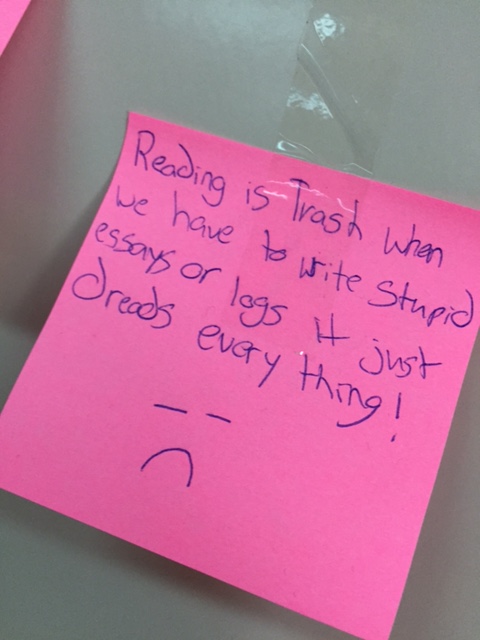
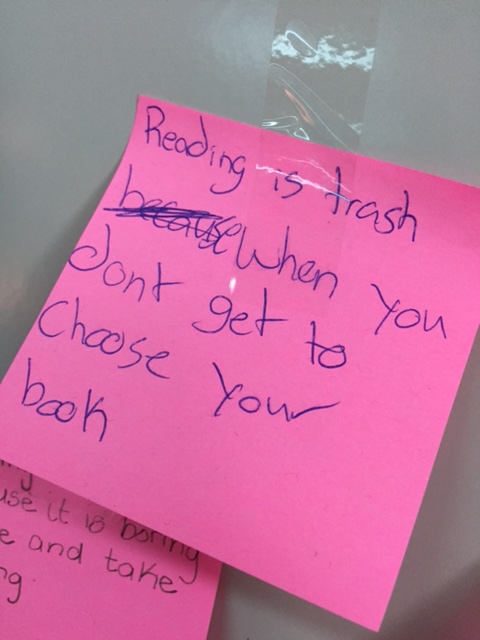
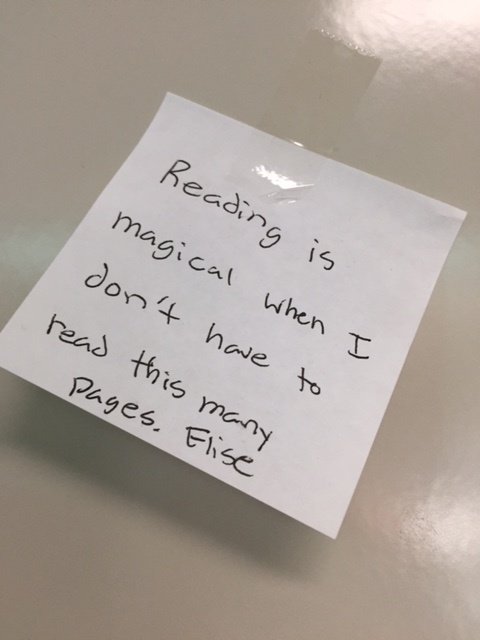
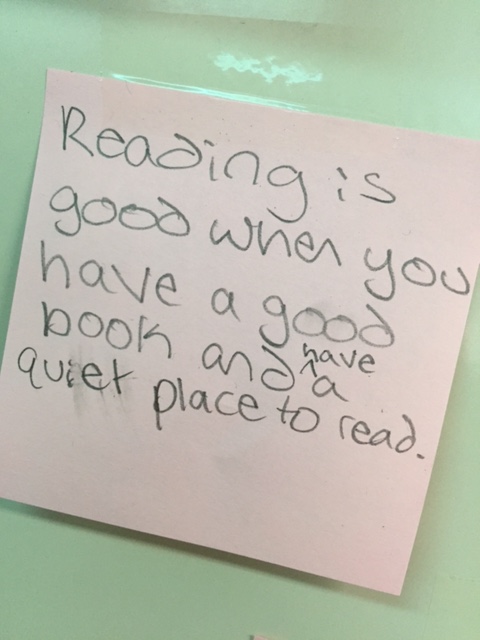
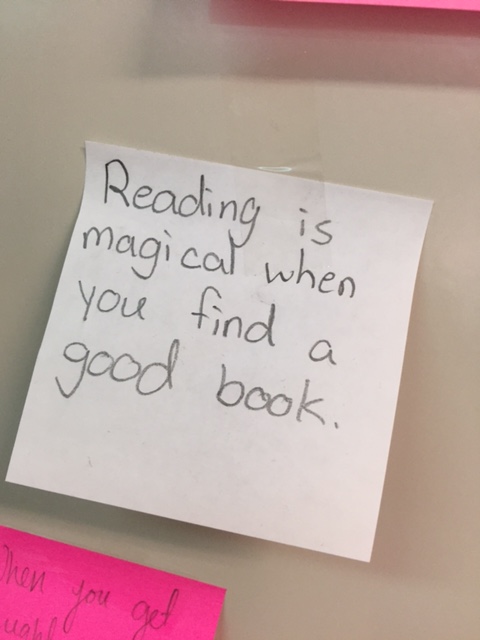
I wrote in big bold letters “Reading is magical” and then asked them what to write on the other side.  “Reading is trash!” they said as they chuckled, not quite sure, I am sure, of what to make of all of this.

They grabbed as many post-its as they could and then started to write their reasons.  Please tell me when reading is amazing.  Please tell me when reading is trash.  Tape your post-its to the board so they stay up.  Sign your name if you want.  And then step back, read the post-its.  What do you notice?

IMG_7092.JPG

Over and over their words joined together to form the same patterns I see year after year.  The same things I have done to kids through the years.  The same things many of us educators are told to do every year by well-meaning administrators who are led by an expert curriculum that someone told them to purchase to raise test scores.

No choice!

Boring books!

Too much writing!

Tests!

Forced reflections!

Sitting still!

Their words glared at us.


IMG_7087.JPG  IMG_7083.JPGIMG_7078.JPG IMG_7079.JPG IMG_7080.JPG IMG_7088.JPG

But wait?  When is reading magical?  Again a pattern that we all know.

When I find the right book!

When I am given time to read!

When I find a great series or author!

When it is quiet!

When I am allowed to just read!

IMG_7070.JPG  IMG_7071.JPGIMG_7072.JPG  IMG_7073.JPGIMG_7074.JPG

Their words have carried us into our beginning reading conversations, into our analysis, into our very community.  They have guided us as we start to figure out where reading fits into our lives and whether we can protect or promote a strong and personal relationship with reading.  They have guided us as they have mentioned the amazing experiences they have had with their previous teachers, and the ones they wish that had not had.

We fret so much over what curriculum we should use, how we should teach, and how we should grade, yet sometimes the biggest impact we can have with kids is simply when we stop and ask them for their truths.  Do you know what your students would say?

PS:  This lesson and the others that surround it are all discussed in my new book, Passionate Readers.  Passionate Readers.  

If you like what you read here, consider reading my newest book, Passionate Readers – The Art of Reaching and Engaging Every Child, out August 2017.  This book focuses on the five keys we can implement into any reading community to strengthen student reading experiences, even within the 45 minute English block.  If you are looking for solutions and ideas for how to re-engage all of your students consider reading my very first book  Passionate Learners – How to Engage and Empower Your Students.      Also, if you are wondering where I will be in the coming year or would like to have me speak, please see this page.