being me, student voice

It Appears My Students Have More Faith in Me Than I Do

image from icanread

Sometimes I don’t know why I hit “publish.”  Sometimes I shake my head at myself in disbelief; why would I ever want to put “that” out there.  Yet I still hit the button, and then I hold my breath a little.  Thursday’s post was one of those moments.  I wrote it in a few minutes, tears streaming down my face, hit “publish” and hoped to feel a little relief now that the thoughts were out. Brandon, my husband, came home soon after and we talked for a long time about what teaching means to me and feeling like I’m home or not.

I had no idea I was not alone.  I had no idea that so many others once again had gone through the exact same thing.  That this would make others open up and pour so much love my way.  Thank you.    Thank you for reaching out to me.  To assure me it is normal.  To remind me that change can be so very hard yet ultimately so rewarding.

I knew I needed to dig into my students’ heads a little bit, so Friday was a new day and I came in with a survey.  I needed answers to help my heart a bit.  So I asked them if they felt respected.  If they felt their voice mattered.  What I could change.  What I should keep.  I told them that they could remain anonymous if they needed to and then I waited.

Their voices poured forth and with each survey my heart got a little lighter and the ideas started to come back.  Even those that confessed to hating English said that they liked me as a teacher.  Almost all said that they felt respected and that their voices were heard.  That there were great things and things that could be changed.

It wasn’t what I expected.  It wasn’t as bad as I feared.  Yes, there are things for me to work on, there always is, but there was also sparks of kids that felt that the job I do every day matters to them, is making a difference.  So while my heart is still heavy with thoughts of what if, my spirit has been renewed a bit.  Perhaps as so many said, I wont know right now that I am making a difference, but maybe some day I will.  I still don’t know where I ultimately belong, but for now, I am going to embrace where I am.

I am a passionate teacher in Oregon, Wisconsin, USA,  who has taught 4th, 5th, and 7th grade.  Proud techy geek, and mass consumer of incredible books. Creator of the Global Read Aloud Project, Co-founder of EdCamp MadWI, and believer in all children. I have no awards or accolades except for the lightbulbs that go off in my students’ heads every day.  First book “Passionate Learners – Giving Our Classrooms Back to Our Students” can be purchased now from Powerful Learning Press.   Second book“Empowered Schools, Empowered Students – Creating Connected and Invested Learners” is out now from Corwin Press.  Follow me on Twitter @PernilleRipp.

aha moment, Be the change, Passion, student choice, student voice

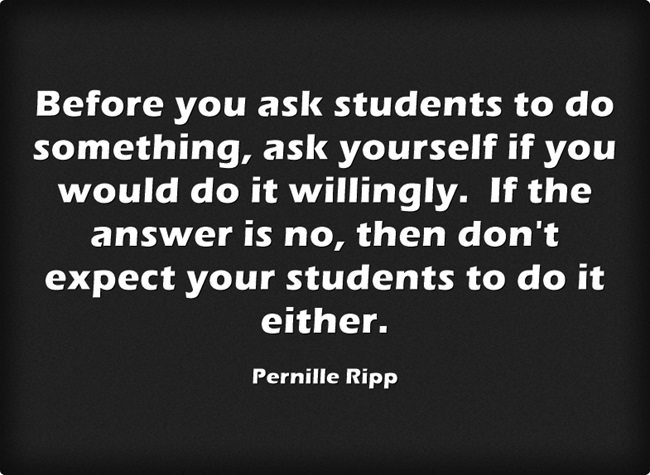
5 Rules We Impose on Students that Would Make Adults Revolt

Before-you-ask-students

I remember the first time I walked through a silent school, the quiet hallways, the shut doors.  You would think it was testing season, but no, simply a school going about its day. At first I felt in awe; what order, what control, what focus!  Yet that night, as I shared my story with my husband, I realized something; schools aren’t mean to be silent.  They are filled with kids after all.  Quiet sure, but silent, no.  Yet here this school was; silent, and all I could think about was; why?  So what things are we expecting students to do that we would probably not submit to as adults?

Expect them to work hard all day with few breaks.  I could not do the schedule of my 7th graders; five 45 minute classes, then 30 minute lunch, then 3 more classes.  In between those classes?  3 minutes to get from one place to the next.  And high expectations everywhere they go.  We assume that they can just do it because we were subjected to the same, because the classes are all different, because this is not that bad, but as adults we would never be asked to sit focused, giving our best, and problem-solving for such long periods without taking small brain breaks, stretches, or in some other way reigniting our focus.  I know we do it so that we can fit everything in, but it still amazes me that we think it is is a good system.

Silent hallways.  Or most of the times we force silence when it is not for studying.  Of course, there needs to be quiet in the hallways while learning happens, but silent hallways – not needed.  Neither are silent lines, silent lockers, or silent lunch rooms.  Quiet and respectful can include talking.  Once, when I asked why my 5th graders had to be silent while they got ready for lunch, I was told it was in order to speed them up, apparently talking slows them down.  On the surface that may be a great reason, we want them to get to lunch sooner.  BUT.  These kids have just spent how many hours being told when to speak, not being allowed to speak to their friends, and now we tell them they have to be silent for longer?  As adults, we speak to our colleagues as we walk down the hallway, in fact, sometimes more loudly than the students.  We get to where we need to go just fine, often with a better focus because we got to relax for a minute.

Only go to the bathroom during breaks.  I remember telling my students that they had better use their lunch breaks to go to the bathroom because we didn’t have time the rest of the day.  Then I got pregnant and the whole idea of planned bathroom breaks imploded.  Yes, there are good times to leave the classroom and bad times, and yes, some kids will use the bathroom to get out of class because they are bored, tired, or want to simply get out.  So what?  To ask students to only go certain times, serves little purpose other than to establish teacher control.  Going to the bathroom can be just  the brain break a child needs to come back awake.  We use it all of the time as adults, why need trust students to do the same?

Do hours of homework.  I have long been an opponent of meaningless homework.  My severe distaste is based on many things, but one of them is that we have just asked students to put in a full day of hard work with us in the classroom.  Now, we are asking them to work even more outside of school.  Yes, some jobs require work outside of work hours, hello teaching, but not all, and often those jobs are by choice.  However, when we ask students for several hours more of their time, no matter our intentions, after they have gives us their best in class, we are treading on dangerous territory.  Why would students want to give us their best in school if we simply ask them to do more after?  I expect my students to work hard, use their time well, and get work done with me.  Yes, there is sometimes homework, no I am not perfect either, but I do think long and hard before I assign anything.

Be ready to show mastery on the same day.  This one took a while for me to realize.  You see, it doesn’t matter that you taught the concept at the same time; kids learn at different rates.  We know this intimately as adults; what may take our friend a day to understand, may take us a week or more.  Nowhere is that more apparent than in college where some students seem to study for weeks, while others breeze through the same material, ready for the test.  So why we expect our students to show mastery on the same day I will never understand.  Obviously it makes sense from a management perspective; it is hard to manage 113 students on different learning journeys.  It is also coming from a completion standpoint; the end of the quarter is the end of the quarter.  Yet research upon research shows us just how crazy this notion is, so why do we keep pushing it for it?  We need fluid mastery to serve our students best.

What other rules have you encountered?  Why do we do this to kids?

I am a passionate teacher in Oregon, Wisconsin, USA,  who has taught 4th, 5th, and 7th grade.  Proud techy geek, and mass consumer of incredible books. Creator of the Global Read Aloud Project, Co-founder of EdCamp MadWI, and believer in all children. I have no awards or accolades except for the lightbulbs that go off in my students’ heads every day.  First book “Passionate Learners – Giving Our Classrooms Back to Our Students” can be purchased now from Powerful Learning Press.   Second book“Empowered Schools, Empowered Students – Creating Connected and Invested Learners” is out now from Corwin Press.  Follow me on Twitter @PernilleRipp.
Be the change, being me, Passion, student voice

How Dare You Tell Me You’re Bored?

image from icanread

I remember the first time a student told me that they were bored.  Not with school. Not with life. But with me.  I remember the anger.  I remember the disbelief.  “How dare they tell me I’m boring?  How dare they be bored?  Don’t they know how important this is?  Don’t they know that I am the teacher?  Don’t they know that it is not my job to entertain, but to teach?”

There was no moment of clarity.  There was no moment of thankfulness.  Instead I got upset at the child.  I carried my resentment with me, and it tainted our relationship.  I didn’t grow, I didn’t reflect, I didn’t push my teaching to realize what a gift that was.  Those moments would come much later, two years to be exact when enough students had told me they were bored that I realized that something had to change.  And it wasn’t them, they kept changing, it was me, and I needed to grow some thicker skin.

We tell our students that we want to help them become lifelong learners.  That they should learn how to advocate for themselves.  That they should try to change the world by adding their voice.  And yet, we get angry, defensive, upset when students tell us that the way we are teaching does not work for them.  We don’t want to hear their opinion often.  We don’t want to hear their thought about us.  Sure, they may not always phrase it well.  Sure, they may tell us at a really bad time.  Still, when they tell us, we should listen.  Even if we can’t change at that very moment, we should listen.  Even if we are not sure how to even change, we should listen.

If we truly want empowered students who take control of their own learning journey then we have to grow thicker skin.  Then we have to grow.  Period.  We have to be able tot take the criticism we so effectively dole out.  We have to learn our own lessons of seeing every moment as a chance for growth, as taking every chance we have to be better.

So the next time a student tells you that there has to be a better way.  The next time a student asks you to change.  The next time a students asks why they have to learn this, don’t get mad like I did.  Don’t waste those learning moments.  Reflect instead.  Ask questions,  search for change.  Yes, being told you are boring hurts, take it from someone who was, but I wouldn’t change the past.  I would rather have students who speak their mind in a thoughtful way, than students who are afraid to speak.  Wouldn’t you?

I am a passionate teacher in Oregon, Wisconsin, USA,  who has taught 4th, 5th, and 7th grade.  Proud techy geek, and mass consumer of incredible books. Creator of the Global Read Aloud Project, Co-founder of EdCamp MadWI, and believer in all children. I have no awards or accolades except for the lightbulbs that go off in my students’ heads every day.  First book “Passionate Learners – Giving Our Classrooms Back to Our Students” can be purchased now from Powerful Learning Press.   Second book“Empowered Schools, Empowered Students – Creating Connected and Invested Learners” is out now from Corwin Press.  Follow me on Twitter @PernilleRipp.

aha moment, student choice, student voice

These 5 Minutes Will Make a Difference

I find myself looking at the clock more and more.  Call it the constraint of 45 minute class periods.  Call it the middle school urgency that seems to haunt my every move.  That clock on the wall; yeah, it seems to be always leering.  Yet lately it has been taking on a new role for me; no longer the reminder of how little time I have left to help these students grow, but now a reminder of how much time we still have.  How much time we still have to talk.  How much time we still have to share.  How much time we still have to teach each other.

Why this change in perspective?  I have just started giving my students 5 minutes.  5 minutes to discuss.  5 minutes to figure out.  5 minutes to prepare.  It is indeed quite impressive how much can be accomplished in just 5 minutes.

5 minutes before the quiz, they review with each other.  5 minutes before the assessment, they speak to one another and compare notes.  5 minutes before the share with class, they share with a friend.  Giving them those 5 minute means that my students are more confident, are less rushed, are more ready.  Giving them those 5 minutes mean that I am forced to slow down and let them think, let them digest the learning, frame in their own words and then support each other.

I have no research to back me up.  I have no test scores to show the difference, but what I see in front of me has sold me.  Students who are ready.  Students who are willing.  Students with more confidence in their abilities.  we are moving toward becoming a community of teachers, not just learners, 5 minutes a day.

I am a passionate teacher in Oregon, Wisconsin, USA,  who has taught 4th, 5th, and 7th grade.  Proud techy geek, and mass consumer of incredible books. Creator of the Global Read Aloud Project, Co-founder of EdCamp MadWI, and believer in all children. I have no awards or accolades except for the lightbulbs that go off in my students’ heads every day.  First book “Passionate Learners – Giving Our Classrooms Back to Our Students” can be purchased now from Powerful Learning Press.   Second book“Empowered Schools, Empowered Students – Creating Connected and Invested Learners” is out now from Corwin Press.  Follow me on Twitter @PernilleRipp.

Be the change, Passion, student choice, student voice

6 Changes Toward Personalized Learning

Say personalized learning to most people and it conjures up classrooms where every child is doing their own thing and the teacher is furiously trying to maintain order and overview in an otherwise rule-free classroom.  Yet, this is not exactly what it is.    Instead, personalized learning to me means student voice and choice, where student input is used to create a personalized learning path that allows students room to explore their passions while exposing them to new things.  Sounds great but where do you even begin on this path?  Or even better, what are you already doing that would count as a step toward personalized learning?

Change the way they sit.  I ask my students to sit wherever they want as long as they can work.  Only once in awhile do I have to interfere as to their seating choice and I have much happier students.  Why?  Because they got to have a say in their classroom environment, they were given control.

Change the way they work.  I ask my students to discover how they work best; do they like to hand-write things, type, dictate?  Are they kids that love to write papers rather than make a movie?  How do they want to read?  How do they want to think?  If students are to discover how they work best we have to give them choice and room for exploration.  This doesn’t mean that every single thing has to be open for anything, but simply providing choice in some things is a step in the right direction.

Change the knowledge they have.  One push-back against personalized learning has been that students don’t necessarily know what they need to know, and I agree.  That is why personalized learning also has to include exposing students to various topics, such as the materials we have to cover due to standards.  However, there are many ways to expose students to these topics, so don’t do the same thing over and over; change it up and allow for student ideas in the way material is covered.

Change the expectations for all.  We tend to teach the way we learn best but that is not always the way our students learn best.  So rather than plan by yourself, plan with your students.  Their ideas are often much better than ours anyway.  This also allows us to move out of our comfort zone rather than use the same type of format, or go with just your own thinking.  So ask the students HOW they would like to learn something and then heed their advice.  You don’t have to go with every single idea but try a few of them at least.

Change the timeline.  I used to think all students had to gain mastery of something at the same time because I had taught it to them all at the same time, until I had my twins.  Kids, even born at roughly the same time from the same mother, do not learn things at the same time so why do we expect our students to?  My students will now show me mastery of the standards when they feel they are ready within the quarter.  Sure, it will require a more lucid timeline but it really doesn’t add more work to me, all I need is a more flexible mindset.

Change the conversation.  I used to be the queen of all answers and solutions.  If a student had a problem, I fixed it.  If a student needed help, I helped them.  I used to think that was one of my main components of being a teacher; the helper/fixer/teacher role.  Now I know that students need support so they can help themselves and figure things out themselves and my language reflects that.  Rather than giving an answer, I ask a question back.  Rather than affirming an answer, I ask them to explain it.  I ask for their input, I ask them to reflect, I ask them to provide solutions and to teach others what they know.  This classroom is no longer about what I need them to do or know, but what they need to do or know, and that carries power.  So change the way you speak, include the students in the conversation, and stick with it.

Starting a journey toward personalized learning can be a terrifying endeavor, but have faith; every step you take toward giving your classroom back to your students matter.  Every idea you have that gives the students more power matters.  We have to create environments where students are passionate learners, that want to take control of their learning journeys.  I wrote my first book on how I did my journey, hoping to inspire others, and still my journey continues.  I am not done changing the way I teach because every year I have new students to grow with.  It is not just the students that need to be exposed to personalized learning, it is us the adults as well.

being me, ideas, student voice

Unleash the Power of Post-Its

The students would always show up with them; stacks and stack of yellow post-its.  My pile in the cabinet would grow year after year with graduated student names, not quite collecting dust, but definitely not being utilized.  We used them for reading sure, after all, how else would we mark all of our thoughts, but other than that, I had not understood the power of the post-its quite yet.  That changed a few years, when after an aha moment prompted by a student, I finally realized just how much power a small post-it can really hold.

So what can you use them for beside the obvious?

Give your reluctant speakers a voice.  Every year I have a few students that have so much in their heads but seemingly few ways to express it.  Whether it be due to shyness, self-doubt, or any other barrier, these students would rather the teacher think they don’t know an answer than share it with the class.  Behold the mighty post-it!  I speak to my students beforehand, hand them some, and ask them to write down their thoughts, their comments and questions as the discussion progresses.  At the end, they hand them in to me so that I can see their thinking.  Often I use them as a way to affirm their thoughts as well, hoping to build their self-confidence.

Level the playing field.  Some of my students are really quick thinkers that usually get it right the first time, others are more meticulous, sifting through various opportunities, possibilities, and methods before finding an answer.  Rather than make our sharing times a race for who is the fastest thinker, I have students write down their thoughts.  If a child is done, I ask them to add more while we wait for others to think through their answers.  I can walk around and see their thinking without them feeling the pressure to come up with something brilliant on the spot.

Creates visual thinking maps.  This goes hand-in-hand with having them write thoughts down as a class; if students continue to add their thoughts, they can lay them out in front of themselves as their thinking hopefully deepens.  They can also all add more thoughts to something they had previously written and see their thinking grow.  It is quite powerful for a child to see how much they have to offer to the world in terms of their ideas.

As a quick assessment.  I always have small groups created for possible re-teaching but nothing beats my post-it groups.  Once we have done our mini-lesson, I ask students to apply it right then on a post-it and hand it to me.  I can quick flip through them and immediately see who needs to be re-taught or just needs a check-in.

A story starter.  Sometimes I have students brainstorm possible topics for a new writing assignments and then lay them out on a table.  Everyone can then shop for ideas for stories and borrow others by simply taking them.  For students who have no idea what to write about, this can be an easy way to get started.

As surprise book recommendations.  If a student loves a book, I ask them to place a post-it in it with their thoughts or recommendation right in the book.  That way when the next student open it up, they get to see another child’s thought, whether it is from someone they know or someone they don’t.  The power of a student recommendation cannot be replicated.

An affirmation.  I have been doing the “I have noticed…” post-its for two years and I cannot tell you how fun it is to hand to students.  All it is is a post-it starting out “I have noticed…” and then whatever great thing I have seen.  Sure, they take time to write but the students take them to heart.  Every year, I have a few students leave them on my table as well on their own accord, I keep them all.

I am a passionate teacher in Oregon, Wisconsin, USA,  who has taught 4th, 5th, and 7th grade.  Proud techy geek, and mass consumer of incredible books. Creator of the Global Read Aloud Project, Co-founder of EdCamp MadWI, and believer in all children. I have no awards or accolades except for the lightbulbs that go off in my students’ heads every day.  First book “Passionate Learners – Giving Our Classrooms Back to Our Students” can be purchased now from Powerful Learning Press.   Second book“Empowered Schools, Empowered Students – Creating Connected and Invested Learners” is out now from Corwin Press.  Follow me on Twitter @PernilleRipp.