Be the change, being a student, being a teacher, student choice, Student dreams, student driven, student voice

Planting a Seed – Our Project on the Refugee Crisis

I grew up in a home that had a newspaper on our table every morning.  Laid out for us kids to see, we grabbed the comics first, then the Danish news.  I was a teen when I started reading the international news.  Being aware of the world was something that was expected of us, after all, Denmark is a small nation.  We read the paper, we listened to the radio, we watched the news.  Not always fully attuned but always aware of at least some of the bigger things happening in the world beyond our own.

Being a globally aware and invested teacher is something I have tried to live and breathe for many years now.  After all, the Global Read Aloud was created with the idea of making the world not only smaller, but also more interconnected to create more empathy and kindness.  My students have therefore in varying degrees always brought the world in, been a part of projects that involved others and tried to know more about the outside world than when they came in.  Working on a team with an incredible geography teacher has only made my job easier.

So this year as my English standards starred me in the face a small idea started to form, a seed began to grow; what if instead of “just” doing summaries, what if instead of “just” having an opinion, I was able to structure an inquiry project into something that I have been following myself; the Refugee Crisis?  What if we created a two-week experience where the students got to learn at their own pace with the end goal of having an opinion?  With that, I started to plan…

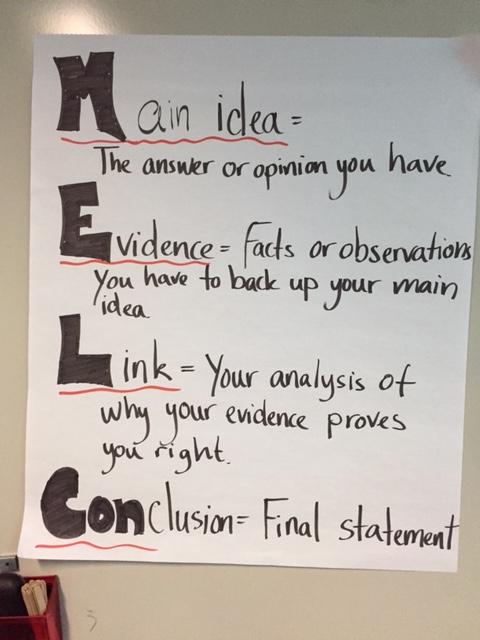
We would have two weeks roughly of work time, with time dedicated every single day after we do our 10 minutes of independent reading.  Students could choose how they wanted to work and engage with the materials.  I used a sheet that simply asked kids how they would like to engage with the learning and then crafted lessons based on this.  I have used this approach in the past and it has worked pretty well, this time I should have been more diligent with using it though after the kids filled it out.  However, that being said, kids were also good at reaching out and asking questions, as well as use each other for help.  I did promise the students that I would only do one whole class lesson; how to write an opinion piece using the MEL-Con format, and I kept my word.  My students have asked me to do less whole class teaching and I am adhering to that as I can help them better in small groups anyway.
img_2059
Our anchor chart for the MEL-Con format

We first needed a question, one that would give us a focal point but would not be shaped or tainted by my opinion, after all, I did want the students to come to their own conclusion.  So our guiding question became ; What should America’s role be in the refugee crisis?  This was what the students would work toward and discuss.
img_2107
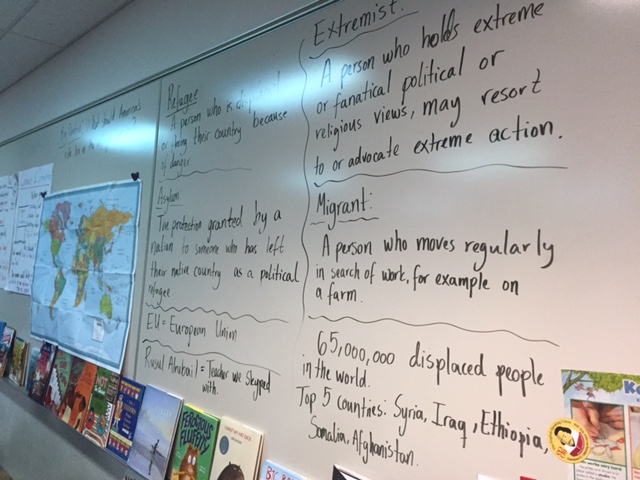
We created a running word wall as student questions came up.

I knew I needed texts to start with; thank you Newsela for your text-sets, you saved me so much time.  So I pulled nine different texts that highlighted different aspects of the crisis, printed them at three different reading levels and told the students to choose three of them to read at least.  I also made all of the texts available as a folder in case they lost their copies.
img_2060
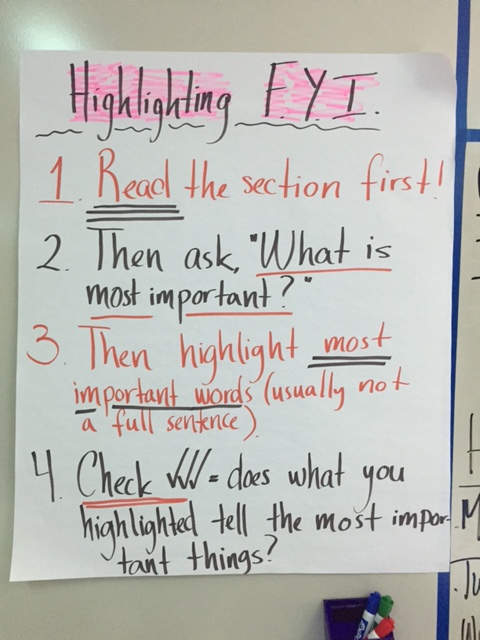
Another teaching tool for students to reference

I also wanted students to watch videos; I created a padlet with different short videos that would be appropriate for 7th graders and also less than 20 minutes.  Students were asked to watch at least one, but could do more if they wanted to.

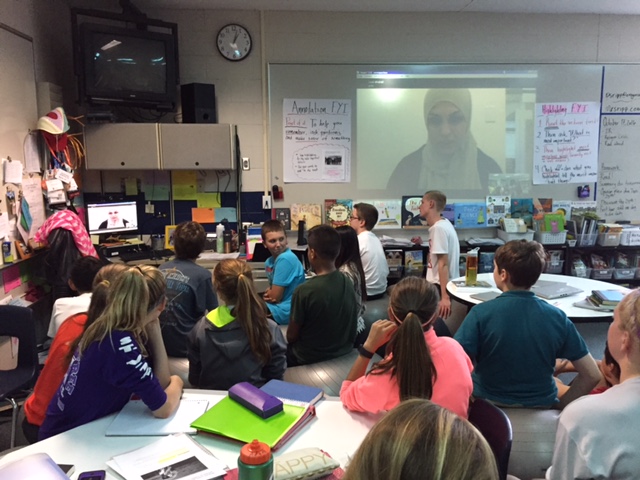
I then crossed my fingers and asked on Twitter; would anyone Skype with my students about being a refugee?  I am so grateful for the response.  Three of my classes were so incredibly lucky to Skype with the incredible Rusul Alrubail,she graciously and courageously shared her story of how she became an Iraqi refugee at a young age.  To say my students were moved by her story would be an understatement.  Yet, the kindness of strangers continued.  Another teacher, Emily Green, from Michigan asked her students, some of them refugees, if they would create a small video for my students.  Last night, I received three different videos from her courageous kids sharing their stories.  Today as I played them for my students, you could have heard a pin drop.
img_2023-1

So for the past two weeks, my students have annotated the texts (using their own systems rather than ones created by me) for anything that stood out, they have written a summary on one article, and they have crafted an opinion on the guiding question, as well as craft an opinion piece based on all of their newfound knowledge.
img_2102
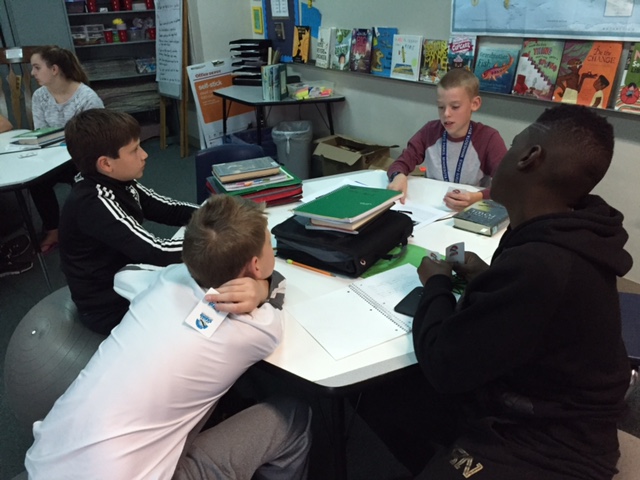
In some classes we started in small group before we went to whole class discussion.

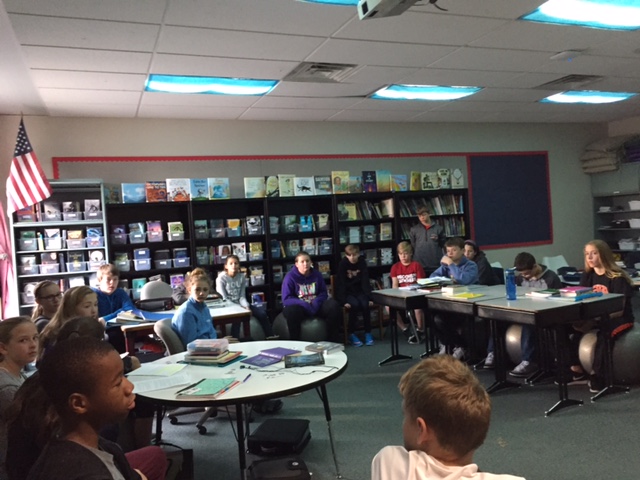
Today, as we came together as a group to discuss what we have learned and what our opinion is, I sat back behind the kids and watched them practice their discussion skills.  As kids navigated the ins and outs of adult unmoderated conversation, I couldn’t help but feel just the tiniest bit proud.  Yes, they were discussing, yes they were listening to each other, but that was not the only thing I observed.  I observed kids who all of a sudden understood just how vast of a nation we live in.  Kids who now know where Iraq and Syria are.  Who know tales of children passing through Europe unattended as they try to reach freedom.  Of people who never wanted to leave their homes but were forced too.  Of what we can possibly do as a nation but how many hurdles there may be to making any decisions.  I also saw kids who started to understand that for some reason they equate refugee with terrorists.  Who thought 10,000 refugees is a large number but have since discovered it might not be.  Who know that we need to help but are not sure just how to do that.
img_2104
Discussing  as a whole class

I didn’t set out to shape the opinion of my students, that is not my job as their teacher.  Instead I wanted to create an opportunity for them to form an opinion on fact rather than hearsay, on research rather than rapid talk.  I know that some believe America should do more and others think we do too much already.  I know that for some they don’t really care either way.  But I also know that by giving them more control over their learning, by giving them tools to start with, by creating a guiding questions and then by bringing others in via Skype and YouTube that we have created an experience that matters.  That together we now have this piece of the world that ties us together and that will continue to crop up through the year.

Yesterday, a child asked me what the deal was with Mosul and weren’t they bombing over there?  A child that two weeks before was not even sure that Iraq was a country or what refugee meant.  That child had heard on the news that fighting was starting up again and now wanted to know more.  As teachers of literacy we have incredible opportunities to bring the world in, to help our children find their opinions, and to create experiences that connect us with other human beings.  I wrote a book on how to do just this,  not for the sake of the book, but for the sake of making this world a better place.

I ended our discussion time today with the following words; “My job is not to make you think a certain way, my job is to make you think.  So whatever your opinion may be, all I ask of you is to have one based on fact, rather than what others believe.  Keep your ears open and ask a lot of questions.  That is the least you can do as the future of this country.”

As teachers, we can bring the world in when it makes sense.  To make it matter more than just getting through the year or working off our checklist.  The year has just started and yet we have so much more to discover about the world.  I cannot wait where our learning takes us next.

PS:  If you would like to see my folder of resources, go here, some of it is loose.

I am currently working on a new literacy book.  The book, which I am still writing, is tentatively Passionate Readers and will be published in the summer of 2017 by Routledge.  I also have a new book coming out January, 2017 called Reimagining Literacy Through Global Collaboration, a how-to guide for those who would like infuse global collaboration into their curriculum.    So until then if you like what you read here, consider reading my book Passionate Learners – How to Engage and Empower Your Students.  Also, if you are wondering where I will be in the coming year or would like to have me speak, please see this page.
aha moment, Be the change, being a teacher, homework, no homework, Student dreams, student driven, student voice

Are You Doing Your Own Homework?

itec-passionate-learning-environments-google-slides-clipular

This summer as I saw my niece, who is now a sophomore, we inevitably spoke about her reading life.  She used to be a voracious reader, we could not get enough books in her hands.  Then she came to the whole class novel, which inspired this post, and since then her reading life has been limping at best.  This summer I asked, as usual, “What are you reading?”  She told me The Kite Runner and then scoffed.  Surprised I asked why the reaction.  She then told me that she had read the book and loved it but now had to reread it to annotate it.  “The whole book?”  I asked.  “The whole book.”When I asked her why she was not quite sure, perhaps they would use parts for discussion.

I wondered then, as I often do, when I come across homework assignments that appear nonsensical, whether her English teacher had done their own homework?  Whether they had taken the time to annotate the entire book themselves.  Whether they understand the labor that was involved with that task and how it would take away from the enjoyment of the book.  It seems to me that once again something that is meant to teach kids how to better thinkers, instead is implicit in the killing of their love of reading.

Several years ago I started to do my own homework.  From the stories we wrote, to the essays, to the speeches, and to the presentations.  I started to experience what I was putting on the shoulders of my students and I quickly realized that what I thought would just take a few minutes never did.  What I thought would be easy hardly ever was.  What I thought would be meaningful sometimes wasn’t.  So I stopped giving homework, except for reading.  I stopped going by the formula of grade times 10 minutes.  I stopped handing out packets and instead vowed to stop talking so much and instead spend the time in class on discussion and work time.  I expected pushback or concern, but have hardly gotten any in the last six years.  Most parents express relief instead.

So every year I make a deal with my students; if you work hard in our classroom, you should not have to do work outside of English.  If you give me your best then besides reading a good book you don’t have to give me anything more after you leave our classroom.  And for most it works.  Most of my students come ready to work, ready to learn, and they hand their things in.  Not everyone, just like when we have homework we have those kids that do not get it done, I also have kids that do not use their time wisely.  So I work individually with them, after all, the acts of a few should never determine the conditions of the many.

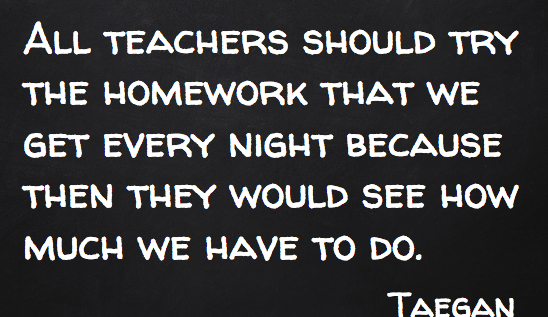
So if you are still giving homework, I ask you for this simple task; do it yourself.  Go through the motions as if you were a student and then reflect.  Was it easy?  How much time did it take?  What did you have to go through to reach completion?  In fact, if you teach in middle school or high school, do it all, truly experience what we put our students through on a day-to-day basis. I would be surprised if the process didn’t shape you in some way.

I still do my own assignments, although I have been slacking lately.  Whenever I do, I am reminded of just how much time homework swallows.  Of sometimes how little actual practice it gives, or even learning.  How homework is unfair because we have already been given hours of their time in school.  How those who really need the practice do not need it at home, but instead with us as support in our classrooms.  Do your homework, tell your students, and see how they react.  Then ask them how they feel about homework.  Let their thoughts shape you as a teacher, I promise you won’t regret it.

I am currently working on a new literacy book.  While the task is daunting and intimidating, it is incredible to once again get to share the phenomenal words of my students as they push me to be a better teacher.  The book, which I am still writing, is tentatively Passionate Readers and will be published in the summer of 2017 by Routledge.  So until then if you like what you read here, consider reading my book Passionate Learners – How to Engage and Empower Your Students.  Also, if you are wondering where I will be in the coming year or would like to have me speak, please see this page.


being a teacher, Literacy, Reading, Reading Identity, student choice, Student dreams, student driven, Student Engagement, student voice, Student-centered

How to Create Empowered Readers – A Beginning

The sniffles started almost immediately.  Small choking noises came soon.  Then full out wails, tears, and gasps.  Theadora, our oldest daughter, was a mess as we drove home from Chicago today.  What had caused this sudden crying?  The end of Harry Potter Book seven.  The end of our 9 month journey accompanied by the ever amazing Jim Dale and the audio books of Harry Potter.  I was wistful myself to tell you the truth.  As I tried to console our distraught daughter,  I couldn’t help but feel slightly pleased, after all, isn’t this exactly the type of relationship that we hope our children, our students, have with books?  One that makes you want to cry, or laugh, or scream in frustration?  One that allows you to feel so intimately attached to something not created by yourself?  To feel the gratitude of brilliant writing and a long journey along with an author’s imagination?  To feel the loss of characters and of story as a book series finishes?

Yet, how many of our students have never experienced this type of sadness?  How many of our students have not experienced what is means to complete a series that one has become so invested in that it feels like the loss of a family member once the last page has been read?  How many years has it been for some, if at all, since they truly loved a book?  While we cannot change the past, we do have control over the now, over what happens in our classrooms. Over what happens from the moment they enter to the moment they leave.  And with that power comes an immense responsibility to empower our students, to offer them a chance at an incredible relationship with reading once again or for the very first time.  While it may start with having them choose their own books, this is not the only place students need more control to be empowered and passionate readers.

IMG_1281 (1).JPG

Book choice.  This fundamental right to choose what you read is one that is so often taken away from our students because we want to help them develop as readers.   Yet when a child is not a  allowed to choose the very text they are asked to engage with, we give them little room for an emotional attachment.  How many of us adults will willingly invest in something we have been told to read?  So while we can expose and recommend, we must create classrooms where student choice is the norm, not the exception.  Where we help students find that next great book in order for them to become independent book selectors so that they can leave our classrooms knowing that they do not need us.  Not in the same way as they did in the beginning.  Where wild book abandonment is the norm and not something you need permission for.  Where indifference rules when a book is given up because we know that a new book awaits.  If we truly want students to feel in control of their reading identities then giving them the choice over which book to read is the very least we must do.

Book truths.  If we do not know what we are up against, then we can never change their minds.  This has been a mantra of mine since I started asking my students all sorts of things about their education.  So every year, and throughout the year, we continuously discuss how we feel about reading (and writing).  I never dismiss their truths, nor try to correct them.  It is not my job to tell them how they should feel, but it is my job to hopefully create a better experience for them.  I cannot do that well if students do not trust me, trust the community, and trust themselves and also trust the fact that perhaps how they feel about reading right now, if it is negative in any way, is something that can be changed.  (Yes, growth mindset at work here).  So ask them how they really feel and then truly listen, because it is when we listen, we can actually do something about it.

IMG_1290 (1)
Student post-it’s cover our whiteboard, our very first discussion of why we like reading or not from Friday.


Book Tasks.  Just Friday I was asked how many book summaries we would do this year.  I must have looked perplexed, because another student quickly added, “You know, write a summary every time we finish a book?”  I assured them that while we would work on summarizing, it would not be on every book, nor even books mostly.  Instead we discussed what we want to do when we finish a book; discuss with others, pass it on, perhaps forget all about it.  We must give our students control over what they do with a book once it has been finished.  We must allow them to explore ways to communicate their emotions with a book and certainly still develop as thinkers.  I keep thinking how I want our students to have choices every few weeks as we advance our reading; review, conversations, written ponderings, perhaps a summary, perhaps a video.  The point is, I am not sure at this point what we shall do once we finish a book because it depends on what the students would like to do.  I do not ever want to implement a task that makes a child slow down their reading or stop it altogether just because the task attached to it is horrific in their eyes.  So when we plan our reading tasks make sure that the long-term effects are not unwanted.  Make sure that it actually plays into our bigger picture; students who actually like to read, and does not harm this.

Book Selection.  While choice is of utmost importance, so is the way books are selected.  Too often we schedule in book shopping time for when it is convenient to us, forgetting that all students need books at different times.  Selecting a book is a also something that must be taught, even in middle school, because many students still have a hard time finding a book.  We therefore discuss how to bookshop, which yes, includes, judging a book by its cover, and then we take the time it takes.  If we really want students to wander among great books then we must give them time for that wandering and we must embrace the social aspect that comes along with it.  After all it is this book loving community that should sustain student reading after they have left our classrooms.

IMG_1283 (1)
How many students would say the exact same thing?

Book Access.  While I cannot continue to purchase books at the rate I have been due to a change in our household, I know that one of the biggest reasons many of our students end up identifying as readers is because of the sheer volume of books they have access to both in our classroom library and in our school library.  Kids need books at their finger tips at all times.  Much like they must have time to book shop when they need it, they also need to be able to book shop right in our classrooms.  When a child is obviously lost, we or other classmates can jump in.  When a child is only pretending to bookshop we can offer guidance.  We cannot control how many books our students go home to, but we can make sure that whenever they are in our classrooms; the books are plentiful.

Book Time.  Providing students time to read in our classes is one of the biggest ways we can signal to students that reading really matters.  After all, it is what we give our time to that must be the most important.  So whether it is only 10 minutes, like I provide every day, our a longer amount of time; time for reading in class is essential.  Otherwise, how will we ever know that they are truly reading because anyone can forge a reading log.  The time for reading should be just that, not time for tasks or post-its.  Not time for partner discussions or writing.  Reading, in all its glorious quiet.  In all its glorious discovery.

IMG_1285


While the above areas may seem so commonsense, perhaps it is their commonsense-ness that makes us forget to implement them all.  It seems so obvious and yet… how many of us have told a child what to read (I have!).  How many of us have asked students to create task upon task after they finished a book (I have!).  How many of us have asked students to bookshop at a certain time and for a certain amount of time and wondered why they came up empty-handed (I have!).  The point is really that we have the choice to empower our students.  That we have the choice to show our students that their reading identity and developing it is a major part of our curriculum even if the standard does not cover it.  Even if the test does not measure it.  Because we know that at the end of the day we are not just teaching students that should be college and career ready, but instead are teaching human beings that should grow as human beings in our classrooms.  I may not be able to change every child’s mind when it comes to books and reading, but I will go in there every day trying, because my hope will always that they too will someday cry when they realize that a series has ended.

I am currently working on a new literacy book.  While the task is daunting and intimidating, it is incredible to once again get to share the phenomenal words of my students as they push me to be a better teacher.  The book, which I am still writing, is tentatively Passionate Readers and will be published in the summer of 2017 by Routledge.  So until then if you like what you read here, consider reading my book Passionate Learners – How to Engage and Empower Your Students.  Also, if you are wondering where I will be in the coming year or would like to have me speak, please see this page.

being a teacher, Literacy, Reading, student choice, Student dreams, student voice

The One Thing that Made the Biggest Difference (According to My Students)

http---www.pixteller.com-pdata-t-l-419967.jpg

I asked my students what made the biggest difference. I  asked them what I should tell other educators as I ready myself for speaking this summer, honored to be invited to so many great states.  I asked them what they wished every teacher would do, if they had to pick one thing, what would it be?  Answer after answer, paper upon paper, they told me their one thing.  And while I wasn’t surprised, I had not expected it to be so frequent.  I had not expected it to show up on so many independently answered surveys.  I had not expected it to be the ONE thing so many times.

Please tell them to give us time to read.  Please allow us at least 10 minutes.  Please tell us to read.  Tell us to read only great books.  Give us the time so we can fall back in love.

The time; that was the most important.

I have started almost every single day with a sacred 10 minutes of reading.  Not enough, I know, but when I only get 45 minutes to teach English, it is more than 1/5 of our time.  Every day I have expected all students to read and to read a good book.  Every day I have expected students to fall into the pages that they chose and only come back up when the timer sounds and the rest of our class begins.  I was scared of what we would lose in our curriculum by giving them so many minutes.  I was scared that I would not be enough of a teacher by telling them that for those 10 minutes I would only interrupt a few of them every day, but mostly they would be left to read.  I have read the research, of course, that speaks of the power of 10 minutes.  As a teacher I believe in it, but to have it come straight from the very students it effects?  That is powerful.  That is something worth sharing.

When we hope for a reading miracle, when we hope for the one thing that will make a child a reader, it seems like this is it.  That independent reading of self-chosen books is truly what will help all of our readers, whether dormant, resistant, or already in love, develop into readers who will leave our classrooms knowing that books have a place in their life.

So as we teach the older students, those students that might not have the luxury of longer literacy blocks.  Who may not have the luxury of reading work shop.  Who may not have the luxury of choice. I implore you to please take my students’ advice to heart; give them time to read, even if only for 10 minutes.  Give them time to read a book they choose.  Make it the expectation and not just once in a while, but every single day. I promise it will make the biggest difference.  At least it will, according to my students.

If you are wondering why there seems to be a common thread to so many of my posts as of late, it is because I am working on two separate literacy books.  While the task is daunting and intimidating, it is incredible to once again get to share the phenomenal words of my students as they push me to be a better teacher.  Those books will be published in 2017 hopefully, so until then if you like what you read here, consider reading my book Passionate Learners – How to Engage and Empower Your Students.  Also, if you are wondering where I will be in the coming year or would like to have me speak, please see this page.

Be the change, being a student, being a teacher, being me, Personalized Learning, student choice, Student dreams, student driven, Student Engagement, student voice

You Cannot Buy Your Way to Personalized Learning

http---www.pixteller.com-pdata-t-l-388588.jpg

When I decided to change the way I taught, I didn’t have a system.  I had a lot of ideas, a lot of thoughts, a lot of failures to push me forward in my quest to be a better teacher.  I had kids who hoped that school would be about them again.  I had parents that hoped that their kids would like school when their year with me was done.  I had dreams of something different, but I didn’t have a clear path, I didn’t have a curriculum to follow.  If I would have, I don’t know where I would have ended up.

You see, when you choose to make learning more personal to the students, it is not about buying a curriculum.  It is not about buying a solution.  Or even reading a book and following the step-by-step directions to make it more personal.  It is not about finding the new tool so that you can adapt and make it fit all of your learners.  In fact, it may be just the opposite. It is about getting to know your students, getting to know yourself, and then finding as much inspiration you can to become a better teacher for all of your kids.  So when I wrote my book, Passionate Learners, it wasn’t so that others could teach like me, but instead so others could start to question their own teaching as well.  I didn’t want to give directions, but just ideas, questions, and things to reflect on.  Because making learning about the kids again means that we have to be the ones to figure it out.  Because they are our kids, in our schools, and no one can tell us better than what they need than them.

Personalized learning is not about a system.  It is not about a box.  It is not about a computer where students can self-pace as they work through a set curriculum.  It is not about a checklist, nor learning in isolation.  Personalizing learning is about what is right for the kid that is in front of you at that very moment.  About helping them get to a place where they can figure out what they need and what they would like to accomplish.   And yes, sometimes that kid doesn’t know what they need and then it becomes our job to help them figure it out.   It is not about what you can do for the students to take control of their learning, it is about what they can do.  Personalizing learning is indeed what great teaching is all about; knowing the students and helping them find ways to make all learning worth doing again. 

So if someone tries to sell you or your school a  personalized learning system, a personalized learning curriculum, or even a technology solution so that all students can work at their own pace, I would stop and think about that for a moment.  How can they possibly promise you personalized when it is far from personal?  How can someone who does not know your students, your school, your needs, deliver something that will fit all of those things?

Education is a business and we should never forget that.  As much as we may think that every person who creates something for the education market is in it for the right reasons, we would be fools if we truly believed that.  Much like every other educational buzzword, personalized learning will become the new cash cow until a new buzzword overtakes it.  Don’t let companies ruin what kids need.  Don’t fall for the sales pitches.  Personalizing learning for students means the emphasis is on the personal and for the personal to happen, we have to know our kids and we have to listen to our kids.  Not a company.  Not a sales pitch.  But the voices of the very students we teach.  And that is free.

If you like what you read here, consider reading my book Passionate Learners – How to Engage and Empower Your Students.  Also, if you are wondering where I will be in the coming year or would like to have me speak, please see this page.


aha moment, Be the change, being a teacher, Literacy, student voice

Somewhere in My Education #AgeofLiteracy

Somewhere in my education, I was taught to let others speak before me  I was taught to wait my turn.  To eat my words if that turn never came.  I was taught to listen.  To raise my hand.  To share when asked.  To give praise to others but downplay my own achievements.  I was taught to be a good girl, someone who sat still, said “please” and “thank you” and always offered to help, even if it meant sacrificing my own creativity.

Somewhere in my education, I was taught to plan lessons for fictitious children that would make my classroom look like a mini UN with a smattering of acronyms.  That came to us fed.  That came to us with clean clothes and new supplies and unshattered dreams.  That came to us believing that school was still about them and what they had to say had value.  Who loved to read, to write, to discover, and all I had to do was preserve that notion of loving literacy.  That those who needed more than what I could offer would always get it in some way.

Somewhere in my education, I was taught who the leaders were and to follow their ideas, for they had paved the path and certainly knew more than I ever would.  In that same education, I was taught the research I needed to be better, and so I grew, but I was never taught to trust myself.  I was never taught to seek more than just what was presented to me.  I was never taught to see myself as a leader because good girls don’t lead, they follow.

But within this age of literacy where we fight to keep our students reading, where we have to know our research before others tell us what best practices are, we are all leaders.  We are all of importance.  Our ideas matter because our ideas change the way students feel about the very act of reading or writing.  What we do now will not end with us today, but instead will live on in the lives of the students we teach.  So we are leaders when it comes to the very ideas that shape the literacy identity our students have.  Our words carry weight.  Our words can harm or protect, so we must believe that our words have value.  

So I hope today, that you will look in the mirror and tell yourself that your words should be heard.  That your words deserve a larger audience than just you.  That your ideas are worth spreading, even if no one asked you to.  That when you change a student’s perception of what literacy means that whatever you just did then needs to be shared.  That you can be a leader, that you probably already are.

Somewhere in my education I found my voice.  I found my brave.  I found my driving force, which will always be the students.  Somewhere in my education I found out I could be a leader, even though no one told me so.  Perhaps it is time for others to find the same.

This post is a part of the Age of Literacy that ILA encourages all of us to participate in on APril April 14th.  How are you a literacy leader?  If you are wondering why there seems to be a common thread to so many of my posts as of late, it is because I am working on two separate literacy books.  While the task is daunting and intimidating, it is incredible to once again get to share the phenomenal words of my students as they push me to be a better teacher.  Those books will be published in 2017 hopefully, so until then if you like what you read here, consider reading my book Passionate Learners – How to Engage and Empower Your Students.  Also, if you are wondering where I will be in the coming year or would like to have me speak, please see this page.