aha moment, being a teacher, writing

I Am Not a Writer – On Developing Student Writing Identity

I have taught writing for 8 years.  8 years of outlines, of brainstorms, of on-demand writing.  Of peer editing and feedback cycles.  Of writer’s notebooks to mine for ideas.  Of blank stares and “I have nothing to write.”  And never once did I think deeply about the writing process.

I knew I had to write with my students.  I knew I had to develop my own writing in front of them.  I knew that writers needed different conditions to spark creativity.  And yet, we still followed a pretty linear process, a one path to greatness type of ideal.  We write different pieces but all for the same purpose.

This summer, I was asked to speak out loud while I wrote to be part of a series of videos called Wisconsin Writes.  I was asked to write in front of a camera and a person and just talk as I wrote, providing a running commentary on how my process worked.  It was awkward.  It was stilted.  But it was also enlightening.  That is not the writing process I teach.

Yesterday Jacqueline Woodson spoke about her writing process.  An offhand comment about how she doesn’t outline but just keeps asking “what if.”  Sees where the story takes her and then jumps from piece to piece when she gets bored.  She knows there is a story, she just doesn’t know what it is.  That is not the writing process I teach.

Last night, Donalyn Miller and I spoke about writing and her words sit with me still; there is not one process to writing, there are many.  I know this as a writer myself, so why have I forgotten it so often in the classroom?

Our job as teachers who write is to help students uncover their writing identity.  To show them many different ways of writing and constantly asking them to find what works for them.  To ask questions rather than dictate a path.  To have them reflect on the very creative process that they undergo.  We should not just be assessing their final product but instead support them uncovering their process.  Because their process will be distinctly unique much like ours is.

So as I turn my eyes on developing writer identities, there are a few things I must keep in mind.

All writers are writers.  We say this all the time but if we do not give them opportunities to feel like successful writers then they will never believe us.  So writing must be bigger than one thing.  Writing must be about thinking like a writer, feeling a writer, and not just producing.

All writers need time.  We tend to think that writing is only happening when students are physically writing, but most of us know that writing is also thinking, mulling, abandoning and coming back to our work.  That writing is an unseen process most of the time and the actual act of writing is the product of something so much bigger.  So why do we expect students to write right away?

All writers need choice.  Not just in what they write, but also how they write.  That choice can be whether it is typed or handwritten, where they physically write but also who they write for.  Different audiences require different thought processes.

All writers need ownership.  We expect students to want to share their writing all the time, whether with others through peer editing, feedback or simply celebrating their writing by making it public.  But not all written work needs to be shared.  Some things are just for the authors and that is to be celebrated as well.

All writers need to end it.  Why must every piece be finished?  Why must every piece be edited?  When we tell students that they can start something and when they feel it is done, it is done, it gives them courage to write more.  It gives them ownership over completion rather than asking the teacher whether something is done or not.

All writers write differently.  Much like my writing process is one that only suits me, the writing process of my students is uniquely theirs.  Yet we keep squeezing them into a box of how writers write and then wonder when their writing isn’t powerful.

All writers need self-discovery.  We need to lead conversations where students can put into words what their process is. So using videos of writers speaking about their process gives us a common language and starting point to talk about their writing process.  Our writing instruction needs to encompass all aspects of writing, not just the visible part of it, but the thinking, the journey, the progress.  We need to bring that into the open so that students can understand what it really means to write.

All students need questions.  When someone says they are not a writer, we must ask “Why?”  And if they are not sure then keep asking questions.  Most students say they are bad writers because they cannot spell.  Because they cannot come up with ideas.  Because writing is for other kids.  But writing is bigger than that.  Writing is about finding a way to express the thoughts that jumble our heads.  Not just being a great speller. Or being like others.

I have a long way to go.  I have a long way to teach.  I have some big conversations to have with my students and I cannot wait.  We are all different yet our difference is what makes us unique writers.  What makes our writing powerful.

being a teacher, Literacy, writing

Some Rules We Need to Bend As Teachers of Writing

http---www.pixteller.com-pdata-t-l-248852.jpg

I have been thinking a lot about writing.  Call it that time of year, call it seeing a need, call it teaching middle schoolers who either seem to love writing or really really hate it.  But writing is definitely on my mind.  And it’s about time.

You see, I keep fighting with myself and my own expectation of what a teacher of writing looks like.  The poor English teacher hunched over essays, red pen in hand comes to mind, and yet the teachers of writing that I keep learning from, that I emulate are far from that.  They is so much more than a red pen.  Yet, the old expectations, the old rules, of what I should be continue to haunt the corners of mind, trying to sway me to be something I am not.  I cannot be alone fighting all of these expectations.  I cannot be the only one that feels we need to bend some rules.

Rule number 1:  The teacher must read every piece of writing a student creates.

Kelly Gallagher freed me when I heard him say that students must write more than we can read.  Until then I lugged the journals home every weekend.  I wrote back on every piece of writing.  I read and read all of their writing, eager with my comments.  Now I ask the students what they would like me to read.  I invite them to share their work with the expectation that they must share something and then I read, devour, and assess.  It has changed the amount of writing we do.

Rule number 2:  We must know the purpose of a writing conference beforehand.

I used to think that I had to have every conference pre-planned, that every child that met with me I was ready for.  Now students schedule conferences and I ask them what I can help them with.  They tell me what they need and together we look at their world.  The conversations have deepened and their independence as writers has increased.

Rule number 3:  We must publish all finished work.

As writers, we do this all of the time; write more than we publish, write more than what others see.  And yet, in our classrooms we are taught that writing is a social thing, that all writing must be shared with another person.  That it is not finished until it is shared.  However, writing is a personal thing and sometimes that thing we wrote does not need others’ eyes on it, instead it needs to be tucked away, finished but not for the world to see.

Rule number 4:  We must always write for an audience.

I love having authentic purpose, like we have right now, but I also believe in writing for yourself.  Writing for the teacher.  Writing just to write.  And that means that sometimes you have no idea who you are writing something for but just are writing.  That does not make it without purpose, it simply makes it private.

Rule number 5:  All finished pieces must be, well, finished.

How many things have I published on here that were far from perfect?  How many times has a piece only gotten better because others joined in and shared their thoughts?  We do not always have to see a story through to be done with it.  We do not have to write a whole piece to share.

Rule number 6:  We must edit for perfection.

As teachers, we can do great damage with our editing skills; we can edit out the very thing students are trying to protect.  So I have pulled back on what I edit, I ask students what they would like me to help them edit, and I ultimately put the responsibility for most editing back on them; we are not striving for a perfectly edited piece.  We are striving for a better piece.

Rule number 7:  We must have a peer editor.

The peer editor comes up as one of the most hated things my students do in writing.  Often they do not trust the person that is editing their work, or the process itself is not helpful.  Until we teach students to actually edit their own work, we cannot expect them to be able to edit each others.  Until students get to choose who sees their work, they will not trust us in their writing.  So give students the choice and the time to work with someone else, but do not force them to.  At least not every time.

Rule number 8:  Writing must be linear.

Too often we teach students to start at the beginning and “just” write a rough draft, yet often students cannot think of the beginning.  They then stare at the page for days.  But writing does not have to be linear.  Students can start at the end, they can start in the middle, they can start wherever they want, what matters is that they write.  What matters is that they start.

Rule number 9:  Writing must be instantaneous and constant.  

We forget that writing takes time.  That part of writing is thinking.  That part of writing is searching for inspiration.  My students ask for time to simply think, to look for inspiration.  To write a little bit and then be allowed to stop.  Sometimes silence is the biggest friend a writer can have.

Rule number 10:  The writing process is the same. 

If our goal is to create true writers, and not just teach the act of writing, then we must make room for individualization.  That means that students must have choice in how they write, where they write, and also for how long they write.  While students should be exposed to many different writing techniques, processes, and also have time to experiment with them, we need to be careful when we expect them to all follow the same process.  What we should be aiming for instead are students who discover who they are as writers and develop that path.  Not follow the one we have set out for them.

Rule number 11:  Good writers write like me.

I’ll admit it; I have a wonky writing process.  I often do not write until I have the very first line figured out, but once that happens I can write the whole piece or chapter in one sitting.  I cannot read mentor texts for inspiration because they seep into my writing in all of the worst ways.  I work best under pressure, and I must have absolute silence when I write.  This process is not taught in school, but was one that I discovered myself when I got older.  And it would be a horrible process to teach to others.  Yet, how often do we teach students to write a certain way because that is what good writers do?  Instead, we should be focusing our energy on student self-exploration as writers, to give them opportunities to figure out how they write best.  Ask them, give them ideas, give them time and then have them reflect; did that work for them?  Why or why not?  Let them discover their identities now so they can identify as writers, not as students trying to be writers.

I know there are more hidden rules that haunt my classroom.  I know there are more expectations that drive my instruction in all of the worst way.  I know I have so much work to do in how I teach the act of writing, in how my students become writers, but at least this is a start.  Which rules do you think we need to bend?

If you like what you read here, consider reading my book Passionate Learners – How to Engage and Empower Your Students.  Also, if you are wondering where I will be in the coming year or would like to have me speak, please see this page.


aha moment, being a teacher, student voice, writing

A Few Ideas for Better Writing Conferences

http---www.pixteller.com-pdata-t-l-224750

Thea, our oldest, missed her bus today which meant that I missed my morning prep as I drove her to school.  Missing my prep is usually not a big deal, but this morning I was feeling rather sleep deprived (thanks to the amazing book An Ember in the Ashes which I just had to finish last night) and overall rather discombobulated.  My very first instinct as I tried to get ready in the 4 minutes before the students showed up was to cancel the writing conferences I had planned with the kids, after all, I was not ready.  I had not pre-read all of their drafts, made copious amounts of comments in them, nor had I carefully selected who I would meet with.  Surely, I could not lead their conferences.  Surely, they could would get anything out of it if I did.

Yet, a tiny voice inside me kept whispering that I had promised them a writing conference and I had to keep that promise.  That perhaps this was my chance to not lead their conferences.  To not have all of the answers, but instead be ready to listen and support.  To let them tell me what they needed rather than vice versa.  So I did, and it felt like I held my breath all day, but it worked.  It worked!  And I could not be happier with the outcome.  So what did we do?

I had the students sign up to confer.  Rather than me telling them to meet with me, I left it open for those who wanted to meet.  This meant that those kids with burning desires to show their work got a chance to do so.  In the one class where I didn’t have a lot of students sign up, I walked around and did mini-conferences as they wrote, only interrupting when there was a good moment to ask my questions.  At the end of the day, I marked down whom I had conferred with so that I can keep track of who I still need to meet with and will plan accordingly in the days to come.

I asked them what our purpose was for the conference.  Using the question, “What would you like me to look for?” really helped students narrow the focus of our conference.  Often times, a student will tell me they just want my opinion, but through follow up questions, we were able to narrow it down.  Some kids had an immediate idea of what they needed from me, others needed a little more prodding.  Typical requests became wanting to see if they had too many details, if their flow was choppy,  or other specific needs that were important to them.  Because they had to describe what they needed, they had to reflect on their piece and purposefully weigh those needs.  Rather than just having me read it for an opinion, they ended up with specific feedback that could support them as they continued writing.

I didn’t write suggestions.  I purposefully did not add my thoughts to their document in front of them, nor will I for a while yet.  I think with the advent of Google Docs our comments/suggestions/edits have become just another checklist for fixing their writing, rather than supporting them in becoming better writers.  As my friend, Jess Lifshitz  pointed out, “We need to teach students how to be writers, not just follow our directions to fix their writing.” (paraphrase)  I couldn’t agree more.

We kept it short.  Because I was only given one purpose, students and I spoke briefly and then they were off to work again.  Because I was not editing their work, we quickly got to the point of their needs and they could continue working on their vision for their piece, rather than be tainted by my ideas.

I held my tongue.  I have a wide variety of writers in our classroom, many who identify themselves as non-writers.  I therefore knew that this very first writing conference would set the tone for the rest of the year and further fuel their relationship with writing for better or for worse.  I therefore stopped myself from pointing out all of the things they could work on, all the mistakes that should be fixed, all of the things that should get attention.  We will get to it later, right now they just need to write.

I didn’t give them my opinion.  And not one asked for it either.  Often our opinion is what students strive to hear, to get that seal of approval.  Yet, I have seen what an honest opinion can do to a child that is still drafting their story.  How even the most carefully wrapped sentence can totally stop a child from writing.  Instead, I kept it to the chosen focus.  I asked them their opinion, I asked them to speak about their piece.  And they did.  And I listened, and then they found their own path rather than attempting to walk on mine.

At the end of today, I was excited, not exhausted as I normally would have been.  It was not me who had done most of the talking, it was the students.  It was not me who had set the purpose, it was the students.  Not once had a child asked me if their story was long enough.  Not once had a child asked me whether their story was good enough.  Instead they had told me how excited they were to write, how they could not wait for me to see the final version, how they might try a new story if this one doesn’t go as planned.  Just as I had hoped.  Just like it should be.  Perhaps being discombobulated on a Monday was not such a bad thing after all.

If you like what you read here, consider reading my book Passionate Learners – How to Engage and Empower Your Students.  Also, if you are wondering where I will be in the coming year or would like to have me speak, please see this page.

being a teacher, classroom management, classroom setup, MIEExpert15, our classroom, Reading, writing

12 Tips for An Organized Book Loving Classroom

Anyone who enters our classroom immediately notices all of the books we have.  It’s hard not to, they seem to be everywhere.  While I have always believed in having as many books as possible in the classroom, I was not always sure on how to best organize it for optimal student access and interest.  Now, seven years into having a library, there are a few things that have made my life easier.

No check out system

I have tried so many different check out systems, from a catalog system, to student librarians, to an electronic version, and all of them turned out the same; a ton of work for me and I still lost a lot of books.  So a few years ago I abandoned the check out system.  Now students know they can grab any book as long as they promise to return it.  It is amazing to see the look on a students’ face when they hear that.  Yet, I am not sure this is still the best way, I do lose a lot of books but for now replacing books is easier than spending all of that time checking them out.

“Return Your Books Here” Bin

I used to have students shelve the returned books but I always ended up having to remind them and then re-teach them how to get them in the right bin even though everything was marked.  I now have a plastic tub with a “Return your books here” sign taped to it right by all of our bookshelves.  Once a day I take the time myself to shelve all of the returned books because it gives me a way to see what is popular, look for books other students are wanting, and check on the conditions of some of our most beloved books.  It takes me less than five minutes and all the books are in the right bin.

Bins for every genre and then some

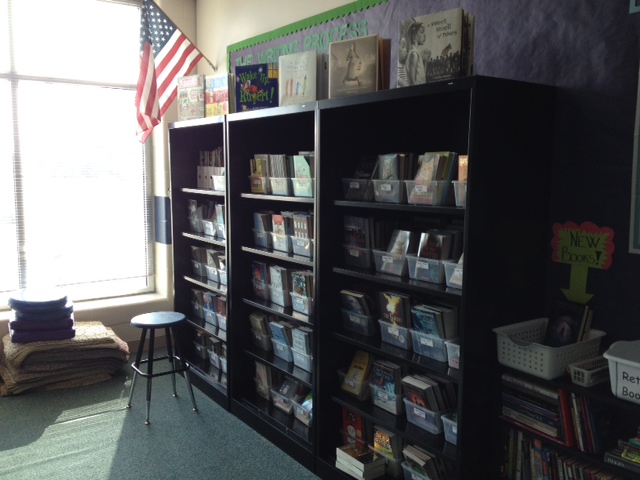
I have loved having book bins for many years.  While they cost money and give you less shelf space, it has proven to be the easiest way for us to categorize books.  Bins are grouped by genre and some by popular authors.  Students suggest bins as well as they see a certain collection grow.  Two such examples are our newly formed Cassandra Clare bins and military history bins when students pointed out that we had a collection now.

This Book Belongs to Mrs. Ripp Stamp

This inexpensive stamp purchased from Amazon several years ago has saved me so much time.  All new books get stamped with “This book belongs to Mrs. Ripp.  Please return when finished” on the inside cover and then the genre abbreviation (or author if they are in an author bin) is handwritten below it in black sharpie.  I cannot tell you how many books are left behind in other classrooms around our school and this little inexpensive stamp means they all come back to me.

The Hardcover Post-It

The only exception I have to my no book check out system is that if a student is borrowing a hardcover book, I ask them to give me the book jacket and put their name on it with a post-it.  I then save them all in a bin and ask students for them periodically.  This has saved many hardcover books from disappearing as students see their name and then remember that they probably left in that one place.  It also gives me a way to track a book down if someone else is looking for it.

The Gutter Picture Book Organizer

Someone long ago hung gutters all around my room under the white boards and I could not be more happy.  Gutters make a perfect display rail for any amazing picture books we may have and ensure that all of the new ones get read right away as well.  A very inexpensive way to get more display space indeed.

Beginning of the year book shleves

Printed and Laminated Bookmarks

We use Kylene Beers’ book Notice and Note throughout the year to give us a shared reading language, so it was natural for me to make some printed bookmarks reminding students of the strategies as they read.  Bookmarks are i the same place next to post-its, which some kids prefer to use.  They don’t have to ask for one, they take them as needed, and return them when they don’t if they feel like it.

“Our Favorite Books” Spinning Wire Rack

For a long time I had a wire rack where I placed all of my favorite books on for students to browse.  Yet, it was not being used very much even though it was in a prime location.  After inspiration by Nancie Atwell, I hung a sign above it declaring it a rack for the students to share their favorite books and then took all of my books off.  I told the students its new purpose and have since watched it fill up with their favorite reads.  This spinning rack has now become the first stop whenever they need a new book.

A Separate Book Case (Or Two) For Picture Books

While we have many of our favorite picture books out on display in the classroom (it’s amazing how many time students gravitate toward them in a day when they have a few minutes), I also have an entire book case just designated to picture books.  I used to organize them and group them together and then realized it didn’t make the slightest difference to the students.  They looked through a lot of books anyway whether they were organized or not.  Since I don’t have these in bins, I gave up on organizing them and haven’t looked back since.

The Readers’ Notebook That Doesn’t Leave

I used to ask students to carry their readers’ notebook back and forth for some reason, which meant many days they left it in their locker, or at home, or didn’t know where it was.  I also had to ask them to specifically leave them behind whenever I needed to assess them which meant the pressure was on to get them assessed so I could hand them back.  Now I ask the students to leave all of their readers notebooks in the classroom.  I have a bin for each class, I don’t care what name order they are in and at the start of each class all I have to do is grab the right bin off of my shelf and put it out for the students to grab.  This is also how I do attendance these days, by seeing whose notebook has not been picked up.

Pre-printed Standard Comments Sheets

I assess my students readers notebooks every two weeks and while I often take the time to write in specific comments to them, I have also learned to pre-print address labels stickers with certain broad comments such as “Remember to use text evidence to support your thinking” or “Why do you think the author did this?.”  Not only has it saved me a lot of time when I need to assess 120 readers notebooks, but it also allows me to focus on the comments they really need while covering all bases.  The students do not mind (I have asked them) since they know it allows me to support them more often with my thoughts.

Learning to Let Go

This has been my biggest take away in having a classroom filled with books and readers.  Sometimes you don’t have to have a perfect system for it to feel perfectly fine.  The students make our book loving classroom their own so they change the organization of books, the shelving of them, and even how we read them.  I don’t mind, I just have to let go sometimes and trust the students.

I am a passionate teacher in Oregon, Wisconsin, USA but originally from Denmark,  who has taught 4th, 5th, and 7th grade.  Proud techy geek, and mass consumer of incredible books. Creator of the Global Read Aloud Project, Co-founder of EdCamp MadWI, and believer in all children.  The second edition of my first book Passionate Learners – How to Engage and Empower Your Students” is available for pre-order now.   Second book“Empowered Schools, Empowered Students – Creating Connected and Invested Learners” is out now from Corwin Press.  Join our Passionate Learners community on Facebook and follow me on Twitter @PernilleRipp.

aha moment, student blogging, student choice, student voice, writing

In Which We Change the Way We Write

For a while, I have been struggling with how to teach writing well.  Sure, we write every single day almost, sure we blog, we write by hand, and we type.  We have authentic purposes and authentic audiences.  The kids write, we discuss, we create.  And yet, something has been missing and for the longest time I couldn’t put a finger on what it was.

Then I watched this video from Brad Wilson – please stop and watch it right now, it is 6 minutes, and it is so powerful.

Brad is right, “…the containers have hijacked the concept.”  I have compartmentalized everything we do in writing rather than just teach the craft of writing.  I have created barriers for my students so they think that writing is a completely different thing depending on the purpose.  The ideas of writing, the craft has been lost, and students are going through the motion of writing as drones, even if we are blogging, even if we are doing something “fun” with our writing.

We need to get back to the core of story-telling.  We need to focus on the journey we are on as writers and celebrate how we develop our stories.  We need to see that in all of the writing we do, we are working on becoming better writers, not better bloggers, not better editors, not better persuaders, but writers and that being a great writer is an essential skill to all.  Not just those that gravitate toward it.  The conversation within English has to change.  The language I use has to change.  Enough with the self-invented purposes and barriers, back to the core of writing we go.

I am a passionate teacher in Oregon, Wisconsin, USA but originally from Denmark,  who has taught 4th, 5th, and 7th grade.  Proud techy geek, and mass consumer of incredible books. Creator of the Global Read Aloud Project, Co-founder of EdCamp MadWI, and believer in all children.  The second edition of my first book Passionate Learners – How to Engage and Empower Your Students” is available for pre-order now.   Second book“Empowered Schools, Empowered Students – Creating Connected and Invested Learners” is out now from Corwin Press.  Join our Passionate Learners community on Facebook and follow me on Twitter @PernilleRipp.

being a teacher, education, ideas, MIEExpert15, Passion, writing

5 + 1 Simple Ideas to Make Writing Fun Again

Over and over their comments come.

“…I hate writing…”

“…Please don’t make me write…”

“…Writing is soooo boring…”

And with each comment, I am grateful for my 7th graders honesty and also very, very challenged.  How do you make writing fun again when all of the joy has disappeared for some?  How do you make writing something students want to do, or at the very least don’t hate, when you have a curriculum to get through?  How do we continue to inspire students to become writers, even when facing so many old writing demons?  Two weeks off have given me some time to think, so here is what I have realized.

  1. Writing cannot be for me.  Writing has to be personal and for an audience.  Not a made up one, although they can come in handy, but an actual real live audience that will give feedback on the writing.  Whether it is for a class across the hallway, the local paper, or any connection you can make; establish a purpose and then have that audience give feedback.  My students’ writing grew immensely when they knew they were writing for “real” kindergarten and first grade classrooms.  This also is why we blog, they know people are reading their writing.
  2. It is okay if they don’t write.  I forget that I only write when I am inspired and how hard writing is when it is “on demand.”  Yet, on demand writing is what we ask students to do every single day and we expect it to be great writing!   Sometimes, we just need time to think, to ponder, to reflect, to doodle, to stare into nothing.  Not every day, because yes there are still things to cover, but we seem to have forgotten that a lot of writing happens in our head before anything is even written down.  So allow students to think, help them along if they are stuck, allow them conversations and to look outside of themselves for inspiration.  Yes, this takes time away from covering curriculum but writing needs to be less forced and more organic.
  3. Know when to publish, rather than revise.  We get to so caught up in having students continually revise that sometimes we forget to just let a piece go.  Even if it is not perfect.  Even if it is not finished.  Too often we force students to revise, edit, and revise some more so that we can see their best writing for every single piece, yet writers don’t do that.  They pursue their best piece, abandon others, and sometimes circle back.  We have to offer students an opportunity to decide when something is finished and then let it stand by itself.  Even if that means publishing a blog that is not their best writing, even if it means showing me unfinished work.
  4. Allow for 5 minutes of free write.  I plan on incorporating 5 minutes of free write into my tight 45 minute schedule.  Just as I devote 10 minutes to read independently, I have to devote time for them to just create, think, and possibly write something.  Whether it is a story, a journal, a doodle, a poem, whatever it is, they need the time to get into writing mode.  This will not be graded, nor will it be read by me most days.
  5. Enough with the grades.  I am not a fan of letter grades or even scores when it comes to all writing.  Yes, there is a place for teaching writing through final feedback, but we tend to get so grade heavy that students can’t see any of the progress they have made, nor the feedback they are receiving.  As one of my colleagues told me regarding her writing experience in high school, “…There was so much red pen on my papers when I got them back, I just threw them away without reading any of it.”  That’s what an overabundance of grades and feedback can do.  Instead, have students pick a piece they want graded and have them explain why this represents them as a writer.  Our lens should be on providing specific and short feedback that can boost their writing skills, not continually grading their practice writing.

And yes, as always there is a plus one…

      6.  Use different types of writing tools.  This idea is stolen right form Kindergarten, still has merit with our older                    students.   Why not have them write on post-its, big posters, or anything else that can take some writing?  Why not                bring out the markers?  The sparkly pen?  The paints?  We get so confined in what constitutes writing that we forget to          have fun with it, and while this is a superficial fix that will lose its luster, it can still inject the beginning push for writing to          be viewed as fun again.

On Monday, I plan on having students critique my ideas.  They are, after all, for their educational benefit.  I will share what they say but in the mean time, I would love to hear from you; what has brought back life in your writing with students?

I am a passionate teacher in Oregon, Wisconsin, USA,  who has taught 4th, 5th, and 7th grade.  Proud techy geek, and mass consumer of incredible books. Creator of the Global Read Aloud Project, Co-founder of EdCamp MadWI, and believer in all children. I have no awards or accolades except for the lightbulbs that go off in my students’ heads every day.  First book “Passionate Learners – Giving Our Classrooms Back to Our Students” can be purchased now.   Second book“Empowered Schools, Empowered Students – Creating Connected and Invested Learners” is out now from Corwin Press.  Follow me on Twitter @PernilleRipp.