aha moment, being a teacher, books, Passion

Got a Minute? One Sure Fire Way to Get Students to Read

For the past 3 years I have avidly shared my reading life.  Students always know the book I am reading, they know the titles I am excited about it, I have shown them pictures of my ever growing TBR (to be read) pile at my house and every week I am lucky enough to bring in new books for my students.  I place them on the shelves, the ledges, the window sill.  I place them on their desks and I place them into their hands.  And yet, something was definitely missing.  Students were reading sure, I see them with the books in their hands, but for some reason my excitement was not carrying over.  Those books I had loved that were given 5 stars on my “Read” poster were still staring at me from the shelves.  Enter Nancy Atwell and her idea that is so simple, yet I had forgotten to do, the idea that has changed the way my students are finding books, the idea that has taken 1 minute to implement in every class.  Yup a minute.

Got a minute?  Do a book talk.  Seriously.  Grab a book and plan one right now.  

For a little more than a week, I have started every class with a book talk.  A one minute recap of why a book was amazing and deserves to be read.  Sometimes I have expanded it to 4 minutes as I have read the first few pages of a book when I don’t feel the back page gave it enough selling power.  Then I have put it down where the students can see it and then started to teach class.  Easy to prep, easy to do, doesn’t take much time out of our precious 45 minutes.

The result has been palpable.  Almost every single book I have book talked has left the room.  Almost every book has found a new reader right after the talk.  That is why I talk up a different book to each class, so they all get a chance at something amazing.

The best part though is that a book talk doesn’t just end with the one reader that gets the book.  Once a child loves a book, they pass on that love to another friend,  and that friend passes it on.  A whole chain of book love going on all because you took one minute to talk up a book.  I should have done this from the start.  Thank you Nancy Atwell for reminding me.

I am a passionate teacher in Oregon, Wisconsin, USA but originally from Denmark,  who has taught 4th, 5th, and 7th grade.  Proud techy geek, and mass consumer of incredible books. Creator of the Global Read Aloud Project, Co-founder of EdCamp MadWI, and believer in all children. I have no awards or accolades except for the lightbulbs that go off in my students’ heads every day.  First book “Passionate Learners – Giving Our Classrooms Back to Our Students” can be purchased now.   Second book“Empowered Schools, Empowered Students – Creating Connected and Invested Learners” is out now from Corwin Press.  Join our Passionate Learners community on Facebook and follow me on Twitter @PernilleRipp.
aha moment, being a teacher, education reform, Passion, student voice

Want More Student Understanding? Try This.

I don’t know when my classroom first got so quiet, but I remember the moment when I realized that it shouldn’t always be.  I remember looking around at the students, some working through the task at a steady pace, others with their hand up waiting for me, and some staring into space completely lost.  There were no words spoken.  My shushes and teacher looks had effectively taken care of that.  So those kids with their hand up waited until I could get to them while I tried to get those who stared into space started.  The time wasted for all was significant; not much had been gained by the silence other than compliance and loss of learning time, but at least they were silent.

It seems an epidemic of silence has been harming our schools for many years.  That we long for silent hallways, which also mean quiet classrooms, as we tour schools.  That we often equate silence with good learning and noise with bad.  Teachers are evaluated on how quickly they can get students to settle in and listen, not how quickly they can get them talking.  

I knew then that this was not the type of classroom I wanted to be a part of; one where students were so well-trained in being quiet that they didn’t even dare advocate for themselves anymore.  Where students waited patiently at a time when they should have been figuring out how to access the information they needed without the teacher.  The quiet, the shushes, yes they still had a place but it could not be for everything.  It should not be the golden standard with which we held our learning too.

So I changed the way I taught, in fact, it was quite easy to do.  I started to plan for when they students should speak.  Rather than plan for silent engagement at all times, I plan for discussion, for deeper learning to occur because more than one person (IE the teacher) has shared their thoughts, doubts, or wonderment.  When I teach, I seek out moments for students to talk.  They turn and talk or discuss with their groups before we discuss as a whole group.  Even before an assessment, I ask the students to discuss for a few minutes to help them sort through their thoughts, to gain confidence in their beliefs, and to get mentally started with the task ahead.  I can still assess their thinking just fine, in fact, I think theirs has gotten stronger simply by allowing them a few more minutes to process in a different way.

I am not saying that all noise, all the time, is what we should strive for but there should be more.  Students should leave every single classroom having used their voice to further the learning.  Students should feel that their voice mattered, that they were heard, that those questions they carried, those ideas they had were brought into the world and at the very least touched upon.

So as you plan ahead for the week today, ask yourself; when are the students speaking?  When are they a part of the teaching going on?  My students will discuss every single class, every single day this week, much like they have in the weeks past. They will grow their listening skills by speaking.  They will grow their ideas by sharing them.

Our classrooms should not be judged on how quiet they are but instead on the type of noise they create.  Please allow the students to speak, teach them how to use their voices for good, for learning.  Let our classrooms be about the students speaking and not just their listening.

I am a passionate teacher in Oregon, Wisconsin, USA but originally from Denmark,  who has taught 4th, 5th, and 7th grade.  Proud techy geek, and mass consumer of incredible books. Creator of the Global Read Aloud Project, Co-founder of EdCamp MadWI, and believer in all children. I have no awards or accolades except for the lightbulbs that go off in my students’ heads every day.  First book “Passionate Learners – Giving Our Classrooms Back to Our Students” can be purchased now.   Second book“Empowered Schools, Empowered Students – Creating Connected and Invested Learners” is out now from Corwin Press.  Join our Passionate Learners community on Facebook and follow me on Twitter @PernilleRipp.

being a teacher, education, education reform, student choice, student voice

Does It Matter Whether Students Recognize What We Do As Teachers?

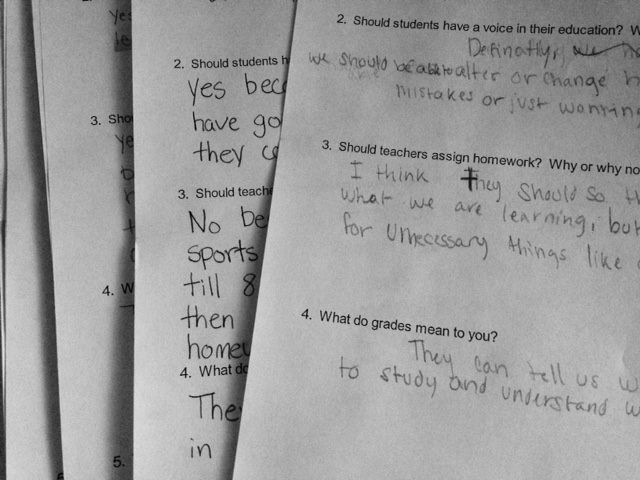
I asked my students, all 114 of them, to show off their typical day in school.  Then I asked the world to join in.  Yesterday more than 3,000 students did the #studentlife challenge.  Images shared through the hashtag, blog posts, or any other social media platform all to let the world in to what happens when you are a student.

I was not surprised when I saw all of the sitting.  Students learning by listening rather than doing.  I was not surprised when I saw many teachers teaching, standing at the front of the room handing out information.  I was not surprised when I heard students tell us how tired they were.  How many hours of homework they had. How every day was the same; monotony rules their world.  We know this, I have been fighting that type of school for the last 5 years.

I was surprised though, when I saw how many of my students said these things.  How many of my students told me they sat down, that they wished for more movement.  That they wished for more breaks, longer lunch, more doing, less listening.  That they wished for more freedom in their own school.

I was surprised because in many of the classrooms around my school, they do move.  They do speak.  They do rather than just sit.  And yet few mentioned any of this.  Few mentioned how hard their teachers work to try to make lessons interactive, engaging, and worthwhile.  Few mentioned how little homework they have.  How little we ask them to do outside of school.  How much choice they do have in a day.  My students sounded like all other students; like school was a punishment they had to suffer through every day until their real life starts.

Disheartened, I wonder if students will ever notice, or whether it even matters?  Will students ever see how hard their teachers are working to change their educational experience?  Will students ever realize that the way many are teaching now is not the traditional way of teaching anymore?  Will students ever realize that they do have a say in their education but that they need to speak up for us to change?

There seems to be two lenses of education; the one shared by students and the one shared by teachers.  And they don’t seem to mesh up at all.  You ask a teacher what their classroom is like and they will show you pictures of happy students doing learning.  You ask a student what their day is like and they will show you a picture of textbooks and teachers standing at the front speaking.  Where is our educational narrative not matching up?

I will never stop tying to engage my students.  I will never stop trying to make their days active.  To give them choice.  To give them voice.  I will never stop trying to make school a place of curiosity and fun, rather than mandatory listening.  I wonder if I am being too optimistic that students would notice all of this?  Does it matter whether students recognize what we do?

I am a passionate teacher in Oregon, Wisconsin, USA but originally from Denmark,  who has taught 4th, 5th, and 7th grade.  Proud techy geek, and mass consumer of incredible books. Creator of the Global Read Aloud Project, Co-founder of EdCamp MadWI, and believer in all children. I have no awards or accolades except for the lightbulbs that go off in my students’ heads every day.  First book “Passionate Learners – Giving Our Classrooms Back to Our Students” can be purchased now.   Second book“Empowered Schools, Empowered Students – Creating Connected and Invested Learners” is out now from Corwin Press.  Join our Passionate Learners community on Facebook and follow me on Twitter @PernilleRipp.
books, collaboration, education, Passion, Personalized Learning, Reading, student choice, student voice

How to Do Book Clubs in the Middle School Classroom

I knew when I moved to 7th grade that book clubs would be one of the things that moved with me.  That shared reading experience where students would get to just read and discuss is something I have loved having in the classroom the past few years.  I knew it would be a  different experience in the middle school classroom, after all their maturity would push their thinking, what I had not accounted for was also how my whole approach to the purpose of it would need to change to cater to a more critical mindset.  So what do book clubs in the middle school classroom need to be successful?

 An honest conversation.  I would not have gotten student buy in if I had not had an honest conversation with them beforehand.  They needed a chance to vent all of their frustrations with book clubs in order to see how this time around they might be different.  They needed to know that their thoughts and yes, feelings, were validated and considered.  While most would have invested themselves in the process simply because it was expected, I didn’t want that type of buy-in, I wanted a genuine desire to use this for good, to enjoy the 4 weeks or so it would last.

Choice in books.  I know it is easier to have a small amount of pre-selected books for students to choose from so we can help facilitate the conversations, but with more than 100 students to cater to I knew I needed choice and lots of it.  With the help of my amazing library team, bonus points from Scholastic, and the phenomenal Books4school, I was able to present the students with more than 50 different choices for titles.  This way no group needed to share books and all students should be able to find something to agree on.  I also told them that if they couldn’t find anything, to let me know, we would find the right book for them.

Choice in rules.  While I may have an idea for how a book club should function, I needed student ownership over the reading, as well as how their discussions would unfold.  All groups decided their own rules and posted them on the wall.  It has been powerful to see them guide their conversations, and yes, also dole out consequences to members within their groups that have not read or are not participating.

Students self-made rules hang as a reminder on our wall

Choice in speed.  All of my groups read at different paces, so they determine how many pages a night they need to read as well as when they would like to have the book finished by within our 4 week time frame.  One group, in fact, has already finished a book.

Choice in conversation.  Book clubs should not function around the teacher, in fact, I have noticed that when I do listen in to an otherwise lively conversation the students immediately get timid in most cases.  I have learned to listen from a distance and only offer up solid small ideas to push their conversation further when they really needed it.  Too often our mere presence will hijack a group and students don’t learn to trust their own opinions and analysis.  Removing yourself from the process means students have to figure it out.  For those groups that struggle we talk about in our private mini-lesson.

Choice in abandonment.  I do not want students stuck with a book they hate, so some groups chose to abandon their books within a week and made a better choice.  Rather than think of it as lost reading time, I cheered over the fact that my students know themselves as readers.  All of my students are now reading a book that they at the very least like and that is an accomplishment in my eyes.

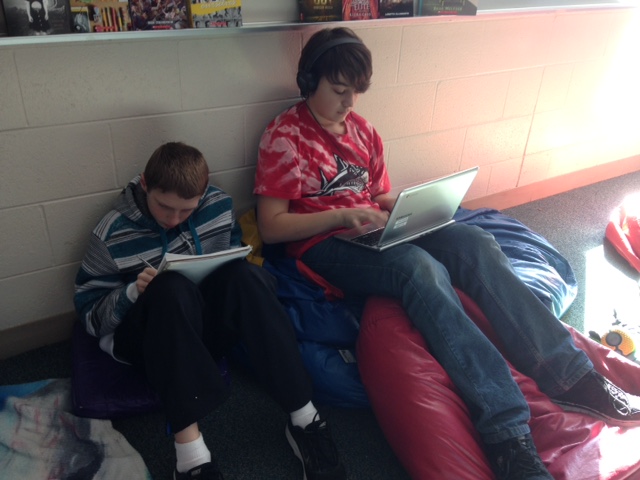
Choice in length and meeting time.  Students are allotted time every other day to meet in their book clubs and have 28 minutes to discuss and read some more.  While I have told student to try to push their conversations, I have also urged them to keep them under 10 minutes unless they are having a great discussion.  Students vary the length of their book clubs depending on what their self-chosen topic of discussion is and figure out how their group works best in the process.

Choice in final product.  While our true purpose of having book clubs is to have a shared reading experience, I am also asking the students to do a book talk of some sort when they finish.  There are two reasons behind this; to assess the standards we are covering in the quarter but also for them to develop their critical thinking skills.  If the book they read is not suited for future book clubs then I need to know why.  I don’t want students to have a lengthy project because that is not what book clubs are about.

While my method for integrating book clubs may seem loose at best, I have found incredible buy-in from the students.  They have been excited to read their books, they have been excited to share their thoughts, and the accountability that they feel toward one another is something I would not be able to produce through force.  Middle schoolers need a framework to grow within, they need our purposes to be authentic as much as possible, and they need to have a voice in how things function within our classroom.  Book clubs offer us a way to have these moments in reading that abound with deep reading conversations that I may not be able to have as a whole group, they allow even the quietest student to have a voice.  They allow students to feel validated in their thoughts and they allow them to share their knowledge with each other.  What have you done to create successful book clubs?

I am a passionate teacher in Oregon, Wisconsin, USA but originally from Denmark,  who has taught 4th, 5th, and 7th grade.  Proud techy geek, and mass consumer of incredible books. Creator of the Global Read Aloud Project, Co-founder of EdCamp MadWI, and believer in all children. I have no awards or accolades except for the lightbulbs that go off in my students’ heads every day.  First book “Passionate Learners – Giving Our Classrooms Back to Our Students” can be purchased now.   Second book“Empowered Schools, Empowered Students – Creating Connected and Invested Learners” is out now from Corwin Press.  Follow me on Twitter @PernilleRipp.

being me, Passion, students

The One Thing We Forget to Plan For

Today I added a column to my electronic lesson planner, a column I should have added at the beginning of the year but realized that now is better than never.  It is not more work for me, nor is it something I was told to do, I added it because I had to, the urgency haunted me in my sleep; a column labeled “Fun.”  While right now the column is mostly empty as I plan my days ahead it serves as an important reminder; that fun is not a four-letter word in education and that learning should be filled with joy.

We plan for the standards.  We plan for our students needs.  We plan for progress.  We plan for assessment.  But when do we take the time to plan for fun, to make schools places of joy where students are encouraged to have fun?  We seem to be too busy getting through all the things we need to get through that fun is the furthest  things from our minds.  Yet, fun is exactly what we need to have more of in schools.

Learning should be fun.  Curiosity should have a place in our classrooms.  Laughter should happen on a regular basis.  Smiling should be a classroom rule.  Fun should be one of the many pillars that supports all of the learning that we do.  It should be embraced, discussed, worked on and celebrated.  Schools should be filled with fun.

So while I find it sad that I have to plan for it, I recognize that I often get too caught up in all that we have to do that it simply slips my mind.  That I worry more about whether students get something than whether they like coming to school.  Than whether they laughed today.  Yet, that is exactly what I should be worrying about.  We lose kids when they disconnect from school.  Making school fun again should be on all of our priority lists.  So next  time you plan; ask yourself; is this fun?  Is this something the students will enjoy working with or will it be yet another thing they just have to do?  Push your thinking, ask the students, plan for moments of joy.  We have lost too many students because school had no joy, but it is not too late to change the way we teach.  The first step is to change the way we plan.

To see actual ideas for how to create more joy-filled moments, go here

I am a passionate teacher in Oregon, Wisconsin, USA but originally from Denmark,  who has taught 4th, 5th, and 7th grade.  Proud techy geek, and mass consumer of incredible books. Creator of the Global Read Aloud Project, Co-founder of EdCamp MadWI, and believer in all children. I have no awards or accolades except for the lightbulbs that go off in my students’ heads every day.  First book “Passionate Learners – Giving Our Classrooms Back to Our Students” can be purchased now.   Second book“Empowered Schools, Empowered Students – Creating Connected and Invested Learners” is out now from Corwin Press.  Follow me on Twitter @PernilleRipp.

aha moment, being a student, being a teacher, being me, change, education, Passion, student voice

When A Student Stops Asking Questions, Who’s to Blame?

I pulled her aside, wondering how I could help as we face another half a year of 7th grade.  Carefully I asked why she was with me, what had held her back from understanding what I had planned out.  What stood in her way of not completing her work. I searched for clues to be a better teacher for her and hoped she would she some light on why she never asked the questions I am sure she had.

“Do you get what the assignments ask you to do?” I asked searching for a place to start.

“No.” She answered matter of fact.

“Well, why don’t you ask me questions about them then?” A classic follow up question.

“A teacher once told me I asked too many questions.  Whenever I raised my hand he would say, “Oh here comes another question…” and so I stopped.  I figured I didn’t want to upset my teachers.  I figured they didn’t want to hear it.”

The weight of that statement swallowed me for a moment, the enormity of a child telling me they had stopped questions, so I looked her and said the only thing I could.

“You have our permission to ask as many questions as you need.  You have our permission to ask even after you have asked and you still don’t understand.  Don’t ever let someone stop you from asking a question.  Part of my job as a teacher is to answer your questions, don’t forget that.”

I think of what I have probably said in the past when I have been in a hurry.  When I have been annoyed that a student asked that question.  When I felt sure that they just hadn’t listened  and so they didn’t really deserve for me to answer their question.  I shudder at the permanent damage I may have caused from my own terrible judgment.  I shudder at the things I have taught students just because of my own impatience.

The thing is with teaching that I sometimes forget; part of our job is to answer questions, not judge them with our answers.  Not judge them with our veiled contempt at yet another question.  Part of our job is to create classrooms where students feel safe to ask.  Safe to ask again.  Safe to ask in a different way. Our job is to teach all of the kids.  Even the ones who don’t understand.  Even the ones who ask us question upon question.  Our job is not to teach students that they should never ask a question.  Think of the damage our words may cause.  Think of what we truly teach children with our words.

I am a passionate teacher in Oregon, Wisconsin, USA but originally from Denmark,  who has taught 4th, 5th, and 7th grade.  Proud techy geek, and mass consumer of incredible books. Creator of the Global Read Aloud Project, Co-founder of EdCamp MadWI, and believer in all children. I have no awards or accolades except for the lightbulbs that go off in my students’ heads every day.  First book “Passionate Learners – Giving Our Classrooms Back to Our Students” can be purchased now.   Second book“Empowered Schools, Empowered Students – Creating Connected and Invested Learners” is out now from Corwin Press.  Follow me on Twitter @PernilleRipp.