Be the change, classroom management, new year, Student-centered

How to Make Your Anti-Rewards Philosophy Fit in A Pro-Rewards/PBIS School

image from icanread

4 years ago I decided that rewards in its most basic sense of trinkets, special events, and things to earn had no place in my classroom.  I threw it all out, decided to go rewards free and then held my breath.  3 years ago my former school adopted PBIS.  And I was in a dilemma.  Questions like what do you do when you are anti-rewards but part of a school that has a school-wide reward system?  What do you do when you are seemingly the only person like this?  How do you follow the expectations and rules without betraying your own philosophy? surrounded my brain.  Turns out I am not the only one in this situation.  In fact, this is one of the most common emails I get from people who have read my book “Passionate Learners” or this blog; how do you fit into a school that does rewards when you don’t believe in it yourself?

It would be easy to say that you stand your ground.  That you refuse to give them.  That you tell everyone how wrong they are and that you will never, ever participate.  But let’s be real.  If I had done that it would have been put in my file as being a non-team player.  I also would have looked like a jerk.  And nobody wants to look like a jerk.  So instead there is a few things you can do if you find yourself in this situation.

You can participate like everyone else.  I did this my first year.  I followed all of the expectations, didn’t ask any questions (for a while any way) and made sure I gave it a chance.  I did not want to judge something that so many people loved before I had fully tried it.  What I discovered helped me shape how I worked with the expectations in my own classroom.

I discovered that PBIS, or similar all school “management philosophies” works on noticing the positive.  That I could stand behind.  It also works on common expectations and common language.  That I also believe in.  So those parts were fine with me.  What I didn’t like so much was the handing out of rewards to earn something materialistic, the singling out of certain students, and the exclusion of others.  I had a hard time being okay with handing a student a ticket for walking properly in the hallway, following normal rules, and pretty much just doing what was expected.  And yet I had to work with it, not against it and thus make it work.  So, some ideas to work with this are:

  • Create your own “awards”– rather than trading tickets in for things, my students could show them to me and get a thumbs up/wohoo/high five etc.  This may sound totally ridiculous but my students work on being noticed for their great behavior and so I worked on noticing those.  Often we get too busy with teaching that we don’t see or say when kids are being great, a few seconds here or there for positive call outs go a long way.  So when students were awesome, I told them that.  When students weren’t so awesome, I also told them that.  They would rather have words from me than a ticket.  However, if you have to hand out tickets for students to earn things, see if they can earn time with you, earn time to read more, earn time to read a picture book etc.  That way you are still following school rules but getting rid of the trinkets.
  • Have class parties.  My students never earned these in the traditional sense, I would surprise them with a special afternoon when they had worked really hard.  Parents knew and would help behind the scenes, but the students most of the time did not know it was coming.  They never acted in a certain way to get something and no one ever lost the privilige to take part.
  • Have students pick students to be recognized.  I was put in the uncomfortable position or picking two kids to honor at an assembly.  Uncomfortable because I really had a lot more than two that could have been honored.  So instead of picking, I let the students vote.  That way they were recognizing their peers, which meant more in the long run.
  • Have them set their own rules.  Yes, we were a PBIS school with PBIS rules, but I also wanted students to set their own expectations for behavior within our class.  I wanted them to decide how they would get the most out of school by deciding what their learning environment should look like and feel like.  This was not to replace what the school had decided but to supplement it.  Students made rules that worked for them in their language and then modified/fine-tuned throughout the year.
  • Plant a seed.  It is okay to start a conversation on how PBIS or other all-school reward/award philosophies can be changed to fit your school and all kids better.  You don’t have to come out with guns blazing, you can bring up small questions and points, thus planting the seed of change.  You can discuss how you would rather not reward students with trinkets for what they are supposed to do, and then offer alternatives.  You can discuss how you work with it in your class.  You can also have students discuss it.  When I asked my students whether they thought the tickets made a difference, some of them laughed.  They did not care much about them and saw them as silly since it seemed random as to whether they got them and the prizes associated with them were not very good (gotta love 5th graders’ honesty).
  • Band together.  Find people who also question some of the philosophies and discuss it with them, this is not to form a terror group of “we are right, you are wrong” but rather to not be alone in presenting your views.  If more than one person is questioning certain parts, a better conversation can be had with differing viewpoints.
  • Make it work for you.  I think we can take even some of the strictest systems and make them work for us by starting thoughtful conversations with those in charge, by asking for small tweaks and changes and explaining why.  Don’t try to ridicule the system because parts of it does work, but find ways to work with it without making yourself sick.  There are always battles to pick and fight, but compromise goes a long way as well.  Yes, in a perfect world, we would not have to change our own philosophies to fit our school’s, but we work in buildings with many needs.  What works for us may not work for others and if we model that belief we can create a space where we all fit.

I know I am not the only one in this boat, so what has worked for you?

I am a passionate  teacher in Wisconsin, USA,  who has taught 4, 5th, and 7th grade.  Proud techy geek, and mass consumer of incredible books. Creator of the Global Read Aloud Project, Co-founder of EdCamp MadWI, and believer in all children. I have no awards or accolades except for the lightbulbs that go off in my students’ heads every day.  First book “Passionate Learners – Giving Our Classrooms Back to Our Students” can be purchased now from Powerful Learning Press.   Second book“Empowered Schools, Empowered Students – Creating Connected and Invested Learners” can be pre-ordered from Corwin Press now.  Follow me on Twitter @PernilleRipp.



being a teacher, new year, reflection, Student-centered, students

I Know What Students Want So Why Do I Forget It?

image from etsy

The new year anxiety and excitement is creeping in.  The days are ticking down.  I am awake more often with dreams of schools and ideas trailing around my mind.  Can I do this?  haunts me in my thoughts  Do I know what I am doing? keeps me awake.

Then I remember.  I know what students want.  Not my new students, those I have yet to uncover, but year upon year when I have asked my students what they need from school and teachers their answers have been the same.

We need someone who cares.

We need someone who listens.

We need someone that believes in us.  Notices when we are not there.  We need someone who likes what they are doing.

They need us to be kind.  To be honest.  To be present.

They need us to have open minds, open hearts, and open arms.

They need a safe place to try.

But it is not just what they need that I remember.  It is also what they want.

They want to be respected.

They want to be pushed.

They want us to see that having in fun in school does not mean learning has stopped.

They want to have a voice, to have choice, to know that their opinion matters and so do their ideas.

They want to know that what they are doing is relevant and not just because.  They want to know we trust them,

They want to feel loved.  To feel important.

They want what so many of us want; a place where they belong.

So why do we forget this every year?  Why do we allow the curriculum to push us into a frenzy, forgetting about these most basic things?

Children don’t remember the tests, the homework, not even always that crazy, cool project you did.  They don’t remember the posters, the seating, or even the rewards necessarily.

But they do remember how they felt, and that we can control.  They do remember if our rooms felt like home, and whether they mattered.  Don’t forget that as our year gets busy.  We know what to do, just do it.

I am a passionate  teacher in Wisconsin, USA,  who has taught 4, 5th, and 7th grade.  Proud techy geek, and mass consumer of incredible books. Creator of the Global Read Aloud Project, Co-founder of EdCamp MadWI, and believer in all children. I have no awards or accolades except for the lightbulbs that go off in my students’ heads every day.  First book “Passionate Learners – Giving Our Classrooms Back to Our Students” can be purchased now from Powerful Learning Press.   Second book“Empowered Schools, Empowered Students – Creating Connected and Invested Learners” can be pre-ordered from Corwin Press now.  Follow me on Twitter @PernilleRipp.
Be the change, being a teacher, being me, new year

What We Can Choose

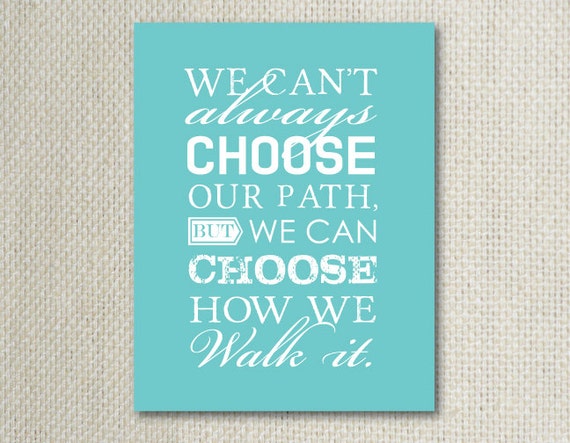
image from etsy

We get so caught up in our big things.  The units we have to teach.  The conferences we need to do.  The to-do list that always grows with our next big project.  We lie awake at night wondering about our direction, whether students are invested?  Whether what we do matters?  And yet, the big things are not always the things that matter the most.  We may think they do, but really, the little things have a lot of power.  There are choices we make every day that seem so small, yet make such a big difference.

We can choose to look at a child when they speak to us.  That matters.

We can choose to withhold judgment as an answer is given.  That matters.

We can choose to do something we promised we would, even if it is so small we think the other person may forget about it.  This matters.

We can choose to smile when someone greets us.

We can choose to stop by, say hello, even if we are busy.

We can choose to be interested, to slough away our tiredness, and instead remember why we do this job.

That matters.

We can choose to remember names.  To ask about a weekend.  To find a book.  To lend a pencil.  We can choose to take time for talking.

We may be busy.  We may always have the next big thing waiting for us, pressing down on us, urging us to move faster and further.  Yet.

We can choose to slow down in small moments.

We can choose to savor the time.

We can choose to tell a story.  To laugh out loud.  To show our humanness.  We can choose to share our mistakes.

We can choose to unveil our dreams, our fears, and in turn create a community.  This matters.

We may dream big, but we should think small.  Everything matters, especially the things we think matter very little.

That’s what we can choose.

I am a passionate  teacher in Wisconsin, USA,  who has taught 4, 5th, and 7th grade.  Proud techy geek, and mass consumer of incredible books. Creator of the Global Read Aloud Project, Co-founder of EdCamp MadWI, and believer in all children. I have no awards or accolades except for the lightbulbs that go off in my students’ heads every day.  First book “Passionate Learners – Giving Our Classrooms Back to Our Students” can be purchased now from Powerful Learning Press.   Second book“Empowered Schools, Empowered Students – Creating Connected and Invested Learners” can be pre-ordered from Corwin Press now.  Follow me on Twitter @PernilleRipp.
Be the change, being me, building community, new year, Student-centered

May I Speak to You Privately?

image from icanread

“Hey Pernille, can I speak to you in my office?”  My new principal asked me today.  Immediately my heart dropped; what had I done?  Had I screwed up already?  Were they regretting their decision to hire me?

I followed her in, sat down, took a deep breath and waited for the inevitable.  I must have screwed up somehow, why else would she want to speak to me privately?  And then she surprised me.  It wasn’t to yell or reprimand, nor was it to point out my rookie mistakes.  It was to connect, to ask questions, to ask how she could help.  To further welcome me and discuss the year ahead.  I stayed for almost 30 minutes, inwardly amazed at the moment.  So thankful that this is the kind of person I get to work for and with.  That this is the community I get to represent.

As I left I couldn’t help but cringe at my initial reaction.  My assumptions had gotten the better of me.  Yet, I realized that those assumptions are based upon my experience, that asking to speak privately with someone has a negative connotation.  That being asked to step into an office is usually not positive.

So think of how our students feel when we do the same to them? When we ask them to stay back for a moment? To come in during recess?  To hang on?  Wait up?  Don’t go?  Do they assume we have something positive to share or something negative?  I can tell you right now, that I have missed so many opportunities to use this moment for praise.  I have reserved the private moment for corrections, reprimands, careful questions of concern.  I have almost never used it for good. Have you?

This year that will change.  I want to reclaim the power of the private moment and change the assumption.  I want students to not automatically assume that staying behind means something bad.  That waiting for a moment does not signify trouble.  Sure, there will be times where a private moment is needed to discuss decisions or actions, but there should be more of celebration.  There should be more positive surprises.

So just as I tell students what I notice on post-it notes, I will look for the moment to praise privately.  I will look for that small sliver of time where I get to speak one to one to someone and tell them what I see, how proud I am, how I am here to help.  I hope they leave feeling relieved like I did and then proud.  I hope they will see that I care.

I am a passionate  teacher in Wisconsin, USA,  who has taught 4, 5th, and 7th grade.  Proud techy geek, and mass consumer of incredible books. Creator of the Global Read Aloud Project, Co-founder of EdCamp MadWI, and believer in all children. I have no awards or accolades except for the lightbulbs that go off in my students’ heads every day.  First book “Passionate Learners – Giving Our Classrooms Back to Our Students” can be purchased now from Powerful Learning Press.   Second book“Empowered Schools, Empowered Students – Creating Connected and Invested Learners” can be pre-ordered from Corwin Press now.  Follow me on Twitter @PernilleRipp.
 

Be the change, being me, classroom setup, new year, Student-centered

Your Classroom Does Not Have to Be Pinterest Worthy to Be Effective

image from icanread

The night before I met my first group of students, I was at school in a panic.  Not because I was about to actually be a teacher.  Not because I felt like I had no idea what I was doing.  All true, however, my panic was from the feeling that my classroom didn’t look cute.  It didn’t look lived in.  It didn’t look inviting.  So at 9 PM, the night before school started, I was in the hallway ripping down my welcome bulletin board, furiously folding party hats to create a new 3-d one that would live up to what I thought everybody was expecting.  By 11 PM I went home, exhausted (did I mention I was pregnant with my first child) and still feeling completely inadequate.  My room would never live up to all the other cute rooms I saw around my school.  And I felt like I was doomed to fail as a teacher from the beginning.

It turns out my experience was not unique, nor dated.  7 years later, I get contacted a lot asking what to do with these feelings of inadequacy. What to do when we feel our room does not live up to what the supposed expectation of elementary classrooms is.  But it is not the pressure from seeing our colleagues rooms anymore that drives us into panic.  It is Pinterest, the internet, blogs that shows decorated classrooms that I will never be able to replicate.  And so these new teachers ask for validation, ask whether their rooms are enough.  They fear posting pictures of their room because they don’t feel they are ready.   They wonder if they can be effective teachers without a “pretty” room.  Our fear of inadequacy spurred on by an internet movement of cute.

I advocate for giving the room back to students.  This does not work well with having a completed room on the first day of school.  My walls are not very decorated.  There are no chevron stripes (I do love chevron though), no fancy displays, no motivational posters.  The walls are bare, the chairs and tables in pods, the room is functional but probably not super inviting.  I do the inviting on the first day by placing myself in the hallway, big smile on my face, and then I ask students to become a part of the room.  To move the tables.  To create displays.  To set the rules, to tell me what works and what doesn’t.  And so then it becomes our room, but I cannot achieve that before the first day of school.

Why is this so important to me?  Because for too long we have invited students into our rooms.  We have let them visit.  And yes, I know that our rooms are our home away from home.  That we need to feel comfortable in them as well.  That our personality should show through.  But I feel like it sometimes goes too far,  That we overdecorate, we overdo, and it leaves no rooms for students to be a part of it.  They continue on as visitors in our beautiful rooms and their engagement shows it.

Now, this is not to say that having a nice looking room is a bad thing.  I think there is a balance between decorating your classroom and focusing too much on it.  I see some pictures and I cringe because although they look beautiful, there is no room to make a mess.  There is no room to be creative because all decisions have already been made.  And as the mother of a boy, I wonder how welcome he would feel in a room full of polka dots and pinks?

So I am here to say to all you new teachers, or old ones like me that need to hear it too; your classroom does not have to be Pinterest worthy to be effective.  It does not have to have everything figured out, everything in its permanent place.  It does not have to have all of those things we see in other classrooms, because  we are not other people.  We do not have the same stuff they do, we do not have the same personalities.  Make your classroom work for you, allow yourself to not get hung up on how cute it is, how inviting it is.  Focus on creating a community that invites all children to be stakeholders.  Don’t feel you need to spend so much money decorating, find a balance, allow yourself to stop.  If we really want to build a community with our students, nothing says “I trust you” in the beginning than giving the room back to them.  And you can’t do that if every decorating decision has already been made.  You cannot say “this is your room too” if you are clearly in charge of everything.

I am a passionate  teacher in Wisconsin, USA,  who has taught 4, 5th, and 7th grade.  Proud techy geek, and mass consumer of incredible books. Creator of the Global Read Aloud Project, Co-founder of EdCamp MadWI, and believer in all children. I have no awards or accolades except for the lightbulbs that go off in my students’ heads every day.  First book “Passionate Learners – Giving Our Classrooms Back to Our Students” can be purchased now from Powerful Learning Press.   Second book“Empowered Schools, Empowered Students – Creating Connected and Invested Learners” can be pre-ordered from Corwin Press now.  Follow me on Twitter @PernilleRipp.


Be the change, being a teacher, new year, reflection, Student-centered, students

Just Fine is Not Enough

Today, my baby twins turn two.Hard to think they were ever small enough to fit in my body when they stand in front of me demanding another waffle, another kiss, another story.  And yet, two years is a long time, a lot has changed.  Not only have they changed, but we have changed. The world has changed in ways we could never imagine.  Sometimes on purpose, other times out of necessity.  Change, as they say, is a constant.

I think of how we change in the classroom and how we often change based on what we need.  We are after all the ones who wield most of the power.  We are the ones who plan the lessons.  Who chart the course.  Who have to act in charge, even if we don’t feel it.  We change when things don’t work for us, when things don’t fit into our framework of what our classrooms should look like.  We change when the little voice inside tells us we need to.  And sometimes we change because the kids ask us to. Then we get happy, we stay, we think our change is enough and the years start to tick by, and we forget that we ever needed the change because what we are doing seems to work just fine.

“Just fine…”something I hear so often when I ask people to whether they can change.  We hold up our files of success, our pictures of kids engaged, we find the proof we need that things are working and kids are learning, that our change that happened so long ago was enough for now.  Yet those kids are not the same, I see that in my own four kids.  The twins are nothing like Theadora when she was two, the world has changed a lot since then.  And when Augustine turns two, the world will have changed again, and so will the kids in it.

So be proud of your change, but check it too.  You may have found it works “just fine” but is it time to change again?  To fine-tune?  To adapt?  To throw it all out?  Is it time to listen to the kids that are coming to you now, not those that you taught a few years ago.  The ones who are excited to have you be their teacher this year.  Is there change that needs to be done for them? I know there is for me.

I am a passionate  teacher in Wisconsin, USA,  who has taught 4, 5th, and 7th grade.  Proud techy geek, and mass consumer of incredible books. Creator of the Global Read Aloud Project, Co-founder of EdCamp MadWI, and believer in all children. I have no awards or accolades except for the lightbulbs that go off in my students’ heads every day.  First book “Passionate Learners – Giving Our Classrooms Back to Our Students” can be purchased now from Powerful Learning Press.   Second book“Empowered Schools, Empowered Students – Creating Connected and Invested Learners” can be pre-ordered from Corwin Press now.  Follow me on Twitter @PernilleRipp.