being a student, being a teacher, Literacy, student choice, Student dreams, Student Engagement, student voice, writing

Recapturing the Magic of Stories – Practical Ideas for Better Creative Writing

“Do we have to write?”  He looks at me and awaits my answer.  I know he wants me to say no, but instead, I nod.  Every day.  Just try.  It’ll get better.  “But I hate writing…” and the kids around him nod.  So many kids not considering themselves writers.  So many kids who write simply because school tells them to.  And I see it every time I assign a story project.  I see it when they write summaries of stories rather than an actual story.  I see it when they fiddle with their papers, break their pencils or write one line.  We hate writing, and there is nothing you can do about it.

And yet….writing is stories.  Writing is our past and our future.  Writing has the power to break us apart or put us together.  So when our students tell us that they hate writing, it is usually not the writing itself they hate, it is everything attached to it.  All of the tasks we add in with writing to make sure they know how to write.  To make sure they can write.  And I wonder, once again, in our eagerness to create students who can write are we, instead, producing students who won’t?

So what can we do within our writing instruction to reignite or protect the writer that lingers within each child?  What are ways we can help them see that writing is something we need as human beings, and not just because the teacher told us to?

We hear their truths.

Much like we must uncover what protects or demolishes their love of reading, we must ask the hard questions about writing too.  Why do you think you are not a writer?  When is writing hard?  When is writing amazing?  How can I be a better teacher of writing for you?  And then we take those truths with us, we unpack them and then we reflect on our teaching practices; what have we done that have done damage?  How can we navigate all of our requirements without doing irreparable harm?

We make it a priority.

I know we do a lot of writing but how much of that is process writing; summarizing, essays, analysis, informational writing.  Where is the creative writing?  I know when I taught 5th grade it was the final unit of the year.  If we got to it, that is.  Why not start with them finding their writer’s voice.  Tell them to write a story, either real or fictional.  and reconnect them with their storytelling skills.  Begin the year with free writing and maintain it throughout the year.  Don’t save it until the end of the year when we can have done so much damage already.

We give them time.

We cannot create writing opportunities in our classrooms without dedicated time.  And I don’t mean the writing instruction slot where they are working on their assigned project, but free writing time, where they are encouraged to write whatever they want.  Free writing time every day so that they get in the habit.  Free writing time so they can work through what it means to be a writer and start to see the small success that will carry them forward.  Whether it is ten solid minutes like it is in my Informational Studies class or even just four minutes like it was last year for me.  Time should be dedicated to free writing every single day, even if you only have 45-minute classes.

We give them freedom.

Every day we tell our kids to write something in their writer’s notebook.  We offer up a prompt but we also tell them they don’t have to use it.  And then we step back, encourage them to write, but nothing else.  This is about them, not us.

We tell stories.

Great writing starts with stories, so we tell our own stories and model what it means to capture an audience.  We have them share their own stories as they practice how to hold an audience captive.  We do speeches so they can see what grabs people’s attention and what doesn’t.  Through the stories we tell we encourage them to write someday, to find ideas for writing.

We withhold judgment.

Every few weeks I look through their writer’s notebooks just to get to know them.  I don’t assess, I don’t correct.  Instead, I write comments, genuine reactions to what they have written so they know I am reading.  But I do not tell them how to be a writer, not here, not now.  That writer’s journal is exactly that; a journal, not an assignment.  And so some write comics, others journal, some writ lengthy stories.  Poetry, scribbling, moments of their lives burst at me from their pages and I hope that within all of their ideas they start to see what writing really is; an extension of self, of who we are and an exploration of how we fit in.

We bring authors in.

Many of my students are under the impression that “real” writers knew they were writers from a young age.  That story ideas just come to them.  that they sit down and a whole book just flows from their fingers.  But that’s often not the case at all.  how do I know?  Because “real” writers have been speaking to my students via Skype for the last few years.  And they dispel their writing myths one at a time.  It turns out there is no one right writing process.  There is not a right way to write.  Inspiration comes from many places.  And it also turns out that writing is hard work.  That getting the idea is often the smallest part but the actual revising and cutting out and making better is where the work comes in.  They don’t believe me when I say these things always but when authors do, they start to.

We are real writers.

How many of us teach writing but don’t write ourselves?  How many of us create our modeled texts at home because we know it will be hard to do it on the spot in front of the kids?  How many of us would never consider ourselves writers but then expect our students to be?  Be a writer yourself, it doesn’t have to be published, but go through the process and do it authentically.  Share how hard writing is for you, share your bad habits of writing, give them a real role model of what writers are so they don’t think that it is something that just happens.

We ask them who they are as writers.

And we come back to the question throughout the year.  We ask them to explore what writing means to them.  We ask them what their writing process is and we share our own.  We ask them to find some sort of value in writing, not because they have to love it but because they should be at peace with it.

We have them lead the conversations.

Less checklists.  Less pre-determined goals only set by the teacher.  Less specific feedback that teaches them that this is the only thing they need to work on because that is all the teacher told them to work on.  More student reflection, more student questions, more student ownership over how they need to grow.  When we confer they should do most of the talking.  When we confer they should start to find out what they need our help with, not vice versa.  In the beginning, it is hard but it will never get easier if we don’t start the conversations and hand over the reigns.

We don’t give up.

Every day we write.  Every day we share stories.  Every day we create something.  Every day we become more than what we were.  And we don’t give up.  We hear their truths as we gently encourage them forward.  We showcase many kinds of writing.  We give them freedom, trust, and a safe space to share.  We tell them to share when they can and not when they don’t want to.  We tell them to use our space as writers would; get comfortable, listen to music, discover your writing process.  Find your writing peers so you have people you trust that will give you honest feedback.

For too long creative writing has taken a backseat to task writing and while I know we need to be able to write things that fulfill purposes, we cannot lose sight of the bigger picture here.  We have to give our students opportunities to have a relationship with writing that goes beyond what the teacher told them to do.  And that starts with the very decisions we make every day in our classrooms.  That starts right now.


If you like what you read here, consider reading my newest book, Passionate Readers – The Art of Reaching and Engaging Every Child, out August 2017.  This book focuses on the five keys we can implement into any reading community to strengthen student reading experiences, even within the 45 minute English block.  If you are looking for solutions and ideas for how to re-engage all of your students consider reading my very first book  Passionate Learners – How to Engage and Empower Your Students.      Also, if you are wondering where I will be in the coming year or would like to have me speak, please see this page.

being a teacher, being me

And Yet…

On the morning of the kickoff to the largest Global Read Aloud yet.  On the morning of what should have been a happy Monday,  One where more than 2 million students would connect through the invisible threads of a read aloud.  One where a global project kicked off that is focused on perspective, understanding, acceptance, kindness, empathy, and everything that is good about our world, we are instead faced with the news of another mass shooting.

Once again the largest in newer US history.  And I spend my day in front of my computer not checking in on the Global Read Aloud, but instead seeing the death toll rise higher, the injured numbers climb, and the desperate pleas for someone to do something.

And we do; we send our thoughts and prayers,  We donate our blood, and then we say to not make it political.  That now is not the time for action out of respect for the tragedy.

And yet, tomorrow I will send my children to school knowing that they have to do active shooter drills in their classrooms so that they can be prepared for the worst.

And yet, I will ask my son about these drills and he will tell me that he did a great job being quiet mom, so the “bad guy can’t get me…”  And I will smile and tell him good job but inside I will rage and tremble.  This is my child, these are my most precious, and they are being taught to sit silently, hoping to not become victims.

And yet, I will go through training in my own district for what I can do to try to protect the very kids I teach. I will be told I have an option to fight or to hide, and that no one will fault me for making the wrong decision.

And I will tell my friends, who sit in my home nation of Denmark, that I am afraid again.  That I am not sure this country is really sane anymore.  That I am not sure I am really able to protect anyone because all it takes is one person with a weapon.

And yet, this is not the time to be political.  So when is it?  Because I am ready, because I am afraid, and I don’t want my children to have to wonder what will happen when they go to school, or a movie theater, or a mall, or a concert, or on a plane, or walk down the street.


Be the change, being a teacher, being me

What the Test Didn’t Care About

Dear Theadora,

Today you told me you were stupid.  That you couldn’t even read the stupid test.  That you knew you failed and so you gave up.  That you will never be a reader.  Again.

And I looked at you and I asked if you needed a hug.  As you crept into my arms, there was so much I wanted to tell you and like your bumbling mother I tried.

I told you to remember that you are not a stupid test.

That you are not a correct answer.  Or an incorrect one for that matter.

That you are not just a level, a piece of data, an insignificant number determined by a profit-making entity.  You will never be just a J.

That you are not stupid.

That you are not failing.

But that you are smart.

That you are brave.

That you are a reader.

Because what the test didn’t care about is that we see you read.  We see you listen.  We see you choose a book and make your way through the pages, even when the words don’t make sense.

We see you ask to go to the library and please can I have one more book?

We see you read to your siblings, to ask for just one more page, to tell me everything that has happened in the Lightning Thief since I last drove the car.

We see you try, We see you fight for the words at times, and other times, they come so easily.

What the test doesn’t care about is how far you have come.  How you know all of the strategies but when you know you are getting the answers wrong it doesn’t matter what you were taught because all you can think about is how you know you are wrong and now the rest of the world knows it too.  How does anyone face that as a child?

What the test doesn’t care about is how much you love reading.  How much your teachers work hard to protect it.  How much being a reader, one that reads chapter books, means to you.  Which is why you keep trying every single day, every single time.

So when we look at the data, dear Thea, I wish it told the full story.  That it actually showed us what we needed to know.  Not just a level.  Not just a score.  Not just the incorrect or the time spent struggling.  Not just the suggested lessons or the gaps in your skills.

I wish it knew you.  No test ever will.  That is why we are so thankful for your teachers.

But I can tell you now, and you have to believe this loudly.  You have to believe this proudly.  You have always been a reader.  You will always be a reader.  Nothing will change that if you don’t let it.  So don’t let it.

Love,

Mommy


Be the change, being a teacher, Literacy, Reading, Reading Identity

On Creating Reading Experiences

They groan when I tell them about the Signposts.

“Another thing to write about, Mrs. Ripp?”

“Do we have to?”

“Why can’t we just read?”

Their post-its hang behind me, reminding me of all they have said about what kills their love of reading.

And I get it, we, meaning educators, have written reading to death.  With every post-it, every jot, every stop and think, every time we ask them to do more work and forget about the virtues of aesthetic reading as discussed by Louise Rosenblatt, we make them dislike it more.  In our eagerness to help kids become better readers, we have made the kids drown in their post-it notes.  We have broken meaningful stories into such small tasks so that the very meaning that made the story worth our time is gone.  We have forgotten about the purpose of all this instruction it seems; to create literate human beings that can grow from what they read, both intellectually, but also on a heart level.

Yes, we need to teach skills, of course, we do.  But we also have to let the kids use those skills in meaningful ways.  We have to let them practice too without telling them to use post-its, without telling them to write down, without telling them to look for specific things, because if we don’t, we don’t know if they will ever be able to do it without our prompts, our scaffolds, our tasks.  We have to remind them, and ourselves, that when we read it is not just to complete a task attached to it.  That the task is just a practice for the real deal; for when we read and we have an experience with the text.

So I tell them not to worry.  The signposts, or any other skills we review or learn are just tools.  Tools to use when it makes sense.  Tools to use so they can complete the tasks that we do need to do at times.  Practice them so they become habit when we need them but that it is also okay to just read and let the movie flow in our heads to the point where the rest of the world falls away and all we can focus on is how close we are getting to the end of the book.

So let your students experience meaningful words, not just more reading tasks.  Let them experience what it means to read and then feel something.  Let them experience what it means to read and sit in silence.  Let them read and get to the end and then discuss what the text made them think of, not just a few skills you have just taught, not just the repertoire of tools they may have.  Balance is needed in all of our classrooms for the purposes of reading, our students are telling us this loudly if we will only listen.

If you like what you read here, consider reading my newest book, Passionate Readers – The Art of Reaching and Engaging Every Child, out August 2017.  This book focuses on the five keys we can implement into any reading community to strengthen student reading experiences, even within the 45 minute English block.  If you are looking for solutions and ideas for how to re-engage all of your students consider reading my very first book  Passionate Learners – How to Engage and Empower Your Students.      Also, if you are wondering where I will be in the coming year or would like to have me speak, please see this page.


Be the change, being a teacher, Literacy, Reading, Reading Identity, student choice, Student dreams, student driven, student voice

Why Reading Sucks…

A couple of years ago I asked my students to tell me why reading was amazing.  When Jack whispered to Michael that “Reading sucks…” the rest, they say, is history.  Inspired by Jack’s words of truth, I have asked students for years now to tell me their reading truths and not hold back.  I cannot be the kind of teacher I would like to be if I don’t get to know them.  The real them.  Not the school-primed, sanitized version.  Not the kid that knows how to play the game.  Not the kid that says whatever they think we want to hear so they start off on a good foot.

So on the third day of school this year, I told the story of Jack. Of how I had been doing that lesson where I talk about the magic of reading.  How he had dared to whisper those words.  Some of the students laughed, they remember the lesson I was referring to, as they have also head about how amazing reading is for years.  And then they got quiet as I asked them so when is reading not magical?  And when is it?

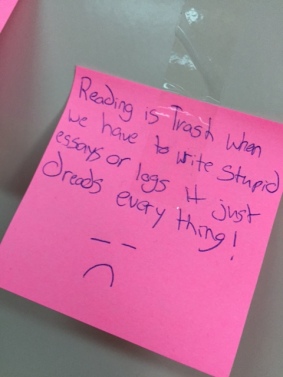
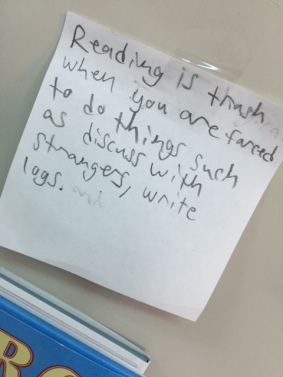
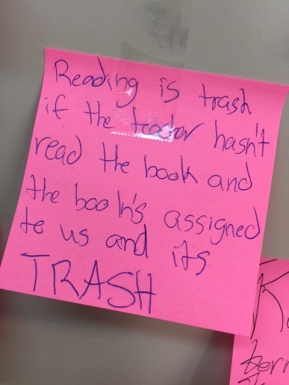
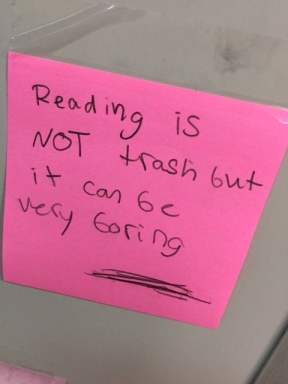
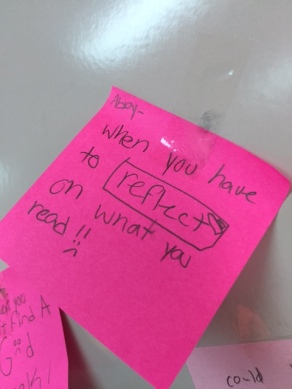
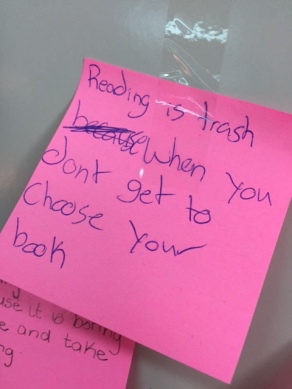
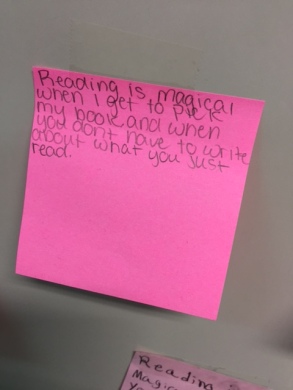
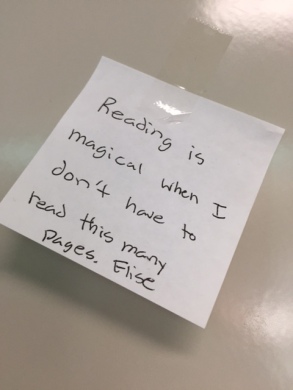
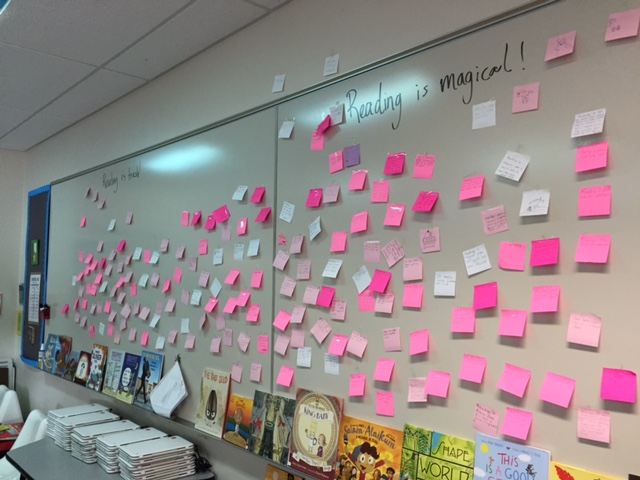
I wrote in big bold letters “Reading is magical” and then asked them what to write on the other side.  “Reading is trash!” they said as they chuckled, not quite sure, I am sure, of what to make of all of this.

They grabbed as many post-its as they could and then started to write their reasons.  Please tell me when reading is amazing.  Please tell me when reading is trash.  Tape your post-its to the board so they stay up.  Sign your name if you want.  And then step back, read the post-its.  What do you notice?

IMG_7092.JPG

Over and over their words joined together to form the same patterns I see year after year.  The same things I have done to kids through the years.  The same things many of us educators are told to do every year by well-meaning administrators who are led by an expert curriculum that someone told them to purchase to raise test scores.

No choice!

Boring books!

Too much writing!

Tests!

Forced reflections!

Sitting still!

Their words glared at us.


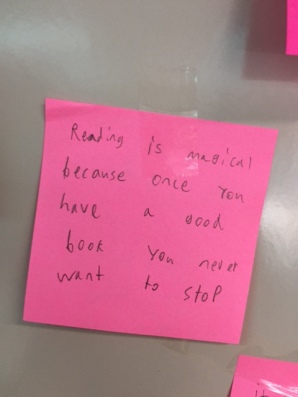
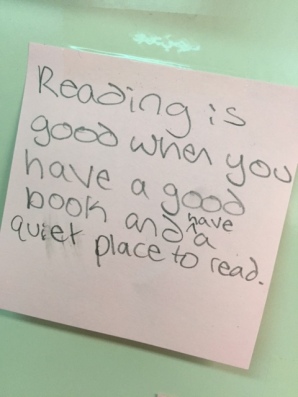
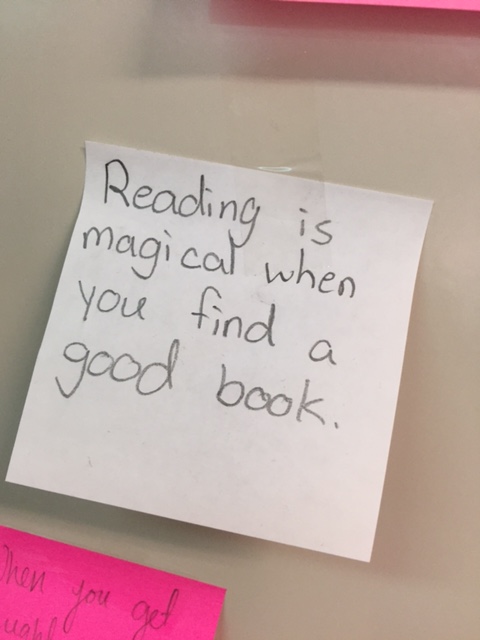
IMG_7087.JPG  IMG_7083.JPGIMG_7078.JPG IMG_7079.JPG IMG_7080.JPG IMG_7088.JPG

But wait?  When is reading magical?  Again a pattern that we all know.

When I find the right book!

When I am given time to read!

When I find a great series or author!

When it is quiet!

When I am allowed to just read!

IMG_7070.JPG  IMG_7071.JPGIMG_7072.JPG  IMG_7073.JPGIMG_7074.JPG

Their words have carried us into our beginning reading conversations, into our analysis, into our very community.  They have guided us as we start to figure out where reading fits into our lives and whether we can protect or promote a strong and personal relationship with reading.  They have guided us as they have mentioned the amazing experiences they have had with their previous teachers, and the ones they wish that had not had.

We fret so much over what curriculum we should use, how we should teach, and how we should grade, yet sometimes the biggest impact we can have with kids is simply when we stop and ask them for their truths.  Do you know what your students would say?

PS:  This lesson and the others that surround it are all discussed in my new book, Passionate Readers.  Passionate Readers.  

If you like what you read here, consider reading my newest book, Passionate Readers – The Art of Reaching and Engaging Every Child, out August 2017.  This book focuses on the five keys we can implement into any reading community to strengthen student reading experiences, even within the 45 minute English block.  If you are looking for solutions and ideas for how to re-engage all of your students consider reading my very first book  Passionate Learners – How to Engage and Empower Your Students.      Also, if you are wondering where I will be in the coming year or would like to have me speak, please see this page.
 

being a teacher, Literacy, Reading, Reading Identity, student choice, Student dreams, student driven, student voice

On Authentic Reading Goals and Conversations

The silence envelops us a few minutes into class.  I look around and see one of my favorite sights in the world; kids reading.  Quietly I walk up to the first kid, grab a chair, sit next to them and ask; what is your goal for the year? And for the next few minutes, I get to know this child a little more, not just as a reader, but also as a human being.

Last week, I wrote about our the changes to our 7th- grade reading challenge and how this year we had decided to move away from just quantity to make it more authentic for students.  I was excited to roll it out but not sure how the students would react.  Were they even up for a challenge or would it just be another thing to get done just so the teacher would stop bugging them?  Only one way to find out; ask them.

This week, as I started my quick reading check-ins, asking about their goal, has been the main topic of conversation.  With a simple question, we are off and I am starting to get a feel for these kids and who they are as readers.

So what have I noticed?

That no goal fits all.  As an elementary teacher, I often provided my students with a specific goal for them to work on and while instructionally this makes sense, after all, I can see what they need to work on, there often was very little buy-in.  When students reflect on their own needs and set a goal, they immediately see the reason for it. Those goals that I also see for them?  We will work on them together in a small group.

That when we ask kids to really think about what they need to work on the answers are very varied.  This also means that the years I have pushed for more of a quality goal or other single-minded goals, that many kids have not bought into it because the goal has not mattered to them.  Some kids immediately had something come to mind, while others needed more support.  Most kids though have created a goal that is specific to not just their reading identities, but also their reading lives.

Those individual goals encourage more honesty.  I always operate under a policy of total honesty when it comes to reading and ask my students to also do so.  By starting our reading conversations early in the year and asking for them to tell me the good and the bad as far as their reading experiences, that judgment-free reading discussion follows us into their goal setting.  When I ask students why they chose that goal, many discuss how or when they read or when they don’t and why they need to change that.  Some kids also discuss how even with this goal they don’t think they will be successful because of various obstacles.  Rather than hiding these thoughts, they are willing to share them which means I can now note it and try to do something about it.

That they do most of the talking.  While I start the conversation and also offer up follow-up conversations, I need to make sure that it is their response that guides the path.  Too often I have overtaken a conversation out of my own helpfulness, but now I try to listen and then respond to get them to elaborate.

Those relationships are built in small pieces.  One of the best benefits of these reading check-ins simply has to do with relationship building.  Every time I am able to devote a few minutes to just one child that is one child I know better.  While this might be a “Well duh” moment, I often think of how many conversations we don’t make time for especially in middle school and high school.  How often do we feel like we don’t have time for that check-in or small group because we have so much to cover?  The reading check-in is a foundation of my further instruction and I need to remember that when I feel like I am pulled in a different direction.

That quantity goals often mean that the child does not know themselves well as a reader.  While quantity goals used to be our norm, I have found in my conversations that often when a child now sets the minimum quantity goal it is often because they do not know what else to work on.  Our reading check-in then centers around what else they could focus on.  When they are not sure then that tells me a lot about their reading identity.

That reading check-ins offer me a chance to remind.  Those first few days of school are such a blur for all of us and I shudder to think of all of the information that these students have been presented within all of our classes.  So while I offer reminders in the beginning of class, I am also reminding them of reading rights as we speak.  It is important that kids know that they can book shop anytime they want, that they can abandon any book they need to, and that they need to plan for reading throughout their day.  How many times do we say things in those first few days that kids never hear?

That I write very little down.  Too often we get caught up in our conferring notes, rather than in the conversation itself.  I am intentionally limiting my notes just so I can focus on the child, so I can look them in the eye, react to what they are saying and then jot a few things down that can spark the next conversation.  (To see the form I use, go to our Facebook group).

As I think ahead to the coming week, I am excited.  Excited to have more conversations.  Excited to move further in our instruction.  Excited to learn more about these kids that have been entrusted to me every day.  All through one little goal and a few minutes of conversation.

PS:  If you would like to have more reading conversations or you have questions, come join our Passionate Readers Facebook group, 

If you like what you read here, consider reading my newest book, Passionate Readers – The Art of Reaching and Engaging Every Child, out August 2017.  This book focuses on the five keys we can implement into any reading community to strengthen student reading experiences, even within the 45 minute English block.  If you are looking for solutions and ideas for how to re-engage all of your students consider reading my very first book  Passionate Learners – How to Engage and Empower Your Students.      Also, if you are wondering where I will be in the coming year or would like to have me speak, please see this page.