being a teacher, being me

On Hygge and What It Really Is

I am not wearing wool socks right now.

There are no lit candles in my classroom.

I am not smothered in blankets, nor playing a board game with a loved one.

I am not slowing down, nor contemplating life.  I have not cooked an elaborate breakfast before I started my day.

And yet, “jeg hygger” right now in my classroom.  The morning is quiet and dark, I am content, I have my tea and a new day awaits.

This past year, it has been interesting being a Dane outside of Denmark.  It seems as if everywhere I go, my entire culture has been distilled into one word, “Hygge.”  (Not pronounced hoo-ga by the way.)  Strangers have asked me for tips, my friends have shared their own experiences, and I have smiled, laughed and tried to explain that hygge and being “hyggelig” is not something you create meticulously.  That yes candles may be a part of it and so are warm blankets and fires and laughter and love and books, don’t forget about books.  But if you think that that is what hygge is, then you are sorely missing the point.

As the elements of hygge have been sold to the world, they have become just another form of cultural appropriation.  There are, indeed, practical explanations for most of them; we wear warm socks in winter because it is cold, drafty, and sometimes dreary during our dark winters.  Candles are for reminding us of the sun which we don’t see for long stretches of time during those same months.  Books are because Denmark believes in an educated populace and so we have amazing libraries all around our country.  Growing up we played board games because we didn’t have devices and we had very few channels on TV.  Cooking together was much more economical and practical than eating out.

So what is hygge, in the eyes of this Dane?  It is hard to say, although I have been asked to explain before.  Hygge just is.  But perhaps part of what it is can be said like this; it is a state of contentment.  Of being at peace with yourself and others, even if just for small chunks of time.  Of being in the now, whatever the now is.  Of comfort when the elements seem rough, but also about not taking yourself too seriously.  About gentle when you need to be. About love.  About togetherness even if you are alone.

So before you try to create an atmosphere of hygge, before you make your life overly complicated searching for an elusive state of something; don’t be fooled. Look around, check yourself; are you content?  Are you happy?  If yes, then you may already have mastered the art of “hygge” and you didn’t even need to wear warm socks.


Image may contain: 1 person, sitting, living room, table and indoor
Oskar and I reading a book together in our messy living room – this was hyggeligt


being a teacher, Literacy, writing

An Exploration Into Found Poetry

My students don’t love poetry.  I know this because when I told them we would be creating poetry, the cacophony of noise that erupted was not one of joy or happiness.  It sounded more like some of them were sick.

But this is exactly why I love teaching poetry in 7th grade.  It is a chance to rewrite and reclaim the whole notion of what poetry is.  To help students see that they too can create things with meaning without feeling like poetry is just one more thing they are not smart enough to produce.

So instead of “regular” poetry, we create found poetry.  Introduced to us by the amazing David Daniel, an actor who does a weeklong poetry workshop with us every year (the kids have no idea how much they will love it).  We create poetry out of words that were not made by us.  We make poetry out of our surroundings, out of noises, out of words found in books and on books.  And I see the change, I see the spirit with which kids embrace this task.  How they all of a sudden feel like poets.

What are the different components?

Video:

Every day we share a video of a spoken word poet, some of our favorites are – if you have others, please share them in the comments:

To This Day Project by Shane Koyzcan

Knock Knock by Daniel Beaty

What Kind of Asian Are You? by Alex Dang

Somewhere in America by Belissa Escobedo, Rhiannon McGavin, and Zariya Allen

An Ode to Whataburger by Amir Safi

Why I Hate School But Love Education by Suli Breaks

Different Concepts:

There are many ways to create found poetry, here are a few of our favorites

Black-Out Poetry

Where students black the words out on pages of books, leaving only the words of their poem behind.  We use discarded library books for this.

IMG_4114.JPG

Found Words Poetry

Students search the classroom for words to fill out in a table on a piece of white paper.  Once they have filled all of their boxes, they cut them out, put them in the order they want and then glue them down.

Book Spine Poetry

Students create poetry using the titles of books, by stacking them on top of each other and then snapping a picture of their creations.  We shared them on social media using the hashtag #OMSreads


Collage Poetry (or Ransom Note poetry as the students coined it)

Using images and words from magazines, students cut out what they need and create a poem collage.


Conversation poetry

Send students to a busy area listening for sounds and snippets of conversations.  Write them down and then use them as lines in your poem.

Model poetry

Who says poetry needs words?  Using maker space materials create a visual poem that tells its stories using words or not.

There are many other ways of creating found poetry, if you have other ideas, share them in the comments.

While this may seem like just fun and games, it has been quite amazing to see the transformation.  We have also spoken about poetic terms that the students have been exposed to before, but may have forgotten.  This great word wall came from our 8th grade English teachers and help kids get reacquainted with terms they may either need or would like to be inspired by.

IMG_4115.JPG

So while my students didn’t love poetry in the beginning, and some might not still, many have realized that can be poets.  That poetry should make them feel something.  that poetry can be all around us.  I have loved this exploration so much.

If you like what you read here, consider reading any of my books; the newest called Reimagining Literacy Through Global Collaboration, a how-to guide for those who would like to infuse global collaboration into their curriculum, was just released.  I am currently working on a new literacy book, called Passionate Readers and it will be published in the summer of 2017 by Routledge.If you are looking for solutions and ideas for how to re-engage all of your students consider reading my very first book  Passionate Learners – How to Engage and Empower Your Students.      Also, if you are wondering where I will be in the coming year or would like to have me speak, please see this page.

being a teacher, being me

On Turning Older


C65btKVWoAQ0y_h.jpg
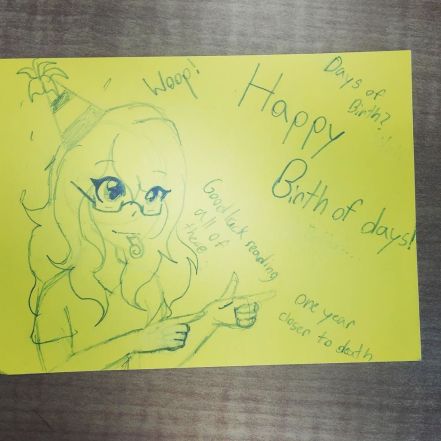
Birthday card from a student today – one year closer to death, I love it 


I turned 37 today.

Every year I receive an email from myself on my birthday, a letter from the previous birthday reminding me of what is important.  Asking myself the questions we tend to ponder when our birthday rolls around and our own mortality becomes more apparent.

This year I noticed the pattern; are you slowing down?  Are you relaxing?  Are you eating better?  Are you exercising more?  Like the ghosts of long lost new years resolutions, my birthday letters have become reminders of what I should be doing but don’t.

As I see my children grow older, I feel my own years adding up.  I don’t feel old, but I know in the eyes of my kids, I have never been young.  I have never been a teenager, nor an early twenty-something who had no idea what her future would hold.  Instead,  I have always been Mom, someone who seems to have many things to do and who sometimes raises her voice or is tired. Who sometimes misses that amazing dance move or that quiet moment playing.  Who sometimes tries to be everywhere at once and thus ends up being nowhere.  Who never misses the big moments, but is sometimes absent from the small.  Who carries more guilt about how she uses her time than should be allowed for anyone.

And so as I drove home this evening after a day of celebration, it struck me that perhaps I am going about this whole life thing a little bit wrong.  That perhaps it is not about changing habits, although, I should do all of those things, that perhaps it is, instead, about changing my attitude.

Perhaps the change I need to make this year is not to do less work, but instead to enjoy the things that I do more.

Perhaps it is not to slow down, after all, when does that really work for most people, but instead to live in the moment of what I am doing and find pleasure in that.  Because is it not in the mundane details that our lives are lived?

To stop feeling so guilty and instead embrace the things I am doing rather than pining away for the ones I am not.

So for the year ahead, I will enjoy more.  I will not try to fight the battle against time or carry the guilt of all of the habits I cannot seem to change.  I will find the pleasure in what life has to offer, even the details we seem to never notice and be at peace with that.  Be at peace with myself.  That is the gift I can give myself right now.  And for right now; that will be enough.


Be the change, being a teacher

It’s On Us

img_page_1_58c412e3781dc.png

We know we set the mood of our classrooms.

We know that the power we have to make a day better or worse is immense.

We know that what we think about a kid, or a class, sometimes matters more than what we actually do.  After all, kids can read us in ways we have yet to fathom.

So when I had gotten stuck on a class being negative.  When I had formed a narrative in my mind that a class was never excited to come to English.  When I had decided that this was my least engaged class, I was right.  Because the moment I decided it, it became true.

Kids will gladly live up to what we believe they are.

And every day I would think of ways I could get the kids to change.

Every day I would think of ways to re-engage them.  To discuss with them what the room felt like.  To ask them how we could get better.

This went on for months.  Wrack my brain to come up with ways to make it a “better” class, yet dreading the energy of the room.  I even told others that I didn’t know what to do.

One day, after I had asked the class what else we could try, a child asked me this, “Is it all of us, Mrs. Ripp?  Is it me…”

For some reason, I didn’t know what to say.  It took me a while at least and finally, I realized that when I told him “It was the energy of the class…” I had lied.

It wasn’t them.

It was me.

I was the one that had determined the fate of this class.

I was the one that had shaped the narrative of our community and the kids, while responsible too, could not do anything to change my mind.

And so I took a moment at home and realized that what I had pegged as negative energy, was just 7th graders being calm.

That what I had taken as disengagement was instead a quiet pondering of facts.

That what I had taken as hating English, instead was an investment, albeit a quiet one, into learning deeply.

My class wasn’t a negative class, it was a chill class, and as a 7th-grade teacher, I was not used to that.  I created a problem, breathed in the narrative, and then looked for evidence to back it up.  It wasn’t the kids, it was me.

So before we blame the kids.

Before we blame the class.

Before we assume there is nothing we can do because we have tried everything.  Stop.  Look at yourself.  Look at what you have determined to be true and then what you are doing to make it true.

We hold more power than we can ever imagine, let us never forget that.

If you like what you read here, consider reading any of my books; the newest called Reimagining Literacy Through Global Collaboration, a how-to guide for those who would like to infuse global collaboration into their curriculum, was just released.  I am currently working on a new literacy book, called Passionate Readers and it will be published in the summer of 2017 by Routledge.If you are looking for solutions and ideas for how to re-engage all of your students consider reading my very first book  Passionate Learners – How to Engage and Empower Your Students.      Also, if you are wondering where I will be in the coming year or would like to have me speak, please see this page.


Be the change, being a student, being a teacher, Literacy, Reading, Reading Identity, student choice, Student dreams

Can We Please Stop Grading Independent Reading?

“But how do you grade their independent reading?”

I am asked this question while presenting on how to create passionate readers.

I am stumped for a moment for an answer.  Not because I don’t know, but because we don’t.  Why would we?  And yet, it is a question I am asked often enough to warrant a decent response.

My middle school does not issue a grade for how many books a child has read.  For how many minutes they have read.  For how far they have gotten on their book challenge goals.

And there is a big reason for this.

How many books you read does not tell me what you can do as a reader.  How long you can sustain attention to a book may tell me clues about your relationship with reading but it will not tell me where you fall within your reading skills.  Actual skill assessment will do that.  Explorations where you do something with the reading you do will tell me this.  The amount of books you have read will not tell me what you are still struggling with or what you have accomplished.  Instead it will tell me of the practice you do with the skills that I teach you.  With how you feel about reading in front of me and when I am not around.  About the habits you have established as you figure out your very own reading identity.  These habits are just that; skills you practice until something clicks and it becomes part of who you are.   Those are not gradeable skills but instead a child practicing habits to figure out how to get better at reading.  A child figuring out where books and reading fits into their life.

So just like we would never grade a child for how many math problems they choose to solve on their own, how many science magazines they browsed or how many historical documents they perused, we should not grade how many books a child chooses to read.  We should not tie pages read with a grade, nor an assessment beyond an exploration into how they can strengthen their reading habits.  Number of books read, minutes spent, or pages turned will never tell us the full story.  Instead it ends up being yet another way we can chastise the kids that need us to be their biggest reading cheerleaders.

So when we look to grade a child on how they are as a reader we need to make sure that the assessments we provide actually provide us with the answers we need.  Not an arbitrary number that again rewards those who already have established solid reading habits and punish those that are still developing.  And if you are asked to grade independent reading, ask questions; what is it you are trying to measure and is it really providing you with a true answer?  Are you measuring habits or skills?  Are the grades accurate?  If not, why not?  And if not, then what?

PS:  And for those wondering what we do assess in our reading, here is a link to our English standards.  

If you like what you read here, consider reading any of my books; the newest called Reimagining Literacy Through Global Collaboration, a how-to guide for those who would like to infuse global collaboration into their curriculum, was just released.  I am currently working on a new literacy book, called Passionate Readers and it will be published in the summer of 2017 by Routledge.If you are looking for solutions and ideas for how to re-engage all of your students consider reading my very first book  Passionate Learners – How to Engage and Empower Your Students.      Also, if you are wondering where I will be in the coming year or would like to have me speak, please see this page.


being a teacher, being me

Introducing Passionate Readers – My New Book

When I moved to 7th grade English, I didn’t know how much this change would affect me.  How I would spend more hours than I had ever spent trying to help all of my students like reading more.  How their reading truths would shape me as a teacher.  How there would be lost sleep, but also triumphant moments of knowing that what we did together made a difference to a kid.  That what we did together meant that a child might actually keep reading or even start back up.

I have shared our experiences here.  I have spoken about it wherever I have been invited.  I have taken the words of my students and held them up for others to learn from because they have taught me so much.  Through their insight, I was able to become a better teacher, even if I still don’t have all of the answers.

And so I wrote a book.  A book to hold all of their ideas.  A book to hold all of mine.  A book to take the ideas of others that have pioneered better reading instruction and meshed it with what we are asked to do within our English instruction, within our 45 minutes, within the confinement and the pressure we feel.  And I asked a woman I admire so much if she would read it and possibly write the foreword.  I couldn’t believe it when Donalyn Miller said yes.  After all, her groundbreaking book The Book Whisperer is one of the books that gave me the courage to change in the first place.

I have poured every ounce of truth that my students gave me into this book and this book is now ready for the world.  Or, almost ready.  With a release month of July or August – the book is written and now I am ready to reveal its cover.  So world; meet the book that I hope helps others.  Meet the book that I hope will be inspirational for those who need it.  Meet the wisdom of the kids from room 235D and may their words be a light for you as they were for me.  To pre-order your copy, go here.  

Passionate Readers: The Art of Reaching and Engaging Every Child (Paperback) book cover