Be the change, being a student, being a teacher, student choice, Student dreams, student driven, student voice

Planting a Seed – Our Project on the Refugee Crisis

I grew up in a home that had a newspaper on our table every morning.  Laid out for us kids to see, we grabbed the comics first, then the Danish news.  I was a teen when I started reading the international news.  Being aware of the world was something that was expected of us, after all, Denmark is a small nation.  We read the paper, we listened to the radio, we watched the news.  Not always fully attuned but always aware of at least some of the bigger things happening in the world beyond our own.

Being a globally aware and invested teacher is something I have tried to live and breathe for many years now.  After all, the Global Read Aloud was created with the idea of making the world not only smaller, but also more interconnected to create more empathy and kindness.  My students have therefore in varying degrees always brought the world in, been a part of projects that involved others and tried to know more about the outside world than when they came in.  Working on a team with an incredible geography teacher has only made my job easier.

So this year as my English standards starred me in the face a small idea started to form, a seed began to grow; what if instead of “just” doing summaries, what if instead of “just” having an opinion, I was able to structure an inquiry project into something that I have been following myself; the Refugee Crisis?  What if we created a two-week experience where the students got to learn at their own pace with the end goal of having an opinion?  With that, I started to plan…

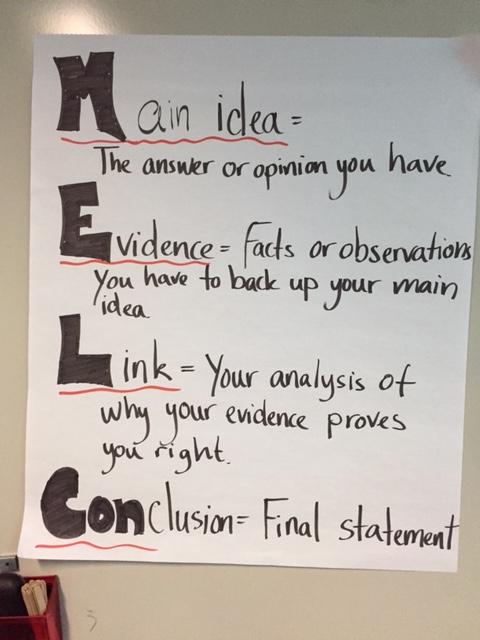
We would have two weeks roughly of work time, with time dedicated every single day after we do our 10 minutes of independent reading.  Students could choose how they wanted to work and engage with the materials.  I used a sheet that simply asked kids how they would like to engage with the learning and then crafted lessons based on this.  I have used this approach in the past and it has worked pretty well, this time I should have been more diligent with using it though after the kids filled it out.  However, that being said, kids were also good at reaching out and asking questions, as well as use each other for help.  I did promise the students that I would only do one whole class lesson; how to write an opinion piece using the MEL-Con format, and I kept my word.  My students have asked me to do less whole class teaching and I am adhering to that as I can help them better in small groups anyway.
img_2059
Our anchor chart for the MEL-Con format

We first needed a question, one that would give us a focal point but would not be shaped or tainted by my opinion, after all, I did want the students to come to their own conclusion.  So our guiding question became ; What should America’s role be in the refugee crisis?  This was what the students would work toward and discuss.
img_2107
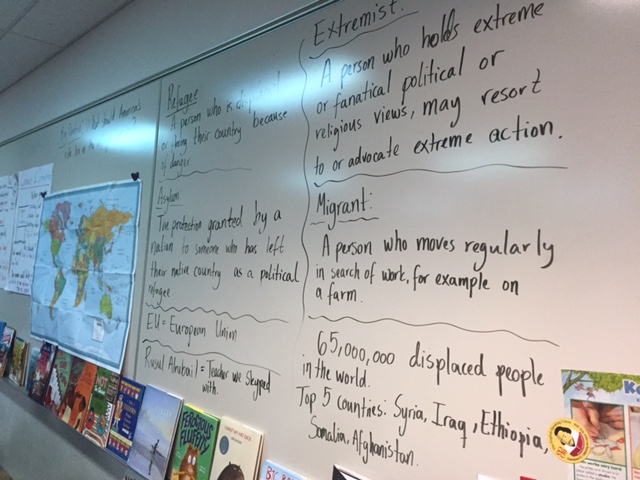
We created a running word wall as student questions came up.

I knew I needed texts to start with; thank you Newsela for your text-sets, you saved me so much time.  So I pulled nine different texts that highlighted different aspects of the crisis, printed them at three different reading levels and told the students to choose three of them to read at least.  I also made all of the texts available as a folder in case they lost their copies.
img_2060
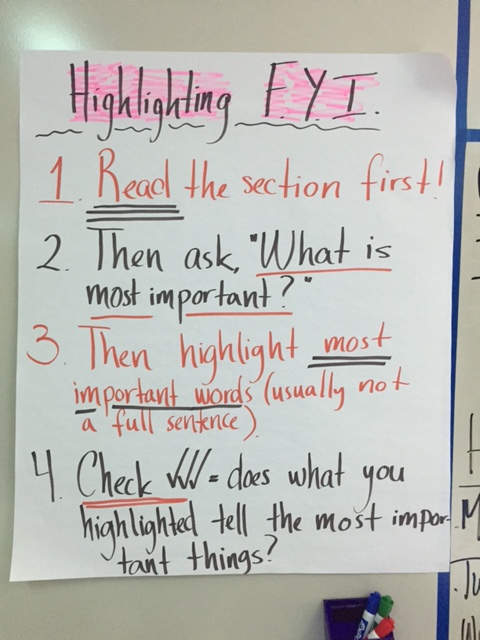
Another teaching tool for students to reference

I also wanted students to watch videos; I created a padlet with different short videos that would be appropriate for 7th graders and also less than 20 minutes.  Students were asked to watch at least one, but could do more if they wanted to.

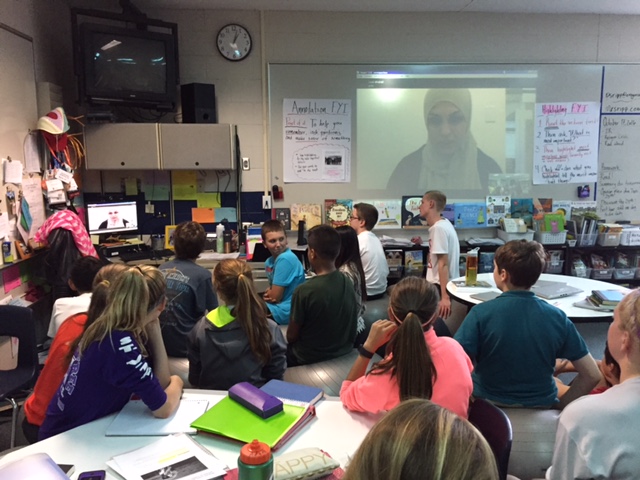
I then crossed my fingers and asked on Twitter; would anyone Skype with my students about being a refugee?  I am so grateful for the response.  Three of my classes were so incredibly lucky to Skype with the incredible Rusul Alrubail,she graciously and courageously shared her story of how she became an Iraqi refugee at a young age.  To say my students were moved by her story would be an understatement.  Yet, the kindness of strangers continued.  Another teacher, Emily Green, from Michigan asked her students, some of them refugees, if they would create a small video for my students.  Last night, I received three different videos from her courageous kids sharing their stories.  Today as I played them for my students, you could have heard a pin drop.
img_2023-1

So for the past two weeks, my students have annotated the texts (using their own systems rather than ones created by me) for anything that stood out, they have written a summary on one article, and they have crafted an opinion on the guiding question, as well as craft an opinion piece based on all of their newfound knowledge.
img_2102
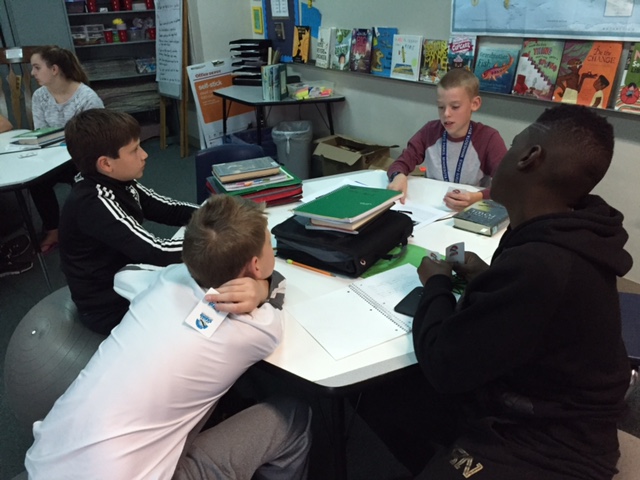
In some classes we started in small group before we went to whole class discussion.

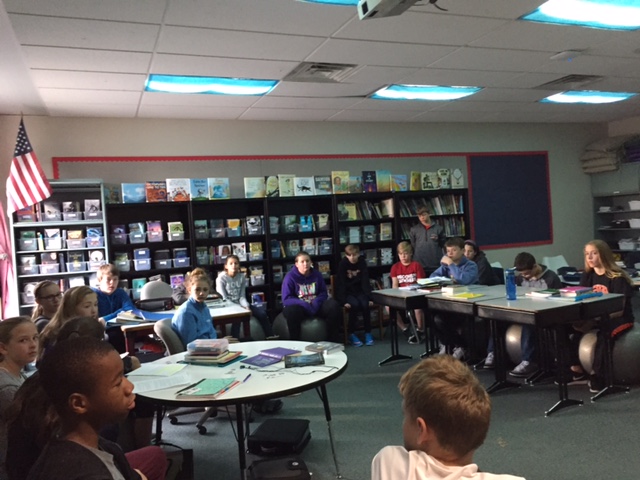
Today, as we came together as a group to discuss what we have learned and what our opinion is, I sat back behind the kids and watched them practice their discussion skills.  As kids navigated the ins and outs of adult unmoderated conversation, I couldn’t help but feel just the tiniest bit proud.  Yes, they were discussing, yes they were listening to each other, but that was not the only thing I observed.  I observed kids who all of a sudden understood just how vast of a nation we live in.  Kids who now know where Iraq and Syria are.  Who know tales of children passing through Europe unattended as they try to reach freedom.  Of people who never wanted to leave their homes but were forced too.  Of what we can possibly do as a nation but how many hurdles there may be to making any decisions.  I also saw kids who started to understand that for some reason they equate refugee with terrorists.  Who thought 10,000 refugees is a large number but have since discovered it might not be.  Who know that we need to help but are not sure just how to do that.
img_2104
Discussing  as a whole class

I didn’t set out to shape the opinion of my students, that is not my job as their teacher.  Instead I wanted to create an opportunity for them to form an opinion on fact rather than hearsay, on research rather than rapid talk.  I know that some believe America should do more and others think we do too much already.  I know that for some they don’t really care either way.  But I also know that by giving them more control over their learning, by giving them tools to start with, by creating a guiding questions and then by bringing others in via Skype and YouTube that we have created an experience that matters.  That together we now have this piece of the world that ties us together and that will continue to crop up through the year.

Yesterday, a child asked me what the deal was with Mosul and weren’t they bombing over there?  A child that two weeks before was not even sure that Iraq was a country or what refugee meant.  That child had heard on the news that fighting was starting up again and now wanted to know more.  As teachers of literacy we have incredible opportunities to bring the world in, to help our children find their opinions, and to create experiences that connect us with other human beings.  I wrote a book on how to do just this,  not for the sake of the book, but for the sake of making this world a better place.

I ended our discussion time today with the following words; “My job is not to make you think a certain way, my job is to make you think.  So whatever your opinion may be, all I ask of you is to have one based on fact, rather than what others believe.  Keep your ears open and ask a lot of questions.  That is the least you can do as the future of this country.”

As teachers, we can bring the world in when it makes sense.  To make it matter more than just getting through the year or working off our checklist.  The year has just started and yet we have so much more to discover about the world.  I cannot wait where our learning takes us next.

PS:  If you would like to see my folder of resources, go here, some of it is loose.

I am currently working on a new literacy book.  The book, which I am still writing, is tentatively Passionate Readers and will be published in the summer of 2017 by Routledge.  I also have a new book coming out January, 2017 called Reimagining Literacy Through Global Collaboration, a how-to guide for those who would like infuse global collaboration into their curriculum.    So until then if you like what you read here, consider reading my book Passionate Learners – How to Engage and Empower Your Students.  Also, if you are wondering where I will be in the coming year or would like to have me speak, please see this page.

Be the change, being a student, being a teacher, being me, Student dreams

The Least We Can Do

What follows is my ITEC Ignite…

On December 19th, 2013, our youngest daughter, Augustine, was born almost 10 weeks early.  She came so fast that there was no doctor in the room, just the nurse.  She came so fast that I now know what the big red emergency button in a hospital room does.  She came so fast that I did not see her.  I did not hold her.  She did not cry.  For the first minute of her life, I did not know if she was alive.  It wasn’t until my husband, Brandon, told me she was breathing that I think I took a breath.  That life started up again because for that longest minute of my life, with no wailing to calm me down, I had no idea if I was still the mother of three or the mother of four.

They whisked her away from me into their machines, into the equipment that would help her tiny body breathe, stay warm, and her heart keep beating.  See when babies are born that early they need help with everything.  And we can prepare all we want but it is not until they actually arrive and we see how much they need us that we realize that all of a sudden we have started a new journey, one that will take us down a perilous path where we might not be able to see our destination for a long time.

In the week leading up to her much too soon arrival, I was in the hospital waiting.  Willing my body to slow down.    We were not ready.  She was not ready.  One night a doctor from the NICU visited me to help me prepare for what would happen in case she came.  His words has stuck with me all of this time.

He said, “When she comes we will be ready.  We will have the machines that will help her breathe.  We will have the machines that will keep her warm.  We will monitor her heart and we will be by your side.  We will do everything in our power to keep her alive, to keep her safe, to help her no matter what.  While we can help her with her needs, we will not know about her brain.  We will not know what long term effects being born so early will have on her learning.  We will not know if her brain will be damaged,  we will not know until she grows, until she reaches her milestones.  We will not know what her future path will look like when it comes to learning but we will be ready.  We will be by her side because that is what we do.”  That is what we do…

As I held Augustine for the very first time more than 24 hours later, I held all of our dreams for her as well.  As we sat in the quiet, listening to the alarms and the beeps on her monitor, I knew that her future was now in my hands as well, and that all we could do now was our best.  That all we could do now was to be by her side and hope that her future teachers would see her for the miracle she is and not just a child who might have difficulties learning.

16848553711_55192d39bb_o.jpg

Every year as the new year awaits, our students arrive in all of their glory.  They arrive with all of their dreams, their hopes, and their needs.  They show up whether we are ready or not.  And so we prepare, we plan, we dream over the summer that this will be the year that we reach every single child we teach.

We do not pick who we teach.  We do not pick who shows up.  We do not pick who these kids are that we are supposed to have life-changing experiences with but instead we stand by our doors  like the Statue of Liberty and say; “Give me your tired, your poor, your huddled masses yearning to breathe free …”

We can prepare all we want as teachers.  We can create classrooms where most of our students will thrive.  We can plan for fictitious children and hope they will fit into the boxes we create.  Or we can teach the kids that come.  We can create classroom experiences that center on the kids that actually show up instead of the kids we hope to teach.  


We can open our classroom doors wide to make sure that every child that enters, that every child that shows up, know that with us they will learn, with us they will create, with us they will matter.  Because they do.   And we can ask those kids how we can be the types of teachers they need.  We can ask those kids how they would like to learn and then we can listen to their truths and become the teachers they need.

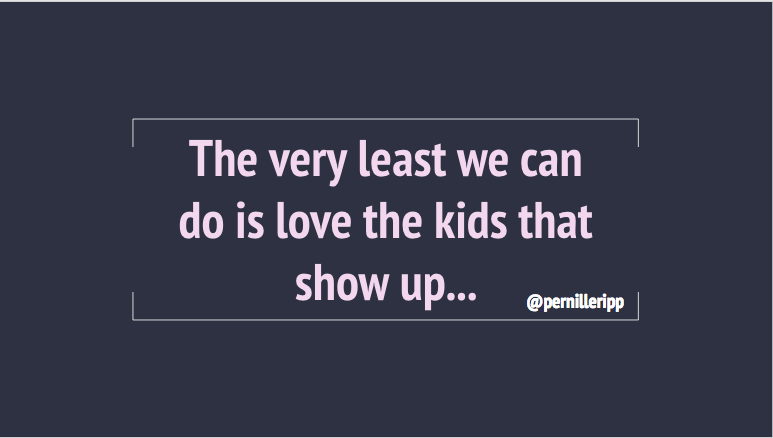
So we can take them all and we can love them all because that is the least we can do.  We work tirelessly every day so that those kids that become our kids know that with us they belong, that with us it does not matter what their start in life was because in here they have a chance at success.  That with us it does not matter whether they were born 10 weeks early, don’t have a good home life, or have never liked school.  That with us all that matters is that they showed up.


Augustine did not ask to be born early, she did not ask to have such a hard start in her life.  She did not ask to have harder path than our other kids.  The kids that come to us with their broken dreams and their battered hearts, didn’t ask for that either.  Didn’t ask to have a different life than so many others.  So our job is to teach.  Is to love.  Is to be by their side.

ITEC Ignite The Least We Can Do - Google Slides.clipular.png

This summer, as Augustine went to her NICU check up appointment, we heard the sweetest words.  “Your daughter is perfectly average…” and while her path is still unwinding and we are not in the clear just yet, we see hope with every word she learns, every task she accomplishes.  We see her for the miracle she truly is, a child that would not have lived not too many years ago.  So may we all see the miracle that is the child that enters our schools.  May we all know just how lucky we are to teach these kids, even when our days are long and our lesson plans are broken.  Even when we feel we are not enough, may we still try.

As teachers, we were never promised it would be easy.  We were never promised that our jobs would be effortless.  Or that our hearts would stay protected.  But we were told that it would be worth it.  That this may be one of the hardest jobs and yet also the most rewarding.  So every day as we welcome the kids, make sure it is every child we welcome, not just the easy ones, the ones that barely need us.  Make sure your classroom is a place for any child to succeed.  No matter their start in life.  Because much like the NICU doctor told me almost three years ago; we are ready, we are here, and we will stay here until you no longer need us.  It is the very least we can do…

I am currently working on a new literacy book.  The book, which I am still writing, is tentatively Passionate Readers and will be published in the summer of 2017 by Routledge.  I also have a new book coming out January, 2017 called Reimagining Literacy Through Global Collaboration, a how-to guide for those who would like infuse global collaboration into their curriculum.    So until then if you like what you read here, consider reading my book Passionate Learners – How to Engage and Empower Your Students.  Also, if you are wondering where I will be in the coming year or would like to have me speak, please see this page.
 

being a teacher

Keep Doing

I seem to have a theme this year in my writing.  Perhaps it is my theme for the year; just keep going, just keep trying, just keep loving these kids and what you do.  So often we get caught up in all of the things we cannot do yet, in all of the things we have not figured out.  My own list is miles long it seems.  I still have so much to get better at.  I still have so many things to learn.

Yet, today, as I sat surrounded by all of our amazing seventh graders, and saw the seeds that we have planted as a team, I was reminded of one important thing.  One that is easy to forget when we are surrounded by the new, by the innovative, by the flash that comes with changing.  We must not forget to keep doing the good stuff.  Keep doing the things that work.  Keep doing the little things that make others’ days better.  Keep doing the tried and true.  Keep being you, or at least the version of you that works, for we all have parts of us that need to improve.

Keep an eye on the horizon as to not stand still, but don’t forget to celebrate what you already are and what you already can do.  I may not be the best English teacher out there, in fact I know I am not, but there are things that I am proud of.  There are things that work for us.  That I will keep doing even as I change other things.

So keep doing those things that work, those things that make a difference.  Even as the world spins and rally cries go out for change, don’t lose yourself in the shuffle.

I am currently working on a new literacy book.  The book, which I am still writing, is tentatively Passionate Readers and will be published in the summer of 2017 by Routledge.  I also have a new book coming out January, 2017 called Reimagining Literacy Through Global Collaboration, a how-to guide for those who would like infuse global collaboration into their curriculum.    So until then if you like what you read here, consider reading my book Passionate Learners – How to Engage and Empower Your Students.  Also, if you are wondering where I will be in the coming year or would like to have me speak, please see this page.

being a teacher

We Are All A Work in Progress

http-www-pixteller-com-pdata-t-l-547127

Sometimes I am asked if other educators can come to our classroom, just to see.  Just to visit, just to speak to our incredible students.  Sometimes I am asked when would be a good time for such a visit.  When will our classroom be ready.  Never, I think to myself.  Right now, I think to myself.  Maybe tomorrow, or next week, or maybe the last day of school.

Because there is no day that is perfect in our classrooms.  There is no lasting moment when we feel we have mastered this year or mastered our content.  There is no point in the year when we know that from here on out all will be right, all will work, all will be figured out.  There is always more work to do.  Moment filled with greatness only to once again be faced with the truth that we still have so much to do.  There are always ways to grow.  There are always more experiences to create and student experiences to be a part of.

So before we get scared to open our doors to strangers, to those who just want to see, to those who perhaps see something in you that you do not see in yourself, remember this; we are all a work in progress.  We are all still learning.  We are all having days that feel so great followed by days that don’t.  We all have moments where we realize that today was not the best of our days but then hope that tomorrow will be.

So we are all a work in progress and such we all have much to share.  We are all a work in progress, with so much still to learn.  Do not be afraid of opening your door and letting the world in.  We are all in this together.

I am currently working on a new literacy book.  While the task is daunting and intimidating, it is incredible to once again get to share the phenomenal words of my students as they push me to be a better teacher.  The book, which I am still writing, is tentatively Passionate Readers and will be published in the summer of 2017 by Routledge.  So until then if you like what you read here, consider reading my book Passionate Learners – How to Engage and Empower Your Students.  Also, if you are wondering where I will be in the coming year or would like to have me speak, please see this page.
Be the change, being a teacher, books, global, Literacy

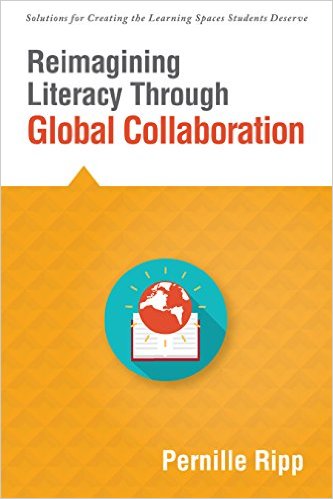
Reimagining Literacy Through Global Collaboration

Since 2010, my students and I have been bringing the world in.  We have asked others to be our teachers, whether authors, experts, children.  We have asked others to share more of their world with us so that we could make more sense of our own.  We have created, we have become experts.  We have made the world smaller by becoming a moving piece of the world, and we have grown.  In our literacy collaborations and creations, we have become authors, poets, performers, and teachers.  We have become more than what we started as.

So when I was asked what I would propose to make school different, the answer came quickly; besides empowering students, I feel an urgent need to infuse global collaboration throughout our literacy instruction (or any subject matter for that sake).  That in a world that seems so divided at times, where we seem to be hellbent on finding each others differences and using them to distance ourselves, we need to actually know our similarities.  We need to bring the world in to make the world smaller, kinder, more empathetic.  Have students create so that they can become the person they envision rather than just pretend.

I have written this book three times over.  Starting over every single time because it was not good enough.  Within the span of sixty pages I get to plead my case for why doing global collaboration is an urgent endeavor.  For why it is easier than you think to bring the world in.  For why it should be at the top of our lists when we plan our literacy instruction. And the how.  How can you do it, what are ideas, what does it look like.  By opening up my own classroom practices, as well as other educators, I hope to inspire those that need ideas or a boost to jump in.   To create another consideration as we plan our school year and our learning adventures.  And now, it is ready for the world.  My newest book Reimagining Literacy Through Global Collaboration is out for pre-order with a birthdate of January 20th, 2017.  I cannot believe it is almost here.

cover

I hope you find it useful, that is truly my biggest dream for this book.  That you will learn something, that it will inspire you to try and to change in ways that are meaningful to you.  It may have been a long process to write this book, sometimes that is how it goes, but the words are genuine.  We need to create classrooms where students learn with others, for others, and through others.  And our literacy instruction time gives us the perfect conduit for just that.  Welcome to the world.

To see the book on Amazon, go here.To see the book on Amazon, go here.To see the book on Amazon, go here.

I am currently working on a new literacy book.  While the task is daunting and intimidating, it is incredible to once again get to share the phenomenal words of my students as they push me to be a better teacher.  The book, which I am still writing, is tentatively Passionate Readers and will be published in the summer of 2017 by Routledge.  So until then if you like what you read here, consider reading my book Passionate Learners – How to Engage and Empower Your Students.  Also, if you are wondering where I will be in the coming year or would like to have me speak, please see this page.
 

aha moment, Be the change, being a teacher, homework, no homework, Student dreams, student driven, student voice

Are You Doing Your Own Homework?

itec-passionate-learning-environments-google-slides-clipular

This summer as I saw my niece, who is now a sophomore, we inevitably spoke about her reading life.  She used to be a voracious reader, we could not get enough books in her hands.  Then she came to the whole class novel, which inspired this post, and since then her reading life has been limping at best.  This summer I asked, as usual, “What are you reading?”  She told me The Kite Runner and then scoffed.  Surprised I asked why the reaction.  She then told me that she had read the book and loved it but now had to reread it to annotate it.  “The whole book?”  I asked.  “The whole book.”When I asked her why she was not quite sure, perhaps they would use parts for discussion.

I wondered then, as I often do, when I come across homework assignments that appear nonsensical, whether her English teacher had done their own homework?  Whether they had taken the time to annotate the entire book themselves.  Whether they understand the labor that was involved with that task and how it would take away from the enjoyment of the book.  It seems to me that once again something that is meant to teach kids how to better thinkers, instead is implicit in the killing of their love of reading.

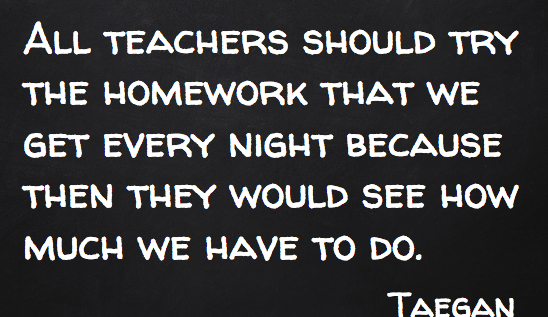
Several years ago I started to do my own homework.  From the stories we wrote, to the essays, to the speeches, and to the presentations.  I started to experience what I was putting on the shoulders of my students and I quickly realized that what I thought would just take a few minutes never did.  What I thought would be easy hardly ever was.  What I thought would be meaningful sometimes wasn’t.  So I stopped giving homework, except for reading.  I stopped going by the formula of grade times 10 minutes.  I stopped handing out packets and instead vowed to stop talking so much and instead spend the time in class on discussion and work time.  I expected pushback or concern, but have hardly gotten any in the last six years.  Most parents express relief instead.

So every year I make a deal with my students; if you work hard in our classroom, you should not have to do work outside of English.  If you give me your best then besides reading a good book you don’t have to give me anything more after you leave our classroom.  And for most it works.  Most of my students come ready to work, ready to learn, and they hand their things in.  Not everyone, just like when we have homework we have those kids that do not get it done, I also have kids that do not use their time wisely.  So I work individually with them, after all, the acts of a few should never determine the conditions of the many.

So if you are still giving homework, I ask you for this simple task; do it yourself.  Go through the motions as if you were a student and then reflect.  Was it easy?  How much time did it take?  What did you have to go through to reach completion?  In fact, if you teach in middle school or high school, do it all, truly experience what we put our students through on a day-to-day basis. I would be surprised if the process didn’t shape you in some way.

I still do my own assignments, although I have been slacking lately.  Whenever I do, I am reminded of just how much time homework swallows.  Of sometimes how little actual practice it gives, or even learning.  How homework is unfair because we have already been given hours of their time in school.  How those who really need the practice do not need it at home, but instead with us as support in our classrooms.  Do your homework, tell your students, and see how they react.  Then ask them how they feel about homework.  Let their thoughts shape you as a teacher, I promise you won’t regret it.

I am currently working on a new literacy book.  While the task is daunting and intimidating, it is incredible to once again get to share the phenomenal words of my students as they push me to be a better teacher.  The book, which I am still writing, is tentatively Passionate Readers and will be published in the summer of 2017 by Routledge.  So until then if you like what you read here, consider reading my book Passionate Learners – How to Engage and Empower Your Students.  Also, if you are wondering where I will be in the coming year or would like to have me speak, please see this page.