I get asked for a lot of book recommendations, I think it comes with the territory when you share the love of books. And while I love pairing books with potential readers, I have also noticed a pattern that causes me to pause, that should cause all of us to pause.
I get asked for a lot of books featuring male lead characters for male readers.
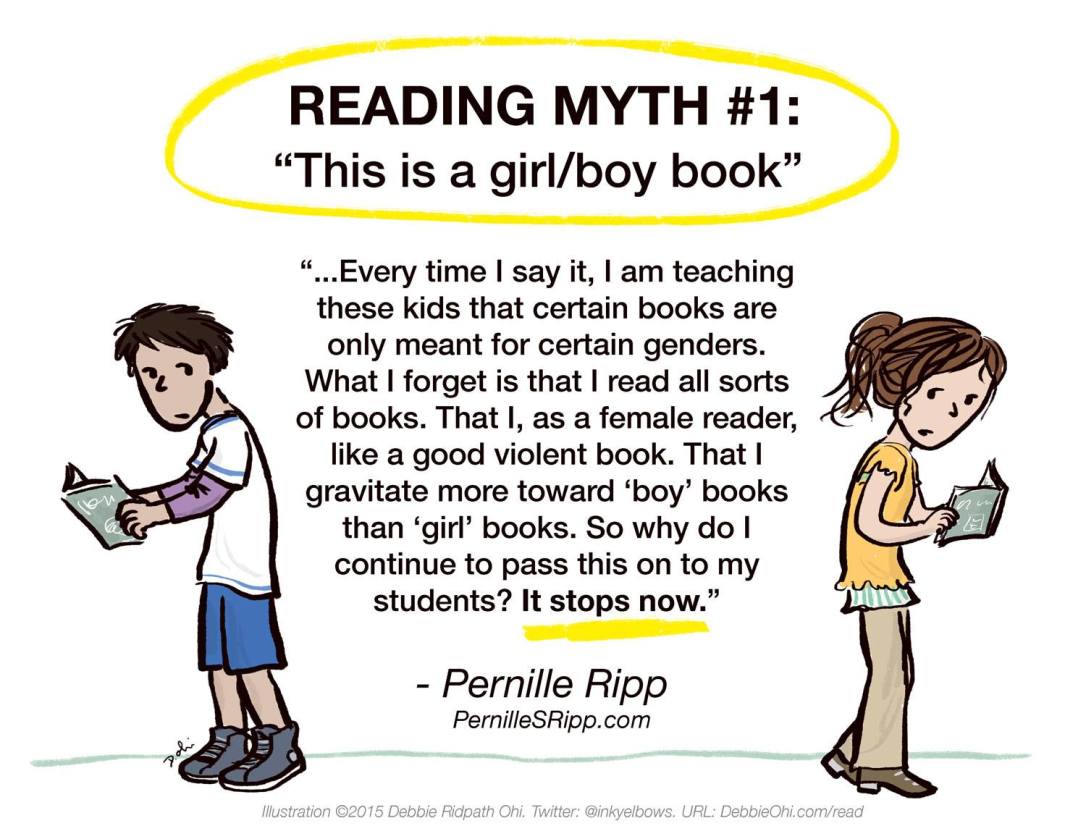
When I ask why the need for a male lead, I am often told that “they” just don’t think a boy will read a “girl book.” That a boy will not like a book about feelings. That a boy only wants books that have action. That have other boys in it. That feature characters that look just like them or at the very least think like them.
As if every single boy thinks alike.
When written like this it is easy to see the problem; when we assume that there is such a thing as books for girls and books for boys, we are continuing a tired and sexist narrative that has only furthered the power inequity that already exists within our society. We are creating a new generation of mansplaining, of groupthink, of toxic masculinity. Of girls only liking one thing, and boys liking another. Of men and women being from different planets. Of readers being shaped more by their assigned gender than their actual interests.
We are furthering the stereotype that boys don’t like to read about girls because they see little value in what girls do.
We are furthering the stereotype that boys don’t like to read about feelings because they are somehow above all of that.
We are furthering the stereotype of what it means to be a boy which translates into what it means to be a man and not seeing the incredible harm in that.
Because what about the boys that love a good tearjerker? What about the boys that don’t like sports? What about the boys that love to experience the emotional development of a character? What about the boys that love a great female lead character? What about the girls who don’t fit into the opposite boxes? Do they not deserve to have books suggested to them, no matter the gender of the protagonist?
And I think of my own children, my three girls and one boy, whose reading interests are as varied as their personalities. Sure there are Minecraft books being read by Oskar, but not until Thea reads them first. Sure there are unicorn books with pink sparkly covers being read by Augustine but not until Oskar sees if the unicorn gets rescued first. I would hate for anyone to assume that they knew who they were as readers based only on their gender.
So when we claim that a read-aloud featuring a female protagonist will likely not catch the attention of our boy readers, we have whittled the male reading identity down to practically nothing. Males – good. Sports – good. Action – good. We have diminished what it means to be a reader who develops with the books they read. We have diminished what it means to identify as male. We have diminished their chance to learn from a perspective that may at first seem foreign but in the end may just be more similar than they ever thought. We have effectively boxed our boys in only to then wonder why they may act a certain way.
How often does this thinking then translate into the very books we recommend to the boys we teach? To the girls? How often do our assumptions about their needs as a reader surpass what they actually need? How often does this translate into the read alouds we choose? The texts we bless by spending our time on them as a community?
And I realize that I don’t get asked the opposite very often. That often when I am asked for a recommendation for a female reader, the gender of the protagonist is hardly ever brought up. That instead the most common descriptor is a strong story development, a story that will hold their attention. Why do our boys not deserve the same?
So I am wondering if we for once and for all, can we all agree that there is no such thing as a girl or a boy book? That kids need to be exposed to characters that inspire them, no matter their gender. That kids need to be exposed to characters that will expand their worldviews and invite them into new worlds that they knew little of before, no matter their gender. That kids need to be exposed to great books, without us adults thinking that they will only read a certain type of book based on what we see in front of us.
We must give them a chance to experience more than what they are. Books allow us to do just that, but not if they never read them. Not if we never recommend them. That’s on us, which means we can change it, so let’s do that starting now.
If you like what you read here, consider reading my newest book, Passionate Readers – The Art of Reaching and Engaging Every Child. This book focuses on the five keys we can implement into any reading community to strengthen student reading experiences, even within the 45 minute English block. If you are looking for solutions and ideas for how to re-engage all of your students consider reading my very first book Passionate Learners – How to Engage and Empower Your Students. Also, if you are wondering where I will be in the coming year or would like to have me speak, please see this page.
 Pernille Ripp
I loved reading Bridge to Terabithia with students because it can provide a great opportunity for a look at what “what boys do and like” and “what girls do and like.” Each of the characters experiences a bit of dissonance in their life because of these gender-ideas that are ingrained in our culture.
“what are boy should do”,”what are girl should do” is so ingrained in many different culture and country. especially, the education from parents who every day indicate children of boys or girls should read and play differently.
One of my pet peeves. Not only do we see this in books but also in all entertainment. Movies about girls (The Little Princess, The Secret Garden) do poorly at the box office even though they a great movies. A study done found that families with boys and girls usually would see only the films that the boys wanted to see.
I watch booktube and love seeing boys reviewing so called “girl books” and loving them.
So very true and important! I’m thankful to be noticing a shift in this thinking lately. Before, many of my male students wouldn’t give books with a female protagonist a second look. This year, a number of my ‘coolest’, most athletic gentlemen worked their way through the entire Dork Diaries series. 🙂
Dork Diaries, that’s just what I was going to mention. I have had several of my 6th and 7th grade boys go through that series and love them. When boys shrug off female protagonists then I always whip out my Katnis Everdeen card which always gives them pause to consider my book suggestions. Freedom to choose, its a good thing.
I feel that ever since the influx of Harry Potter on the reading sceme of life this has changed a lot. I typically ask children to tell me about other books they life My youngest son just blew through a bunch of books that could be considered more “girl books” – Star Girl, Mockingbird and such because they were suggested books based on the Wonder book series. We need to help children pick books based on interest not based on their gender
This is a wonderful read!! I personally don’t have children of my own, but I have five amazing nephews, and the second oldest takes after my love for reading. They all used to feed into the stereotype, mostly through peer pressure. They would say things like, “we don’t want to watch Mulan,” and “that’s for girls, not for boys.” Thankfully, through the influence of both their parents and my sisters and I, we were able to show them how great “girl things” can be, and how it never should stop them from doing things they are interested in, reading or otherwise.
This is one of the tenants I’ve held close while raising my son (and eventually his baby brother). I don’t care what color he likes (notable when he picked a purple fan instead of a blue or white one) or what night lite he wants (he picked Frozen, having never seen it at that point, instead of an aquatic one or an action hero one) or what books he likes (he likes all books, honestly) or what shows (I watched the My Little Pony movie the other night and ‘True’ on Netflix, right in between some detective animal show and his 800th viewing of Cars 3).
It’s an eye opener and a constant reminder that he’s going to like what he likes and it really shouldn’t matter what anyone else things regardless. And more to the point, I’ll never tell him not to read or watch something simply based on the perspective. That’s ridiculous in a culture moving away from reading as a whole and understanding other viewpoints being foreign to most. I want my kids well-versed in a variety of views, perspectives, and positions. And if that means sometimes I’m watching a show about a princess finding the right dress instead of a show about a monster truck preparing for a rally, then I’m happy that’s what he wants to watch. 🙂
Reblogged this on The Arrow Pointer.
Preach🙌🏼
Thank you, I liked the idea!
yes! we start to focus on differences between boys and girls in a very early age, toys, books, dreams and etc, and this limit the improvements of both of them to be open to know and improve their skills to interact with other people and to be great in their social abilites!
Given adult American politicians saying rape is legit, the children need better social role models.
Hello
And you’re so right on this dear
Thanks honey.
Can we talk more I really wanna know more hun
Reblogged this on reemfakhry5 and commented:
Someone else is saying this and I’m over joyed!
Given the se hinton books from the 60s about boy feelings but written by a girl who had initials used to hide her gender, in 2018, too little has changed.
I very much agree with you Sir , This boy books and girls book is restricting boys from expressing themselves and feel deep emotions. This is one example why the world has become so sexist. When you’re a girl it doesn’t mean you aren’t interested in books that are to be said are for “boys” only .
I agree for the most part with much of what is discussed in your post; however, there is the issue of trying to help foster an appeal for reading to the reluctant reader. I think most parents try just about anything to get their child to get ‘hooked’ into reading. Most I say, and we do need to take gender into consideration. I think perhaps we ignore the fact that many stories written for young children are well-developed and have dynamic characters. Otherwise, no one would read them–male or female. Once a child has been hooked on reading, then the job of the parent who is concerned about reading matter becomes a non-issue. The child is likely to gravitate towards whatever books appeal to him or her out of pure love for reading. Courage, honesty, integrity and adventure are intrinsic values everything searches in order to to become more fully human, and both boys and girls should read about what it means to do the right thing. Violence and meanness have their place in stories too and the hope is the bully is not so glorified the character becomes a role-model. No question. My experience working with children suggests they’ll read what they want to read if they love reading. Interest really becomes about the child not the parent.
I’m not so sure a stereotype exist in the form of a ‘boy book’ or ‘girl book’, but what is certain is a poorly asked question. Perhaps parents should be more informed about what categories/themes are available for their children, so that their questions are a bit more well-informed. For example, Can you suggest a book that explores the topic of (gun violence in schools, bullying, losing a best friend to Leukemia, moving away from friends)? Fill in the topic or theme of your choice.
Just some thoughts,
Phil Vergon
I thought I was the only one who worried about this! I’m glad there is more awareness on the topic.
I am going to throw the Little House series out there for example (although they are taking heat now for racism – and rightfully so), books you might consider “girl books.” I have found boys who love the descriptive writing, Pa building the cabin for example.
Totally agree with previous statement about Bridge to Terabithia. I read that every year – that book has so many layers!! Gender roles. Religion. Economic and Education disparity. Death. I have kids who see this simply as a sad book about friends, and other kids who talk about the big ideas about life after death.
BRAVO for your fascinating take on Boy vs. Girl book.
PS. Someone said they pull the “Catniss” card, I too pull that card and also the Lyra Belacqua card.
In a family like mine while I was growing up, I understand why my mother may have sought to find a “boy” book when my little brother came along, the first boy out of 4 children. The only books in the house were those that my sisters and I read at his age and those were often from the genre most would consider “girl” books.
In a parent’s defense I would say that the idea behind the request was not necessarily about finding a book that fit the stereotypical boy, but more an impassioned search for something (anything) that may engage her son in a good book.
Because children are going to become who they are based on the enviornment in which they live and not necessarily the books they read, are we not stretching the argument a little far by assuming a book and what we call it is going to program a child to feel discriminated against based on his sexuality?
As a teacher and a mother, sometimes we seek certain books by genre simply in our anxious desire to change the child’s feelings about reading. As the years go by, we will see more and more students who will never pick up a book with pages. In fact, we are already reading online to encourage more reading.
Remember, a child can be perfectly normal for not appreciating books or even stories at certain ages. Let’s not judge a parent or an educator because they were not “politically correct” as they searched for a book that would engae their non-reading child. I would venture to guess that if someone does call them “boy book” or “girl book” it is most likely their lack of knowledge about genre and how to ask for genre-specific reading materials.
Hi everyone😇 You can also check out http://womanlybeaufash.wordpress.com this account for supporting my blog ♥️ thanks
Excellent post, really got me thinking. I read together with my ten year old son and seven year old daughter at bedtime each night. We vary the books often reading a chapter from 2 or 3 different books each night. I hope by doing this i am doing as you suggest – I think most of the time we don’t even notice if the protagonist is male or female, we are more interested in the story!!
Well said! I’m passionate about sharing books with my son with strong female characters – this is just as crucial for young boys as well as girls, arguably more so. I love to buy Rapunzel by Bethan Woollvin for children of all genders as this new version of the fairytale has a fantastic led character.
I really enjoyed this post, it’s something that I wouldn’t normally think about- the stereotypes and reading, but it’s definitely there.
Not only does this fit for books but also things like television shows. My sister loves the typical ‘girly’ shows like Peppa Pig and My Little Pony, but she also really loves to watch Spiderman cartoons and animations of Dinosaurs on YouTube. Just because she’s a girl doesn’t mean she can’t like superheroes or scary dinosaurs.
One can’t obviously make all encompassing statements regarding gender… all men are xyz, all women are abc!! But it can’t be denied also that GENERALLY, statistically speaking, boys and girls have different interests. To deny it is to deny biology. Unless one believes that gender is a social construct, in which case I got nothing else to say!!
Both boys and girls should be exposed to all types of books, but at the end you’ll get a trend on their preference that will show a gender bias!!
Interesting post, Pernille. I agree that we should match books to a child’s interests and reading style rather than simply gender. However, there’s no denying that they are some books that girls tend to gravitate to more often than boys. For example, Anne of Green Gables and Little Women. Pink, sparkly picture books may interest also fewer boys. In my experience, boys in grades 4-6 like more action oriented books than interiority. In the school I taught in, the novel Sarah Plain and Tall was read in the 4th grade. Year after year, most of the boys claimed it was boring. Again, this is just a tendency to be aware of. Treating each reader individually is the best course of action.
individually reading is best way for class teaching. same novel the boy thinking boring but girl like it.
Are there boy and girl books? No, probably not. But why the heck should we force anyone to read something they don’t want to read? If a boy is happier reading a book with a male lead, and same with girls, why should we point them in another direction? The point is to get kids to read, right? So who cares? Let’s stop forcing all this sexual BS on kids. Get them to read and they will expand their minds organically to read other things.
According to the stereotype Boys aren’t supposed to read emotional books, not because they’re above it, but since they’re being trained to take care of the family, emotion is not very high on the list in that aspect. Boy books and girl books are definitely existing and rightly so. Because the perspectives are different. And it would not be a mistake to generalise such statements. Forcing them to adhere to such books is perhaps wrong. But not the stereotype itself. And by stereotype I mean my afformentioned one.
If you are born with a vagina you are a girl and if your born with a dick then you are a boy. Character has nothing to do with it.
Very well writeen. I definitely believe the stereotype needs to be broken and everyone should read what motivates them!
This is so true. I agree with you completely. We are taking the children’s rights by assuming what they would like to read. Who are we to judge?
As much as we don’t want boys feeling there is a book meant only for them to read and girls thinking the same way, I think it’s up to curriculum planners, education policy makers and children’s book writers to find ways of bridging the divide. There’s an excellent piece on this published in the World Education Blog about gender stereotypes in schoolbooks. The idea is for writers to also write books with female characters who are fearless and geeky as we are beginning to see more women with these qualities in real life.
Ohh that’s true! This same goes for colour specification too! My baby boy wears pink too 💗
Brilliant post. I’ve been surprised by some of the books my son has chosen from library.
I mean I’m gonna say against that because there are such things as boy and girl boys say you have one with fairies and one with war and realize a boy and girl between them … It’s a lot more Likely the boy won’t go for one with fairies and you know what everyone, there is nothing wrong with that, also saying that its because there is a female protagonist as an excuse it bs toon of guys i know read books with a female main lead and they still don’t want to read fairy books, so id say your wrong
Reblogged this on .
Fabulously worded. This post needs to be read by everyone. This concept is too important to avoid.
Reblogged this on Cynthia Hilston – Author & Blogger.
I agree and enjoyed this read. I think we do our children a great disservice if we label books as “girls’ books” and “boys’ books.” Nothing is to be gained from that. So much is to be gained from exposing them to a wide variety of good books.
http://www.cynthiahilston.com
Hi
My favorite books:
There’s a Boy in the Girls Bathroom
Runaway Ralph
Winnie the Pooh
Return of the Homerun Kid
Let the kids read.
Sharing this…
I’d like to agree with your premise, but companies love demographics and are gonna keep using a gender divide unless we all vote with our wallets
Definitely agree with you here. I should also add that all the ideas about (straight) boy and (straight) girl books are problematic for those who, say, are gender nonconforming. (Though there’s an increasing number of children’s books with gender nonconforming protagonists, which makes me happy.)
I love the honesty with which you’ve written this blog and preached one of the most important lessons that human existence needs to learn, gender equality. We all should stand as one and preach what is beneficial.