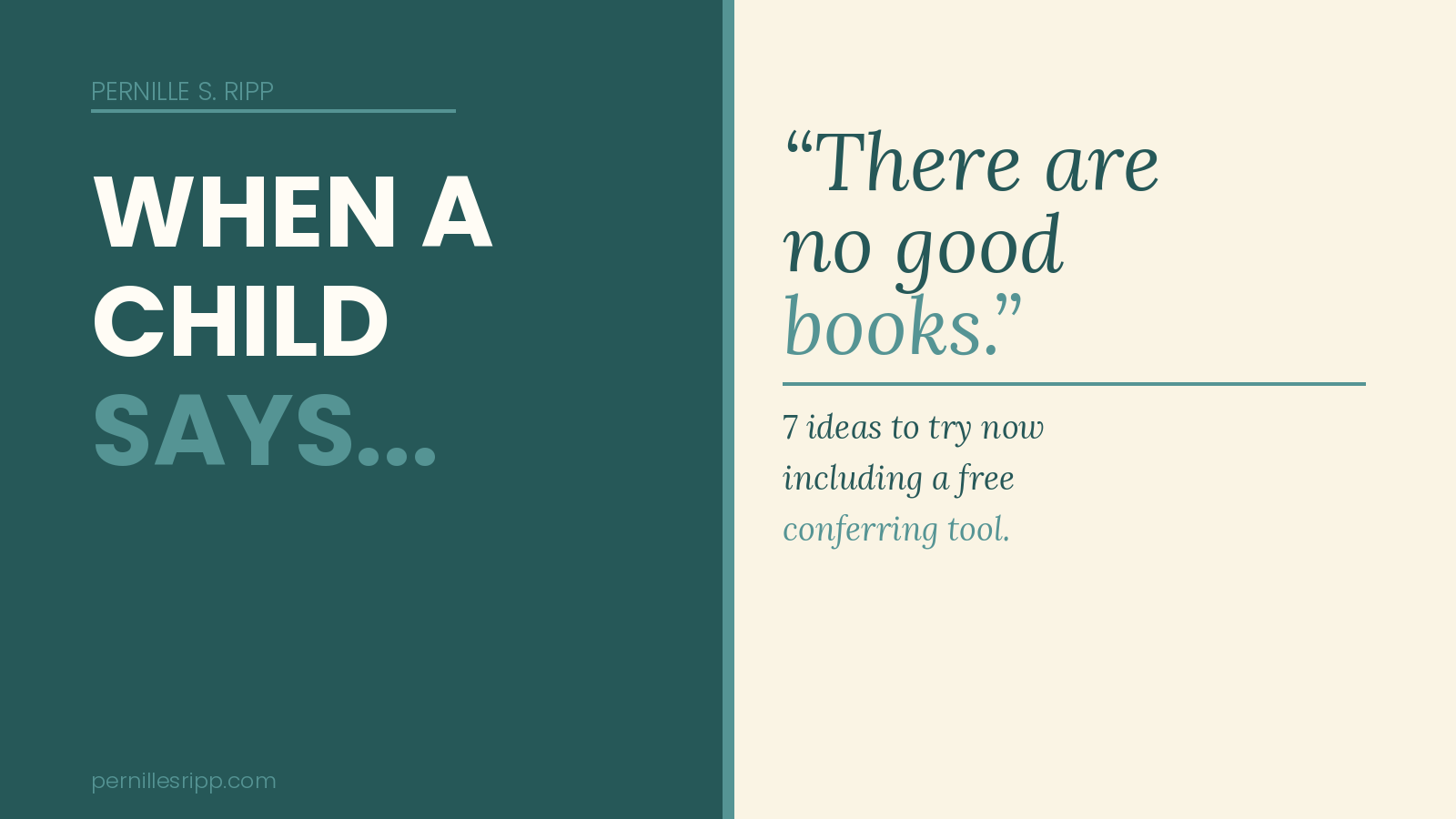
A good reader. Bright. Funny. And yet he hates reading. Tells me there are no good books despite me bringing all my tricks. Book recommendations, book excitement, cheerleading and all of that.
And then I realized something.
It’s an ingrained habit now. A quick dismissal. Because if there are no good books then the work stops. The responsibility doesn’t sit with him. It sits with the circumstances surrounding him. There are no good books. What can you do?
So how do we break that pattern of dismissal?
Not with more recommendations. I’ve tried that. Not with more excitement or more cheerleading. I’ve tried that too.
I think we break it by handing the ownership back. Slowly. With small moves that ask something of the child rather than offering something to them. Moves that say I believe you can find your own way to a book. Let me show you what that might look like.
I put together a free conferring tool with 7 ideas for what to try. Not scripts. Not book lists. Just moves worth trying when you hear those words and I shared them on Instagram. I thought they would be worth sharing here too.
It seems, no matter what I do, it still happens. Year after year.
I started this work in 2010 and the voices were smaller then. Present but quiet. Now, with passive consumerism, with the need to be constantly entertained, with the pressures of life growing for so many kids due to inequity, it seems to have grown to a cacophony of voices. Eagerly chanting. Even from my 1st graders. Before they had even fully learned to read, they would say it.
I hate reading.
I know I cannot be the only one.
So what do we do? How do we speak to them in a way that shows we are actually listening — and also that it doesn’t have to be this way?
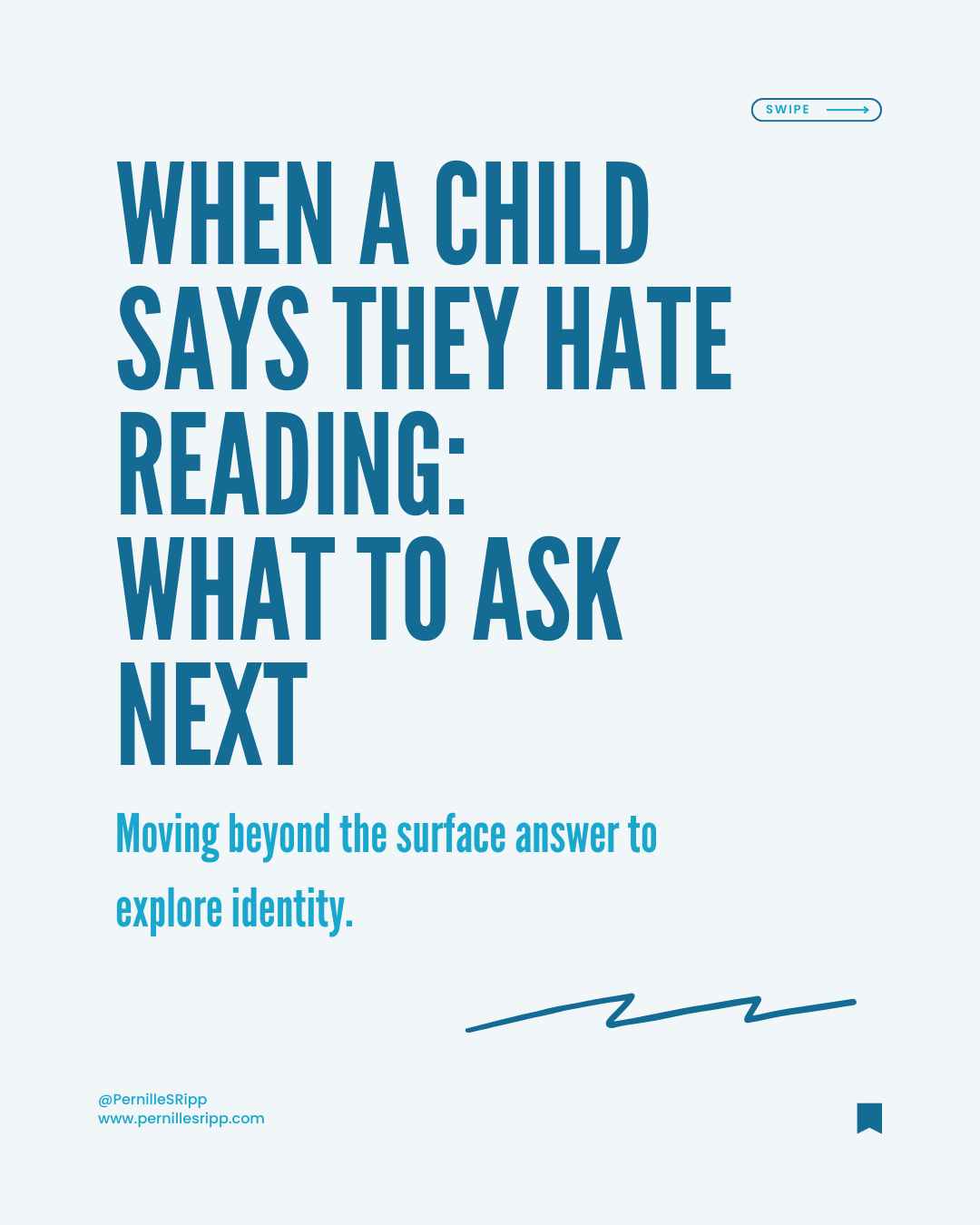
I don’t think the answer is a better book recommendation. I don’t think it’s making reading more fun or more gamified or more rewarded. I think it starts with a question. The right question. One that treats what they said as information rather than a problem to solve.
I’ve been collecting those questions for a while now. The ones that seem to open something up rather than shut it down. The ones that get underneath the “I hate reading” to whatever is actually being said. And I posted them on Instagram, and it seems like I wasn’t the only one who needed ideas for this work.
So here, I put them together here as a free conferring tool, something you can print and keep in your folder for those moments when a child says the thing and you want to respond with more than a recommendation.
I keep thinking about the ones who came to us loving books.
You know the ones. The kids who wanted to tell you everything about what they were reading, who recommended titles before you could recommend them first, who couldn’t walk past a shelf without stopping. Somewhere between then and now, they faded into the wallpaper. They still sit in our rooms. They still do the things we ask. But the books? The books stopped mattering to them. Or maybe they stopped believing the books were for them. And somewhere along the way, we stopped noticing that the energy we had poured into them as readers had quietly drained away.
That’s the loss I want to talk about. Not the child who never loved reading — we see that child, we have some ideas for that child. I’m talking about the reader we already had. The one we thought we didn’t need to worry about anymore.
We have systems for the child who stops reading.
Logs. Conferences. Check-ins. We notice when the pages stop turning and we intervene. That system exists because we built it, and mostly it works.
But there’s a second loss we almost never catch. The moment a child stops sharing their reading with us. Stops recommending. Stops bringing things to our desk. Stops starting conversations about books at all.
Those are not the same loss.
A child can still be reading every night and you can have no idea what their reading life actually looks like anymore. Because they stopped bringing it to you. And there was no system to catch that. No log for the conversation that didn’t happen. No conference protocol for the reader who went quiet.
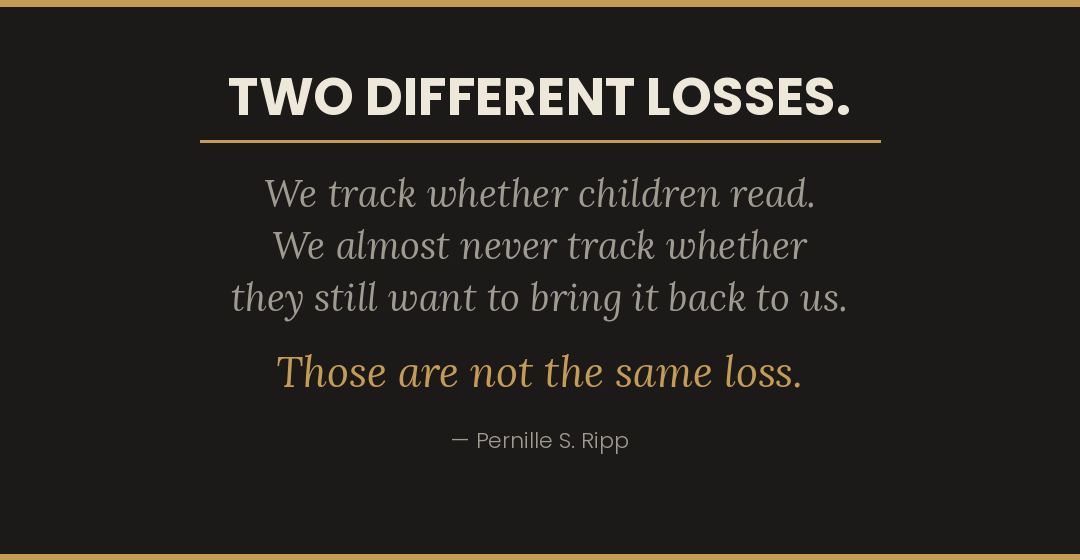
We track whether they read. We don’t track whether they still want to bring it back to us.
And those are two different losses.
So why does it happen?
I don’t think it’s one moment. And I don’t think it’s about judgment, not usually. Most teachers I know aren’t dismissing the readers who go quiet. They’re just not getting to them. Because the curriculum needs covering. Because there’s an assessment coming. Because the things that get measured are the things that get time, and a quiet conversation about who a child is as a reader — what they’re choosing, what they’re abandoning, what they’re curious about — that conversation isn’t on anyone’s rubric.
And children notice.
Not in a conscious way. But they are always reading the room. And what the room tells them, slowly and consistently, is that their reading life — the one they own, the one they choose, the one that exists outside of any assignment — doesn’t need to be brought here anymore. Nobody is asking. Nobody has time. And so they stop thinking of themselves as people with a reading life worth talking about. They hand the agency back. Quietly. Without making a fuss.
And we let them. Because the system made it easy to let them.
That’s the loss I can’t stop thinking about. Not the reading. The sense of self that goes with it.
And yet. We are not helpless here.
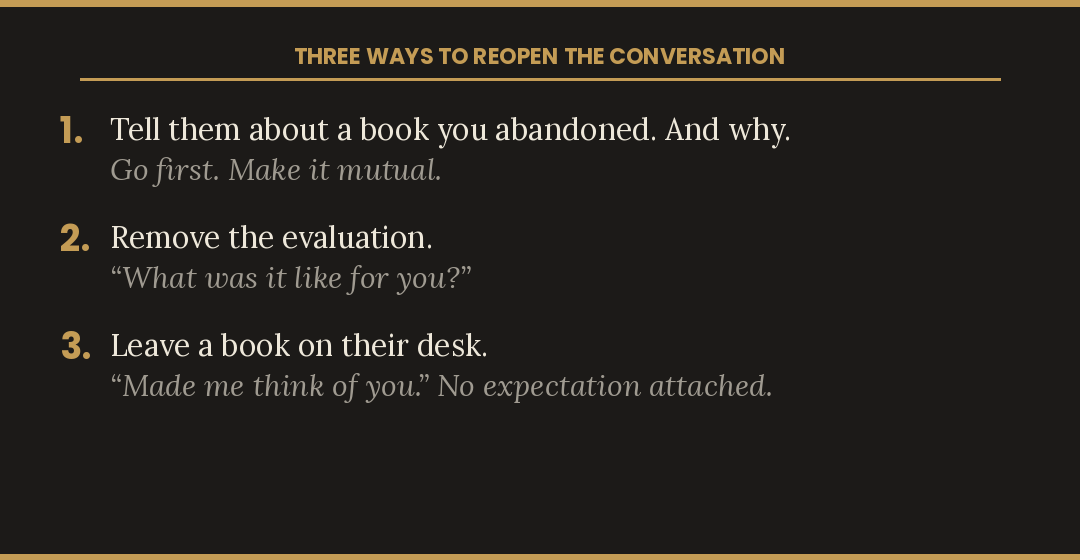
The first one is simple. Go first. Tell a child about a book you abandoned. Not a book you loved — one you put down and walked away from. Tell them why. This does something important: it lowers the stakes entirely. It says reading is a relationship between a reader and a book, not a performance for an adult. And it makes the conversation mutual. You went first. Now it’s safer for them.
The second move is harder because it requires resisting a very natural instinct. When a child does start to share, don’t evaluate. No “did you understand it?” No comprehension check disguised as curiosity. Just: “What was it like for you?” That question has no wrong answer. It hands the agency straight back to them. And children who have learned to be guarded around reading conversations will slowly start to open up when they realize there’s no trap waiting.
The third move costs nothing. Find a book that genuinely makes you think of a specific child — not because it’s at their level, not because it would be good for them, but because something about it just reminds you of them. Leave it on their desk. A small note: “made me think of you.” No expectation. No follow-up. No asking if they read it.
Just the book. And the message that you saw them.
That’s sometimes enough to make a child remember that they are a reader. That someone noticed. That it still matters.
We cannot get those years back. The ones where they loved books and we were too busy to notice when that changed.
 Pernille Ripp