Reading Identity

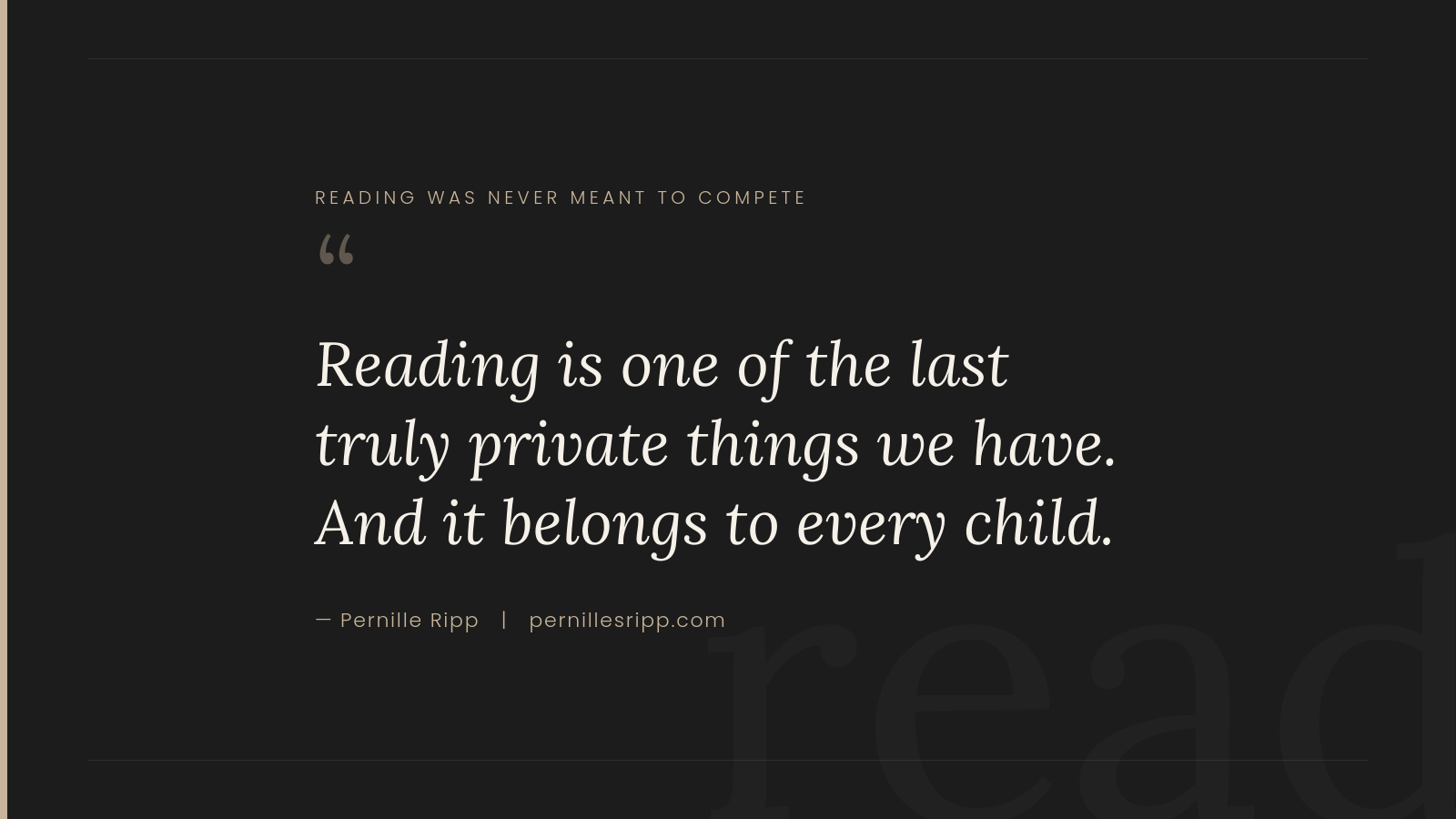
Reading Was Never Meant to Compete

We talk about reading as if it is in a race. As if every time a kid picks up a phone instead of a book, reading has lost a point. And I understand why we frame it that way. The competition feels real. YouTube, social media, every platform built around the endless scroll, they are extraordinary at what they do. The additives of a phone and everything that comes with it, the brain chemistry they tap into, the way they are engineered to keep you coming back, it’s a losing race, we cannot compete with that.

But here is the thing. Reading was never supposed to compete.

It is not a faster, quieter version of TikTok. It is not trying to win your attention the way an algorithm does. Reading is its own thing entirely. And the moment we stop treating it like a competitor and start presenting it to kids as something categorically different, something that exists in a completely separate space from their devices, everything about the conversation changes.

Reading offers quiet. It offers balance in a world that is otherwise relentlessly loud. It offers the health benefits we know are real, focus, empathy, stress reduction, the slow building of an inner life that is completely our own. But more than any of that, it offers something increasingly rare: A place where we do not have to perform.

How often does that happen?

With a book, no one is watching. Well, unless you are reading in public, of course. There are no likes, no comments, no version of yourself being constructed for an audience. You get to just be with a story. Not be judged. Not worry about what anyone thinks. That is a selfish indulgence, and I mean that in the best way. In a world that is constantly asking us to consume, to engage, to spend more time on their platforms, reading quietly says: this is for me. Just me. And the way it restores me is something I can’t let go of.

Giving kids the gift of reading is one of the few things we can offer them that pushes back against all of of the consumption and production. Not by banning phones or lecturing about screen time. But by showing them that reading exists in a different category altogether.

If we want kids to see reading as its own thing and not as a lesser version of entertainment, we have to change how we talk about it.

Stop framing it as the alternative to screens. When we say “put down your phone and read,” we immediately set up a competition reading will lose. Instead, talk about reading as something you do for yourself, not something you do instead of something else.

Talk about the privacy of it. Kids live remarkably public lives, even at young ages. I don’t envy my own children in any way when I think of the type of teen years I had, I am so glad there were no cameras ready to record at any moment. The idea that reading is a space that belongs entirely to them, where no one can see what they are thinking or feeling or imagining, is genuinely powerful. Name that out loud.

Celebrate the selfish part. Reading is one of the few things in a child’s life that is purely for them. Not always to improve their grades, not just to make a teacher happy, not to perform for anyone. Let them hear you say that. Reading is something you do because it feels good and it is yours.

Model the quiet. Let kids see you read. Not as a lesson, but as something you genuinely want to do. When they see an adult choose a book, not to be productive but simply to be still for a while, that lands differently than any message we could ever deliver. This is yet another reason to make your reading life public in some way.

Connect it to who they already are. Reading identity is not built through assignments. It is built through the experience of finding a book that reflects something true about you, or takes you somewhere you wanted to go, or makes you feel something you could not name before. Our job is to help kids find those books and then get out of the way.

The algorithm wants our attention and it is so easy to fall into. Social media wants your engagement. Every platform is designed to want something from you.

Reading wants nothing. It just waits.

That is not a weakness. That is exactly what makes it worth protecting and worth giving to the young people in our lives as the gift it truly is.

Reading Identity

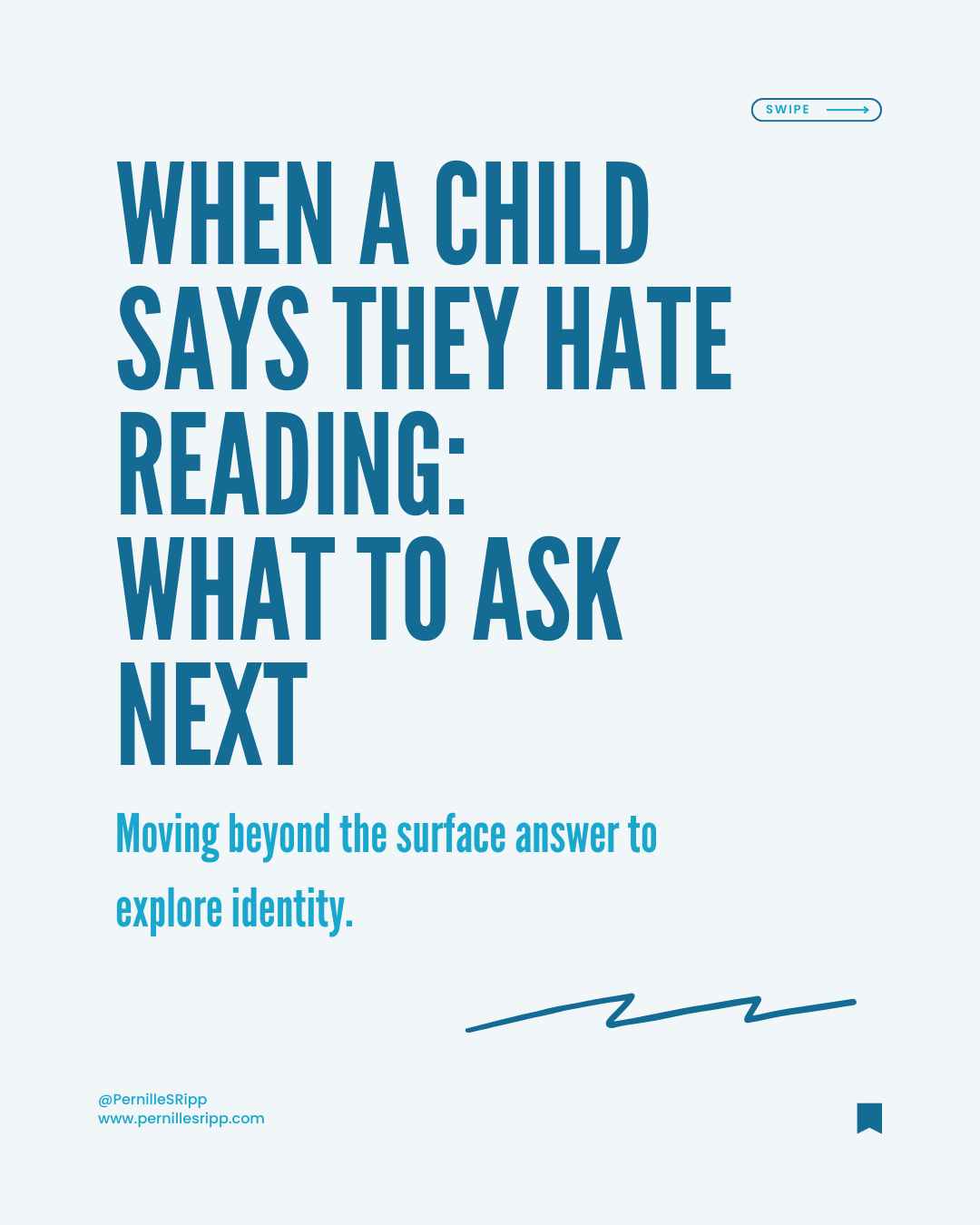
When a Child Says They Hate Reading: What to Ask Next

It seems, no matter what I do, it still happens. Year after year.

I started this work in 2010 and the voices were smaller then. Present but quiet. Now, with passive consumerism, with the need to be constantly entertained, with the pressures of life growing for so many kids due to inequity, it seems to have grown to a cacophony of voices. Eagerly chanting. Even from my 1st graders. Before they had even fully learned to read, they would say it.

I hate reading.

I know I cannot be the only one.

So what do we do? How do we speak to them in a way that shows we are actually listening — and also that it doesn’t have to be this way?

I don’t think the answer is a better book recommendation. I don’t think it’s making reading more fun or more gamified or more rewarded. I think it starts with a question. The right question. One that treats what they said as information rather than a problem to solve.

I’ve been collecting those questions for a while now. The ones that seem to open something up rather than shut it down. The ones that get underneath the “I hate reading” to whatever is actually being said. And I posted them on Instagram, and it seems like I wasn’t the only one who needed ideas for this work.

So here, I put them together here as a free conferring tool, something you can print and keep in your folder for those moments when a child says the thing and you want to respond with more than a recommendation.

Download: When a Child Says They Hate Reading — What to Ask Next

It won’t fix everything. But it might start a different kind of conversation.

Reading, Reading Identity

Two Different Loses

What we track. And what we miss.

I keep thinking about the ones who came to us loving books.

You know the ones. The kids who wanted to tell you everything about what they were reading, who recommended titles before you could recommend them first, who couldn’t walk past a shelf without stopping. Somewhere between then and now, they faded into the wallpaper. They still sit in our rooms. They still do the things we ask. But the books? The books stopped mattering to them. Or maybe they stopped believing the books were for them. And somewhere along the way, we stopped noticing that the energy we had poured into them as readers had quietly drained away.

That’s the loss I want to talk about. Not the child who never loved reading — we see that child, we have some ideas for that child. I’m talking about the reader we already had. The one we thought we didn’t need to worry about anymore.

We have systems for the child who stops reading.

Logs. Conferences. Check-ins. We notice when the pages stop turning and we intervene. That system exists because we built it, and mostly it works.

But there’s a second loss we almost never catch. The moment a child stops sharing their reading with us. Stops recommending. Stops bringing things to our desk. Stops starting conversations about books at all.

Those are not the same loss.

A child can still be reading every night and you can have no idea what their reading life actually looks like anymore. Because they stopped bringing it to you. And there was no system to catch that. No log for the conversation that didn’t happen. No conference protocol for the reader who went quiet.

We track whether they read. We don’t track whether they still want to bring it back to us.

And those are two different losses.

So why does it happen?

I don’t think it’s one moment. And I don’t think it’s about judgment, not usually. Most teachers I know aren’t dismissing the readers who go quiet. They’re just not getting to them. Because the curriculum needs covering. Because there’s an assessment coming. Because the things that get measured are the things that get time, and a quiet conversation about who a child is as a reader — what they’re choosing, what they’re abandoning, what they’re curious about — that conversation isn’t on anyone’s rubric.

And children notice.

Not in a conscious way. But they are always reading the room. And what the room tells them, slowly and consistently, is that their reading life — the one they own, the one they choose, the one that exists outside of any assignment — doesn’t need to be brought here anymore. Nobody is asking. Nobody has time. And so they stop thinking of themselves as people with a reading life worth talking about. They hand the agency back. Quietly. Without making a fuss.

And we let them. Because the system made it easy to let them.

That’s the loss I can’t stop thinking about. Not the reading. The sense of self that goes with it.

And yet. We are not helpless here.

The first one is simple. Go first. Tell a child about a book you abandoned. Not a book you loved — one you put down and walked away from. Tell them why. This does something important: it lowers the stakes entirely. It says reading is a relationship between a reader and a book, not a performance for an adult. And it makes the conversation mutual. You went first. Now it’s safer for them.

The second move is harder because it requires resisting a very natural instinct. When a child does start to share, don’t evaluate. No “did you understand it?” No comprehension check disguised as curiosity. Just: “What was it like for you?” That question has no wrong answer. It hands the agency straight back to them. And children who have learned to be guarded around reading conversations will slowly start to open up when they realize there’s no trap waiting.

The third move costs nothing. Find a book that genuinely makes you think of a specific child — not because it’s at their level, not because it would be good for them, but because something about it just reminds you of them. Leave it on their desk. A small note: “made me think of you.” No expectation. No follow-up. No asking if they read it.

Just the book. And the message that you saw them.

That’s sometimes enough to make a child remember that they are a reader. That someone noticed. That it still matters.

We cannot get those years back. The ones where they loved books and we were too busy to notice when that changed.

But we are here now. And so are they.

That’s enough to start.

Be the change, being me

One breath at a time

I have the lung capacity of a 70-year-old.

Several years ago, I was diagnosed with a genetic deficit in my lungs and liver. One that can lead to emphysema, asthma, and a whole list of other things no one hopes to casually collect. It made sense. Walking up the stairs while talking would leave me breathless, still does. And yet, hearing that my lungs were not the way they were supposed to be was a quiet devastation. One more heavy thing to carry. A moment where my imagined ending shifted, where my future suddenly looked smaller, more fragile, than I had planned for.

And then we did what people tend to do.

We carried on living.

I noted how biking uphill became harder, how running became officially impossible (not that it was ever my thing), how nearly every cold turned into bronchitis or pneumonia, how exhaustion lingered long after the illness had passed. How my body kept whispering, something isn’t right, even when I was trying very hard not to listen.

And my fear grew. Because living beside your own mortality, really beside it, is exhausting. It’s scary. It makes you feel out of control.

A year ago, I realized I needed to change the trajectory. That I was living inside a self-fulfilling prophecy of decay. Because I knew biking would be hard, I didn’t bike. Because I knew exercise would leave me gasping for breath, it did, and once I was out of breath I stopped. I avoided the very things that might help because they confirmed everything I was afraid of.

But I also knew this: the constant current of stress, needed an outlet. And sugar wasn’t it. Alcohol wasn’t it. Tears weren’t it. Rage definitely wasn’t it.

A change had to come.

So I signed up for an introduction to CrossFit, bought actual trainers, and showed up — wildly out of my depth, unsure of what I was doing, and hoping no one would notice how hard breathing felt. I didn’t do it because I suddenly believed in myself. I did it because staying the same felt worse.

What followed wasn’t a transformation. It was resistance.

It was showing up fueled more by desperation and anger than motivation. It was loud, angry music. It was the fear of being the first to die in a zombie apocalypse. It was learning that I will never like running, or be good at it — and that this does not mean I can’t do it.

It didn’t come from a big training program. It came from small steps. From doing a little, resting, and then doing a little more. From learning that my pace is not a failure, but a necessity.

My pace. My way.

How much of change is exactly this?

Not the sweeping programs. Not the inspirational speeches. But lacing up your shoes (I promise this won’t turn into an exercise blog) and seeing how it goes.

So on January 1st, I made the goal that I wanted to be able to run one kilometer in a month. I turned to ChatGPT and asked it to create a plan. Its first suggestion was to warm up by running three kilometers.

And I couldn’t stop thinking about how familiar that felt.

How often do we ask for a small change and are handed an overhaul? A new program, new training, new language — when what we really needed was permission to start where we are. To try one thing. To begin without confidence, without mastery, without pretending this will be easy.

I see this all the time in education. We want to support children better, reach them sooner, help them regulate, belong, and learn. And so often, the answer becomes more: more systems, more steps, more expectations, more work for the adults — while the children wait for us to fix everything.

And then we wonder why we burn out.

Because the truth is, we cannot meet every child’s need. And that expectation, implicit or explicit, is impossible to carry alone. What we can do — what truly matters — is show up. Notice. Offer presence, consistency, and a small, safe step forward. For some children, just knowing that someone sees them, waits for them, or trusts them to make a choice is enough to shift something inside.

The children carrying so much anger, fear, grief, and overwhelm spill it into our shared spaces. They trust us enough to bring all of that mess into school — even when we cannot fix it.

This work rarely starts with big interventions. It starts with the smallest possible step. Not because it will fix everything, but because it might shift something, and because we, too, need to survive alongside them. And so we start small.

Letting a child decide when a check-in happens — now, later, or not today — and trusting that choice as information, not defiance.

Creating one predictable question that never changes, not to extract answers, but to signal safety: Do you want me close, or do you want space?

Making the exit plan visible before it’s needed, and then honoring it without commentary when it is used.

Lowering the academic demand in the moment without lowering the relationship — fewer words, shorter tasks, a pause instead of a push.

Offering literacy as regulation: a book already on the desk, a familiar text reread, writing without an audience, reading without assessment.

Naming what you notice without asking for repair: Something feels heavy today. I’m here when you’re ready.

Returning to the child later, always later, to restore, not resolve.

It is allowing yourself to not be perfect. To say good enough. To try, live with it, and then, when it becomes familiar, add another layer. It is resisting the urge to rush toward resolution and choosing presence instead.

This is slow work. It is unglamorous. It is deeply human.

And maybe that’s why we miss it while it’s happening. Because change rarely announces itself.

And like taking small steps with your own health or fitness, it is done one breath at a time.

Today, I ran 2.6 kilometers. That’s 1.6 miles for those of you in the U.S. A new personal record. Something I didn’t think I could do a year ago, and not even a week ago.

And maybe that’s the point. Change, for me, for a child, for a classroom, doesn’t announce itself.

It slips in quietly, one breath at a time.

So do we keep breathing? Or stop?

balance, Be the change, being me

The Work That Still Works

It has been ages since I have written here.

Not created content, not shared ideas, but simply written in the ways that I have been writing for so many years. A familiar refrain, a coat that fits just so, but left forgotten in a closet because who has time to take it out?

It seems I moved to Denmark and forgot parts of myself.

As with so many other things, there are many reasons. We moved back home, but home was something brand-new. I had to create a support system for everyone in the move, which also included two of my children receiving neurodivergence diagnoses that finally made so many things make more sense. I had to learn how to be a teacher in an education system that I have only ever been a student in.

And so I put my head down, and I took the steps every day, trying to get all the pieces to fit together, even though the instructions never came, and the pieces seemed to change overnight.

And I ran, and I felt I couldn’t share because what we navigated was too hard at times, too raw, too foreign—even though it shouldn’t have been—and I knew I would have found solace in sharing out, but also felt that this story was one that had little importance, while the world we had left behind seemed to light on fire. And it didn’t feel new or worthy, because the whole world is filled with glitz and glam, and influencers telling you that they indeed hold the key to happiness.

But now, I am here. Back in this space, still holding hope that there is a space to return to.

Because the work is still there. The need to shout for more sanity, to slow down, to get back to basics, even though there are so many forces that work against us.

And so we take the basic steps every day to retain dignity, to further understanding, and to create spaces where children get to be fully human.

This year, I took over a parallel 3rd grade, a bunch of incredible kids who, through circumstances beyond them, have had a slew of incredible teachers who haven’t been able to stay. And so, rightfully so, they demand a lot of the adults who now get to be their teachers, because why should they trust us to stay when so many others have left?

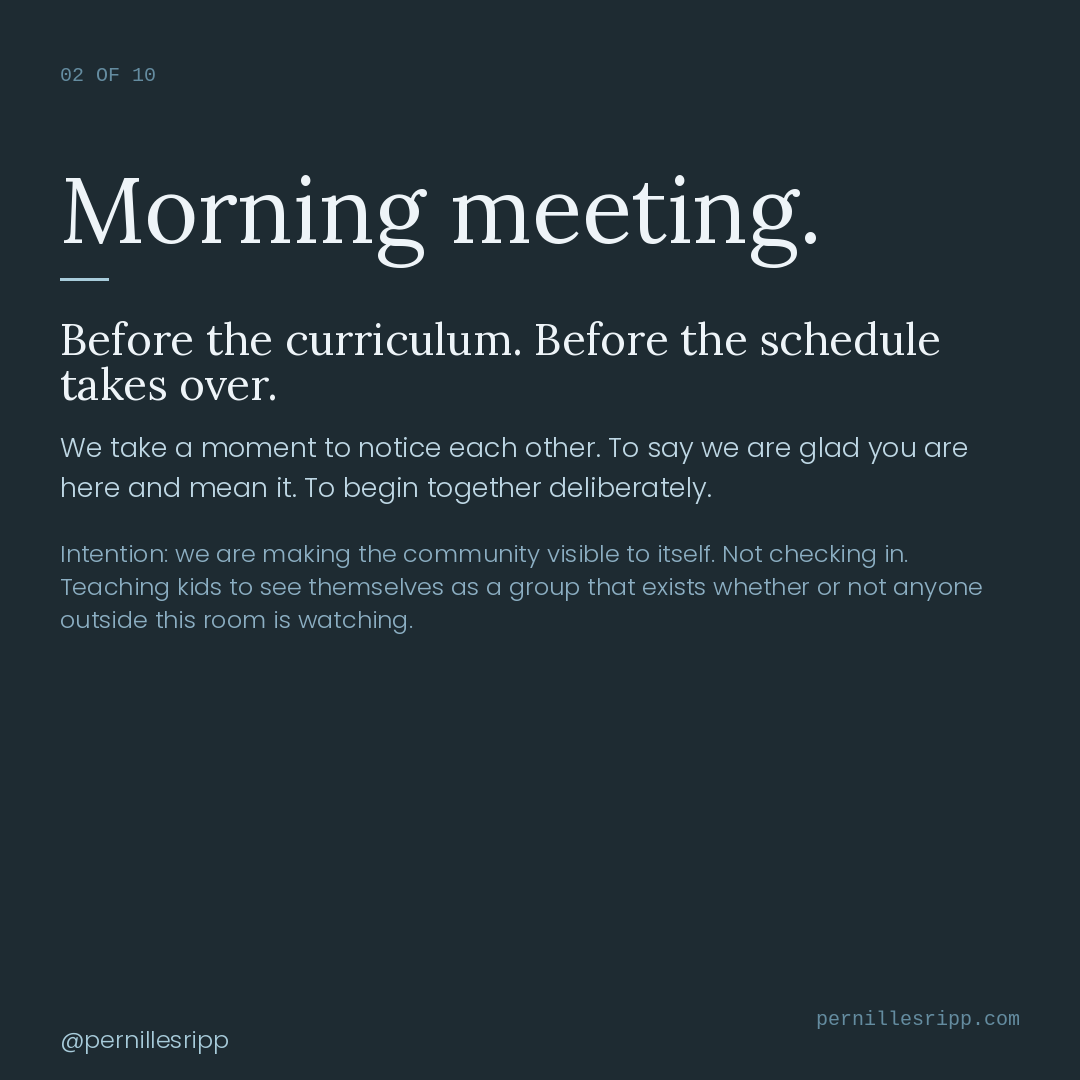
And so we have done what we have always done: we have slowed down. We have integrated morning meetings every day, we have reclaimed independent reading. We have taught conflict solutions for them to use before they come to us. We have talked, and talked, and talked—but not at them, with them—giving them ways to voice their worries, their hopes, and their ideas. We have differentiated the work, given them more freedom to move, to shape their learning, so that they too can answer how they learn best.

And I have wanted to share about all the progress that we have built, but is there really a way that something as simple as starting with a morning meeting, and how simply asking children to hold space for each other’s voices, can help another educator out there?

Because it is not flashy. It is basic. And it is being pushed out of our schools at alarming speeds, replaced with more learning, more rote, more prepackaged programs. And in this rush, we forget that gathering in schools is also meant to simply gather us. And when so many of our children gather more and more behind a screen, they don’t know how to gather on the floor unless we make the spaces for it.

Unless we hold on to the value of it.

Unless we stand steadfast and refuse to let the invented urgency of more curriculum drown out our common sense.

And so we plan for it, because we see the inherent strength of asking others to listen, to set their needs aside while others speak, to wait their turn, and then know that when they do speak, others do the same.

And so, I sit in the light of my soon-to-be taken-down Christmas tree, and I recognize the need for simplicity. For recognizing and owning that I don’t want to create simply to produce. That what works for me still works. Basic, down-to-earth ideas that may not be flashy or glitzy, but at their core recognize the humanity of the children we teach.

And so, for now, I am here. I will share. I will hold space for those of you who are also running every day, who also feel that what you are doing is maybe not the flashiest of work, but Lord knows, it works. And we see it in the way the kids carry themselves. How they ask us whether we can do a morning meeting when our schedules are changed. Who want to share all the things they have been holding in. Who come to school knowing that when they are not there, they are truly missed.

Perhaps I was missed too, here. I am not sure, but I know I missed this.

student choice

The Thinking Classroom in ELA

Next week, in my 3rd grade Danish class, we’re starting something new — or maybe something old, just done differently.

We’re bringing the Thinking Classroom to our literacy work. I have seen the excitement from it in math, which made me wonder; how can we model the same concept but within ELA (or DLA in my case 😊).

So in true Pernille fashion, I asked if anyone was interested in seeing the slides with prompts I had made in either Danish or English, and it turned out that, yes! Many were interested, thus this blog post. I’ve made about 40 slides filled with open-ended prompts — things that make kids talk, think, argue a little, and notice patterns together. They’ll work in groups of three at whiteboards with pens in hand, no right answers in sight.

Some prompts are silly. Some are uncomfortable. Some might just stay half-finished on the board — and that’s fine. The goal isn’t to finish, it’s to think.

We’ll spend 15–20 minutes at a time exploring ideas like the rules of horror, what truth really means, or how emotions might have colors. The work will shift with them — from laughter to silence to something that feels almost like discovery.

I can’t wait to see what happens next week when we start.

If you want the Danish slides, join my Facebook group: Læselyst i Danmark.

If you want to try it too, I’ve shared all of the Thinking Classroom slides here — take what you need, change what you want, and see where your students take it.

Let me know how it goes.