being a teacher

How to Combat Summer Reading Slide with Students

I have 43 school days left and I can already feel it. That quiet guilt that starts sneaking in sometime around May. The one that whispers I did not do enough this year. That the readers in my care will walk out that door in June and the reading lives we built together will quietly unravel over the summer and somehow that will be on me.

I have been a teacher long enough to know that feeling well. And I have also been a teacher long enough to know that some of it is a lie.

The summer reading slide is real and the research is probably the reason why many of us carry this guilt. The largest national study in the US found that 52% of first through sixth graders experience summer learning slide, losing an average of 39% of their school-year reading gains over a single summer (Brighterly, 2025). Students in grades 3 to 5 lose roughly 20% of what they gained during the year, and younger readers are most at risk because decoding and word reading skills are particularly susceptible to decay without frequent practice (Scholastic). In Denmark, Hans Henrik Knoop at Aarhus University puts it plainly: seven weeks is a very long time, and what happens neurologically when you stop practicing is that you forget. The brain deteriorates when you do not use it. Danish research confirms that the gap between strong and developing readers widens over summer specifically because strong readers keep reading while others do not (Folkeskolen.dk).

That is the slide. And here is the part we need to sit with: the research is equally clear about what drives it. What happens inside a child’s home matters enormously. Whether the adults in their home prioritize reading, whether they have quiet and time and someone who models what it looks like to reach for a book, those things shape a summer in ways we simply cannot reach from our classrooms. The socioeconomic realities of our students’ summers are real. Some of our kids are working. Some are caring for siblings. Some are navigating things we will never fully see or understand. And some simply don’t like reading.

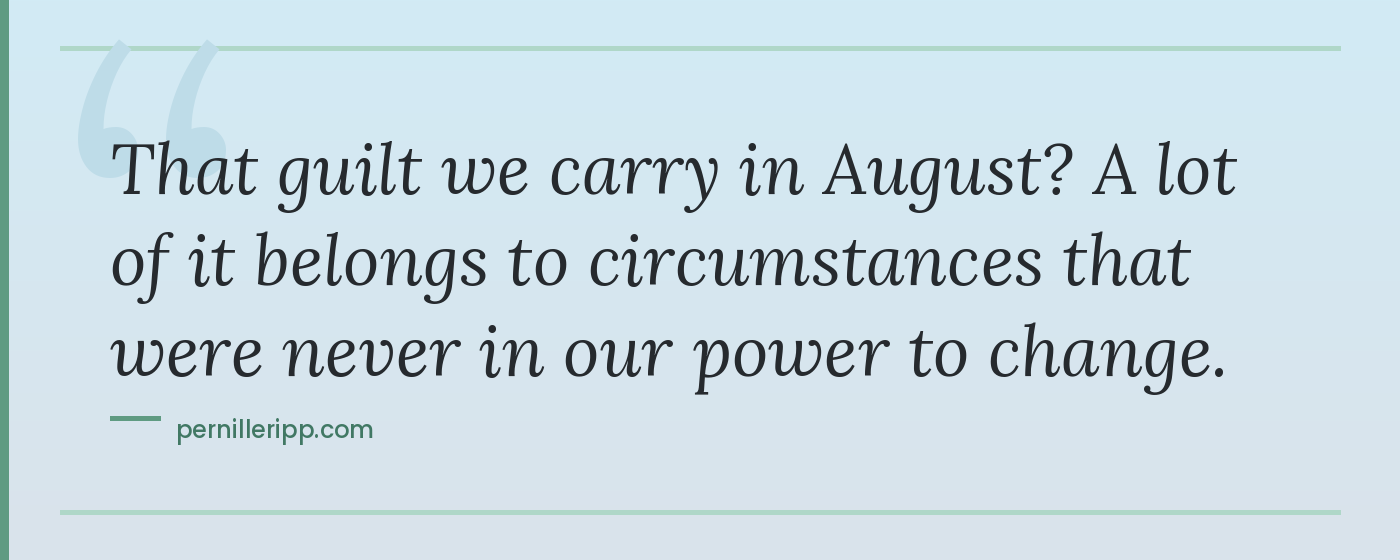
That guilt we carry in August? A lot of it belongs to circumstances that were never in our power to change. We forget sometimes how limited our reach really is once that door closes in June. And naming that is not giving up. It is being honest about where our energy actually belongs, so we can stop spending it on guilt that was never ours to carry in the first place.

Because here is the thing. There are a few things still within our reach. Not all. But a few, and they matter.

Start with curiosity, not books. Before the last week of school, ask the readers in your care what they are actually curious about right now. Not what they want to read. What they are curious about. Dinosaurs, true crime, how engines work, why people get sick. Whatever it is, that curiosity is the thread to pull. Point them somewhere. A book, a magazine, a rabbit hole online. Curiosity is the door — we just help them see it is already open.

Get the actual book into their hand before they leave. Not a list. The physical book, checked out, going home with them. A list is an intention. A book already in their bag is a reality, especially on a Tuesday in July when boredom hits and there is nothing else to reach for. Talk to your librarian now, before the last week. Have books ready. Make the handoff personal because it is.

Write them a note. One sentence, specific to that child. Something that says you saw them this year, that you know something real about who they are as a reader. Kids keep those notes longer than you would expect.

Give them a short survey about people, not books. Ask them who in their life actually reads. Is there a teenager they look up to, a young adult, someone among the adults in their home who might talk books with them over the summer? Most readers have never been asked to think about this. The survey itself is the intervention. Help them name someone before they leave. That name matters more than any list we send home.

Lower the bar out loud, directly to them. Not always “read every day”. But “just keep trying”. Pick something up, put it down, try something else. The goal is a brain that keeps reaching for words all summer, even imperfectly. Tell them explicitly what counts to expand their preconceived notions. Graphic novels, audiobooks paired with the text, nonfiction articles even short ones online, digital reading, news sites written for kids, Wikipedia rabbit holes, chapter books on an ereader. All of it counts. Say it clearly.

And finally, give them a reading dare. Not a class challenge, one dare, one kid. Something specific and slightly ridiculous. A dare that is personal enough that they know you actually thought about them when you wrote it. Readers in our care need permission sometimes to approach reading as something that could actually be fun rather than something they are supposed to do.

We have worked all year to invite the readers in our care into reading, to support their reading lives, to help them see themselves as readers. We cannot control the summer. But we can make sure they leave knowing we believed they were a reader.

That belief is not nothing. Sometimes it is the only thing that carries them through to August. And that is worth holding onto, even when the guilt tries to tell us otherwise.
Reading Identity

Reading Was Never Meant to Compete

We talk about reading as if it is in a race. As if every time a kid picks up a phone instead of a book, reading has lost a point. And I understand why we frame it that way. The competition feels real. YouTube, social media, every platform built around the endless scroll, they are extraordinary at what they do. The additives of a phone and everything that comes with it, the brain chemistry they tap into, the way they are engineered to keep you coming back, it’s a losing race, we cannot compete with that.

But here is the thing. Reading was never supposed to compete.

It is not a faster, quieter version of TikTok. It is not trying to win your attention the way an algorithm does. Reading is its own thing entirely. And the moment we stop treating it like a competitor and start presenting it to kids as something categorically different, something that exists in a completely separate space from their devices, everything about the conversation changes.

Reading offers quiet. It offers balance in a world that is otherwise relentlessly loud. It offers the health benefits we know are real, focus, empathy, stress reduction, the slow building of an inner life that is completely our own. But more than any of that, it offers something increasingly rare: A place where we do not have to perform.

How often does that happen?

With a book, no one is watching. Well, unless you are reading in public, of course. There are no likes, no comments, no version of yourself being constructed for an audience. You get to just be with a story. Not be judged. Not worry about what anyone thinks. That is a selfish indulgence, and I mean that in the best way. In a world that is constantly asking us to consume, to engage, to spend more time on their platforms, reading quietly says: this is for me. Just me. And the way it restores me is something I can’t let go of.

Giving kids the gift of reading is one of the few things we can offer them that pushes back against all of of the consumption and production. Not by banning phones or lecturing about screen time. But by showing them that reading exists in a different category altogether.

If we want kids to see reading as its own thing and not as a lesser version of entertainment, we have to change how we talk about it.

Stop framing it as the alternative to screens. When we say “put down your phone and read,” we immediately set up a competition reading will lose. Instead, talk about reading as something you do for yourself, not something you do instead of something else.

Talk about the privacy of it. Kids live remarkably public lives, even at young ages. I don’t envy my own children in any way when I think of the type of teen years I had, I am so glad there were no cameras ready to record at any moment. The idea that reading is a space that belongs entirely to them, where no one can see what they are thinking or feeling or imagining, is genuinely powerful. Name that out loud.

Celebrate the selfish part. Reading is one of the few things in a child’s life that is purely for them. Not always to improve their grades, not just to make a teacher happy, not to perform for anyone. Let them hear you say that. Reading is something you do because it feels good and it is yours.

Model the quiet. Let kids see you read. Not as a lesson, but as something you genuinely want to do. When they see an adult choose a book, not to be productive but simply to be still for a while, that lands differently than any message we could ever deliver. This is yet another reason to make your reading life public in some way.

Connect it to who they already are. Reading identity is not built through assignments. It is built through the experience of finding a book that reflects something true about you, or takes you somewhere you wanted to go, or makes you feel something you could not name before. Our job is to help kids find those books and then get out of the way.

The algorithm wants our attention and it is so easy to fall into. Social media wants your engagement. Every platform is designed to want something from you.

Reading wants nothing. It just waits.

That is not a weakness. That is exactly what makes it worth protecting and worth giving to the young people in our lives as the gift it truly is.

Reading Identity

When a Child Says There Are No Good Books: A Tool for Conferring

All year I have been working with this one child.

A good reader. Bright. Funny. And yet he hates reading. Tells me there are no good books despite me bringing all my tricks. Book recommendations, book excitement, cheerleading and all of that.

And then I realized something.

It’s an ingrained habit now. A quick dismissal. Because if there are no good books then the work stops. The responsibility doesn’t sit with him. It sits with the circumstances surrounding him. There are no good books. What can you do?

So how do we break that pattern of dismissal?

Not with more recommendations. I’ve tried that. Not with more excitement or more cheerleading. I’ve tried that too.

I think we break it by handing the ownership back. Slowly. With small moves that ask something of the child rather than offering something to them. Moves that say I believe you can find your own way to a book. Let me show you what that might look like.

I put together a free conferring tool with 7 ideas for what to try. Not scripts. Not book lists. Just moves worth trying when you hear those words and I shared them on Instagram. I thought they would be worth sharing here too.

Link: When a Child Says There Are No Good Books — 7 Ideas to Try Now

The goal was never for them to need us to find the book.

It was for them to trust themselves enough to find it.

Reading Identity

When a Child Says They Hate Reading: What to Ask Next

It seems, no matter what I do, it still happens. Year after year.

I started this work in 2010 and the voices were smaller then. Present but quiet. Now, with passive consumerism, with the need to be constantly entertained, with the pressures of life growing for so many kids due to inequity, it seems to have grown to a cacophony of voices. Eagerly chanting. Even from my 1st graders. Before they had even fully learned to read, they would say it.

I hate reading.

I know I cannot be the only one.

So what do we do? How do we speak to them in a way that shows we are actually listening — and also that it doesn’t have to be this way?

I don’t think the answer is a better book recommendation. I don’t think it’s making reading more fun or more gamified or more rewarded. I think it starts with a question. The right question. One that treats what they said as information rather than a problem to solve.

I’ve been collecting those questions for a while now. The ones that seem to open something up rather than shut it down. The ones that get underneath the “I hate reading” to whatever is actually being said. And I posted them on Instagram, and it seems like I wasn’t the only one who needed ideas for this work.

So here, I put them together here as a free conferring tool, something you can print and keep in your folder for those moments when a child says the thing and you want to respond with more than a recommendation.

Download: When a Child Says They Hate Reading — What to Ask Next

It won’t fix everything. But it might start a different kind of conversation.

Reading, Reading Identity

Two Different Loses

What we track. And what we miss.

I keep thinking about the ones who came to us loving books.

You know the ones. The kids who wanted to tell you everything about what they were reading, who recommended titles before you could recommend them first, who couldn’t walk past a shelf without stopping. Somewhere between then and now, they faded into the wallpaper. They still sit in our rooms. They still do the things we ask. But the books? The books stopped mattering to them. Or maybe they stopped believing the books were for them. And somewhere along the way, we stopped noticing that the energy we had poured into them as readers had quietly drained away.

That’s the loss I want to talk about. Not the child who never loved reading — we see that child, we have some ideas for that child. I’m talking about the reader we already had. The one we thought we didn’t need to worry about anymore.

We have systems for the child who stops reading.

Logs. Conferences. Check-ins. We notice when the pages stop turning and we intervene. That system exists because we built it, and mostly it works.

But there’s a second loss we almost never catch. The moment a child stops sharing their reading with us. Stops recommending. Stops bringing things to our desk. Stops starting conversations about books at all.

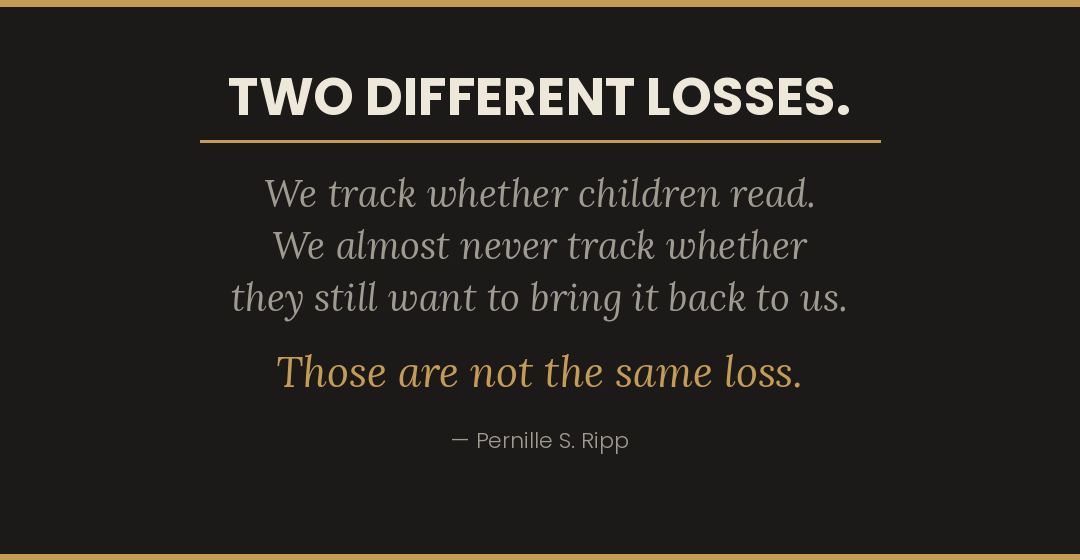
Those are not the same loss.

A child can still be reading every night and you can have no idea what their reading life actually looks like anymore. Because they stopped bringing it to you. And there was no system to catch that. No log for the conversation that didn’t happen. No conference protocol for the reader who went quiet.

We track whether they read. We don’t track whether they still want to bring it back to us.

And those are two different losses.

So why does it happen?

I don’t think it’s one moment. And I don’t think it’s about judgment, not usually. Most teachers I know aren’t dismissing the readers who go quiet. They’re just not getting to them. Because the curriculum needs covering. Because there’s an assessment coming. Because the things that get measured are the things that get time, and a quiet conversation about who a child is as a reader — what they’re choosing, what they’re abandoning, what they’re curious about — that conversation isn’t on anyone’s rubric.

And children notice.

Not in a conscious way. But they are always reading the room. And what the room tells them, slowly and consistently, is that their reading life — the one they own, the one they choose, the one that exists outside of any assignment — doesn’t need to be brought here anymore. Nobody is asking. Nobody has time. And so they stop thinking of themselves as people with a reading life worth talking about. They hand the agency back. Quietly. Without making a fuss.

And we let them. Because the system made it easy to let them.

That’s the loss I can’t stop thinking about. Not the reading. The sense of self that goes with it.

And yet. We are not helpless here.

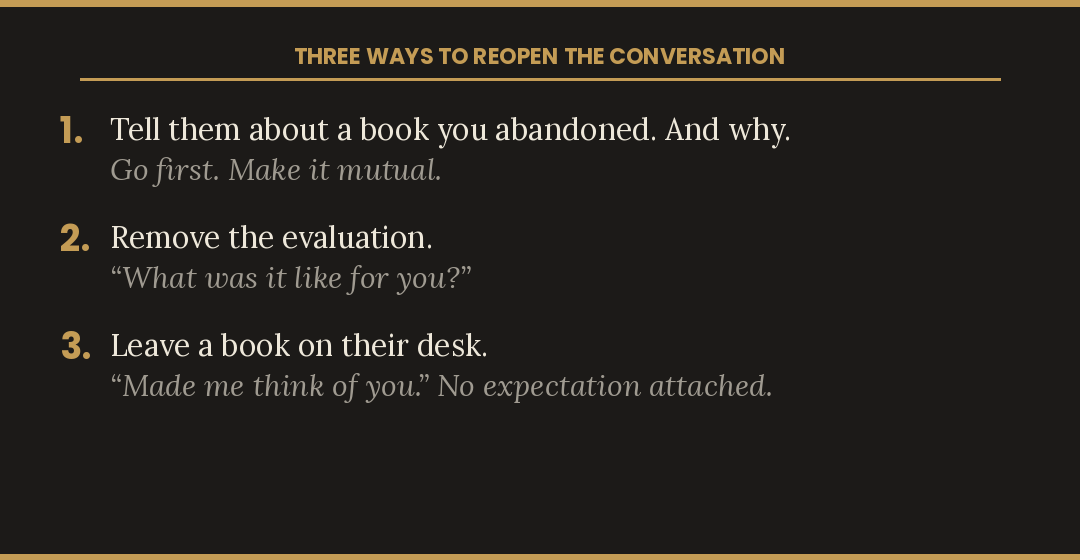
The first one is simple. Go first. Tell a child about a book you abandoned. Not a book you loved — one you put down and walked away from. Tell them why. This does something important: it lowers the stakes entirely. It says reading is a relationship between a reader and a book, not a performance for an adult. And it makes the conversation mutual. You went first. Now it’s safer for them.

The second move is harder because it requires resisting a very natural instinct. When a child does start to share, don’t evaluate. No “did you understand it?” No comprehension check disguised as curiosity. Just: “What was it like for you?” That question has no wrong answer. It hands the agency straight back to them. And children who have learned to be guarded around reading conversations will slowly start to open up when they realize there’s no trap waiting.

The third move costs nothing. Find a book that genuinely makes you think of a specific child — not because it’s at their level, not because it would be good for them, but because something about it just reminds you of them. Leave it on their desk. A small note: “made me think of you.” No expectation. No follow-up. No asking if they read it.

Just the book. And the message that you saw them.

That’s sometimes enough to make a child remember that they are a reader. That someone noticed. That it still matters.

We cannot get those years back. The ones where they loved books and we were too busy to notice when that changed.

But we are here now. And so are they.

That’s enough to start.

student choice

The Thinking Classroom in ELA

Next week, in my 3rd grade Danish class, we’re starting something new — or maybe something old, just done differently.

We’re bringing the Thinking Classroom to our literacy work. I have seen the excitement from it in math, which made me wonder; how can we model the same concept but within ELA (or DLA in my case 😊).

So in true Pernille fashion, I asked if anyone was interested in seeing the slides with prompts I had made in either Danish or English, and it turned out that, yes! Many were interested, thus this blog post. I’ve made about 40 slides filled with open-ended prompts — things that make kids talk, think, argue a little, and notice patterns together. They’ll work in groups of three at whiteboards with pens in hand, no right answers in sight.

Some prompts are silly. Some are uncomfortable. Some might just stay half-finished on the board — and that’s fine. The goal isn’t to finish, it’s to think.

We’ll spend 15–20 minutes at a time exploring ideas like the rules of horror, what truth really means, or how emotions might have colors. The work will shift with them — from laughter to silence to something that feels almost like discovery.

I can’t wait to see what happens next week when we start.

If you want the Danish slides, join my Facebook group: Læselyst i Danmark.

If you want to try it too, I’ve shared all of the Thinking Classroom slides here — take what you need, change what you want, and see where your students take it.

Let me know how it goes.