Reading Identity

Reading Was Never Meant to Compete

We talk about reading as if it is in a race. As if every time a kid picks up a phone instead of a book, reading has lost a point. And I understand why we frame it that way. The competition feels real. YouTube, social media, every platform built around the endless scroll, they are extraordinary at what they do. The additives of a phone and everything that comes with it, the brain chemistry they tap into, the way they are engineered to keep you coming back, it’s a losing race, we cannot compete with that.

But here is the thing. Reading was never supposed to compete.

It is not a faster, quieter version of TikTok. It is not trying to win your attention the way an algorithm does. Reading is its own thing entirely. And the moment we stop treating it like a competitor and start presenting it to kids as something categorically different, something that exists in a completely separate space from their devices, everything about the conversation changes.

Reading offers quiet. It offers balance in a world that is otherwise relentlessly loud. It offers the health benefits we know are real, focus, empathy, stress reduction, the slow building of an inner life that is completely our own. But more than any of that, it offers something increasingly rare: A place where we do not have to perform.

How often does that happen?

With a book, no one is watching. Well, unless you are reading in public, of course. There are no likes, no comments, no version of yourself being constructed for an audience. You get to just be with a story. Not be judged. Not worry about what anyone thinks. That is a selfish indulgence, and I mean that in the best way. In a world that is constantly asking us to consume, to engage, to spend more time on their platforms, reading quietly says: this is for me. Just me. And the way it restores me is something I can’t let go of.

Giving kids the gift of reading is one of the few things we can offer them that pushes back against all of of the consumption and production. Not by banning phones or lecturing about screen time. But by showing them that reading exists in a different category altogether.

If we want kids to see reading as its own thing and not as a lesser version of entertainment, we have to change how we talk about it.

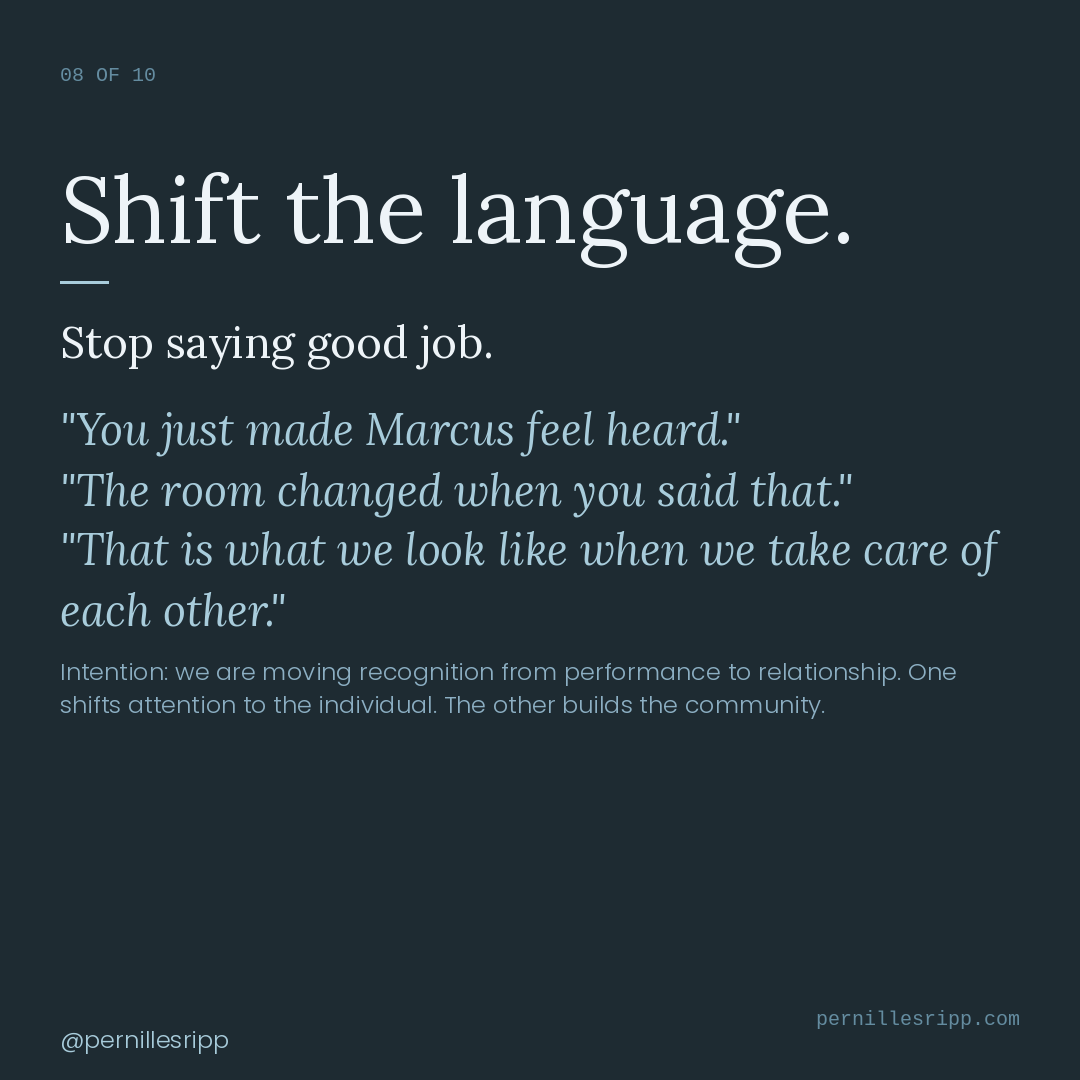
Stop framing it as the alternative to screens. When we say “put down your phone and read,” we immediately set up a competition reading will lose. Instead, talk about reading as something you do for yourself, not something you do instead of something else.

Talk about the privacy of it. Kids live remarkably public lives, even at young ages. I don’t envy my own children in any way when I think of the type of teen years I had, I am so glad there were no cameras ready to record at any moment. The idea that reading is a space that belongs entirely to them, where no one can see what they are thinking or feeling or imagining, is genuinely powerful. Name that out loud.

Celebrate the selfish part. Reading is one of the few things in a child’s life that is purely for them. Not always to improve their grades, not just to make a teacher happy, not to perform for anyone. Let them hear you say that. Reading is something you do because it feels good and it is yours.

Model the quiet. Let kids see you read. Not as a lesson, but as something you genuinely want to do. When they see an adult choose a book, not to be productive but simply to be still for a while, that lands differently than any message we could ever deliver. This is yet another reason to make your reading life public in some way.

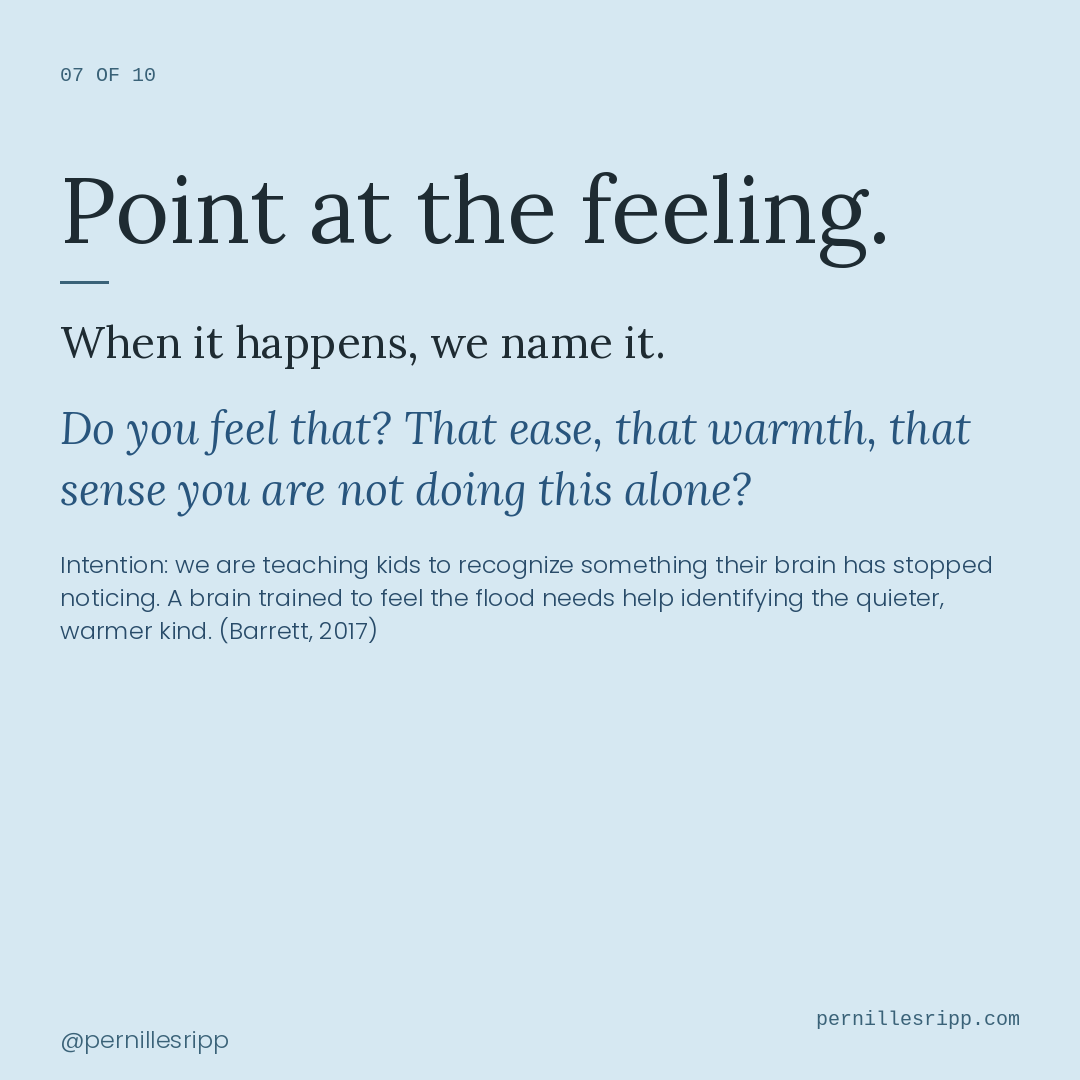
Connect it to who they already are. Reading identity is not built through assignments. It is built through the experience of finding a book that reflects something true about you, or takes you somewhere you wanted to go, or makes you feel something you could not name before. Our job is to help kids find those books and then get out of the way.

The algorithm wants our attention and it is so easy to fall into. Social media wants your engagement. Every platform is designed to want something from you.

Reading wants nothing. It just waits.

That is not a weakness. That is exactly what makes it worth protecting and worth giving to the young people in our lives as the gift it truly is.

Reading, Reading Identity

Two Different Loses

What we track. And what we miss.

I keep thinking about the ones who came to us loving books.

You know the ones. The kids who wanted to tell you everything about what they were reading, who recommended titles before you could recommend them first, who couldn’t walk past a shelf without stopping. Somewhere between then and now, they faded into the wallpaper. They still sit in our rooms. They still do the things we ask. But the books? The books stopped mattering to them. Or maybe they stopped believing the books were for them. And somewhere along the way, we stopped noticing that the energy we had poured into them as readers had quietly drained away.

That’s the loss I want to talk about. Not the child who never loved reading — we see that child, we have some ideas for that child. I’m talking about the reader we already had. The one we thought we didn’t need to worry about anymore.

We have systems for the child who stops reading.

Logs. Conferences. Check-ins. We notice when the pages stop turning and we intervene. That system exists because we built it, and mostly it works.

But there’s a second loss we almost never catch. The moment a child stops sharing their reading with us. Stops recommending. Stops bringing things to our desk. Stops starting conversations about books at all.

Those are not the same loss.

A child can still be reading every night and you can have no idea what their reading life actually looks like anymore. Because they stopped bringing it to you. And there was no system to catch that. No log for the conversation that didn’t happen. No conference protocol for the reader who went quiet.

We track whether they read. We don’t track whether they still want to bring it back to us.

And those are two different losses.

So why does it happen?

I don’t think it’s one moment. And I don’t think it’s about judgment, not usually. Most teachers I know aren’t dismissing the readers who go quiet. They’re just not getting to them. Because the curriculum needs covering. Because there’s an assessment coming. Because the things that get measured are the things that get time, and a quiet conversation about who a child is as a reader — what they’re choosing, what they’re abandoning, what they’re curious about — that conversation isn’t on anyone’s rubric.

And children notice.

Not in a conscious way. But they are always reading the room. And what the room tells them, slowly and consistently, is that their reading life — the one they own, the one they choose, the one that exists outside of any assignment — doesn’t need to be brought here anymore. Nobody is asking. Nobody has time. And so they stop thinking of themselves as people with a reading life worth talking about. They hand the agency back. Quietly. Without making a fuss.

And we let them. Because the system made it easy to let them.

That’s the loss I can’t stop thinking about. Not the reading. The sense of self that goes with it.

And yet. We are not helpless here.

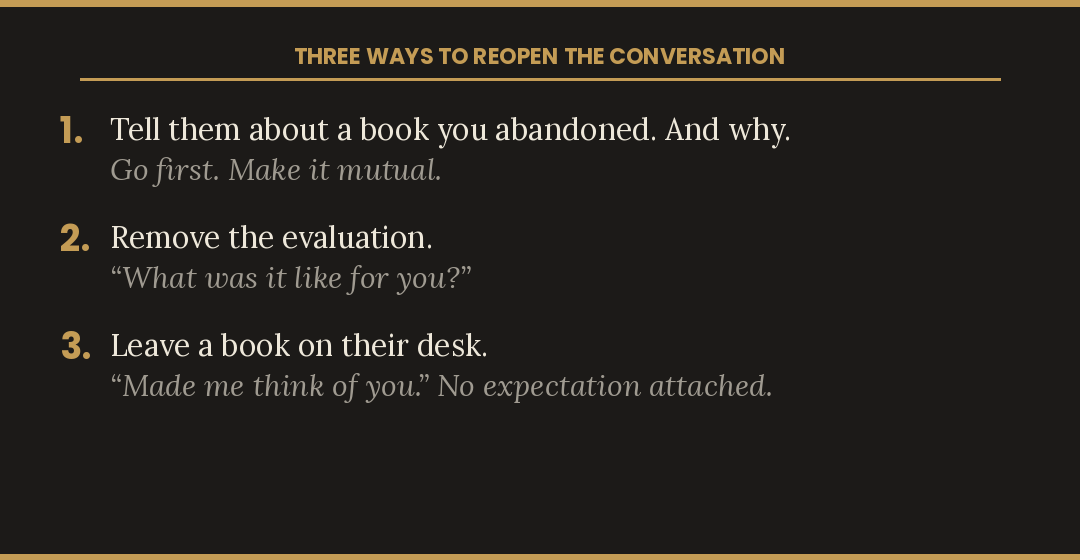
The first one is simple. Go first. Tell a child about a book you abandoned. Not a book you loved — one you put down and walked away from. Tell them why. This does something important: it lowers the stakes entirely. It says reading is a relationship between a reader and a book, not a performance for an adult. And it makes the conversation mutual. You went first. Now it’s safer for them.

The second move is harder because it requires resisting a very natural instinct. When a child does start to share, don’t evaluate. No “did you understand it?” No comprehension check disguised as curiosity. Just: “What was it like for you?” That question has no wrong answer. It hands the agency straight back to them. And children who have learned to be guarded around reading conversations will slowly start to open up when they realize there’s no trap waiting.

The third move costs nothing. Find a book that genuinely makes you think of a specific child — not because it’s at their level, not because it would be good for them, but because something about it just reminds you of them. Leave it on their desk. A small note: “made me think of you.” No expectation. No follow-up. No asking if they read it.

Just the book. And the message that you saw them.

That’s sometimes enough to make a child remember that they are a reader. That someone noticed. That it still matters.

We cannot get those years back. The ones where they loved books and we were too busy to notice when that changed.

But we are here now. And so are they.

That’s enough to start.

student choice

The Thinking Classroom in ELA

Next week, in my 3rd grade Danish class, we’re starting something new — or maybe something old, just done differently.

We’re bringing the Thinking Classroom to our literacy work. I have seen the excitement from it in math, which made me wonder; how can we model the same concept but within ELA (or DLA in my case 😊).

So in true Pernille fashion, I asked if anyone was interested in seeing the slides with prompts I had made in either Danish or English, and it turned out that, yes! Many were interested, thus this blog post. I’ve made about 40 slides filled with open-ended prompts — things that make kids talk, think, argue a little, and notice patterns together. They’ll work in groups of three at whiteboards with pens in hand, no right answers in sight.

Some prompts are silly. Some are uncomfortable. Some might just stay half-finished on the board — and that’s fine. The goal isn’t to finish, it’s to think.

We’ll spend 15–20 minutes at a time exploring ideas like the rules of horror, what truth really means, or how emotions might have colors. The work will shift with them — from laughter to silence to something that feels almost like discovery.

I can’t wait to see what happens next week when we start.

If you want the Danish slides, join my Facebook group: Læselyst i Danmark.

If you want to try it too, I’ve shared all of the Thinking Classroom slides here — take what you need, change what you want, and see where your students take it.

Let me know how it goes.

authentic learning, challenge

7 games to promote brave questioning

When I first moved back to Denmark, I had the privilege of working in marketing—a completely different field from teaching, but somehow familiar. Everything was new: teams, assignments, routines. It was exhilarating, exhausting, and, unexpectedly, deeply thought-provoking when I considered my work as a teacher.

One of the first things I had to learn, fast, was how to ask questions. I knew very little, every day I was surrounded by people who knew far more than I did, even those fresh out of school. My gut and past experience were all I had to rely on. And so I asked questions—constantly. Not because I wanted to seem smart, but because I wanted to learn, to understand, to avoid assumptions that could lead me completely astray.

Even now, I ask a lot of questions. I would rather ask and realize I already know, than assume and be wrong. It’s a habit I try to bring into my classrooms every day.

We tell our students the same thing: ask questions, share your ideas, don’t be afraid. And yet, we also know it’s not easy. It’s hard to speak up when everyone else is silent. It’s hard to admit you don’t know something, especially when you’re unsure if your peers will be kind—or if they even care. And in a world dominated by AI answers, misinformation, and polarizing rhetoric, the courage to wonder, to experiment, and to be wrong can feel more vulnerable than ever.

This is why we continue to focus on questioning as a core part of learning. Not just the act of asking, but creating spaces where students feel safe enough to risk it. Where curiosity is valued above correctness. Where play and collaboration make questioning something natural, not intimidating. Because the ability to ask, to wonder, and to explore ideas is not just a classroom skill—it’s an essential part of growing up in a world that constantly challenges what we know and what we believe.

So how about a few ideas that do just that?

Curiosity is at the heart of all learning—and asking questions is the brave part of that. When we give students the space to wonder, to take risks, and to speak up, we’re teaching them far more than facts. We’re teaching them how to think, how to explore, and how to navigate a world that often values certainty over wonder.

As teachers, our job is to make that bravery feel possible. By using play, collaboration, and experimentation, we can help every child see that their questions matter, their ideas are valued, and their curiosity is worth showing—even when it feels scary. Because when students feel safe enough to wonder, that’s when real learning happens—and the joy of discovery follows them long after they leave the classroom.

being me, new year

When the Back-to-School Nightmares Start

I had my first back-to-school nightmare yesterday.

Woke up feeling unprepared, heart in my throat, and all sorts of nervous. It was nothing special, the standard one where everything starts off smooth, and then all of a sudden everything falls apart. I am unprepared, lost, and being evaluated. I woke up in high alert, what do I need to do right now in order to not get there.

School starts August 11th in Denmark, and on that day I get to take on the role of homeroom teacher for two 3rd grades. I get to continue with the class that has made me a teacher in Denmark, and then I get to add their neighbor class to be mine as well. And the nervousness is real.

After all, how do you split yourself between two classes like that? How do you make sure that both classes know that they matter? How do you invent, create, reflect, and ponder without overworking yourself? How do you make each kid feel seen when you are split evenly between two communities that both need you in unique ways? How do you show up in the way that you know matters, when these new kids are wondering how much you will be their teacher and whether *you will be with us a lot, Pernille?*

It almost feels like I am welcoming my second child, hoping that my heart will stretch enough to love widely, knowing that it will.

But tell that to my nightmares.

In the past, I would have thrown my into prep wok, spending countless hours planning, conceiving, creating. I would have gone in for hours, trying to get it just so, trying to work my way through my nerves. Making copies until I could feel my anxiety ebb.

But not now. Not anymore. Instead, I garden. I bake. I go to cross fit. I read. And sure, I dream a little. I reflect on how I want that first day to be framed. I consider how I want to get to know them, and how we want to continue to build their community.

So I plan. But differently now, a plan where I don’t drown, and summer just feels like the checklist item to be done before another school year. I plan for presence. For slowness. For the moment when a child looks at me and wonders, Are you really here with us? and I can say yes—not just with my words, but with the way I show up. And to do that I need to not work. I need to not stay in that space where teaching takes up most of me. Because that doesn’t fill me in the ways I need to be filled, in order to go all in.

So I give myself permission to pull back. To trust that stepping away is also a kind of preparation—that rest is not a pause in the work, but part of it. Because when I give myself space to breathe, I make space for them too.

I think about how I want that first day to feel. Not just for them, but for me too. I want it to feel calm. Possible. Like a beginning, not a performance. I want them to know I see them, both classes, both groups of humans who deserve a teacher that isn’t running on empty.

And so, instead of drowning in to-do lists, I remind myself of what I already know: that the magic isn’t in the deeply detailed plans or the laminated name tags – although those will come. It’s in the way we build trust, one small moment at a time. It’s in the way I let my heart stretch and make room—just like it always has.

If you’re waking up from your own back-to-school nightmare, you’re not alone. This time of year is heavy with what-ifs and should-dos. But maybe the work isn’t to prepare more. Maybe it’s to believe more—in who you already are, and the teacher you’re still becoming.

We’ll be ready. Not because we’ve done it all, but because we’ll be there. And that matters more than anything else. We’ll be ready, because that’s what we do.

being a student, being a teacher, reflection, Student Engagement, Student-centered

Would I like being a student in my own classroom? A reflection tool

One of my driving questions for the past 15 years has been a simple one; at the end of the day, would I like being a student in my own classroom? And as I have one month left of school, I feel the question pressing in on me as I think of next year and both the joy of continuing with my current class, as well as becoming the classroom teacher for a different class.

Would what we do make me feel safe? Help me engage? Make me feel like my voice was heard and respected? Would the way we learn, grow, discuss, and assess make sense to me?

This question is a conversation starter, an invitation into meaningful reflection where you get to craft the path for what you may need to shift or tweak your day-to-day practice.  Because ultimately it is about creating conditions for shared power as a way to show children just how much power they can have over their own bodies and minds, even within the confinements of a publicly mandated and government decided educational system.

In fact, this question is at the core of my newly published book, Passionate Learners – How to Engage and Empower Your Students, now in its 3rd edition! But it’s not the only question, I ask. In fact, the books has more than 100 reflection questions embedded throughout, some big, some small, all meant for you to carve your own path into a more sustainable, meaningful practice.

But as a way to get you started, I decided to pull together a reflection sheet for you, modeled after questions in chapter 2 of the book.  It’s 3 pages with 12 questions, that can be used by itself, as part of a larger reflection, or a book study, individually or with others. You can do some of the questions or just a few. You can write, discuss, or simply think. It’s a tool, use it as such and make it work for you. 

👉 Link to the tool right here

And if you are interested in diving deeper, I highly recommend my book. I poured my heart into it, making it a practical invitation into co-created spaces that are not exhausting to be in. And right now, it is on sale.

The book is written as a companion to the practice you already have. It is not meant as a long list of abbreviations or new systems, but instead a way to help you reflect, while also offering up a major array of practical strategies and tools that you can use the very next day.  It is meant as an affirmation, while also giving you access points to grow your practice so that you may feel better about the time you spend teaching, the students feel like what you do together matters, and that everyone is given tools to continue being critical questioners and thinkers outside of your learning space.

Is it worth it? You can see the reviews from other educators here

Whether you buy the book, or simply follow my work on Instagram or Facebook, just know that I am here to help.

👉 Access the PDF right here