balance, Be the change, being me

The Work That Still Works

It has been ages since I have written here.

Not created content, not shared ideas, but simply written in the ways that I have been writing for so many years. A familiar refrain, a coat that fits just so, but left forgotten in a closet because who has time to take it out?

It seems I moved to Denmark and forgot parts of myself.

As with so many other things, there are many reasons. We moved back home, but home was something brand-new. I had to create a support system for everyone in the move, which also included two of my children receiving neurodivergence diagnoses that finally made so many things make more sense. I had to learn how to be a teacher in an education system that I have only ever been a student in.

And so I put my head down, and I took the steps every day, trying to get all the pieces to fit together, even though the instructions never came, and the pieces seemed to change overnight.

And I ran, and I felt I couldn’t share because what we navigated was too hard at times, too raw, too foreign—even though it shouldn’t have been—and I knew I would have found solace in sharing out, but also felt that this story was one that had little importance, while the world we had left behind seemed to light on fire. And it didn’t feel new or worthy, because the whole world is filled with glitz and glam, and influencers telling you that they indeed hold the key to happiness.

But now, I am here. Back in this space, still holding hope that there is a space to return to.

Because the work is still there. The need to shout for more sanity, to slow down, to get back to basics, even though there are so many forces that work against us.

And so we take the basic steps every day to retain dignity, to further understanding, and to create spaces where children get to be fully human.

This year, I took over a parallel 3rd grade, a bunch of incredible kids who, through circumstances beyond them, have had a slew of incredible teachers who haven’t been able to stay. And so, rightfully so, they demand a lot of the adults who now get to be their teachers, because why should they trust us to stay when so many others have left?

And so we have done what we have always done: we have slowed down. We have integrated morning meetings every day, we have reclaimed independent reading. We have taught conflict solutions for them to use before they come to us. We have talked, and talked, and talked—but not at them, with them—giving them ways to voice their worries, their hopes, and their ideas. We have differentiated the work, given them more freedom to move, to shape their learning, so that they too can answer how they learn best.

And I have wanted to share about all the progress that we have built, but is there really a way that something as simple as starting with a morning meeting, and how simply asking children to hold space for each other’s voices, can help another educator out there?

Because it is not flashy. It is basic. And it is being pushed out of our schools at alarming speeds, replaced with more learning, more rote, more prepackaged programs. And in this rush, we forget that gathering in schools is also meant to simply gather us. And when so many of our children gather more and more behind a screen, they don’t know how to gather on the floor unless we make the spaces for it.

Unless we hold on to the value of it.

Unless we stand steadfast and refuse to let the invented urgency of more curriculum drown out our common sense.

And so we plan for it, because we see the inherent strength of asking others to listen, to set their needs aside while others speak, to wait their turn, and then know that when they do speak, others do the same.

And so, I sit in the light of my soon-to-be taken-down Christmas tree, and I recognize the need for simplicity. For recognizing and owning that I don’t want to create simply to produce. That what works for me still works. Basic, down-to-earth ideas that may not be flashy or glitzy, but at their core recognize the humanity of the children we teach.

And so, for now, I am here. I will share. I will hold space for those of you who are also running every day, who also feel that what you are doing is maybe not the flashiest of work, but Lord knows, it works. And we see it in the way the kids carry themselves. How they ask us whether we can do a morning meeting when our schedules are changed. Who want to share all the things they have been holding in. Who come to school knowing that when they are not there, they are truly missed.

Perhaps I was missed too, here. I am not sure, but I know I missed this.

authentic learning, Be the change, being a teacher

Protecting Our Practice: What’s Working and How We Keep It

For the past 3 years, I have been sharing resources on my Patreon, with that being shut down, I figured I would share some of them here. This is one of my latest posts, I hope it is helpful.

If there one thing that is constant in education, it’s change. I think it’s what drew me to be a teacher in the first place, besides the kids, of course. Education is full of change. New ideas, new programs, new expectations—always something new to implement, improve, or undo. And yet, we rarely stop to ask:

What’s actually working?

Not in a “let’s be grateful” way. Not to ignore what’s broken. But in a real way—naming the things that are making a difference for kids right now and figuring out how to keep them from disappearing.

Because the best things in education? They don’t vanish because they stop working. They vanish because no one gets to protect them.

Five steps to protect your real best practices

Instead of just naming problems, try this instead:

1️⃣ Name It

What’s actually making a difference right now?

Not “what should be working” or “what’s supposed to work”—but what’s really helping kids learn, feel safe, or stay engaged?

This could be:

• A structure that supports all learners

• A routine that fosters belonging

• A teaching practice that engages even the hardest-to-reach kids

Think about your classroom, your team, your school. What’s worth protecting?

2️⃣ Figure Out Why It Works

• Is it because of a system in place?

• A shared school-wide effort?

• A few committed teachers holding it together?

If something only works because a few people are giving 200%, it’s fragile. The goal isn’t just to notice what works—it’s to understand why it works.

3️⃣ Ask: Is This Replicable?

Would this still work if new teachers joined? If leadership changed? If budgets shifted?

If the answer is no, then it’s not protected.

Good practices should outlast the people who start them. If what’s working is too dependent on individuals, it’s time to build structures that make it sustainable.

4️⃣ Make a Plan to Protect It

The best ideas don’t survive unless someone fights for them. So, as a team, ask:

• What do we need to keep this going?

• Who needs to see its value so it’s supported long-term?

• How do we make sure this isn’t just an “extra,” but a part of how we do school?

If something is working, it should be built into your school’s foundation. Not just something you “hope” stays.

5️⃣ Keep It Visible

The next time a new initiative rolls in, a funding shift happens, or a schedule changes, pull out this list and ask:

❓ Will this change threaten what’s already working?

❓ How do we keep what’s good while making space for new ideas?

We lose the best things in education when no one names them, protects them, and reminds people why they matter. So make the list. Keep it visible. Use it to push back when needed.

Your Turn

What’s working in your school right now that must be protected? How do you make sure it lasts?

Try this with your team. Then come back and tell me what showed up.

Be the change, being me

Living in the Rain

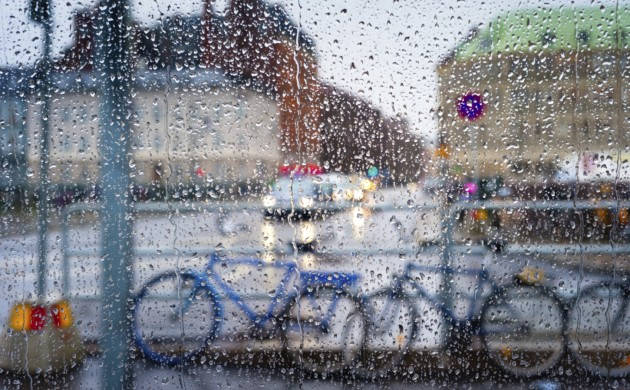
It has been seemingly endless days of rain in Denmark. A drizzle. A storm. A dusting. Sideways, straight down, diagonal to hit every part of you, relentless, endless.

Every time you go outside, the rain pelts you, the wind blows up your umbrella – you arrive just a little bit soggy. Your hair a mess. Grateful for the shoes you at least did think to wear, knowing that the ones you pined for would have left your feet a soggy mess. Layers, wool, and waterproof – such is the fashion these days.

The sun hides behind endless clouds giving us a slim 7-hour window of being greeted by it – we leave in the dark, we come home in the dark. The forecast meticulously studied, my body naturally gearing itself toward any windows that offers just the smallest bit of light. Has my seasonal depression phase started?

Image from the Copenhagen Post – my rainy images don’t look this nice

It is what I had warned my husband about. He who had only ever experienced the glory of Danish summers, the long nearly unending summer nights stretched ahead. He, who thought, we should take the chance offered us to build our life in a new country.

I tried to warn him. Doing the best I could to give him the absolute reality of what it means to live in a country where hygge originated. There is a reason for the lighting of all those candles after all. Did he really understand what a Danish winter would feel like after months of rain and wind? Was he sure he wanted to give up the pristine winter days in Wisconsin where, sure, the cold can kill you but the beauty also leaves you breathless? It might last longer but it had skiing, sledding, and surprise snow days. Not everyday drudging through the rain, not the wind in your face as a constant companion.

As I complained yesterday of how soaked I was after my bike ride to the train station, lamenting how the rain is wearing me out, he told me I had it all wrong. Had I considered how little it had rained? How few days we have truly been soaked through? How warm we have been for so many days?

That perhaps I could focus on other things while still feeling the rain?

That I had made him believe that the rain would be nonstop starting in October, soaking us until March, and instead we have had glorious fall-colored days. Had I forgotten how the sunshine beckoned us outside, the color of the leaves changing so slowly that they seemingly hung on for months?

Had I forgotten the days with snow? Where our winter-loving children bounded out the door to build a snowman before school. Where their red noses and glistening eyes told us all about the snowball fight they had at school – “…with permission, mom!”

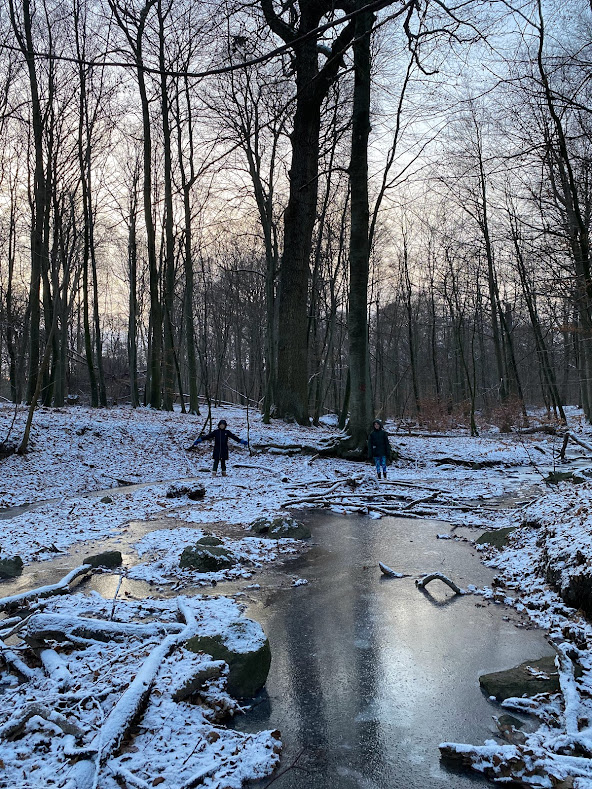
Or what about the days filled with ice? Our footsteps finding any small frozen-over puddle that we could just to hear the satisfying crack as the layer of ice broke by the force of our foot?

Or the days that already felt like spring, how the sun slowly is coming back but until then we light our candles, wear our wool-socks, and still continue to go outside, embracing this season that soaks the earth. Living in the moment, rain or not, breathing in the wonders of this season.

A difference in perception so grand that I don’t know how I missed all of the things he noticed?

It makes me think of teaching. Of how my relentless optimism finally ran out in the midst of the pandemic. How I started to see more rain than sun. How every new opportunity quickly felt like a challenge. How I mustered every day, slipping on my practiced smile, but cried so often in my kitchen.

How I so often heard only the complaints of the kids who hated what we were doing. How I so often focused on the few that clearly disliked me, our class, and our school. How in the season I was in, I only felt the rain because I couldn’t feel everything else, I didn’t have the energy to. I didn’t have anyone with power left telling me to look for the good because so many of us were drowning.

How I tried so hard to feel like I was enough to do all the things asked of me. And I just wasn’t. I am not sure anyone is right now.

And I tried to see all the good. I knew it was there. I knew I was lucky. But in a broken system that only demands more of you without taking anything away, we are made to feel as if we are the problem, rather than the system itself. And so often we are too afraid to say anything. After all, who wants their kid taught byt the teachers who complains?

But I wonder about the difference in perception from us to our students. Would they also say that these years have been the hardest years? Would they also say that the system is broken? What would they say if we asked them?

How often do we ask them?

I asked my students all the time what I could change, how I could grow, what else should we do? I am glad I did. After all, we cannot enact change if we don’t know what to change.

But I often forgot to ask them what we should keep? What they loved or liked? What worked for them? What did they see as positives?

And I wish I had. I wish we did it as a school. I wish parents did before they complain about what teachers are now doing.

I wish we offered educators up more true chances to take a moment and recognize the good. To be recognized for the good. For us to have a moment to breathe and relish that we are doing hard things every single day. That many kids do enjoy coming into our spaces. That many children do like being in our classes.

And not in a superficial way by giving us a donut, or a jean day, or some quickly written email. But by a full recognition of how despite the educational challenge being as hard as it is, we still show up. That despite all of the craziness surrounding education, we still come to teach every day, every kid.

And then we fight to keep the good. We fight to keep the components that make school meaningful; the plays, the assemblies, the read alouds, the contests, the time for creative writing, independent reading, experiments and experimental learning. The curriculum that asks us to think critcally and speak bravely. The texts that show us what humanity really looks like.

And we are protected by the administration. And by the community. And by the kids themselves.

Perhaps a dream, but a glorious one nevertheless.

And perhaps we recognize that yes, the rainy days will continue, the wind will continue to blow us back, but with others surrounding us, we will get to a new season. That within the rain and the wind, there will still be moments where we look up and marvel. Where we can stand in a moment and say that, yes, this is where we are meant to be. That for many kids we teach, this is not the worst season. And so we embrace those moments longer than we do the bad. We open our arms, tilt our faces to the sun and stand still knowing that this moment right here may not make it all worth it but it makes this day worth it.

And we take it day by day, sometimes hour by hour if we need to. And we fight, and we push back, and we raise our voices to reestablish the boundaries that have been wrestled from us.

And we plant our feet, squarely in the soaked earth, and we plant the seeds that the rain allows us to nourish, knowing that some day, the kids we teach will grow up to be teachers themselves, to be parents, and community members, administrators, school board members, and politicians, and that hopefully they saw us embrace what it meant to teach courageously. What it meant to set up boundaries. What it meant to fight for all kids to be safe within our spaces. And what it meant to weather the storm when we could but also walk away when we found ourselves alone.

I know the rain will continue even as we inch nearer to spring. I know the short reprieve we have right now as I write this is shortlived, after all I saw the forecast. But I will put on my trusty boots, I will continue with my day, and I will still go outside, better equipped, with a mind at peace with this moment in time. Knowing that while the rain soaks me it also soaks the seeds we have planted for a future we cannot see yet. How about you?

aha moment, Be the change, being a teacher, being me

On Change

We have settled in. Sort of anyway. The kids know how to get to school, when to leave, where the parks and library are. We meal plan, have Friday night movie nights, and try to be outside as much as possible as fall is here and the leaves are changing. We have ideas for how we want to fill our time and sometimes they come to fruition. I have never felt so adult in my life.

And yet, I still feel unsettled. My routines are partially in place, I get to work on time, get home on time, cook meals, and put the kids to bed. But the other things that make up a life are still not there really. I am out of my reading routine, I am not sure when to call people that I normally talk to, I am posting on social media at the wrong time. I don’t even feel like I know how to dress anymore. And what am I even anymore now that I am not teaching kids actively?

And so I dream of the things I want to do, waiting for that right time. When life has finally settled more. When the kids seem to be okay. When I feel right for longer stretches of time. But when will that happen? Do we ever really feel well-rested and fully ready to take on anything?

Change is hard when ordinary life is overwhelming. When we tread water and try to just make it to the finish line of the day.

Change is hard when we have been in the same place for a long time. We know how to make things work, so why rock the boat?

Change is hard when we have to worry about the daily lives of others, make sure that we don’t up-end too much because who knows how it will reverberate in the future.

Change is hard when it is just us trying to make our way.

It seems there is no time when change is not hard.

I have wanted to winter bathe for years. In Wisconsin, there wasn’t much time for it. But here in Denmark, it is everywhere. I spoke my idea aloud to my husband, tried to sign us up for a membership (sauna included after the dip) but was told there were no open member spots.

Friday night, I got sick of waiting for the time to change. For life to feel under control enough for me to take more on. After all, there is no guarantee that that will ever happen. I cannot think of a time in my life when time was abundant and energy was too.

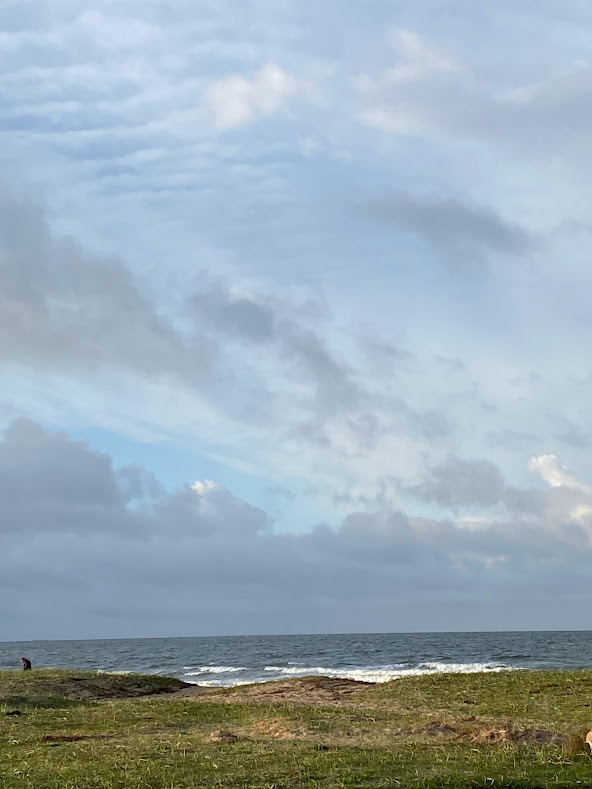
So Saturday morning we drove to the ocean and ran into it. 53-degree air temperature. It was not warm, not winter either. And we ran out and huddled in our towels and laughed. This morning we did it again.

Enoe is gorgeous and 10 minutes from our apartment

We don’t have access to the sauna. I don’t have my flip-flops, they are in a shipping container coming our way. We each have one towel which tends to be damp most of the time. There is sand everywhere in our car. We are probably not doing it right, I think we are supposed to sit in the water for longer.

But we feel alive. And we like it. And we want to do it again. It was just the change I needed to feel good about the now we are in.

Change is funny that way. We can wait for the right time in our lives to finally change. We can wait for the big moments such as a move across the world to finally change. We can wait for others to tell us, to make us. Or we can simply take a step and make the change we have wanted for so long.

I could have waited for our membership to go through. I could have waited to get the right gear. To grow bolder. To grow older. For the time to feel more right.

But I didn’t. Because the change was needed now.

How often do we wait for the right time in our classrooms to change? How often do we think, “next year”, or when I switch grades, or when the time is better. Or even when I am not just trying to survive every day. Our routines save us time and time again but at what cost?

So what are the changes you have been dreaming of? What have you been too afraid to do?

The time will never be right, so consider what you can tweak? What can you replace so it doesn’t feel like more is added? What is that unit? That lesson? That shift in practice you have wanted to try?

If you are scared, tell yourself it is a pilot. Allow yourself to try and know that it doesn’t have to be permanent. We jumped at the chance of moving home because we knew we could return to the US if it didn’t work it (it wouldn’t be easy to relocate don’t get me wrong but that door is not closed).

If you feel there is no time, audit your schedule; where can you fit it in? (What might you pause in order to try something new).

If you feel there is no support, involve your students in the planning. Their excitement often carries us through.

If you don’t know what to change but know there is a need; ask your students. What works? What doesn’t? What are their dreams and hopes? What can you plan together?

I spoke of moving home to Denmark for years, casually mentioning it, and always thinking “some day.” But to take the leap, to say yes, and actually do it has been the scariest adult thing I have done since having children. And it is easy to get paralyzed by that. It is easy to feel like that change was enough change and now we settle into our routine as quickly as we can.

But it turns out there are still many other new things to try.

The change continues. What is the life I have wanted to have for so long? What are the routines I wanted to change? How do I want to raise my children? How do I want to live my one and precious life to quote Mary Oliver?

Because we can wait for the time to be right.

Or we can embrace the time that is now.

It doesn’t have to be perfect, change never is, but it can make us feel alive again.

Don’t wait. It’s not as scary as it sounds.

In fact, you could say, come on in, the water is just fine.

PS: Are you looking for coaching or virtual presentations? I am available and would love to support your work. Whereas I am physically located in Denmark now, I can travel if needed. In fact, I will be in the US and Canada in February 20223.  If you would like me to be a part of your professional development, please reach out. I am here to help. For a lot more posts, resources, live and recorded professional development, please join my Patreon community where most of my sharing takes place these days.

Be the change, being a teacher, being me, punishment, student choice

A Small Question to Help Further Build Positive Relationships

I was speaking to my husband who is a first-year teacher and the topic of navigating student discipline came up, as it often does. He teaches middle school like me, and if there is one thing I know about middle-schooler it is how often they do not think through their decisions before they act. It leads to a lot of funny moments, but at times, also a lot of behavior displays that can be rather disruptive to the rest of the class or to themselves.

He asked me what I do when a child continuously disrupts. How do I approach them to help them change? And while I laughed a little because I am not sure that we can really make a child change, I do believe that there are ways we can invite them into a conversation about their choices without jumping right into punishment. And that has been a major change for me; slowing down before jumping to conclusions, but then how do you do that at the moment when perhaps you also feel heated and a bit indignant at yet another disruption?

I use a simple question, “Are you okay?” before proceeding with any decisions. I have used it so often that it is now hardwired into my language. This is to slow me down, to increase communication, to recognize behavior as a way of communication, and to center my approach in unconditional positive regard.

When I first started using it many years ago, I had to really think about it. Our brains are wired to jump into decision-making rapidly, in fact, educators reportedly make thousands of decisions every single day, each one opening a new instructional possibility. No wonder we often switch into a rapid-fire mode when navigating a child’s seemingly poor decisions; we have so many other things to juggle at that moment. But it is often this automaticity that can backfire in the long run, rather than recognize the uniqueness of the situation at hand, we treat it as if it is routine. Perhaps sometimes it is when handling a child’s repeat decisions. And yet, we must come into each situation recognizing its uniqueness and its opportunity for exploration. Asking, “Are you okay? “ and following up with “This does not seem like you…” (even if it is a repeated behavior pattern) signals that we are concerned about the human in front of us and not just the choice they have made.

That pause also allows us to recalibrate ourselves and get our emotions in check before proceeding further with a conversation. This can make the difference between strengthening a relationship or doing further damage.

Of course, if students are engaged in dangerous behavior, such as fighting, or physical destruction on a larger scale, I don’t often use this approach. When safety is at risk, other communication methods are used, but this does not happen as often as our brain sometimes wants us to believe. Slowing down, seeing the child as a child, no matter their size, and recognizing the inherent power imbalance at play, can help us navigate many behavioral situations.

And more importantly, I am worried about them and their well-being. So why not ask before we jump to further conclusions?

This post originally appeared in my Patreon community, where I share weekly lesson plans, resources, curated book lists, mini-pd recordings, and also live Q&As. If you would like to learn more frequently with me, I invite you to join. If you are wondering where I will be in the coming year or would like to have me coach, collaborate with your teachers, or speak at your conference, please see this page. If you like what you read here, consider reading my latest book, Passionate Readers – The Art of Reaching and Engaging Every Child.  This book focuses on the five keys we can implement into any reading community to strengthen student reading experiences, even within the 45 minute English block.  If you are looking for solutions and ideas for how to re-engage all of your students consider reading my very first book  Passionate Learners – How to Engage and Empower Your Students.

Be the change, being me, end of year

On Counting Down the Days…Again

Make those last days count Design

An older post from 2017 that still rings true today. I will not do a countdown for many reasons, even if I know how many days I have left. While the belief started as an epiphany of the wildness it was creating, it now rests more solidly in the notion that not every child has a safe place to be during the summer. And while this year of teaching has been like no other and every single person involved with schools deserves a break, to step away from simply making it through the day, I still know that for some being out of school does not allow them to thrive in the ways I hope every child has the possibility to; with food, a bed, adults to supervise and care, learning opportunities, and true rest. We can still celebrate a conclusion of an extraordinarily hard year without counting down the days together. We can still be glad to have the chance to step away to recharge without notching days.

The other day I was asked, “What is the one thing you would tell teachers to stop doing as the end of the year nears?”  I needed no time to think because my answer is simple; the countdown.

I used to do the countdown with my students.  20, 19, 18 days left of school.  Each day the kids would get more excited.  “We are almost out of here, Mrs. Ripp!”  They got crazier as the countdown neared the end, energy barely contained, and I loosened the reins, had fun, did less curriculum and more community building.  Except the days dragged on.  The kids grew restless, and I even started looking at the clock, wishing the day to be over.  Was this what teaching the last few weeks of school would always be like?

Six years ago,  after a particularly trying week, I had an epiphany – one that many have had before me.  I was creating the excited mess unfolding every day in my classroom.  My choices in doing a countdown and stepping away from our routines were signaling to the kids that school no longer mattered.  That what we were doing no longer mattered.  That all they had to do was wait it out and then this, too, would finally be over.  As if our students needed any more reminders that school is not a great place to be.

So I stopped the countdown, I went back to teaching and have not looked back since.  Because while the countdown may be fun on the surface; another way to show off student accomplishment – you made it through 7th grade! -it also sends a much deeper message; we are done with the year.  I am done with you.   Is that really what we want to tell our students?

Yet, this is not the only reason I hate the countdown.  One year, a child cried under his desk on the last day of school.  Inconsolable, I asked him what had happened.  Had someone said something to him that I had not caught?  Instead, he looked up at me, tears running down his face and said, “Don’t make me leave…I don’t want to go on vacation, I want to stay here.”  I cried with him and did the only thing I could, hug him and tell him I would always be here for him if he needed me.  Yet, his words have stayed with me all of these years.  This child did not look forward to summer.  This child faced a summer of unknowns, of food shortage, of not knowing who he would live with, of who would care for him.  Summer did not represent a break, but an uncertain future where he had to carry the weight of a society who has very few safety nets for children in poverty and home adults who are trying to survive.  Our classroom was his safe space.  In our classroom, he felt cared for, knew he would eat, and knew he had people with him. Outside of school that wasn’t always the case.  By counting down the days, I was reminding him every day of what was ahead after that last day of school; uncertainty, fear, hunger.  None of those messages were what I hoped to convey to my students. None of those messages were what my silly countdown was meant to convey to him. And I am sure there have been others who silently dreaded the end of school, who didn’t show it through their tears but kept it inside or showed in other ways. Who didn’t excitedly tell their peers about all the things they couldn’t wait to do but instead hoped that they could stay together, sta where they were, instead of walking out on that last day of school. So while school certainly doesn’t represent safety for all children, for some it does.

So It is not that I don’t know how many days are left.  That I pretend to be clueless as to the end of the year. It is just that I don’t advertise it. I don’t actively remind children how much better summer will be than what we are doing together, than what we have built together.  It undermines the entire mission we have had all year of instilling the importance of the work we do.  It undermines every single time we have said that school is important, that our community is valuable.  I have less than three weeks left and so much still to teach and learn, so many opportunities to keep connecting with kids, to continue to build community and provide resources that will hopefully make a difference in the days ahead. So now, when a child tells me that they are excited about summer, I tell them I am too, but also that I will miss them, that I will miss our learning, that I will miss our classroom.  That we have so much learning still to do.  That we will work to the very last day because our time is valuable.  Because we need every minute we can get. Because what we have built matters and I am sad to see it go. I am sad to see them go. I don’t need a countdown to remind me of that.

I am excited to be heading out on the road again to be with other educators in-district or at conferences, while continuing my virtual consulting and speaking as well. If you would like me to be a part of your professional development, please reach out. I am here to help.