Be the change, being a teacher, being me

30 Day Challenge For a Happier Teacher You

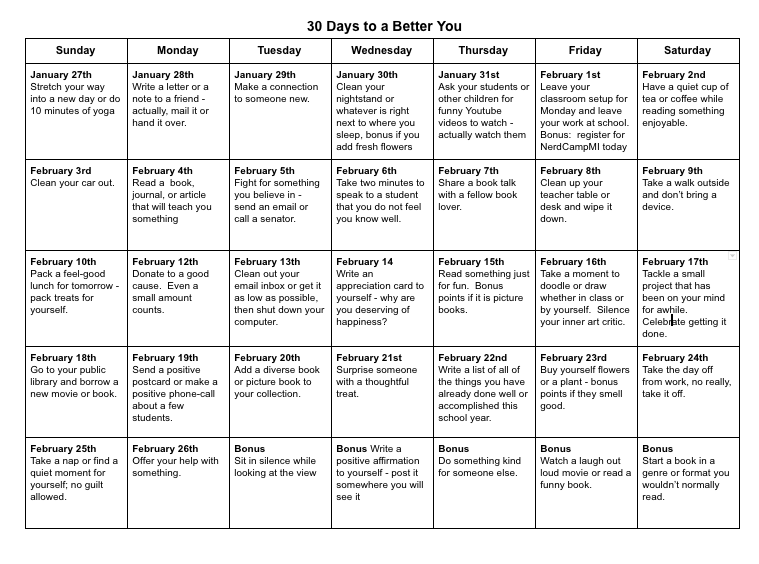
If you are like me, January brings excitement, positivity but also exhaustion.  This quiet month is one where I sometimes find my energy running low, my creativity running out, and rather than take the time to take care of myself I barrel on as if that will do the trick.  So this year, much like the years before, I am challenging myself to take better care of myself, as well as those around me. And so the 30-day challenge is back. A challenge meant to remind me of all the good. Challenge me to take better care of myself.  Challenge me to slow down.  Challenge me to focus more on meaningful interactions, rather than hurried conversations.  Feel free to join me if you want or create your own.

My challenge starts on Sunday, January 27th.  I cannot wait.  To see the challenge document, go here.

If you are wondering where I will be in the coming year or would like to have me speak, please see this page. If you like what you read here, consider reading my book, Passionate Readers – The Art of Reaching and Engaging Every Child.  This book focuses on the five keys we can implement into any reading community to strengthen student reading experiences, even within the 45 minute English block.  If you are looking for solutions and ideas for how to re-engage all of your students consider reading my very first book  Passionate Learners – How to Engage and Empower Your Students.    
Be the change, behavior, being a student, being a teacher, being me

Is School Really Safe for All?

White,                Black,                Red,                 Free Image

I have been thinking a lot about belonging. About how we assume that school is seen as a safe place by all who experience it. How we assume that we are all doing enough to help these kids, these children whose lives don’t often mirror our own, these kids who someone, somewhere have made feel as if they do not belong.

I have been thinking a lot about feeling seen. About how we assume that in our schools we do enough to let every child know that we see them. That we do enough to let the adults know that they belong too. That they matter. That they are an indispensable part of our community, a community that thrives on embracing all, on love, on acceptance.

We write fancy vision statements where we tell the world that this is a safe place, one filled with opportunities for all who enter to learn, to become something more. We ask our staff to live this vision, even as they feel unsafe themselves. We have assemblies and events celebrating our accomplishments. We hand out awards and accolades. Praise and positive notes. We remind each other not to count down to the break, to the weekend, to the end of the year because for some kids home is not a safe place.

And yet, we forget that for some school isn’t safe either.

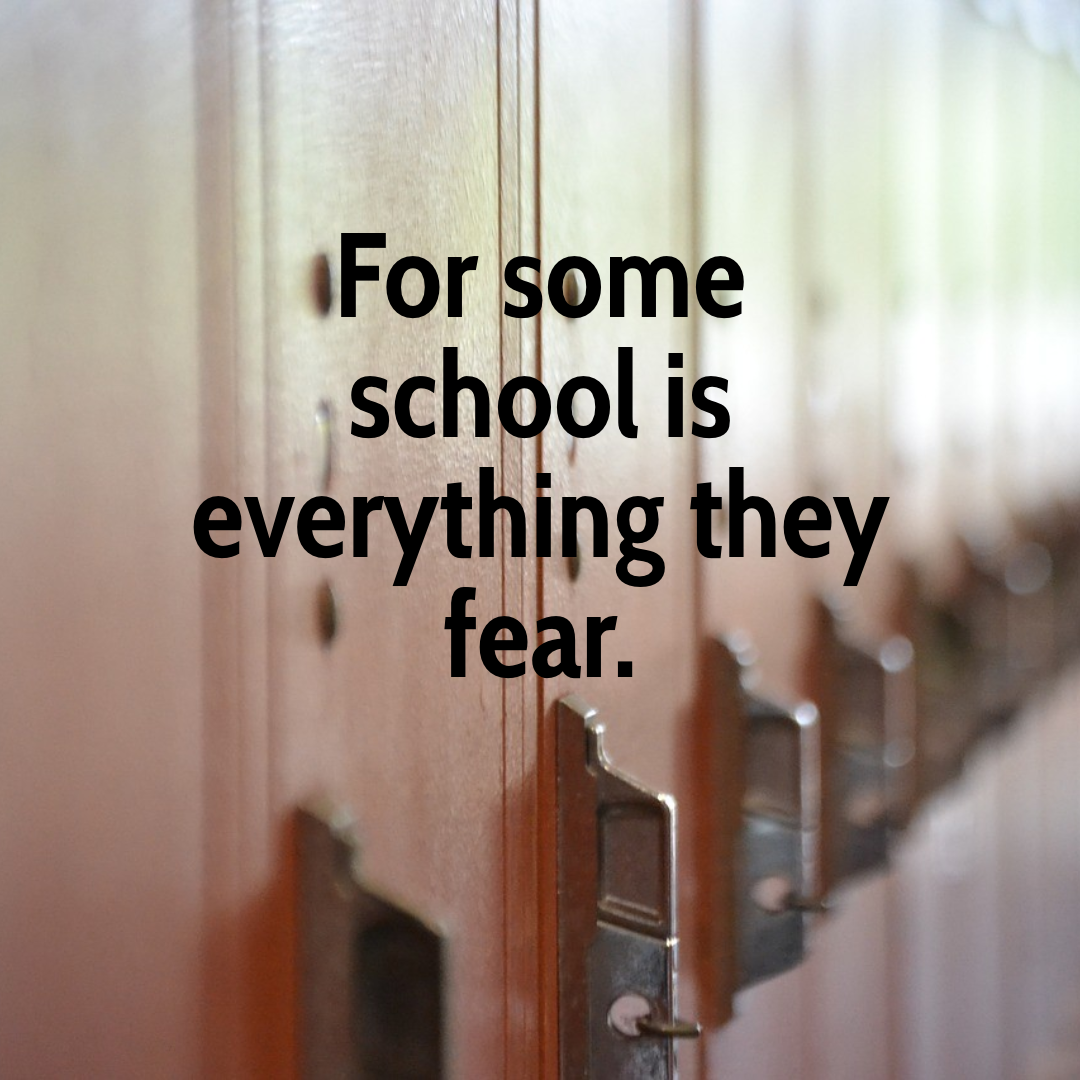
For some school is everything they fear.

For some school is only a mirror of the society who also refuses to acknowledge them as full citizens. As full human beings who deserve to be embraced, loved, accepted.

We fail at times.

Sometimes purposefully when we refuse to acknowledge that those who do not fit into our moral view of what it means to be righteous are still deserving of love. Purposefully when we suspend entire groups of children more than others. Purposefully when we enact dress codes that are only a condemnation of those whose choices we don’t agree with. Purposefully when we offer no protections for those who need it. When we let children fail at extraordinary rates because of the circumstances they face. When we continue to say that “Boys will be boys…”When we fail to stop the adults in charge from targeting each other and creating toxic work environments. When we fail to see that in our own silence, that within our own fear of rocking the boat, we are actively telling some that this, this place, is not one where they should ever let their guard down.

And sometimes we don’t even see our own failure. How when we leave certain books out of our libraries we are telling children whose stories are mirrored in those pages that their lives do not belong in our schools. That their lives are too mature, immoral, or indecent. When we tell kids to cut their hair, to change their clothing, when we display pictures of our district but they fail to show all of the people who are a part of it. When we don’t translate our news so all can read it. When we only set up events during school hours and fail to see that not everyone can change their schedule. When our texts, our videos, our learning materials fail to showcase all types of lives. When we assume that everything is a learning experience and surely those are experiencing it just need to work a little harder to find success. That we have done all we can.

And then we wonder why not every child finds success. Why educators quit. We have so much work to do.

We can do more and it starts with acknowledging those we do not see. Those whose lives are not currently valued. And I don’t mean silently valued, I mean embraced through our language, our decorations, our instructional decisions. Embraced out loud as we continually realize that there is more work to do. Making space for their voices so we can use them as a compass for how we can grow. Reflecting on our own choices and actions so we can see how we too can do more. We can ask questions through surveys and conversations and then act when people tell us that it is not safe. That they do not belong, instead of dismissing it as a fluke, only the opinion of a few. As the mother of a child who was viciously bullied, who begged us not to send her to school because it was not safe, I will tell you this, being heard is where the change begins.

The other day I overheard a child tell others about what it meant to come to our school. She said, “When I came to this school and saw the rainbow stickers, I was shook, it finally felt like I belonged.” She felt like she belonged because of a sticker. How many others do not? We assume all kids feel seen and safe at our schools, but do they really? The only way to find out is to start asking questions. Who will ask the first one?

If you are wondering where I will be in the coming year or would like to have me speak, please see this page. If you like what you read here, consider reading my book, Passionate Readers – The Art of Reaching and Engaging Every Child.  This book focuses on the five keys we can implement into any reading community to strengthen student reading experiences, even within the 45 minute English block.  If you are looking for solutions and ideas for how to re-engage all of your students consider reading my very first book  Passionate Learners – How to Engage and Empower Your Students.    
Be the change, being a student, Literacy, Student dreams

Disrupting the Narrative in Small Ways

I had the chance to sit with a few of my brilliant colleagues this week to plan our upcoming units together. Count this as another reason of why I love working for Oregon School District; the chance to get a sub so that we can collaborate and actually have time together to share ideas, push our learning, and try to craft meaningful experiences.

One thing that struck me among many was the careful selection of the types of materials we were using to illustrate teaching points. As an example, in our upcoming TED talk unit, where we hope students will not only deepen their passion for something but also be able to share that passion with others, we searched for TED talks that not only illustrate the teaching point such as engaging openings or illustrating a certain type of through-line but also spoke to potential social issues that our students are aware of in different levels, meaning some live it and some are not even aware it is an issue.

This purposeful selection of the materials we use to teach something is a big attempt for us to not just teach kids the “standards” but also expand their understanding of the world around them and hopefully find something to become invested in, to disrupt the privileged narrative that many of us live in. Yes, our students need opportunities to grow as students of reading, writing, speaking, and everything else that is involved in their education, but they also need so much more than that; to become (more) aware of the issues that face us all.

And so when I think of disrupting the narrative, of increasing social awareness within the classroom, it certainly is in the large units we plan, how we treat kids, and also the educational framework we place them in. But it is also in the day-to-day, the videos we show of speakers, the read alouds we use, the mentor texts we share, the images, and the quotes we use. Whose stories are we constantly framing our learning in? Whose experiences are the dominant narrative? Are we embracing the small opportunities that naturally present themselves within our classroom to question, to push thinking, to urge students to inform themselves so that they can formulate (better educated) opinions? And more importantly, are we asking students to take on the hard work of noticing? Of questioning? Of changing the world that they function in? Are we giving them the opportunity to explore the perimeters they work within in order to question that very same framework?

When we plan our lessons, we have so many opportunities to make the work bigger than the learning target we are trying to reach. We need to be aware though of our choices and then push ourselves to expand those choices. Whose stories are we upholding? Whose stories are forgotten?

PS: I wrote about the text selections disruption process we use more purposefully here.

If you are wondering where I will be in the coming year or would like to have me speak, please see this page. If you like what you read here, consider reading my book, Passionate Readers – The Art of Reaching and Engaging Every Child.  This book focuses on the five keys we can implement into any reading community to strengthen student reading experiences, even within the 45 minute English block.  If you are looking for solutions and ideas for how to re-engage all of your students consider reading my very first book  Passionate Learners – How to Engage and Empower Your Students.     

achievement, Be the change, students choice, students teach me

Helping Students Set Better Reading Goals

White,                Black,                Red,                 Free Image

An often asked question I receive is, “How do you help kids set a reading goal?” And while the answer really could be an entire book, I promised the Passionate Readers Facebook group that I would write a little bit about my process here. After all, perhaps something I am doing as I try to figure this out myself can help someone else, or perhaps, and this is often the case, somebody else has great ideas that they can share in the comments.

In the past, I used to set the reading goals for all of my students, after all, as the adult in the room I thought it was part of my job to set attainable goals for all students in order for them to read more, comprehend more, be more. And yet, whenever I sat with a student and we discussed these goals that I had pre-determined based on what I saw as their needs, unsurprisingly there wasn’t always full buy-in. Sure, some kids were onboard and appreciated the goals, some even took them to heart and really worked on them, but some also (sometimes many) forgot everything about the goal the minute our conversation ended. This then began a chain of reminders, notes, and post-its for their notebooks as I tried to somehow get them all to not just remember their goals but actually invest in them. Perhaps you have been in this situation as well?

It took me a few years to realize that part of the reason these goals failed was that they had little student input. The goals were, mostly, determined by me, and while many of them were sound and based on best practice within reading instruction, they offered students little chance for ownership or engagement with the goal. This meant there was no skin in the game for our students and the goals were easy to dismiss. There was also a distinct lack of conversation surrounding the goal, sure, we conferred, but it often followed a “script” in a way and didn’t allow for a lot of natural conversation to occur. While I liked having a format as a newer teacher, it stopped me at times from really listening and reacting to what they were saying.

Realizing these two things was a huge step and yet it still didn’t solve my problem; how do we create goals that students may actually want to invest in? Well for me the answer was student reading identity. Not the goal itself, but instead students (re)discovering who they are as a reader because without any kind of realization of this, they won’t do well setting goals.

Knowing this, we start every year with a survey, a reflection, and a discussion of who they are as a reader. The survey changes every year, as it should, but it still creates the foundation of our very first discussion the first time we meet. It allows me a small peek into how they view themselves as readers as we get to know each other. And so the very first goal is typically many-pronged. Many of our students need to increase their reading and so for many that is part of their goal, and yet, that in itself is not a great goal for many. There are many of our students who should be reading more but they have habits that need to be changed first before they can even accomplish that goal. Our conversation may then center around the following items:

Desire – to increase reading stamina, success, and better relationship with books.

Barriers – Doesn’t know how to select a great book, doesn’t take books home, doesn’t have “book people,” and doesn’t actually read outside of class, in fact, some days doesn’t even read in class.

Old goal: I would have asked the student to increase their reading outside of school without realizing which and how many barriers they may be facing.

Potential new goal: Figure out which books they like to read. OR add more titles to their to-be-read list. OR…. (this is where the conversation comes into play – what makes sense for them in order to challenge themselves as readers?)

Questions I (may) use when discussing whether a goal make sense:

  • Is this a goal that will actually work for you?
  • How will this goal challenge you?
  • What barriers are in place for you to reach this goal?
  • Which habits do you need to change in order to reach this goal?
  • What is your next step toward this goal?
  • How can I support you in reaching this goal/What would you like me to do?

The thing is, we need to give students more opportunities to discuss what they know about themselves as learners. And when some students inevitably tell us that they don’t know who they are as readers then that is where we start our conversations. We become detectives trying to help them recognize and then further their own reading identity, this then leads to them discussing and then choosing potential goals, even if for some it is a reluctant goal. The one they set for themselves is recorded and then discussed whenever we meet. This goal may be a goal that some of our students work on all year and while this may seem disheartening, I don’t think it is, in a way it makes sense; after all students sometimes have well-established habits that can take years of great experiences to undo – don’t we all?

What I have learned in goal-setting with students is simple yet has once again transformed how I treat our year together. Conversation and uncovering/rediscovering their reading identity and then basing everything on that is what will fuel our goal setting. The students have taught me that everyone needs a unique goal. That the best goals start with reflection, conversation, and then are set. That goals only mean something if students are part of the conversation. That goals can change. That we should not set the goal for them if we can help it because this transfers the ownership. (Note: I have goals I set for kids privately but that is to inform my teaching and not part of our conversation.) That goals need to mean something.

So as I sit with kids every day discussing what they are working on as readers, I am always amazed at the conversations we have. On how they reflect on themselves and what they need to do. On how more are realizing why this goal setting is actually worth their time. On how proud they are for reaching goals that matter to them. And while I am proud of all of our readers, I cannot help but smile the widest when a child discovers just how much they have grown. Not because a test told them so but because they realized it by thinking about themselves and their progress. Isn’t that how it always should be?

If you like what you read here, consider reading my book, Passionate Readers – The Art of Reaching and Engaging Every Child.  This book focuses on the five keys we can implement into any reading community to strengthen student reading experiences, even within the 45 minute English block.  If you are looking for solutions and ideas for how to re-engage all of your students consider reading my very first book  Passionate Learners – How to Engage and Empower Your Students.      Also, if you are wondering where I will be in the coming year or would like to have me speak, please see this page.

Be the change, being a teacher, student choice, Student dreams

This Is Hard

White,                Black,                 Free Image

“This is hard…”

The group looks at me, hoping I have answers to give, some ways to make it easier.  And while we have been working together for the past ten minutes, while I have been coaching the best that I could, it is also time for the truth.

“Yes, it is…this is hard work but guess what?  You’re doing it.”

They get back to work, we continue with our learning.

This simple moment together doesn’t fix the work that lies ahead.  The hard work of understanding, of growing, of learning.  It doesn’t make it less hard, but what it can do is make it easier to carry.  Make it easier to stick with it, to try again even when it seems unclear, uncertain, or even just plain challenging.  When we acknowledge that this work, whatever it may be, is, indeed, hard we are letting kids know that it is not that they simply don’t understand it.  That it is not because they are somehow dumber than other kids, or less capable, but that instead, that all kids go through these phases of learning and that at times, the work is hard to do, to understand, to break down and carry on with.

So many of our kids who feel less than.  Less than a reader.  Less than a writer.  Less than a student are not always acknowledged for the incredible effort it takes to learn.  For the incredible work that their brain is doing to make sense of something that seems incomprehensible at first.

And so we must tell our kids that learning is hard work and mean it.  We show our own struggles when it comes to doing the work by working in front of the kids rather than doing the work before they show up.  We tell them when we are unsure, when we mess up, when we really have to break it down into small steps in order to feel like we are moving forward at all.  We show them what learning looks like as an adult and then we remember to acknowledge the work behind their growth, no matter how small it seems at times, is something to be proud of.  That in this moment, that in this class, they have grown as a learner, and that is something to be proud of.

The work we are doing right now is hard.  Analyzing text is hard, even for adults, and yet at that moment, when we recognize that this is not easy work, we offer students a chance to see themselves not as students who cannot get it right, right away, but instead as students who are learners.  And learning takes time.  Let’s not forget that.

If you like what you read here, consider reading my newest book, Passionate Readers – The Art of Reaching and Engaging Every Child.  This book focuses on the five keys we can implement into any reading community to strengthen student reading experiences, even within the 45 minute English block.  If you are looking for solutions and ideas for how to re-engage all of your students consider reading my very first book  Passionate Learners – How to Engage and Empower Your Students.      Also, if you are wondering where I will be in the coming year or would like to have me speak, please see this page.


Be the change, being a teacher, Reading, Reading Identity

Let’s Talk About Reading Logs Again

http---www.pixteller.com-pdata-t-l-252897.jpg

Let’s talk about reading logs for a moment.  Yes, I know I have gone down this path before, but it bears repeating because not a week goes by without someone asking about them.  Asking how they can speak to their child’s teacher about the reading log they have now been assigned.  Asking how they can convince their colleagues that they are not needed.  Asking how they can change their own practices.

As someone who used to believe in reading logs and assigned them myself, I get the draw.  A way to check to see if kids are really reading outside of our classrooms – sign me up.  We veil it in reasons such as to become a lifelong reader you need to read for pleasure.  If I am not around to see that then I need proof.  And yet, reading logs is every single year one of the top reasons that my students hate reading.

As a parent, I have seen the damage firsthand.  When presented with a reading log one year, Thea quickly informed me that ALL she had to read was the 20 minutes that it said, after that, she was done.  It didn’t matter how much I told her that it was not just 20 minutes that she needed to read because the piece of paper told her so.  And the paper trumped my insistence to simply read.

We have been lucky in that every time a reading log has been sent home for our kids to do, three times and counting so far, we have had incredible teachers who have been fine with us not doing them.  We explain that we read every night, that the log changes our carefully protected reading habits, and ask whether they will simply trust us when we say that our child reads.  But this is not always the case, sometimes teachers insist that they are done, that they use them for grading purposes, that they are not an option.  They attach rewards, punishments, special treatment to those who either do or don’t do the logs.  As if parents signing a piece of paper tells us anything about a child’s reading habits.  Because I am here to share a secret; as a parent, I lie on reading logs.  I don’t always know which specific books my child just spent the last 30 minutes devouring.  Sometimes I do, but not always.  I can’t tell you the exact minutes of reading because we don’t keep track.  Sometimes we simply forget to sign because life is busy.  It reminds me of what Donalyn Miller says that the only thing a reading log proves is which parents have a pen on Friday morning.

I write this post not to shun, not to rage, and not to put down. I write this post not to say what is right or wrong, but instead to add a little tiny piece to the ongoing discussion of where reading logs may or may not fit into our classrooms.  Of the damage and the usefulness of reading logs.  This is not a post with absolutes, or at least, I don’t think it will be.  Instead, it is a post meant for discussion.

How I Know My Students Are Reading

One of the biggest reasons I know teachers use reading logs is the accountability piece, if students fill out a reading log then I can see their outside reading lives, and while that is sometimes true (remember, parents lie) there are better ways to do it that don’t involve the traveling of paper back and forth.  How do I know my students are reading if I don’t check their reading log?  How do I know that at some point their eyes meet a text?  There are many ways actually.

  • They sign in with their page number.  On our whiteboard hangs a simple sheet that allows kids to put down the page they are currently on in whichever book they are reading.  At the end of a week, I do an average tally for each kid.  They have individual reading goals (set by them) that they keep track of in their notebooks and they also enter in their page numbers in a reading data sheet.  This allows kids to see their own patterns of reading, as well as to reflect on their growth.  I can quickly glance and see who is reading or not.
  • I watch their reaction.  Kids who read want independent reading time.  Kids who are in a great part of a book want time to find out what will happen next.  Kids who slowly get settled into their book, who distract others on the way; those are the kids I need to check in with and help.
  • I keep an eye on their to-be-read list.  As I confer with kids, I glance at their to-be-read list, it should be messy, with titles added and sometimes crossed out.  I know which books have been book-talked so I can see when kids are using it.
  • I kept an eye on their book bins.  A whole bookshelf in my room used to be the proof that my students read.  Periodically I would look through their bins, noting which books a kid has and whether those books had changed.  If they hadn’t, I checked in with that child.
  • We recommend.  Another favorite in our room is the speed book dating.  We quickly rattle off a book we love and why it should be read while the listener has their “I can’t wait to read ” list in their hand.
  • We show off our reading.  I have my reading door outside of the room so that my students always know what I am reading and my students can recommend books to their peers on a book tree.  This makes our reading is visible.
  • We discuss.  Reading should not be a solitary endeavor so we make time to discuss our books and why they are the best or the worst book ever.
  • I kid watch.  If I want to know whether kids are reading, I watch them.  Sometimes instead of conferring, I just sit back and pay attention.  This is one of our great superpowers as teachers, don’t forget that.
  • We reflect.  I often ask students to tie in today’s teaching point with whatever they are reading right now.  Whether it is on a notecard or through conversation, students take a moment to think and apply and once again lets me see what they are reading.
  • We do monthly reading reflections.  This year I really wanted to have a open dialogue with the students in regard to their reading life and although I do constant one on one or small group instruction, I wanted something more formal that I could file away and look at when needed.  My students know they are not judged on what they write but rather that I use it as a way to start a conversation with them.  I always appreciate their honesty and my actions show that.  The surveys are quick and to the point.
  • We have great books.  If you want kids to read, have great books.  I do not know how much money I spend a year on books, I know it is a lot, but every time I am able to book talk a book and see the reaction in my kids, it is worth it.  Couple that with an incredible librarian and my students are pretty lucky in the book department.
  • I lose a lot of books.  Because I encourage my students to take our books home to read, I inevitably lose a lot of books.  While it is hard to think of it from a financial standpoint, I also know that hose books are being read by someone.  So yes, it is hard to constantly replace books (and expensive) but it is something that goes along with being a reading classroom.

If You Have to Use Reading Logs

I have written before on my complicated relationship with reading logs; from being a teacher who demanded all students fill them out, to a teacher who threw them out, to a teacher who was asked to use them as part of their teaching, to a teacher whose students asked them to stop, to a parent who has signed them.  But I have never written about how to use them better.  Because I don’t like reading logs, there I said it, but at the same time, there are so many teachers that do, great teachers that care about children’s love of reading, and there are even teachers that have to use them.  And I don’t feel that shaming others will further the conversations.

My biggest issue with reading logs comes from the inherent lack of trust that they communicate; we do not trust you to read every night, we do not trust you to read long enough, nor do we trust you to grow as a reader, so fill out this paper instead.  And while I could write a whole post on that, I think Jessica Lifshitz did a much better job on it than I ever will.

And yet, I also see the value in getting a window into the reading lives of a student.  I see the value of having students understand their own reading habits so they can figure out how to grow.  To mine their own data so to speak in order for them to discover new patterns and new goals.  So what can we do, if we have to use reading logs (or we want to) to make them better for students?

Ask the students.  Ask the students their feelings on reading logs and consider their feedback carefully.  If most of your students think this tool will help them become stronger readers then work one out with them.  For those that are opposed to them, figure something else out.  If we truly want students to fully embrace the opportunities that we say can be found within a reading log then we need to make sure they have buy in as well.  Create reading logs that are meaningful to the students, which means that they will probably look different from year to year, based on the students we teach.

Ask the parents.  I will flat out tell you that I will sign whatever I have to from school.  I will not count the minutes, I hate writing down titles because we read a lot, and I do not see much value in her logging her reading every night.  If you want proof, ask me in an email or in conversations, but do not make me sign a piece of paper.  If some parents like reading logs then by all means work out a system with them, but exempt the other parents since more than likely they will probably not be invested anyway.

Differentiate.  For the kids that do want a reading log, find out what it is they would like to gain from it.  I have a few students that love coming in every Monday and writing down the titles of the books they read or abandoned over the weekend (that is all they keep track of plus a rating).  For those kids their record keeping is a way for them to remember what they have read and whether they liked it or not.  They do not keep track of minutes or anything like that, we discuss that in our written reading reflections that we do once in a while or face to face.  So find out what it is that the students like about logging their reading, if it is the reward that is attached to it then that should be a huge warning sign.

Keep it in class.  When I had to do a reading log in my former district, we kept it in class.  Students were asked to write down the title and for how long they were focused on the book right after independent reading.  That way, organization and parent follow up were removed from the equation and all kids (and me) were following the district expectation.

Stop rewarding.  If reading logs really are meant as a way to investigate ones’ own reading habits then stop tying in rewards with them.  The reward is in the reading, not the ticket, not the pizza, not the trinket.  Ever.

Stop punishing.  When we punish kids who do not turn in their reading logs, we forget our bigger purpose; to establish lifelong readers, instead investigate.  Why was it not turned in?  What happened?  And for the sake of everything good; do not force a child to then miss recess to make up for the lost time in reading.  You do not want to equate reading with punishment, ever.

Make it an experiment.  If you like using reading logs to find out student habits, then do it as a 2-week experiment with all students.  Have them for 2 weeks keep track of when, where, what, and how much they read and then have daily or weekly conversations and reflections on what they discover.  Set tangible goals from that.  Do it periodically throughout the year if you really want this to be seen as a learning opportunity, that way students can see a value in tracking their reading life this way.  If you have them do it all year, most students lose interest and will not see it as an opportunity to grow but just as one more thing to do.

Leave time for reflection.  Rather than log, we reflect.  My students set monthly reading goals and then at the end of the month they reflect on how they did through a survey.  The students and I will meet and discuss formally and informally and this is what I use for my vantage point into their reading life.  I ask them to tell me what they are working on and they do.

Don’t forget the purpose of reading logs.  If the purpose is to help students grow as readers then make sure that the very act of filling out a reading log, with or without parent signature, is not damaging that purpose.  It is often when we set up more processes for students in order to help them read better that we lose them as readers.  When kids spend more time doing things attached to reading, rather than the act of reading we have a problem.

In the end, in our pursuit to establish classrooms filled with passionate readers, we must make sure that the things we do, even little parts of our day like reading logs, do not do more harm than good.  That we fit our processes around our students, rather than the other way around.  That we continue to debate, question and consider as we decide what to invest our time in.  And that we always, and I mean always, ask the students what they think.  Even the little ones, they have a voice that matters too.

For all my ramblings on reading logs, here is where to start.

If you like what you read here, consider reading my newest book, Passionate Readers – The Art of Reaching and Engaging Every Child.  This book focuses on the five keys we can implement into any reading community to strengthen student reading experiences, even within the 45 minute English block.  If you are looking for solutions and ideas for how to re-engage all of your students consider reading my very first book  Passionate Learners – How to Engage and Empower Your Students.      Also, if you are wondering where I will be in the coming year or would like to have me speak, please see this page.