Be the change, being a teacher

See the Small

White, Black,  Free Image

I forgot yesterday was a Monday.  As I drove home, I couldn’t quite wrap my head around why the day did not seem to have gone as planned.  Why I had just taken away all yoga balls in our classroom.  Why the energy seemed so off, no matter what I did.  And then it dawned on me; it was a Monday, and every Monday I leave thinking that I need to change the way I teach.  That what we are doing is not working.  That surely I should not be writing about the way I teach because if you had been in our classroom, you would have been just a little bit surprised, after all, aren’t we supposed to have it all figured out by now?

This morning as I got ready for another day, a child walked in and declared, “Monday’s turn me into Garfield…” and I remembered once again, that sometimes Monday’s are hard.  Sometimes the final class of the day is loud.  Sometimes the kid we thought we had helped feel comfortable still does hurtful things.  Sometimes I am more tired then I thought I was.  Sometimes things happen outside of our classroom that influences our classroom in ways we couldn’t foresee, and while all of these may seem like excuses o why the day didn’t go as planned, they are not.  They are reminders.

Reminders that we are human.  Reminders that teaching is never perfect.  Reminders that sometimes despite what we plan, despite what we intend, despite what we think a day will be like, it just isn’t.

And they are reminders to see the small wins, the small successes that will ultimately shape this year together.  Like the kid who agreed to give an audiobook a try despite how much they hate reading.  Or the kid who asked for help and never has before.  The kid who started yelling but then realized what he did and apologized.  The kid who couldn’t wait to tell me about the book they finished.  The kid who took the time to tell me that no matter what I always seem to be smiling.  That no matter what, the 7th grade teachers are all pretty nice.

Those are the reminders we all need but seem to forget as we focus on the things that seem to not work.   So I wonder; have you given yourself a moment to realize how much good there has happened?  How far we have actually come?

Because if you look you will see the growth.  You will see those small changes as these kids figure out how to be more than what they came as.  You will see them try.  You will see them stretch themselves, even if it doesn’t seem apparent on the surface.  But you won’t if you don’t look closely, it is so easy to miss in all of the things that have not yet been figured out.

So if you had been in our classroom yesterday, you may have thought it was a rougher day, and yet, I would have told you; it’s just Monday.  Tomorrow will be better because that’s just how it goes.  And you know what, today was a pretty good day, just like yesterday.  How about yours?

If you like what you read here, consider reading my newest book, Passionate Readers – The Art of Reaching and Engaging Every Child.  This book focuses on the five keys we can implement into any reading community to strengthen student reading experiences, even within the 45 minute English block.  If you are looking for solutions and ideas for how to re-engage all of your students consider reading my very first book  Passionate Learners – How to Engage and Empower Your Students.      Also, if you are wondering where I will be in the coming year or would like to have me speak, please see this page.


Be the change, being a teacher, Literacy, Reading, Reading Identity

Small Disruptions in Text

I have been so incredibly inspired by the work of the women behind the #DisruptTexts movement.  This movement, started by a group of fearless educators: Tricia Ebarvia, Lorena Germán, Dr. Kimberly N. Parker, and Julia E. Torres, have been leaders within the work that is needed to disrupt the cannon and also help all of us change the work we do with texts in the classroom.

While I am lucky in the sense that I don’t have canonical texts I am forced to explore with my 7th graders, I have realized that habit and ease had gotten me stuck in certain texts, that sure, seemed to work for students, but didn’t do much for their exposure to other points of view, nor did it represent all of the lives of the students I teach.  Thus a mission for the year began – disrupt the texts I use with students, pay attention to my own selection process, and ultimately create a broader experience for all kids in order for them to have more critical exposure to many perspectives.

So what does that look like for me?  Well, it began with two questions; why am I selecting the texts that I am and how can I select others?  As I looked at my lists of short stories, read alouds, picture books,  and even book talks, I quickly saw a pattern.  While my own reading life is fairly inclusive, my academic usage was not.  The same texts were used year after year and many of them were predominantly created by white, cisgendered, heteronormative people.  Even though I had been trying to purposefully select more inclusive texts!  While there were units where the scope had broadened, there was still this dominance, a thread, of the same type of texts used and highlighted.

So for the past few months, I have spent a lot of time on text selection within a few areas.  By auditing my habits and my patterns, I found plenty of opportunities to disrupt my own “canon” and also help others find better texts.  Here are the areas that I have focused on:

Picture books.  Reading a picture book aloud is something sacred to us, and while I have a fairly inclusive picture book collection, I was not really keeping track of which I was choosing and sharing.  By having a visual representation of the picture books outside our room I am reminded to look for a broader scope and to include many different perspectives.  (To get ideas for great books to read or share, follow my Instagram where I do “live” recommendations as I discover books.)

5380793330040832.jpeg

Read alouds.  I have always mostly selected our read alouds based on the merit of the story.  Is it a story that will elicit interest and conversation?  Will my students be changed after this read aloud?  And yet, I did not pay much attention to the author and the identity they represented.  Now, the two go hand-in-hand.  Questions I use to assess whether a book should be read aloud are many, but a few are:  How is this author’s identity represented within the text?  How is it different than what my students have already been exposed to?  How is the main character different than the last main character we got to know?

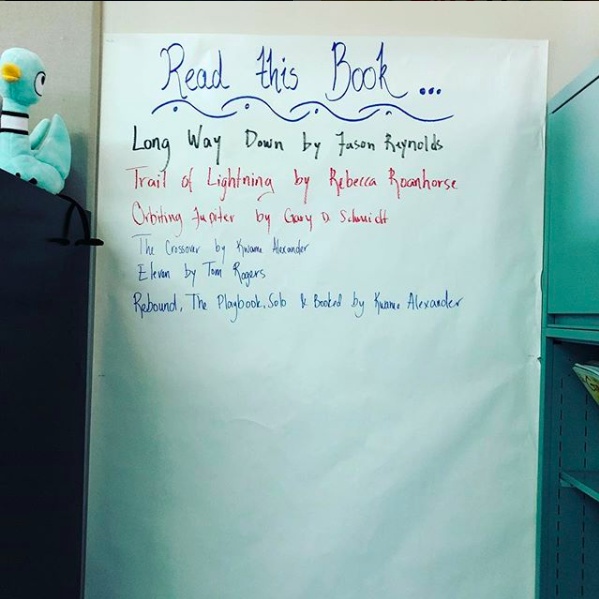
Book talks.  Once again, random selection was the way I did book talks.  Sometimes it was a book I had just finished, other times an old favorite.  This meant that I didn’t always remember which books I had book talked and surely did not pay attention to whose stories I was book talking.  Now, my system is twofold – I write down the books I plan on book talking and also keep a written poster in our classroom, which I fill in after a book talk.  While the poster will need to be replaced soon, it allows me to see the bigger picture of what I am blessing through book talks.  Just looking at it today, I realized that I had not book talked any books featuring characters from within the LGBTQ community, which is something I plan on rectifying.

6017585314004992.jpeg
Seeing this was a reminder to book talk more books by female authors, as well as authors from within the LGBTQ community.

Short stories and text excerpts.  This is where I needed the most disruption.  I had some great short stories that captured the interest of students, but most were by white authors.  I simply had not paid attention to this part of the selection process and had instead just grabbed stories others had recommended or stories that I knew.  And this is part of the problem I think for many of us; we recommend the same stories over and over, we remember the same stories being used and somehow they then receive more merit as legitimate texts than they really deserve.  Now, my selection is focused on the author’s identity, the main character’s identity, as well as whether the story fits our purpose.  By using fantastic short story collections such as Funny Girl,  (Don’t) Call Me Crazy, and Hope Nation, as well as first chapters from great #ownvoices books I am ensuring that my students are meeting new fantastic authors and stories that will hopefully not only better represent their own experiences and identity, but also the identities of others whom they may not know.

So what can you do if you want to start disrupting your text choices as well?  The first would be to follow the work the movement #DisruptTexts  and the women behind it do, but then also audit yourself.  What are you reading?  Book talking?  Sharing?  And using with your students?  Whose identities and experiences are being represented as the norm?  Whose voices are left out?

Read more inclusive texts and start a document to track texts you may potentially use with students and their purpose.  We have a shared mentor text document as a team where we can drop text in as we find them.  Create visuals that show you just what you are blessing and share and take the vow to do better, to notice your own patterns and change the texts you use.  While I still have a long way to go, I am already feeling better with the intentionality of the texts I am exploring with students, as well as the opportunities we still have to do better.

If you like what you read here, consider reading my newest book, Passionate Readers – The Art of Reaching and Engaging Every Child.  This book focuses on the five keys we can implement into any reading community to strengthen student reading experiences, even within the 45 minute English block.  If you are looking for solutions and ideas for how to re-engage all of your students consider reading my very first book  Passionate Learners – How to Engage and Empower Your Students.      Also, if you are wondering where I will be in the coming year or would like to have me speak, please see this page.

Be the change, being a teacher, Literacy, Passion, Reading, Reading Identity, student choice, Student dreams, student driven, Student Engagement, student voice

The Rights of Our Readers

Today was the second day of school.  the second day of trying to get to know these incredible kids that have been gifted to us.  The second day of trying to establish the seeds for the habits that will carry us through the year, hopefully leading us to a year where they leave feeling like this year was worth their time, that this year made a difference.

Today was the day of one of our big fundamental lessons; when reading is trash or magic.  I shared my past reading mistakes in teaching, we shared when reading sucks or when it is lit (student choice of words).  As the post-its crowded the whiteboard, the questions and statements inevitable came.  Will we have to read books you choose for us?  Will we have to write every time we read?  Will we have to do post-it notes?  All things that in the past, I would have answered yes to but now the answers are different.  You always choose your books, even in book clubs, you will have plenty of choices.  You will not always write after you read, sometimes you will, and because of the work of teachers before me, you will be better at it than ever before.  And post-its?  Sometimes, when it makes sense, but not every time and not at home.  Only here because at home I just want you to work on your relationship with reading, the skills teaching that will happen in class.

As we finished our conversation we merged into what their reading rights are this year.  the things that I will not take away.  The rights they have as individuals on a reading journey.  This is not my idea, nor something new, but once again the work of others who have paved the way for my better understanding of what developing student reading identity really looks like.  As we discussed what rights they would have and what they meant, I wrote an anchor chart, a reminder that will hang all year so we don’t forget just what we can do together.  What choices we may have.  As we went down the list, the relief was palpable, the excitement grew.  Even some of the kids who had not so gently told me how much they hated reading right away, looked less scared, less set in stone as we talked about what this year would like.

And so this is where we stand tonight…  Our very first anchor chart to remind us of what it means to be a reader that is honored within our community.  What it means to be a reader that already has a reading identity, that we will continue to develop together, honoring everyone wherever they are on their journey, rather than forcing our well-intended decisions down over the top of kids.  Perhaps, once again, this year kids will develop a better relationship with reading, will grow as readers, will grow as human beings.  What more could we hope for when it comes to teaching?

If you like what you read here, consider reading my newest book, Passionate Readers – The Art of Reaching and Engaging Every Child.  This book focuses on the five keys we can implement into any reading community to strengthen student reading experiences, even within the 45 minute English block.  If you are looking for solutions and ideas for how to re-engage all of your students consider reading my very first book  Passionate Learners – How to Engage and Empower Your Students.      Also, if you are wondering where I will be in the coming year or would like to have me speak, please see this page.
Be the change, being a teacher, Reading, Reading Identity

After Accelerated Reader

One of the questions, I am asked the most often is, “What do you do if you don’t have Accelerated Reader?” Or insert whatever computer program here.  It is a question filled with emotion, after all, change is hard, and for some kids, AR and programs like it seem to work.  For some teachers, it works.  And yet, it doesn’t work for all, it is expensive, and in my opinion, it is not worthy of the precious time we have with students every day.

Last night, as I sat surrounded by incredible passionate educators and leaders in the Imperial Valley in California, I was asked that question again, and here is how I answered it.

Giving up AR can be scary.  After all, it is a program that seems to tell us things we need to know; has this child read the book?  Have they understood it?  It is a program that allows us to chart progress, to reward growth.  To have an understanding of the complex process that is often hidden from view.  And yet, how much of AR is actually a true view?  How often are kids able to take the test without fully reading the book?  How often do they fail the test despite having read the book?  How often do we end up policing the testing, the book choice, the kids without actually doing meaningful work?

Our job as teachers is not to police reading, it is to support the love of reading.  There is a huge difference.

So we start by looking at the components already in place.  Every child deserves a classroom library, a school library staffed with a certified librarian.  Every child deserves a teacher who read children’s literature, who is knowledgeable and excited about reading.  Every child deserves time to read a self-selected book in a supportive reading environment.  Every child deserves to do meaningful work once they finish these books, building a reading community one book, one conversation, one connection at a time.

If we hold these components as rights, then the only thing AR really fulfills is the check off when it comes to whether a book has been read.  When we remove that, we must find other ways to see whether children are reading and whether they understand what they have read.

In my own classrooms, we have different methods to see whether kids are reading.  I have gone into more details about this here and also in Passionate Readers, but the first component is to simply kid watch.  How are they picking up books?  Are they picking up the same book day after day?  Are they making progress in the book?  We use Penny Kittle’s page tracker to help us see the page kids are on in class.  That way if a child is on the same page day after day, I know a conversation is waiting to happen.  Perhaps the book is boring, perhaps they don’t understand it, perhaps something is happening outside of class that is affecting them in class.  Either way, that small sheet of paper allows me to see if they are making progress.  I don’t need it as a reading log, I need it so that kids can take control over their own reading habits and see whether they are making true progress as they challenge themselves.  That way they have tangible data when we reflect at the end of every quarter.

We also set meaningful goals.  I recently wrote about what that looks like at the beginning of the year, but it is these goals that I discuss with kids.  While some may be quantity based, others are based on habit.  You may notice that so much of what we do is conversation based.  Not having a computer to tell me these things forces me to speak more to students, for them to actually reflect on their lives as readers, this is always a great thing.

When students finish a book, they often do what we adults do.  They recommend it.  They put it back on the shelf.  They hand it to someone to read it as well.  Sometimes they write about it in a reading response, but not often, because I have found that it is often all of the things we have kids do with their reading that actually makes them dislike reading.  This year, I will also have them do reading ladders, an idea created by Teri Lesene, explained here, so that students can ponder whether they are challenging themselves or simply reading at the same rung.  They also keep a list of books they have read, finished, or abandoned in their notebook and at any point, I can ask to see that.  This list is something we update in class so that the kids that forget also have a chance to do it.  For kids who are motivated by competition, I try to make it an internal one.   Can they beat last year’s numbers of books or some other goal?  I do not believe that reading should be rewarded with a prize because it tells kids that reading itself is not worthy of their time.  That it is something they are being bribed to do because it has no value on its own.  Reading is its own reward.

And finally, when it comes to the assessment of skills, I don’t need a test on a book to tell me whether they comprehend it.  I can either discuss the book with them even if I haven’t read it or I can use a common text, such as a short story, read aloud, or picture book to assess their skills of reading.  After all, all of the independent reading we do is for practice, for building the love, it is not to be graded, the skills we are developing are what we need to grade and that can happen with any text that we know together.

Getting rid of any component that has been a cornerstone of instruction is scary, it takes work, and it takes a change in practice.  But it is worth it for our students and the reading experiences they deserve.  I would recommend anyone who is looking to get rid of a computer program to really speak about the experiences that need to replace it.  How will that look on a day-to-day basis and also how it will help the students.

Teaching is hard work, it is easy to see how we can be persuaded to place children in front of computers to help us out.  To see the short-term gains sometimes from these programs.  And yet, what about the long-term?  At what point do children, and adults for that matter, need to internalize what reading really is?  A discovery of self?  A discovery of the world?  A transport into more understanding, more empathy, more imagination?  Removing AR is a process, but one that is worthy of our time, because kids deserve rich reading experiences at every level, and computers, no matter how well-tested their programs are, cannot provide the same meaningful interaction as we get from a conversation, real assessment, and building a community of readers.

To see more thoughts on AR please see Jen Robinson’s posts which showcase other work on it.  Donalyn Miller’s post on it and do take the time to read Stephen Krashen’s discussion of the research that AR uses as a selling point.

Be the change, being a teacher, being me

On Airplanes

White, Black, Red,  Free Image

I am hurtling through the air, clouds drifting by beneath me, blanketing the earth from view.  Confined to the seat I was given by a computer, on an airplane as I once again cross the country in order to teach other educators all that my students have taught me.

My seat is comfortable, for short periods of time, the ache in my back slowly making its presence known, reminding me that as I get older, my body carries the signs of frequent travel and confinement.  Of sitting in airplanes and plastic chairs, of hurriedly drinking my tea before I find the seat that has been given to me, that will dictate my next hours all in order to serve a greater purpose of bringing me to the destination I need to go to.

I am reminded of how it used to be a joy to get on a plane, excited for the journey ahead, and now it is mostly just ordinary, a means to an end, no longer covered in sparkles and foil, but just another day at the office.  How my mind has made it a quest for anything to be out of the ordinary just so that this very trip can be wrapped in something other than what I have come to expect; greetings from polite attendants, the same snack selection, perhaps a movie, nothing more, nothing less.

Much like the school experience many of our children have.  One that used to be wrapped up in excitement and possibility but now is immersed in tradition, in used to it’s, in more of the same, and the same expectations for all for the greater good.

I wonder why it has taken me so long to see the similarities between airplane travel and our schools?  Wedged in beside strangers that I may or may not connect with, told within the armrests what our area is, with hidden rules and expectations of what proper behavior is.  Knowing full well how rude it is to take up more space than what we are given. How rude it is to draw attention to ourselves through the food we eat, the scents we bring with us, the volume of our conversations.  How rude it is to be loud, to be seen, to be anything but quiet and nearly invisible in order for the greater good, the common purpose.

How the attendants start us all with the same speech, assuming that only a few are paying attention and yet they try to tell us how important it all is for our future as they vie for our attention while using hands-on manipulatives and humor.

How the seats we are given mirror the very experience our students have when we give them rights that are based on what they already have.  More wealth or status gives you a better seat, a better seat gives you better service, food, blankets, and careful attention.  Remove the privilege, remove the ease, as the rest of us regular folks can only sit and watch behind the mesh curtain, aware that we are not good enough, not properly attuned to sit up there where the air must surely be better because the food certainly is.

And I am confined, not just in my physical space, but also mentally.  I find it hard to concentrate on the tasks at hand, longing instead for the air to move, for the wiggle room to do something other than sitting here, even though I know that the quiet I have been given in this very moment should be seen as a gift.  A chance for me to take a moment and do whatever I want, but this is hard to do when all I want to do is not be confined.

I count down the minutes until the journey is over so that I may resume regular life.  Outside of these rules.  Outside of this space.

And so what do we do within this knowledge of what school may be seen like for some of our students?  How do we, within the rigid systems we claim are in place for the greater good, find space for all of our students to breathe freely, to break the boundaries of the space they are given and recover the sense that where we are going matters?  This is what I ponder as the attendant waits for us to push the button in case we need anything, as they do everything in their power to ensure we all have a pleasant and safe flight.  As they wrap us in infinite patience.  Feed us snacks to make sure our inner rumblings don’t become outer ones.  As they try to take us to a destination that we surely wanted to go to at some point.  But perhaps we just forgot.

If you like what you read here, consider reading my newest book, Passionate Readers – The Art of Reaching and Engaging Every Child.  This book focuses on the five keys we can implement into any reading community to strengthen student reading experiences, even within the 45 minute English block.  If you are looking for solutions and ideas for how to re-engage all of your students consider reading my very first book  Passionate Learners – How to Engage and Empower Your Students.      Also, if you are wondering where I will be in the coming year or would like to have me speak, please see this page.


Be the change, being a teacher

Lessons from the “Bad” Kids

White, Black, Yellow, Red,  Free Image

“I think of the children who make trouble at school as miner’s canaries.  I want us to imagine their behaviors – which are admittedly disruptive, hypervisible, and problematic – as both the loud sound of their suffering and a signal cry to the rest of us that there is poison in our shared air…”

These words from Carla Shalaby’s phenomenal book Troublemakers have haunted me since I read them.  I think I have shared these words with other educators more than anything I have ever shared from a book.  This book is a book that will influence my teaching for years to come.

The image of these kids that so desperately need school to work for them as the canaries is one that I cannot get past.  Is one that we all need to unpack.  What if we saw their behavior as an alert to how our schools are not working, rather than think that they do not work in our schools?  What if we treated each high flyer, each challenging kid, as what they are – spotlights on what we are actually asking kids to do all day; sit still, comply, listen, only do what we tell them to and then realize that just perhaps this is not what every child needs.

What if we unpack our own values and not the ones we claim we have, after all, I have yet to meet an educator who says that making children hate school is part of their job description, but the ones that our actions show us we have.  Who do we listen to?  Who do we praise?  Who do we give positive attention to?  Who do we highlight as valued members of our classroom?  And who do we not?  These actions speak louder than the things we say we value.

And I speak from my own history; for several years, I wielded exclusion and public shaming as my primary tool of control.  So what if other students saw kids move their sticks or put their name on the board, after all, they had been there to witness the behaviors.  So what if the same kids were sent out of the room; to think, to take a break, to go to the principal’s office.  So what if the same kids were “otherized” every time they failed.  Every time they screwed up.  Every time they weren’t “good” students.  They would just have to learn how to adapt, how to fit the mold of school, how to fit “our” classroom and not the other way around.

A few years in, I realized what I was doing.  How I was part of the problem of schools failing kids, how public shame has no place within our classrooms, how exclusion is often the worst long-term solution because it isn’t really a solution at all.  How relationship, giving students power and giving them a way to speak their truths was what I needed to pursue instead, even if it meant more time, more work, and yes, more frustration at not having a quick answer.

Within that revelation I had to uncover a hard truth; that I was the reason that some kids were otherized.  As I was writing Passionate Learners, a book focused on how we change the way we teach to give control back to our students, I asked my students, “How do you know who the “bad” kids are?”  Their answer shook me to the core.

“The teachers tell us…”

So simple and yet so hard to digest.

We, the adults in the room, are the arrows that point out the bad kids.  Are the magnifying lenses.  Are the ones that show that it is okay to exclude others.  That it is okay to police others who step out of line.  That there is such a thing as “good” kids and “bad” kids.

And that is something that needs to change.  We can do better.  We must do better.

So as I prepare for our students to come to school, I think of what I need to do to ensure there are no “bad” kids in our room.  That all kids are truly valued.  That all kids get what they need.  Lofty?  Sure, but it shouldn’t be.  It should be the right of every child to be seen as a valued member of our schools, even if they make their presence known loudly.