being a student, being a teacher, being me, writing

With Permission

We are about to write in class.  15 minutes of free write await.  I have a prompt from the amazing The Creativity Project, I am ready with my own pencil, my notebook, the document camera.  And yet…the hesitation from students is almost palpable.  So many of them already feeling defeated.  Feeling like this will be hard.  Asking if they can read instead of write.  Despite all of their years of great teaching, of great moments with writing, so many of our kids still feel like writing is something they will never like, nor is it something they will ever master.

On our wall hangs our writing rights poster, the rights we created as a writing community at the beginning of the year.  The rights that surround us as we play with writing, as we develop our writing voice.  And yet, something is woefully missing from it.

So I add it quickly.

“You have the right to write “bad” writing.”

And I tell my students this…writing doesn’t have to be great.  Writing doesn’t even have to be good.  You have the right to write bad stories, to write poems that you never want to share.  To write a few sentences that are so cringy that you can’t believe you came up with them.  You have the right to start, to stop, to think, to write whatever pops into your mind.  Not because it is any good but because you are simply writing.

And then I share the beginning of a story I wrote that morning with my first-hour class.  A story that I knew was terrible as I wrote it, filled with cliches, overused plot points and weird sentences, but U was tired and distracted and so that was all I could think of.  I read it aloud, laughing as I go.  At first, I can see the skeptical looks – this isn’t that bad, Mrs. Ripp – but when they get to the genie in the bottle part, they are laughing too.  As I finish, I shut my notebook and declare that I will never continue that story but at least I wrote.

One child yells, “But you write books, Mrs. Ripp, how can you write bad stories?”

“My book took me a year to write..” I answer honestly because it’s true, my books take a long time because I wrote a lot of stuff that never gets published.

We turn back to the prompt.  I remind them to sink into their writing, to simply write something, using the prompt or not, and off they go.  Every single child writing something.  Every child trying.  Not because they are all trying to write something powerful but because they are reminded once again that writing doesn’t always have to be everything we love about writing.  Something you just have to write badly and be okay with that.

If you like what you read here, consider reading my book, Passionate Readers – The Art of Reaching and Engaging Every Child.  This book focuses on the five keys we can implement into any reading community to strengthen student reading experiences, even within the 45 minute English block.  If you are looking for solutions and ideas for how to re-engage all of your students consider reading my very first book  Passionate Learners – How to Engage and Empower Your Students.      Also, if you are wondering where I will be in the coming year or would like to have me speak, please see this page.
 

Be the change, being a student, being a teacher, books, Literacy, Reading Identity

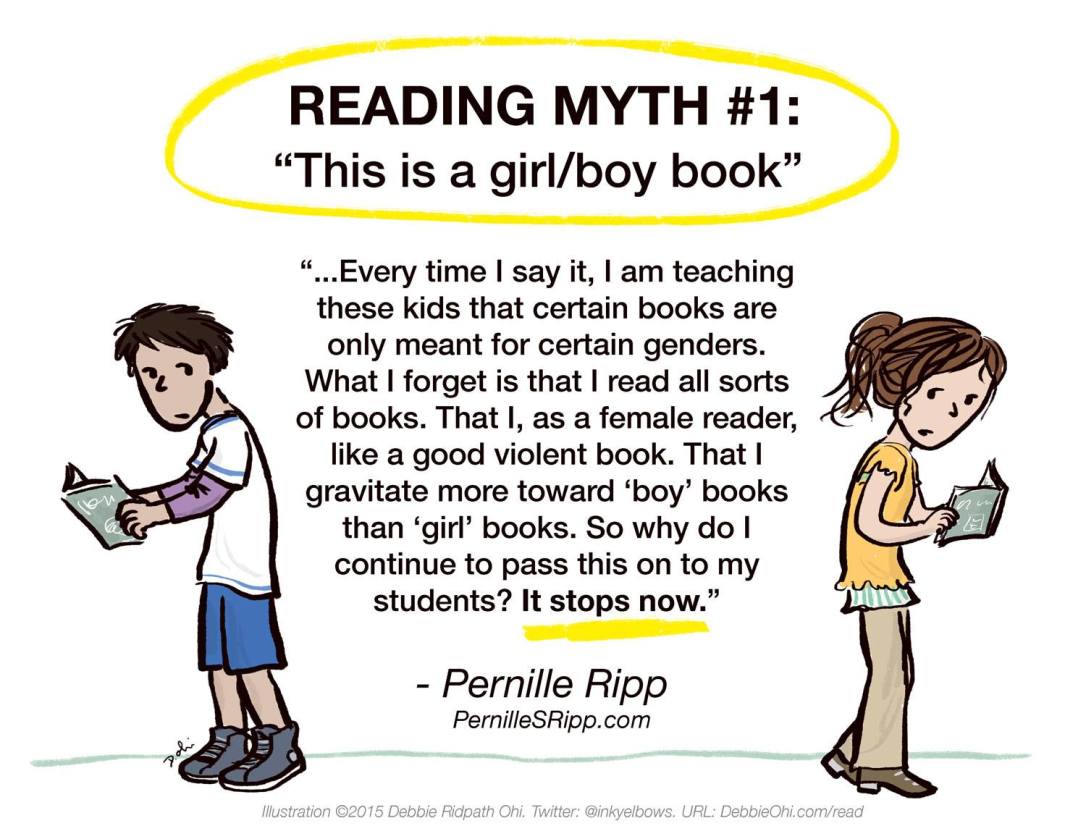
On Boy Books and Girl Books

Image result for pernille ripp boy books

I get asked for a lot of book recommendations, I think it comes with the territory when you share the love of books.  And while I love pairing books with potential readers, I have also noticed a pattern that causes me to pause, that should cause all of us to pause.

I get asked for a lot of books featuring male lead characters for male readers.

When I ask why the need for a male lead, I am often told that “they” just don’t think a boy will read a “girl book.”  That a boy will not like a book about feelings.  That a boy only wants books that have action.  That have other boys in it.  That feature characters that look just like them or at the very least think like them.

As if every single boy thinks alike.

When written like this it is easy to see the problem; when we assume that there is such a thing as books for girls and books for boys, we are continuing a tired and sexist narrative that has only furthered the power inequity that already exists within our society.  We are creating a new generation of mansplaining, of groupthink, of toxic masculinity.  Of girls only liking one thing, and boys liking another.  Of men and women being from different planets.  Of readers being shaped more by their assigned gender than their actual interests.

We are furthering the stereotype that boys don’t like to read about girls because they see little value in what girls do.

We are furthering the stereotype that boys don’t like to read about feelings because they are somehow above all of that.

We are furthering the stereotype of what it means to be a boy which translates into what it means to be a man and not seeing the incredible harm in that.

Because what about the boys that love a good tearjerker?  What about the boys that don’t like sports?  What about the boys that love to experience the emotional development of a character?  What about the boys that love a great female lead character?  What about the girls who don’t fit into the opposite boxes?  Do they not deserve to have books suggested to them, no matter the gender of the protagonist?

And I think of my own children, my three girls and one boy, whose reading interests are as varied as their personalities.  Sure there are Minecraft books being read by Oskar, but not until Thea reads them first.  Sure there are unicorn books with pink sparkly covers being read by Augustine but not until Oskar sees if the unicorn gets rescued first.  I would hate for anyone to assume that they knew who they were as readers based only on their gender.

So when we claim that a read-aloud featuring a female protagonist will likely not catch the attention of our boy readers, we have whittled the male reading identity down to practically nothing.  Males – good.  Sports – good.  Action – good. We have diminished what it means to be a reader who develops with the books they read.  We have diminished what it means to identify as male.  We have diminished their chance to learn from a perspective that may at first seem foreign but in the end may just be more similar than they ever thought.  We have effectively boxed our boys in only to then wonder why they may act a certain way.

How often does this thinking then translate into the very books we recommend to the boys we teach?  To the girls?  How often do our assumptions about their needs as a reader surpass what they actually need?  How often does this translate into the read alouds we choose?  The texts we bless by spending our time on them as a community?

And I realize that I don’t get asked the opposite very often.  That often when I am asked for a recommendation for a female reader, the gender of the protagonist is hardly ever brought up.  That instead the most common descriptor is a strong story development, a story that will hold their attention.  Why do our boys not deserve the same?

So I am wondering if we for once and for all, can we all agree that there is no such thing as a girl or a boy book?  That kids need to be exposed to characters that inspire them, no matter their gender.  That kids need to be exposed to characters that will expand their worldviews and invite them into new worlds that they knew little of before, no matter their gender.  That kids need to be exposed to great books, without us adults thinking that they will only read a certain type of book based on what we see in front of us.

We must give them a chance to experience more than what they are.  Books allow us to do just that, but not if they never read them.  Not if we never recommend them.  That’s on us, which means we can change it, so let’s do that starting now.

If you like what you read here, consider reading my newest book, Passionate Readers – The Art of Reaching and Engaging Every Child.  This book focuses on the five keys we can implement into any reading community to strengthen student reading experiences, even within the 45 minute English block.  If you are looking for solutions and ideas for how to re-engage all of your students consider reading my very first book  Passionate Learners – How to Engage and Empower Your Students.      Also, if you are wondering where I will be in the coming year or would like to have me speak, please see this page.

being a student, being a teacher, Literacy, Reading, Reading Identity

On Reader Identity and Its Importance

I was asked recently why the need to focus on reader identity.  Won’t that develop normally if we just focus on skills and all of the things we do within our reading communities?  In the past, I would have said, maybe, perhaps reader identity develops no matter what we do, now, however, my answer would be a little more complicated than that.

Yes, reader identity develops in whichever way with whatever we do in our classrooms.  This is how we end up with the difference in readers.  Those who love to read, those who tolerate it as a means to a purpose, and those who cannot wait to tell us just how much they hate reading.

But to develop a meaningful reader identity, one that goes beyond the obvious questions of are you a reader or not, we have to have teaching opportunities where students can explore what their reading identity is to begin with and then chart a specific course to further explore it and grow.

That means we spend an awful lot of time self-reflecting, discussing and also setting goals so that every child has a chance to answer thoughtfully, who are they as a reader.  So that every child can leave our year together having a fuller sense of what it means for them to be a reader, particularly outside of school and our set reading environments.  This discovery is what creates lifelong readers, but it won’t just happen for all if we don’t make it a point to actually bring it into our teaching.  If we don’t actually plan for the development of all reading identities within our time together.

So where do you start?  Well, I start with a survey (it can be found here or here ) not just so I can get to know the kids but so that they can start getting to know themselves.

Then we confer: what are their reading goals?  No longer do I set the goals for kids, instead they reflect on the relationship and needs they have within reading and then set a goal.  One that is meaningful and personal to their growth.  Some need a lot of help uncovering what that is and others seem to know right away what they need to work on.  We use the 7th-grade reading challenge to help them goal set as we discuss that for some quantity of reading is a great goal, while for others it is much more about habits and developing who they are.

And then we start the work.  The reading, the lessons, the experiences that create our reading community.  Woven throughout all of that though is the need to go back and reflect on the goal they have set and to help them process their own growth.

So every time I confer.

So every time we reflect.

So every chance we get, I ask, “What are you working on as a reader?” and let their answers guide our conversation.

Those who set a goal just to set a goal are quickly helped to try to come up with a goal that is more meaningful to them.  Those who set a goal that doesn’t make sense are quickly prompted to dig deeper.  And those who set a goal that they have little way to reach on their own, well, that’s where our teaching comes in.

It is within the constant conversation always circling back to the question, “Who are you as a reader?” that our students can start to piece together their answer. That they can start to understand the identity that they carry as a reader.   That answer goes beyond their book likes, their reading minutes, their skills.  It speaks to how they handle books, now just how much they read, but when they read, how they select what to read, and what they do with it once they are done.  How they view reading within the broader scope of their lives and who they will be as readers one they leave us.

So whenever I am asked, why bother with student reading identity, I think of the students who started out simply telling me that reading was not for them but left us knowing so much more.  That reading was for them if they found the right book, had the right place and took the time to read.  That reading was for them because they had found meaningful moments within the pages of a book the previous years.  That they perhaps would even consider reading outside of class now.  This is where we see the change.  This is where we do the work.

PS:  Yup, I am still stepping back and doing less.  This post felt like I should write it so I did.  Who knows when the next one will come.


being a student, being a teacher, books, end of year, Reading, Reading Identity, Student

Best Book of the Year Speech in Just 15 Words

Every year our very last speech is a “Best Book of the Year” Speech.  Every year, my students declare their love for books in front of the class.  They share their favorite reads in order for everyone else to add them to their to-be-read list.  I scribble down each title so I can create a blog post for the rest of the world.  It is always fascinating to see the books that make the cut.

This year, we have worked on brevity.  On the importance of words.  On getting to the point, so we added a twist to this yearly event; you get 15 words exactly.  No more, no less.  15 words to make others write down the title you loved.  15 words to somehow give enough of a glimpse into the book to tempt others.

To inspire my students I read them a Cozy Classic – a 12-word re-telling of some very well-known classics.  Then I have them two days to create their speech, work on their gestures, and prepare for their performance.  The results yesterday were pretty stellar.  Engaged students and lots of titles added.  Lots of laughs while sharing the love of books we have read.  One more step toward creating reading experiences long after they leave us.  Long after the last day of school.

If you like what you read here, consider reading my newest book, Passionate Readers – The Art of Reaching and Engaging Every Child.  This book focuses on the five keys we can implement into any reading community to strengthen student reading experiences, even within the 45 minute English block.  If you are looking for solutions and ideas for how to re-engage all of your students consider reading my very first book  Passionate Learners – How to Engage and Empower Your Students.      Also, if you are wondering where I will be in the coming year or would like to have me speak, please see this page.

Be the change, being a student, being a teacher, Reading, Reading Identity

Who I Am as a Reader – A Reading Memoir Writing Project

White, Yellow, Red,  Free Image

Every year, we have tried to create a meaningful end to the year.  A meaningful way for all of us to come together one last time, to cement the year we have had.  To realize just how far we have come.  In the past few years, it was our This I Believe speeches, given on the last few days where students sometimes decided to delve into their past as they looked at their future.

This year, I wanted something different and an idea I have heard both Donalyn Miller and Teri Lesene mention came to mind; the reader memoir.  A seemingly simple narrative that would allow us to see the growth of our students as writers while they reflected upon their reading.  A way for us to hear the truth that they carry within them, to see the hopes or fears they have for their future reading life.

So three weeks ago, as we started our final reading challenge (a self-selected book club or an independent reading challenge), I unveiled the project, to see the slides, go here.  Write about your life as a reader.  The good, the bad, the future, the past.  Tell me about who you are now, how you have grown, the books you have cherished and those you didn’t.  About what made you a reader or turned you away from reading.

At first, some kids were skeptical, after all, why would they want to write about that, and yet as the memoirs themselves start to roll in, I cannot help but sit in awe as my students dive into their own reading experiences to share who they are as readers now.

“If we lived in a world without books, I’d make my own…”

“When we’re asked to read in class, I actually read.”

“I don’t think I was meant to be a reader.”

My parents would sit with me and my siblings, reading us stories, and we would huddle close and listen. Then I would begin to slump, falling asleep to the flowing words.”

As my students’ words surround me, I cannot help but be grateful for the words they have chosen to share, the truths they have given me as I prepare for another set of readers and nonreaders next year.  What a way to end, by knowing them even more.  What a way for them to end, by knowing themselves a little more.  Perhaps, this will be something they also remember.

If you like what you read here, consider reading my newest book, Passionate Readers – The Art of Reaching and Engaging Every Child.  This book focuses on the five keys we can implement into any reading community to strengthen student reading experiences, even within the 45 minute English block.  If you are looking for solutions and ideas for how to re-engage all of your students consider reading my very first book  Passionate Learners – How to Engage and Empower Your Students.      Also, if you are wondering where I will be in the coming year or would like to have me speak, please see this page.

Be the change, being a student, being a teacher, student driven, Student Engagement, student voice

What Matters to You? An Exploration into #BeingtheChange

“I brought this because my mother bought it for me before she picked me up…”

“I brought this because my brother sent it to me…”

“I brought this because it represents who I am…”

My student holds up a small stuffed toy, the rest of the class sits in a circle in silence, and then a few ask questions.

The next child shares their object, and the experience replicates itself.  Silent listening, thoughtful questions, and a newfound knowledge of who we are and what we are.

For the past few weeks, we have been working our way through experiences inspired by Sara K. Ahmed’s new book, Being the Change.  A book that I knew the minute I read it would be a game changer for me.  And I was right.  The book inspired me to throw out my entire 4th quarter plans and revamp them with a focus on self-exploration, discovery, and social comprehension.

The book inspired me to add more student discussion, more time for reflection, more quiet, more time, deeper experiences.

We started with an exploration of the identity webs we created at the beginning of the year.  What can we add now?  Have we changed this year?  We discussed what identity means, how it shapes our experiences.

The focus naturally shifted then to our names.  I asked students to discover the story of their name or of someone else’s name.  I let those at home know to share the stories.  I shared my own name story, opened up and shared what it meant to only be named by my mother because my father didn’t really have a stake in my name, nor me as he decided that he couldn’t be at my birth because of a meeting.

The questions followed and I answered as best as I could, modeling my own trust in the community we have created, the vulnerability it sometimes takes to open up to others when you are not quite sure what they will do with the information.

We spent a lot of time talking, asking questions, and writing in our identity journal.  A low-key journal where students are asked to share their thoughts on what they are learning about themselves and others.  Quick lessons turned into several days, savoring the pace with which it unfolded in front of us.  Giving the proper time it deserves.

We moved into picture books, diving into amazing stories of others who decided to make an impact on the world.  Students read, inferred and wondered what led someone to take a risk and try to change the world.  I asked the students if they could connect with the person they wrote about.  And they did, not so much in the large feat the book was focused on, but on the everyday resilience, on the goals, on the motivation, the decision to be courageous.

And then I asked them where they were from.  Not just location, but what shapes them as a person.  What smells remind them of whatever home may be.  Which words, objects, moments frozen in time.  I shared my own life once more, opening up for questions and then stepped out of the way, having the students slowly unpack what the question even meant. They reflected, shared, and opened up.

And then I asked them to bring in an object that represented them somehow.  Something that mattered to them.  A 7th-grade show-and-tell but with meaning.  Some forgot, but those that remembered showed parts of themselves that perhaps others hadn’t seen.  It was meant to be a reminder of how to listen actively, a reminder of how to ask thoughtful questions, and yet it became so much more.

An unveiling of small parts that perhaps others hadn’t seen.

A deep sense of appreciation for taking the chance and sharing.

A stillness in our classroom as some kids chose to share deeply personal items, while their peers took it all in.

As a visitor observed yesterday, I can’t believe what they shared, and I agreed.  These kids with their hearts.  These kids with their stories.  These kids with their sometimes bravado laid it out there for all to see.  I am so grateful.  I am so proud.

As we move forward in this exploration of the issues that surround us in our world, I am so thankful for the inspiration for the book.  For the ideas to push us toward a closer understanding to who we are and how we see the world.  For how our very identity shapes the worldview we carry with us.  Sometimes all we need is a little inspiration.

If you like what you read here, consider reading my newest book, Passionate Readers – The Art of Reaching and Engaging Every Child.  This book focuses on the five keys we can implement into any reading community to strengthen student reading experiences, even within the 45 minute English block.  If you are looking for solutions and ideas for how to re-engage all of your students consider reading my very first book  Passionate Learners – How to Engage and Empower Your Students.      Also, if you are wondering where I will be in the coming year or would like to have me speak, please see this page.