being a student, being a teacher, Literacy, Reading, Reading Identity, student choice, Student dreams, student driven

The Leveled Library; When Is It Time to Remove the Scaffold?

Levels were never meant to confine a child's reading choices or life, they were meant to help them on their way. pernille ripp

When I was a 5th grade teacher, I was told to level my library, or at least a part of it.  When I asked why, I was told that it needed to be done so that students could find the right fit books.  Yet, in our classroom, this was already happening.  I was a 5th grade teacher after all and most students had many different ways of determining whether a book would be the right fit for them or not.  This was something we had developed throughout the year.  Just like when they went to our school library, the students knew to pick up books, flip through the pages and determine whether they wanted to read a book by reading a few pages and so on.

When I present, I often discuss levels and our seemingly obsession with the boxes they create for us.  We love when we can quickly point a child in the right direction.  We love when we can hand a kid a stack of books without having read them and say; these are for you because their level told me so.  Whether Lexile, Fountas & Pinnell, AR score, or another contrived measuring form; levels seems to have permeated our educational experience.  And it makes sense, after all, with our obsession with data and standardized testing, we love when we can break something complicated down to something tangible.  But reading identity was never meant to be broken down like this.

Levels are not meant to be a child’s label, but a teacher’s tool to quote Fountas & Pinnell.  They were never meant to be hindrances to children exploring books, nor were they meant to be the focal point of how we know a reader.  They were meant for guiding us, the teachers, as we planned our instruction in order to help students succeed at the reading strategies we were teaching.  And yet, I have seen entire classroom libraries designated by letters, even whole school ones.  I have heard from librarians that were told that they had to police their book check outs to make sure a child had picked the correct books.  From teachers who have seen children stop reading because they were only allowed to pick from certain boxes.  Levels have even shown up in our book order magazines in order to help parents guide their child’s decision.

I cannot be the only one that is horrified at what this is doing to our readers?

You see, levels, much like a child’s reading level, is meant to be a scaffold.  We start our early readers by guiding them using every tool that we have, including the reading level they are at, as we try to help them figure out how to pick books by themselves.  Having a level or a letter helps them on their beginning journeys as readers.  So does the five-finger rule.  Yet at some point, our conversation needs to move beyond the letter, or whatever other designator we have.  We need to shift the exploration of reader identity past the easy and into the hard.  We need to start asking students what draws them to books and what keeps them there.  How do they know when a book will be successful for them?  How do they book shop?  How do they keep track of what they want to read next?  It has to be more than just because the level said it would work for them.  Those conversations take time, they take energy, and they take us knowing our students in a deeper way than just their supposed reading ability.  It also takes investment from our readers, which again, takes time within our curriculum.  If our goal is to create reading experiences where students will leave our classrooms and school knowing who they are as a reader, then our conversation has to extend beyond the level.

So before we level our entire library, or even tell a child what level they are at, remember that depending on our students, it may be not only unnecessary, but also damaging to their future reading life.   As educators our main goal is to create independent learners, yet the very levels we use to help students reach independence means that they are not.  Moving beyond a level, a label, or whatever else we have decided will break down a child for us must be a priority as teachers of reading.  We must ensure that their reading identity does not hinge on an outside indicator, but instead on their own understanding of themselves as readers.  That takes time, and while time seems to be something we have very little of in school, it is an investment into their future life as adult readers.

Levels were never meant to confine a child’s reading choices or life, they were meant to help them on their way.  Much like we remove training wheels from a bike when a child is old enough, we must remove the levels as well.  We owe it to the future adults we teach.

PS:  I love this post from Kylene Beers “A Kid is Not an “H””

If you are wondering why there seems to be a common thread to so many of my posts as of late, it is because I am working on two separate literacy books.  While the task is daunting and intimidating, it is incredible to once again get to share the phenomenal words of my students as they push me to be a better teacher.  The first book tentatively titled The Global Literacy Classroom is scheduled for release November, 2016 by Solution Tree.  The second, which I am still writing, is tentatively Passionate Readers and will be published in the summer of 2017 by Routledge.  So until then if you like what you read here, consider reading my book Passionate Learners – How to Engage and Empower Your Students.  Also, if you are wondering where I will be in the coming year or would like to have me speak, please see this page.


being a student, being a teacher, challenge, Literacy, Reading, Reading Identity

The 7th Grade Book Challenge Revisited

33% of my 118 7th graders told me they had not read a single book last summer.  That books were just not their thing or they were simply too busy.  33%…Many of them told me they had read the book club books they had been assigned the year before but not that much else.  Some told me they had fake read most of their way through years prior, averaging 1 to 2 books a year if even.  Some told me how much they loved books, that their summers were spent with their nose in pages because what else would you do when you have all of the time in the world

Teaching 7th graders has taught me many things, but one of the biggest is the incredible need to inspire a larger love of reading in more of their lives.  Not because teachers before them haven’t, but because for some reason it hasn’t completely stuck for all of them. So that becomes our mission; for the students to fall in love with reading or at the very least hate it less.

When I read the Book Whisperer by Donalyn Miller, it significantly changed my reading instruction as a teacher.  Coupled with other landmark books for me such as The Daily Five by The Two Sisters, and also Mosaic of Thought by Elin Keene and Susan Zimmerman, I finally felt like I had a path I could follow when it came to the aspiration of reading.  It was as if I did not know how high of expectations I could hold my students to until after I read these books.  Donalyn’s 40 Book Challenge became a central tenet of my instruction, not as a requirement, but as a way for my students to challenge themselves.  While I made tweaks because that is what reflective teachers do, I stayed true to its original intent; to challenge my students to read voraciously, based on the research that Donalyn cites in her book that kids who score in the 90th percentile of reading tests read between 30-40 books a year.  I did not offer incentives.  I did not do logs.  I did not tell my less developed readers that their goals should be less because there was no way they could accomplish 40 books.  I asked them to shoot for 40 or more and then helped them reach their goals by giving them time to read, time to book shop, and support as they needed.  Some kids made their goals, others did not, but they all read more than they had before.

I knew that when I moved to 7th grade I wanted to do the 40 Book Challenge but I was also faced with the incredible limitation of 45-minute instructional blocks.  45 minutes to do everything.  45 minutes that only allowed me to give them 10 measly minutes of reading, rather than the 30 we had enjoyed in 5th grade.  After my first week with my 7th graders, I decided to change the language of the challenge in the beginning to 25 books rather than the 40, not because I did not believe that my 7th graders could not read 40 books, but because for some, simply saying 40 in the beginning seemed completely un-doable, especially because I could only give them 10 minutes of reading time every day.  However, if I had 60 minutes or more, I would still start with 40 books, after all with that amount of time kids should be given at least 20 minutes of reading every day.  But the idea remained; this was a challenge, something to strive for, something to work toward, and something that I believe all of my students can reach if we help them have successful reading experiences.

It appears that some believe that because I have called this the 25 book challenge in the past that that means I want my students to only read 25 books.  That somehow the original 40 book challenge is too hard for kids.  Neither of these statements are true.  All kids should be challenged to read 40 books or more.  I believe all of my students can read more than 25 books, my job is often to help them believe it too.  But just as in the original, it is not really about reaching the quantity set, it is about having incredible reading experiences.

As the year goes on we, therefore, adjust our goal, some continue to focus on the quantity while others change their focus either to different genres, harder vocabulary or even formats that they have not dabbled in before.  While some kids continue to focus on quantity, and for them we do the following breakdown for how books count, for others the challenge morphs into figuring out how they can push themselves as readers beyond a quantity standpoint.  (To see more about this read about the reading identity challenge).

  • Books under 200 pages count as 1 book
  • Books over 200 pages count as 2 books
  • Books over 500 pages count as 3 books
  • Books more than 750 – see the teacher
  • Depending on its size a graphic novel may count as a whole, half or quarter of a book.
  • 10 of the books have to be chapter books
  • If this goal is not high enough for a learner, they set a higher goal
  • They write down their titles in a reader’s notebook we keep at school and update it every Monday or whenever needed.

I do not ask them to read certain genres but instead take this as an opportunity for them to explore themselves as readers and figure out what they love to read.  I constantly book talk books, as do they once we get rolling, and I am constantly sharing recommendations to individual students.  We practice free book abandonment, making sure that the books we read are books we actually want to read, and we book shop monthly if not more.  Our to-be-read lists are extensions of our reading life and are used weekly, if not daily.

After three years with 7th-grade book challenge, I can tell you, it works.  I am not surprised, after all, Donalyn Miller and her ideas have never let me down.  While not all kids reach their goals, many do, and many of those who did, never thought they would.  Yet the biggest success is not just the kids that reach their goal but within the kids that don’t.  As one child told me on his reading survey, “…I even read a book at home for fun, I had never done that before.”   That child’s number?  Five more than the year before.  Five more great books that he loved so much he book talked them to others.  Books that gave him such a great experience that he continues to chase that feeling again.

I will not pretend that it worked for everyone, there are always kids that issuing a challenge will not work for, where what we did together was not enough, but there are so many that it made a difference for.  Where the expectation to read every single day and reach a certain goal that mattered to them meant that they turned up their reading, that they selected their books more carefully, that they spent a longer stretch reading then they normally would have.

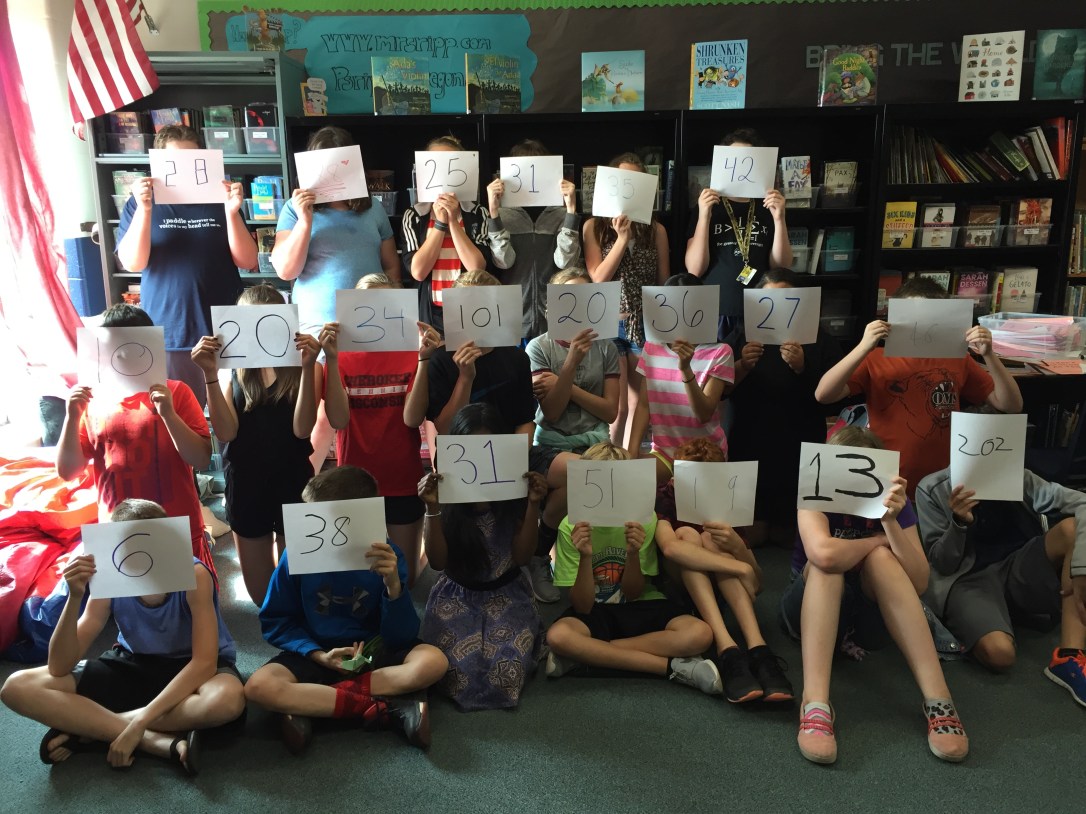
So for the 118 7th graders that I teach, I am so grateful that they believed me when I told then, “Yes, you can read more books.”  But do not take my word for it; let these pictures show you what it looks like when 7th graders read and become readers.  Let these pictures show you that yes we can get kids at this age to read, that just because a child is going through huge personal development reading does not have to become not lost.  What matters is the reading community we create.  And the high expectations we have for all of our kids.  27166703430_98b5a337ba_o26835817253_48478693c8_o27344117862_70e104318d_o27443368625_dc2b4b5b2b_o27344097252_2fe674e6bd_o

And in case you are wondering, that is 4,357.5 books.  Not bad for how many kids told me that reading was not something they felt like doing.

If you are wondering why there seems to be a common thread to so many of my posts as of late, it is because I am working on two separate literacy books.  While the task is daunting and intimidating, it is incredible to once again get to share the phenomenal words of my students as they push me to be a better teacher.  The first book tentatively titled The Global Literacy Classroom is scheduled for release November, 2016 by Solution Tree.  The second, which I am still writing, is tentatively Passionate Readers and will be published in the summer of 2017 by Routledge.  So until then if you like what you read here, consider reading my book Passionate Learners – How to Engage and Empower Your Students.  Also, if you are wondering where I will be in the coming year or would like to have me speak, please see this page.


being a student, being a teacher, being me, end of year, Student dreams

We Carry the Words

Tonight, as I sit quietly processing a moment where a student shared their fragile truth with me.  The moment when a child sat silently watching as I read their words, breath held to see how I would react, and all I could think was how very grateful I was for their trust, their truth, their faith in me as their teacher, as an adult in their life to carry the words they had chosen to share.  I thought of this post, now written 5 years ago and yet ever so true in my heart.  We may feel like we carry our students’ dreams into the world, we may feel we carry their words with us, but it is not just their words we take with us when they leave us.  It is their truth.  We protect it, we support it, and we carry it with us long after their final goodbyes and the summer vreeze settles in.  I am so grateful for the very job that I get to do every single day.

The shuffled movement, the slight look possibly from the left, a small gesture to be noticed. “Ummm, Mrs. Ripp can I have lunch with you?” Oh shoot, there goes that extra prep, but yes, absolutely yes, let’s have lunch. Over food the words come tumbling like a bottle with it’s cork pulled. Didn’t even have to ask a question, they just spill out and out, away from this student, this trusting student that needs someone to carry the weight of the world with them. It is not new, not shocking, but every day life, every day fears, every day needs of wanting bigger, better, more. And yet here, it means the world.

We carry those words.

Another morning, a moment, a need for a hug and then a drawing shown. “Do you think I can make it, Mrs. Ripp?” “Of course, you can, just dream and work toward it,” is what I say but what I think tells more… Work hard, little child, don’t believe those people who will try to steal your dream. Don’t believe those people that tell you you are not smart, that you will not amount to anything. Don’t listen when they make you angry, or when they make you cry. Dream, dream on, dream strong.

We carry those dreams.

At the end of the day, a mad rush, backpacks on, cubbies emptied, and one last, “Thank you for coming.” I mean it too, thank you for being here, for sharing your day with me. For sticking with me when my voice got tired, or my explanation made no sense. For listening when I should have been quiet, for raising your hand patiently and waiting your turn even though you were really, really excited. Thank you for laughing, for thinking, for creating, and trying. Thank you for believing and caring, for trusting and loving, because that’s what it is; trust and love and hope and hard work, every single day.

And within the words they share.  Within the dreams they hold.  Within the hushed conversations and quiet moments, I realize that it is not just me that carries something, or even just the other adults.  But all fo us as we protect the fragile relationship that exists within  our 4 walls.  And when they leave us on the last day of the year all we can do is hope that we have given them enough strength to keep on, to still dream, to still trust.  And in the end, we were not the only ones that carried, fore they carried us too.

If you like what you read here, consider reading my book Passionate Learners – How to Engage and Empower Your Students.  Also, if you are wondering where I will be in the coming year or would like to have me speak, please see this page.
Be the change, being a student, being a teacher, being me, Personalized Learning, student choice, Student dreams, student driven, Student Engagement, student voice

You Cannot Buy Your Way to Personalized Learning

http---www.pixteller.com-pdata-t-l-388588.jpg

When I decided to change the way I taught, I didn’t have a system.  I had a lot of ideas, a lot of thoughts, a lot of failures to push me forward in my quest to be a better teacher.  I had kids who hoped that school would be about them again.  I had parents that hoped that their kids would like school when their year with me was done.  I had dreams of something different, but I didn’t have a clear path, I didn’t have a curriculum to follow.  If I would have, I don’t know where I would have ended up.

You see, when you choose to make learning more personal to the students, it is not about buying a curriculum.  It is not about buying a solution.  Or even reading a book and following the step-by-step directions to make it more personal.  It is not about finding the new tool so that you can adapt and make it fit all of your learners.  In fact, it may be just the opposite. It is about getting to know your students, getting to know yourself, and then finding as much inspiration you can to become a better teacher for all of your kids.  So when I wrote my book, Passionate Learners, it wasn’t so that others could teach like me, but instead so others could start to question their own teaching as well.  I didn’t want to give directions, but just ideas, questions, and things to reflect on.  Because making learning about the kids again means that we have to be the ones to figure it out.  Because they are our kids, in our schools, and no one can tell us better than what they need than them.

Personalized learning is not about a system.  It is not about a box.  It is not about a computer where students can self-pace as they work through a set curriculum.  It is not about a checklist, nor learning in isolation.  Personalizing learning is about what is right for the kid that is in front of you at that very moment.  About helping them get to a place where they can figure out what they need and what they would like to accomplish.   And yes, sometimes that kid doesn’t know what they need and then it becomes our job to help them figure it out.   It is not about what you can do for the students to take control of their learning, it is about what they can do.  Personalizing learning is indeed what great teaching is all about; knowing the students and helping them find ways to make all learning worth doing again. 

So if someone tries to sell you or your school a  personalized learning system, a personalized learning curriculum, or even a technology solution so that all students can work at their own pace, I would stop and think about that for a moment.  How can they possibly promise you personalized when it is far from personal?  How can someone who does not know your students, your school, your needs, deliver something that will fit all of those things?

Education is a business and we should never forget that.  As much as we may think that every person who creates something for the education market is in it for the right reasons, we would be fools if we truly believed that.  Much like every other educational buzzword, personalized learning will become the new cash cow until a new buzzword overtakes it.  Don’t let companies ruin what kids need.  Don’t fall for the sales pitches.  Personalizing learning for students means the emphasis is on the personal and for the personal to happen, we have to know our kids and we have to listen to our kids.  Not a company.  Not a sales pitch.  But the voices of the very students we teach.  And that is free.

If you like what you read here, consider reading my book Passionate Learners – How to Engage and Empower Your Students.  Also, if you are wondering where I will be in the coming year or would like to have me speak, please see this page.


being a student, being a teacher, end of year, student choice, student driven, Student Engagement

It Is Time to Remove the Scaffolds

http---www.pixteller.com-pdata-t-l-384893I think we have 25 or so days left of school.  I may be wrong, I haven’t been counting.  I don’t like to count down, I want to savor every moment, embrace every opportunity, teach until the last minute.  I owe it to the kids.  Yet with the inevitable end of year in sight, I feel the urge to release my students.  To maybe even push them away a little as they need to stand on their own.    To let go a little more, to have them try the exploration by themselves first and not rely so much on me.  Because in 25 days or so, I won’t be there anymore.  I won’t be there when they write, or when they discuss, or when they book shop.  I won’t be there to support, to help, to push.  So they need to find their own way; after all, fostering independent learners is one of our major goals in education.

Yet it seems we have created a paradox.  Within our own eagerness to be the best teacher we can be, to provide everything for every child, I think we forget to let students go a little as well.  We create so many scaffolds in our classrooms in an effort to help students learn more and then forget to remove them, wondering why students come to next year’s teachers seemingly ill prepared to be independent.  And I am not alone in these  thoughts as I am reminded of Bob Probst speaking at NCTE about how we teach kids in early years that NF stands for “Not fake” and then never correct that notion.  Or Donalyn Miller, who wrote an incredibly wonderful book about creating wild readers; readers that would read outside of our classrooms, after they left us.  It seems in our passion for teaching, we may be creating kids who lose sight of what education really is about and instead rely on our systems to pass from class to class.

So right now, as we slip toward the end, I think of all the ways my students must be released.  To make sure that they know that the signposts that we find because of Notice and Note are not the point of reading, but are meant to deepen their experience.  That a MEL-Con paragraph is not the task at hand, but instead just a way to remember that if you present any evidence when you write, you must analyze and explain it.  That they must look inward to discover who they are as a reader so that they can select books using their own methods that do not revolve around what the teacher book-talked.  And the list goes on.

At the beginning of the year, we are so focused on the routines we must set up for our learning communities.  On the expectations that we create along with the students.  We start programs, curriculum, and set our journey up for the most success.  It is therefore only right that toward the end we start to unravel the same routines, the procedures, the scaffolds, so that students can leave us better, bigger, and more independent.  So the students can leave us and not look back when they go, knowing they are ready for the next challenge.

If you like what you read here, consider reading my book Passionate Learners – How to Engage and Empower Your Students.  Also, if you are wondering where I will be in the coming year or would like to have me speak, please see this page.


being a student, being a teacher, Personalized Learning, student choice

A Small Idea for More Choice in Our Curriculum

It never fails; spring break hits and all of a sudden it seems there is very little time left of the school year.  The students feel it as they grow more restless, eager to explore more, not as satisfied with the same old routine.  We feel it as educators, too.  We feel the sheer panic of not having done enough, not having taught enough, not being enough.

So I wanted to do a review of the standards we have covered.  I wanted to give the students way more choice.  While choice and student voice is huge component of what we do, it can sometimes feel lost in the background as we create projects together and try to dig deeper into our learning.  So I wanted to facilitate more small group and I wanted to be able to meet the needs of more students.  I wanted to be more for more of my kids as they really stretch their legs, and their minds.

So on a plane ride home from Texas, it finally fell into place.  A short “Choose your adventure” type of paper where all of the students could choose whatever they needed for the 5 standards.  (We actually have 7 but 2 of them will be  explored in May).  They didn’t have to get a bingo.  They didn’t have to pick anything in particular.  They just had to pick one from each standard after deciding what they needed the most.  Every standard gets 2 days of work-time in class, students can change their minds to their needs, and the best part has been that the two incredible special education teachers that are also in our classroom in various hours are also teaching.  Utilizing their knowledge and ideas is something I have really wanted to do for a long time, but had a hard time figuring out how to do.  This has done just that.

My Standards Review - Google Docs.clipular

So how has it been?  Kind of amazing actually.  Students are more in tune with what they need and want.  They are getting to work with others if they would like, they are coming up with some creative ideas when they want, or they are getting the support they feel they need.  In fact, I asked a group of kids if this was helpful and they all gave me an enthusiastic yes!  I have loved the smaller groups, the one-on-one teaching that I have been able to do, as well as seeing the success that they are experiencing.

While my mission as a teacher is to provide as much choice in learning as possible, in whichever area is needed, sometimes it is hard to wrap my head around personalizing learning more when I teach so many students.  This small breakdown of skills and choices has helped us do just that and is making me think about every thing I teach.  What other units can be made into something like this?  Where else can we provide opportunities that fit the needs of students better?  I hope this inspires you to maybe do something similar.

If you like what you read here, consider reading my book Passionate Learners – How to Engage and Empower Your Students.  Also, if you are wondering where I will be in the coming year or would like to have me speak, please see this page.