authentic learning, Be the change, being a teacher, Personalized Learning, student choice, student driven, students choice

Choose Your Own Learning – 5 Opportunities for Learning as We Continue Emergency Remote Teaching

Note: Yes, you may adapt this to fit your own needs, please just make a copy because these are my original documents. Please give credit and also do not adapt it to sell it online or in any way benefit financially beyond your salary as an educator.

We got the the news yesterday; school will be physically shut until the end of the year. The emergency remote teaching will continue. I cried when I heard. I know it seems so silly in the grand scheme of things but I miss our community so much, we didn’t say goodbye, I worry about them, the work I am assigning and everything in between. While the year is not over, it still feels so final. Who would have thought that this was it when I told them to take care of themselves and have a great weekend on March 13th?

And yet, we have also prepared for this type of teaching and learning without even knowing it would be needed. As detailed in my book, Passionate Learners, we pursue independent choice-based learning in almost everything we do all year, not by happenstance but by design. We focus on creating opportunities for students to be independent while figuring out how they learn best as individuals. We focus on choice, personalization, and giving tools for students to speak up for their needs. We do self-paced learning throughout the year and have introduced tools to them as we need. We didn’t plan to finish the year apart, but we are as ready as we could be.

The first round of choose your own learning was fairly successful. Many students appreciated the choices, many students enjoyed the opportunity to pick something that would fit their own learning needs right now and then pursue it with different levels of support from their teachers. Many students clearly showed off their learning and found it worthwhile, fairly stress free, and interesting.

As I would in our classroom, I asked for their feedback before kicking off this second round and tweaked a few things. I also added a new option for them; the daily writing exercises as a way for students to flex their writing muscles without worrying about a long piece. I added better instructions a few places, added in a check-in virtually for others. I am sure there is still much that can be done.

This second round will last a little more than two weeks hopefully. If we need to adjust we will, if we need to change it mid-flight we will. And yes, I share so that perhaps others can use it, please adapt it to your own students as this is made for the ones I know. I will try to give links here to everything that I can.
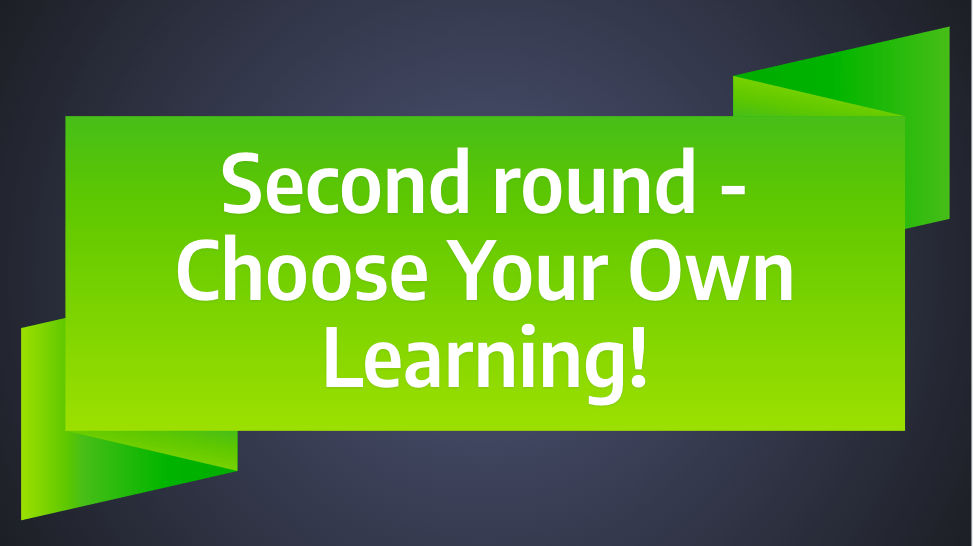
I welcome the students every time with a slide show posted in Classroom. This is where they will see me welcome them back in a video, see the choices and also make their selection on the survey toward the end. To see the slide show, go here it is short and to the point on purpose.

Three out of the five projects require a weekly meeting with me, students are simply asked to sign up on a form that looks like this.

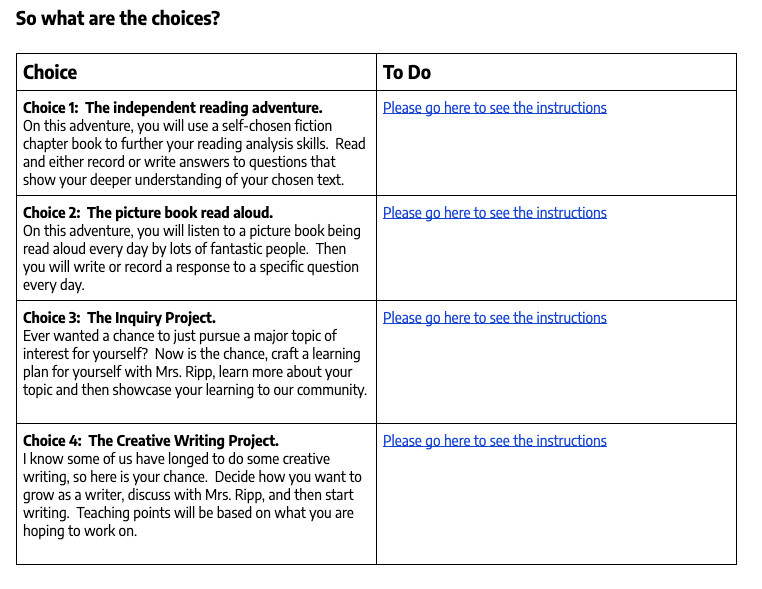
So what are the choices?

Choice 1:  The independent reading adventure.  

On this adventure, you will use a self-chosen fiction chapter book to further your reading analysis skills.  Read and either record or write answers to questions that show your deeper understanding of your chosen text.

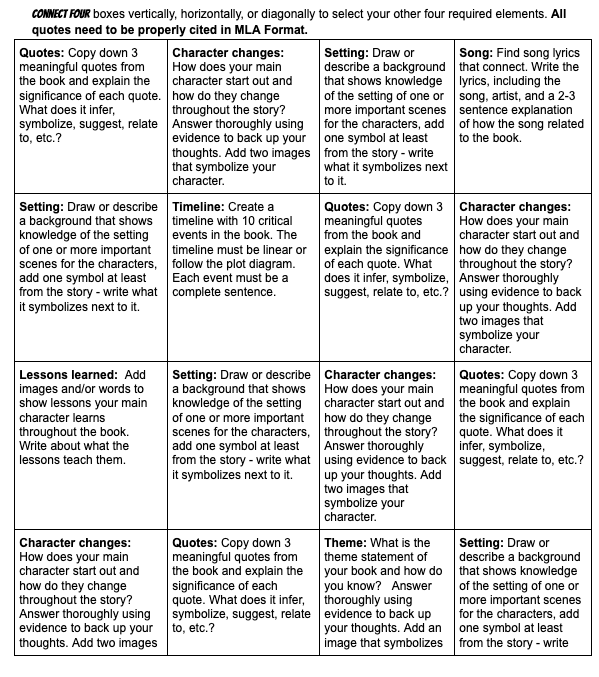
Students are given a choice board where they select 4 “boxes” to do with their book. Every box has a video to help them in case they are stuck. These are mostly lessons from me so if you use this, i would encourage you to make your own lessons for your students using language that is familiar to them.

This used to be a much more art-based project, I modified it to fit a written response, only because I am not sure if kids will have access to art materials. However, kids can still choose to illustrate and use art to answer their selected questions. All of the questions are review, so we have done this work before but they get to practice by applying it to a new book. This was inspired by the one-pager project, my colleague does and I am grateful for her work. 

This required more independence from students then I think some realized and so a tweak I have made for the second round is that students need to check in once a week with me to discuss their progress.

To see the overall directions for teachers and for students to make their choice, go here

To see what students are given to do the project, go here

Choice 2:  The picture book read aloud.

On this adventure, you will listen to a picture book being read aloud every day by lots of fantastic people.  Then you will write or record a response to a specific question every day.

This was a popular choice the first round because a lot of students felt it was easy to manage; listen to one picture book read aloud, write a response a day. I love it because it honors the picture book read alouds we have done throughout the year, and it allowed me to gather fantastic picture book read alouds that have been shared. I tried to make sure that all choices here are following fair use and copyright guidelines as I do not want to harm any of the creators whose work is being shared. Sample questions can be seen below and the rest is found in the links.

To see the overall directions for teachers and for students to make their choice, go here

To see what students are given to do the project, go here

Choice 3:  The Inquiry Project.

Ever wanted a chance to just pursue a major topic of interest for yourself?  Now is the chance, craft a learning plan for yourself with Mrs. Ripp, learn more about your topic and then showcase your learning to our community. The students who chose this in the first round, really liked it and said this was easier than they thought, so don’t be afraid to try this project.

Project requirement:  

  1. Identify an inquiry question you want to pursue – remember, inquiry questions are not straight “Googleable,” they will need learning from many sources or experiences to answer.
  2. Fill in the learning plan to show what you will be learning and how you will challenge yourself.
  3. Do the learning on your own, checking in with Mrs. Ripp every week virtually.
  4. Create a product of your choice to showcase your learning – you have many choices of what to create.

Independence expectations:

  1. This is a project that will require discipline and focus. Because you will not be creating a day-to-day product, you are expected to produce a larger final learning product to share your learning.
  2. The inquiry question you choose to pursue can be one that you already know something about or one that you know very little about, it is up to you. 
  3. There should be NEW learning though that happens throughout, not just a summary of what you already knew.

Students will be asked to do a learning plan, so I can support them if they choose this project. It looks like this:
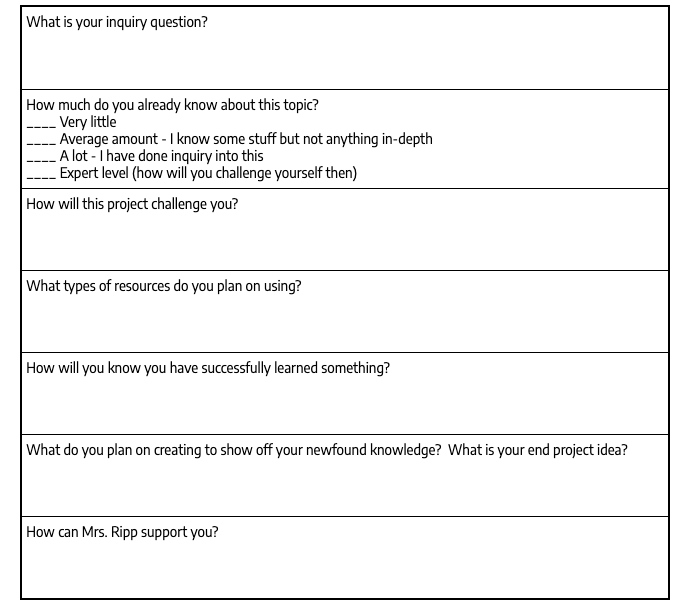
We have done two other inquiry projects so I have seen students navigate this before, I am hoping this will give kids a chance to explore what they would like to explore rather than all of their learning choices being dictated by adults. The few students that chose this the first round loved it and I hope their enthusiam gives other students a chance to try it as well. It was wonderful to see students immersed in learning that they chose again and also thinking about how to showcase it in a way that they may not have used before.

To see the overall directions for teachers and for students to make their choice, go here

To see what students are given to do the project, go here

Choice 4:  The Creative Writing Project.

Have a story to tell?  Here is your chance to use dedicated time in English to pursue your own writing craft and put some of those sweet writing moves you have been working on into action. Decide how you want to grow as a writer, discuss with Mrs. Ripp, and then start writing.  Teaching points will be based on what you are hoping to work on. 

The few kids that chose this loved it. They loved the choice in lessons and the feedback that allowed them to write something meaningful to them. To help with lessons, students are given a video bank of lessons that they can choose from every day, as well as the option to find their own lessons and post those. They are asked to create a daily writing lesson plan so that I can see they are working. The once a week check-ins worked well as well because they were just like the writing conferences we would have in class.

Project requirement:  

  1. Identify your areas of strength as a writer – what do you already do well in writing?
  2. Identify areas of growth in writing for yourself – how will this project challenge you?
  3. Actively work on those areas of growth through independent study of craft techniques and conferring with Mrs. Ripp.
  4. Choices:
    • If a mini-story:  Produce 2 or more pages of a full story.
    • If a longer story (part of a larger piece):  Produce a scene or chapter from beginning to end.
    • If poetry:  5 or more poems or a short story in prose form.
    • If a graphic novel or comic strips:  Discuss with Mrs. Ripp

Schedule a conferring time with Mrs. Ripp each week – that is twice over the two weeks.  These will be via Google Meet.

Independence expectations:

  1. This is a project that will require a lot of discipline and focus. Because you will not be creating a day-to-day product, you are expected to produce a larger final learning product to share your learning.
  2. The creative writing project you pursue should be meaningful to you and show growth in your writing tools.
  3. There should be NEW learning that happens throughout, not just a summary of the skills you already have.
  4. You will need to fill in a  learning plan and submit it to Mrs. Ripp for approval.  It will be posted in Classroom.

Those who chose it loved it but some chose to do poetry rather than story writing so I added some guidelines for that. I also added videos that were shared by students to our daily lesson video bank.

To see the overall directions for teachers and for students to make their choice, go here

To see what students are given to do the project, go here

Choice 5:  Daily Writing Exercises.

Have you wanted to expand your writing techniques and craft?  Here is your chance to be introduced to a new writing exercise a day and then trying it in your own writing.   

Project requirement:  

  1. Watch the video posted for each day (preview in the table below)
  2. Respond either in typing in the box or by submitting an image of your writer’s notebook if you are handwriting. 
  3. You will be given a separate document to record your answer in, this is what you will turn in.

I spent time pulling together ideas for stand alone writing exercises and am incredibly grateful to Amy Ludwig VanDerWater for sharing her daily writing exercises, as well as other resources out there.

I wanted this opportunity to be a way for kids to just have some fun with writing and also have a project that mirrored the manageability of the picture book choice, allowing them do one thing a day and not having to attend to a longer project. I am excited to see how this one will play out.

To see the overall directions for teachers and for students to make their choice, go here

To see what students are given to do the project, go here

A note on choices: Students will indicate their choice on the survey form – this will offer me a pathway forward so that I can send the proper resources to them. Because Google Classroom allows me to only give certain things to certain kids, I can easily provide them the next steps in their choices such as learning plans or other tools. I am encouraging them to choose something else than what they did the first round but have already discussed with one student who would like to continue working on their story. There will be exceptions made as needed in order to make sure this is meaningful to all kids.

A note on grades: You may have noticed that these projects encompass different standards, this is okay because both of these. rounds will be counted toward the same standards. I have also decided that if a child shows any kind of effort then it is an automatic “3” or higher. This is not the time for me to do deep assessment because all I am assessing then is their access to the learning, it is not fair to students, there are way too many inequities playing out for me to pretend that grades would be fair or objective. As far as if a child does not “show effort” then I will be reaching out and discussing with them.

A note on support: I will be individualizing support for my students. For some this will mean just check-ins, for others it will be sharing further resources for their learning. Most kids were successful the first round, some were not, so I will adjust support accordingly. I also have support from an incredible special ed teacher, as well as para educators that I can ask for help from.

If you are wondering where I will be in the coming year or would like to have me speak, please see this page. I offer up workshops and presentations both live and virtually that are based on the work I do with my own students as we pursue engaging, personalized, and independent learning opportunities. I also write more about the design of my classroom and how to give control of their learning back to students in my first book, Passionate Learners.
being a teacher

To This Kid…

I thought I was a pretty good teacher until I started teaching 7th graders. Their love language was so foreign to me. Gone were everyday stories of home, the drawings, the accidental slip ups where they called you Mom. Gone were having all of the time in the world, vowing to get to something later because we could, all day field trips, class parties, and hugs at the end of the day as they went home. Now it was 45 minutes of teaching content. So many kids whose names I desperately tried to learn as quickly as I could. Very little family contact unless it was needed. One teacher among many, teaching a subject that many students had decided they didn’t really need in their life. The smell of failure was real, the mistakes were often, the sense of never being enough was as pervasive as the stacks of things to grade that followed me home.

I cried so much as a beginning middle school teacher.

I thought my second year as a 7th grade teacher would be my last. I decided to give it one more shot before I made a decision of what to do next. Because if I tried one more time then I surely would realize that I wasn’t cut out to be a middle school teacher. That the gap between the 10 year olds I used to teach and the now terrifying 12 year olds was so much more than just a few years. That I was not the teacher I thought I could be. That they deserved so much better than me.

And yet, that second year something quietly happened; I started to get my feet under me. I realized that I could share my worries about being a good enough teacher and I could ask them how to grow. I could be vulnerable and share the stories from my own life as we started to trust each other more with all that we were. I got their names down in less than a week by studying them every moment I had. I asked them over and over how I could be a better teacher for all of them. I took their advice, changed whenever I could and always kept a door open. In turn, they opened up, teaching me as much at times as I taught them, and together we grew to be a community that made me realize that perhaps 7th grade English was exactly where I needed to be for now. That behind the thorny facades, the eye rolls, the hurried explanations of how reading just wasn’t their thing, or how English was just too hard, there was love. There was respect. There was a quiet commitment to what we were trying to establish together. They showed up every day, so I did too.

At the end of that year, we once again ended with our This I Believe assignment. A moment of grace where kids chose to share beliefs that they fully believed in as a speech in our final days together. Where some kids chose to share pieces of themselves that made me hold my breath and tears run down my cheeks as they laid it all out for their classmates to see. As they proved to me that we had created exactly what I thought I would never be a part of again; a place that was safe. Where kids felt accepted. Where they could be whomever they were, and with us, together in those 45 minutes, they would be okay. It was never perfect, but for the most part it was ours, and that was something.

For years in my Passionate Learners keynote I have shared the story a child who chose this final speech to share something that he knew would potentially change how others saw him. How when he slid his computer in front of me to read his first draft, he didn’t tell me what to look for but instead sat back, crossed his arms and watched me in silence as I read. How his second paragraph made me gasp, my eyes well up, as I realized how he had chosen to share a part of himself, how he was not really looking for my editing skills, but for my protection and care with his words. How he was watching for my reaction to see how it would go. As I looked up, I only had one question, “How can I help?” And he told me, “You already have” and pointed to a small sign behind me.

And so when it came time to give his speech, he stood up there boldly sharing his story, asking us all to protect it, to protect him, to help him feel safe, to be true friends when he needed it the most. And the kids did, applauding at the end, some patting his shoulder, others writing compliments, a few wiping tears. Me, I cried, and recognized that in that moment there was no other classroom I would want to be in. That perhaps 7th graders had a space for me, just like I had for them.

And he went on to 8th graders, we passed in the hallways, sometimes stopping for a quick chat, a check in. I saw him last year at the high school, checking in when he passed me on a visit there. He had a big smile. He told me he was reading. He looked happy. But we weren’t in touch, he didn’t know how much his trust had meant to me. How much his faith in the community we shared changed me as a person. That’s just how it goes sometimes.

Tonight, we got the news that this child, this child with his big heart and smile and a bright future ahead, has died.

And for the second time with him, I gasped, and the tears came and I had to sit with the quiet realization that something that had never happened to me has now happened; we lost one of our kids. We lost one of our own. We lost him.

And so I write this through tears as a final goodbye and so long for now to this child who trusted me. To this child who trusted us. Who made our community more than I ever could have thought it would be. To this child, who may have been gone from our team for years, but still was one of our kids, will always be one of our kids.

To this kid, who more than once throughout the past years has reminded me of what it means to fight for kids. To fight for them to be their full selves in our classrooms even as others tell us their lives are against their religion, are immoral, are not natural. To this kid, who saw something in me I had not seen in myself at that time. To this kid who is now gone.

So while I find no peace in this moment, I will say that my life was made better because of his. That I will continue to carry his story with me. That his life will continue to matter in mine. Because this kid, the kids who was, will always be a part of me. A part of us. Whether he knew it or not, but I hope he did.

Five years ago, he wrote, “…everyone should feel wanted, cared for, and believed in by someone who isn’t in their family.” May we all have that. May we all have this kid in our lives, even if only for a brief time.

I send love out into the world to those who need it tonight.

Signing off,

Pernille

authentic learning, being a teacher, choices, Personalized Learning

Choose Your Own Learning – 4 Learning Options As We Go Virtual/Online

Note: This has been updated to have 5 options in the second round as well as to clear up any confusion for students, please see this post to see the updated version. The final round had 9 different options and the slides for that can be seen here.

Yes, you may adapt this to fit your own needs, but please give credit and also do not adapt it to sell it online or in any way benefit financially beyond your salary as an educator.

In yesterday’s post, I mentioned how I wanted to honor the work we have already been doing in our community as we switch to virtual learning starting next week. Because this shut down of our school does not come with an end date at the moment, I am pacing out instruction by weeks rather than days. If we go back sooner than I expect, which would be incredible, then I can switch this particular project to in-class as well.

We were also given guidelines yesterday from our district; plan for about 35 minutes of learning time for each class, I have a double block but am trying to keep it to around that time still, instead with the extra time, I am hoping kids will find the time to read. Kids are not expected to sit in front of a computer all day. We have guidelines in place for making sure kids are connected to us with virtual office hours. We also need to check in if we are not hearing from kids or seeing them do any learning. We are trying to think of things we cannot even think of yet.

We are trying to keep it relevant, accessible, and not overwhelming.

We are trying to help kids continue their learning even when we are not right there with them.

So, for our students, I have created a “Choose Your Own Learning” two-week exploration. This, hopefully, continues the honoring of their individual needs and desires, while still helping them with their growth. There are different levels of independence for them to choose from, as well as choices for recording or writing their responses. There are different levels of teaching involved that will unfold once they select their choice.

From a longer letter welcoming kids into our project

Choice 1:  The independent reading adventure.  

On this adventure, you will use a self-chosen fiction chapter book to further your reading analysis skills.  Read and either record or write answers to questions that show your deeper understanding of your chosen text.

The connect-four template we use for this.

This used to be a much more art-based project, I modified it to fit a written response, only because I am not sure if kids will have access to art materials. However, kids can still choose to illustrate and use art to answer their selected questions. All of the questions are review, so we have done this work before but they get to practice by applying it to a new book. This was inspired by the one-pager project, my colleague does and I am grateful for her work. To see the project guidelines, go here.

Choice 2:  The picture book read aloud.

On this adventure, you will listen to a picture book being read aloud every day by lots of fantastic people.  Then you will write or record a response to a specific question every day.

I wanted to honor the picture book read alouds we have done throughout the year, so I gathered picture book recordings for the students to listen to – one a day – and then created questions to go with it such as the one below.

While I love all of the picture books I am finding, I am still changing some of them out to have a wider representation of creators shown. I am also still working through questions, so this document is very much a work in progress. To see the project guidelines, go here.

Choice 3:  The Inquiry Project.

Ever wanted a chance to just pursue a major topic of interest for yourself?  Now is the chance, craft a learning plan for yourself with Mrs. Ripp, learn more about your topic and then showcase your learning to our community.

Project requirement:  

  • Identity an inquiry question you want to pursue – remember, inquiry questions are not straight “Googleable,” they will need learning from many sources or experiences to answer.
  • Fill in the learning plan to show what you will be learning and how you will challenge yourself.
  • Do the learning on your own, checking in with Mrs. Ripp every two days.
  • Create a product of your choice to showcase your learning – you have many choices of what to create.

Independence expectations:

  • This is a project that will require a lot of discipline and focus. Because you will not be creating a day-to-day product, you are expected to produce a larger final learning product to share your learning.
  • The inquiry question you choose to pursue can be one that you already know something about or one that you know very little about, it is up to you. 
  • There should be NEW learning though that happens throughout, not just a summary of what you already knew.

Students will be asked to do a learning plan, so I can support them if they choose this project. It looks like this:

We have done two other inquiry projects so I have seen students navigate this before, I am hoping this will give kids a chance to explore what they would like to explore rather than all of their learning choices being dictated by adults . To see the project guidelines, go here.

Choice 4:  The Creative Writing Project.

I know some of us have longed to do some creative writing, so here is your chance.  Decide how you want to grow as a writer, discuss with Mrs. Ripp, and then start writing.  Teaching points will be based on what you are hoping to work on. 

Project requirement:  

  • Identify your areas of strength as a writer – what do you already do well in writing?
  • Identify areas of growth in writing for yourself – how will this project challenge you?
  • Actively work on those areas of growth through independent study of craft techniques and conferring with Mrs. Ripp.
  • Produce 2 or more pages in a coherent writing form, you choose the writing form.
  • Schedule 2 conferring times with Mrs. Ripp each week – that is 4 times over the two weeks.  These can be via Google meet, email discussion, chat, or some other mode of communication.

Independence expectations:

  • This is a project that will require a lot of discipline and focus. Because you will not be creating a day-to-day product, you are expected to produce a larger final learning product to share your learning.
  • The creative writing project you pursue should be meaningful to you and show growth in your writing tools.
  • There should be NEW learning though that happens throughout, not just a summary of the skills you already have.

We have done creative writing in small spurts throughout the year but not enough in my opinion, so this is our chance to do it more. I am hoping this will offer up those who choose it a way to sink into their writing and create something meaningful. To see the project guidelines, go here.

A note on choices: Students will indicate their choice on a survey form – this will offer me a pathway forward so that I can send the proper resources to them. Because Google Classroom allows me to only give certain things to certain kids, I can easily provide them the next steps in their choices such as learning plans or other tools.

A note on grades: You may have noticed that these projects encompass different standards, this is okay because all of the work we are doing right now is formative as per our district guidelines. As the closing continues, we will be given updated guidelines. What this means is that when the two weeks are over for this project, I will either recycle the options and ask students to choose a different option or brainstorm further learning with my students. If we switch to live school in the middle, then once this project is done we will go back to our regular scheduled learning, which is debates and Shark Tank presentations.

A note on support: I will be individualizing support for my students. For some this will mean just check-ins, for others it will be sharing further resources for their learning. I teach 76 students, I am not sure how this will look, but we will make it work.

Want to connect with me? I am going to do a Facebook live in the upcoming week in our Passionate Readers Facebook group to take questions and share book recommendations. Join me!

If you are wondering where I will be in the coming year or would like to have me speak, please see this page. 

being a teacher

Switching to Remote Learning While Still Offering Choice

Unknown future Design

I have never experienced a world so quiet before. Not for this long. Every day as I look out our window, I am reminded of the quiet that shrouds us all on January 1st where the world holds its breath and we sit with our dreams in hand, hoping for a new start.

Many now sit with fears in their hands instead, a pervasive uncertainty that permeates even the smallest moments. But the hope is still there, a hope for a world that doesn’t quite feel so unwieldy and uncertain. That doesn’t promise us death, financial losses, and long-term fall out.

And so we went into self-isolation the day after I turned 40, trying to do our part to keep the rest of the world safe, while knowing what it would do for our own children to shut the door on the world as much as possible.

On day 1 of isolation, I thought of all the things I would catch up on during this time; sleep! Books! Cooking! Learning how to play guitar! Writing a book!

On day 2, I was reminded of how extroverted our kids are compared to my husband and I. Do they ever crave quiet? (The answer is; not yet…)

On day 3, I realized I needed to take control over my newswatching or my fear for the world would grow. (CNN check in’s only a few times a day as well as with local news and purposeful social media use).

On day 4, I was reminded of how much I love being a classroom teacher because I love the everyday moments, not just the big ones, the check ins, the community, the being able to reach out to make sure a child feels seen and valued. And I miss it a lot, the putzing around, the excitement to see plans come to life, the moments where it doesn’t work and you have to find a solution. I continue to be a classroom teacher because of how much I love the kids.

On day 5, I recognized that we all needed a moment of space. That our schedule works for the most part but who knows how long it will. That while planning it down to the 30 minute mark works for our kids not going crazy, it doesn’t work for us, the adults, and that there needs to be a balance. That my books are calling and so is my creativity at times.

Turns out the new normal is anything but.

And so as we are told by our district to prepare for our remote virtuel learning, knowing how inequitable that is, and also how I am decidedly not trained in online learning, I keep thinking about what our community has been built on the whole year; read aloud, reflection, inquiry and choice. How in this uncertain time, there are certainties I can hold up for our students; that I will do everything I can to support from afar. That I want them to find success not insurmountable challenges, that I want this to work for them in any way I can. That I want them to have each other.

So rather than assigning one thing, they will have different choices for the un-foreseeable future.

All will be asked to please read for 20 minutes every day something of their choice with nothing but joy and value attached to it.

They can choose to read a fiction book of their choice and do some analysis as they progress through it, using an online one-pager assignment. If they have books at home they are set or they can access our Audible account to choose one to listen to. They can record or write their response to the prompts, whatever seems to work for them the best.

They can choose to do an inquiry project into something they want to learn about, craft a learning plan for me to discuss with them and then create a product at the end of it to teach us about their topic. We have done an inquiry into inquiry and also just finished an inquiry into a self-chosen topic for their TED talks. Their final product should showcase their deepened understanding in some ways, ideas will be offered and support will be based around their learning plan.

They can choose to listen to a picture book read aloud every day by a different creator and then record or write a response to the question I will pose along with it. Questions will range from what is the theme and how do you know? What does this thing (insert specific thing) symbolize and how do you know? How would the message of the picture book change if we changed the narrator? Whose perspective is missing and how does that impact the story being told? How did the perspective of the narrator influence their actions in the story? How did the main character change throughout? How does this picture book connect to your world? If you were to teach this picture book, which questions would you ask to start a discussion?

They can choose to write a story, alone or by themselves, working on all of the tools of storytelling we have been discussing through the year. Before they begin, they will be asked to identity how they want to grow as writers, how they will work on that, and then how I can support them (this is what we do throughout the year). The story can be fiction or from their own lives and teaching points will be based on what they are working on.

Throughout the year, we have done a lot of learning, now is simply the next step to put it all into action. Can they use what we have learned on their own? Have the skills been transferred? How can I continue to support them on a meaningful journey that will help them grow while also recognizing the realities of this world we are faced with right now. While also recognizing that right now schools in Wisconsin are closed indefinitely and so I don’t know how long of a timeline I am even preparing for.

Will it be perfect? Absolutely not. Will it be okay? I hope so. After all, that is the best I can do right now. To be here, to keep trying to connect, to reach out and be there for all the kids.

What are your plans?

If you are wondering where I will be in the coming year or would like to have me speak, please see this page. 

being a teacher, global read aloud, Literacy, Reading

What Are We Reading Aloud? Survey for K-8 Educators in the United States

I have written before about the read aloud and its power for older students. I have written about how read alouds brings us all together, how they offer us a new language to speak as we build our community. How read alouds allow us to step into a world we might not know or invite others into one that we already live in.

Since founding the Global Read Aloud in 2010, I have been responsible for selecting a read aloud to be shared around the world. The task always feels heavy. The task also brings a lot of joy, but as I have mentioned, the task of selecting the books to be read aloud have also made me curious; what is already being read aloud in the United States? What are the corner texts that, we as communities, keep coming back to year after year? What do our students get to experience from year to year as they travel through our classrooms?

Rather than just be curious, I figured I would ask. So will you help me out by taking this survey and sharing it with others? I tried to make it easy to take but still offer up valuable information. I will share the results once I have enough responses, because once we know more we can learn together.

being a teacher

Fully Me

I had just turned 18 when I agreed to move to the US. Unaware of what the world would bring, unaware of what else the world could hold. I may have been a mature 18-year-old per regular Danish standards, but I wasn’t quite ready to leave my mother’s side even as my siblings had found homes around the world. The proud teen in me not quite ready to set off on my own rebellion as it was so much easier to fight against the system comfortably nestled within my own zones of safety. For all of my bravado, I was still a child looking to fit in and where else could I best fit in than right with my family, or what was left of it?

I flew across the Atlantic with a suitcase or two, my papers in hand, and muddled dreams that perhaps included going to school at some point but no plan for longevity, no vision for my life beyond this move that would uproot me in the most significant of ways. I was moving, period, but I wasn’t going to stay, surely, my roots where in Denmark after all. In Copenhagen where the university, and an apartment were sure to be in my future.

Perhaps it is the way of the foolish young mind that allows us to jump into situations without seeing the path before us. Of a new home. Of a new identity thrust upon me that I had never embraced before. Of what it would mean to get on that flight, choice already made for the next many years but not realized.

I have now lived in this identity as an inconspicuous immigrant for 21 years.

My Danish language slips through my fingers much like sand, still accumulating but the piles rapidly decrease. I haven’t thought in Danish in many years, nor dreamt in my native tongue. The morning I recognized this, I felt a deep devastation, feeling as if my world tilted as my language was replaced unconsciously. As my brain let go of what has been my voice for so many years.

Sure, I speak English fluently, write it well, and yet within my own home language was everything I held dear to me. I lose words that were once within my grasp. I stick to rudimentary language with my own children as my mother corrects my grammatical inaccuracies. I used to be fluent. I used to speak and write it beautifully. I used to be able to fully say what I wanted to say without the crutches of English to guide me through when the words that used to flow are outside of my grasp. I used to be fully Danish and not an imposter grasping to the things she remembers.

I hold dear to my traditions. To what I believe are my Danish values, but honestly after so many years as an assumed American I don’t know if I get to call myself Danish anymore. If I have been reduced to the shell that so many others use when they trace their proud lineage but are not really seen as from there. From somewhere else. When I am told I look like an American. When I am told I sound like an American. When I am told that I think like an American. When I am told which parts of my identity holds the most weight to others and I wrestle as the biggest part of me, that of Dane, is one that is pushed aside because surely by now I feel more American than anything else.

And nothing could be farther from the truth, but who listens to that?

Because I left my country behind.

Because I left myself at Vestergade 12, 8850 Bjerringbro. In that little red brick house. In the company of my friends. And nothing will ever replace what I once used to be, no matter how many new identities I add to myself.

And I think of how the world views us all as it boils us down to such few elements. At how we treat the kids we teach who are learning English as less than. How we only ask about their traditons but not their mundane. About the daily life that they left behind. About the essence of what made them truly feel like they were the person they were meant to be.

And we boil it down to traditions.

And we boil it down to small phrases.

We boil it down to dishes passed around the table, songs sung on special days.

And we break it down to trips once in a while across the Atlantic so that I can hear my name pronounced correctly and for a few short weeks I can breathe fully again, among the people that I used to call my own.

And we think that is enough. But it will never fully allow us to feel complete as we straddle new cultures, home in neither, but adapting to both.

And so my heart longs to go home. To bring my family with me. To go back to what once was while realizing that it will never be again. But something new could be.

To be fully me again without having to reconcile what I used to be with what I am now.

But until then that dream becomes a possibility, I will continue to to try to define myself as I want the world to see me and give every opportunity for those I teach to do the same. To let them tell me how they want to be seen. To let them tell me what they need. To be fully human as we go on this journey together.

To just be the person we were meant to be and seen for what we would want to be seen as.