Be the change, being a student, being a teacher, books, Literacy, Reading Identity

On Boy Books and Girl Books

Image result for pernille ripp boy books

I get asked for a lot of book recommendations, I think it comes with the territory when you share the love of books.  And while I love pairing books with potential readers, I have also noticed a pattern that causes me to pause, that should cause all of us to pause.

I get asked for a lot of books featuring male lead characters for male readers.

When I ask why the need for a male lead, I am often told that “they” just don’t think a boy will read a “girl book.”  That a boy will not like a book about feelings.  That a boy only wants books that have action.  That have other boys in it.  That feature characters that look just like them or at the very least think like them.

As if every single boy thinks alike.

When written like this it is easy to see the problem; when we assume that there is such a thing as books for girls and books for boys, we are continuing a tired and sexist narrative that has only furthered the power inequity that already exists within our society.  We are creating a new generation of mansplaining, of groupthink, of toxic masculinity.  Of girls only liking one thing, and boys liking another.  Of men and women being from different planets.  Of readers being shaped more by their assigned gender than their actual interests.

We are furthering the stereotype that boys don’t like to read about girls because they see little value in what girls do.

We are furthering the stereotype that boys don’t like to read about feelings because they are somehow above all of that.

We are furthering the stereotype of what it means to be a boy which translates into what it means to be a man and not seeing the incredible harm in that.

Because what about the boys that love a good tearjerker?  What about the boys that don’t like sports?  What about the boys that love to experience the emotional development of a character?  What about the boys that love a great female lead character?  What about the girls who don’t fit into the opposite boxes?  Do they not deserve to have books suggested to them, no matter the gender of the protagonist?

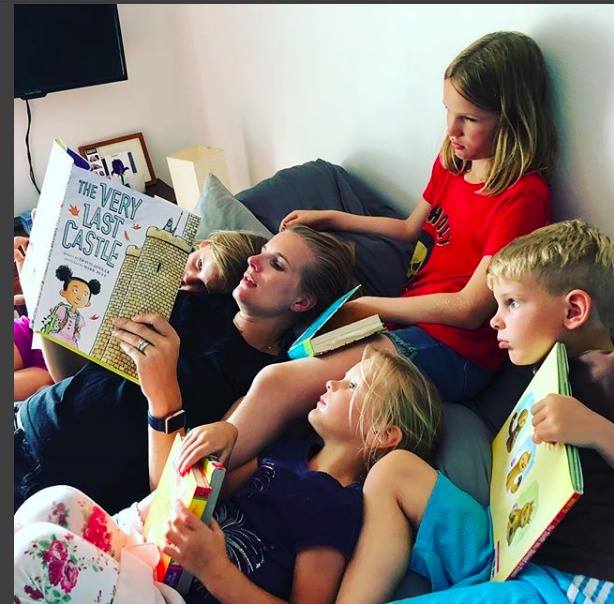
And I think of my own children, my three girls and one boy, whose reading interests are as varied as their personalities.  Sure there are Minecraft books being read by Oskar, but not until Thea reads them first.  Sure there are unicorn books with pink sparkly covers being read by Augustine but not until Oskar sees if the unicorn gets rescued first.  I would hate for anyone to assume that they knew who they were as readers based only on their gender.

So when we claim that a read-aloud featuring a female protagonist will likely not catch the attention of our boy readers, we have whittled the male reading identity down to practically nothing.  Males – good.  Sports – good.  Action – good. We have diminished what it means to be a reader who develops with the books they read.  We have diminished what it means to identify as male.  We have diminished their chance to learn from a perspective that may at first seem foreign but in the end may just be more similar than they ever thought.  We have effectively boxed our boys in only to then wonder why they may act a certain way.

How often does this thinking then translate into the very books we recommend to the boys we teach?  To the girls?  How often do our assumptions about their needs as a reader surpass what they actually need?  How often does this translate into the read alouds we choose?  The texts we bless by spending our time on them as a community?

And I realize that I don’t get asked the opposite very often.  That often when I am asked for a recommendation for a female reader, the gender of the protagonist is hardly ever brought up.  That instead the most common descriptor is a strong story development, a story that will hold their attention.  Why do our boys not deserve the same?

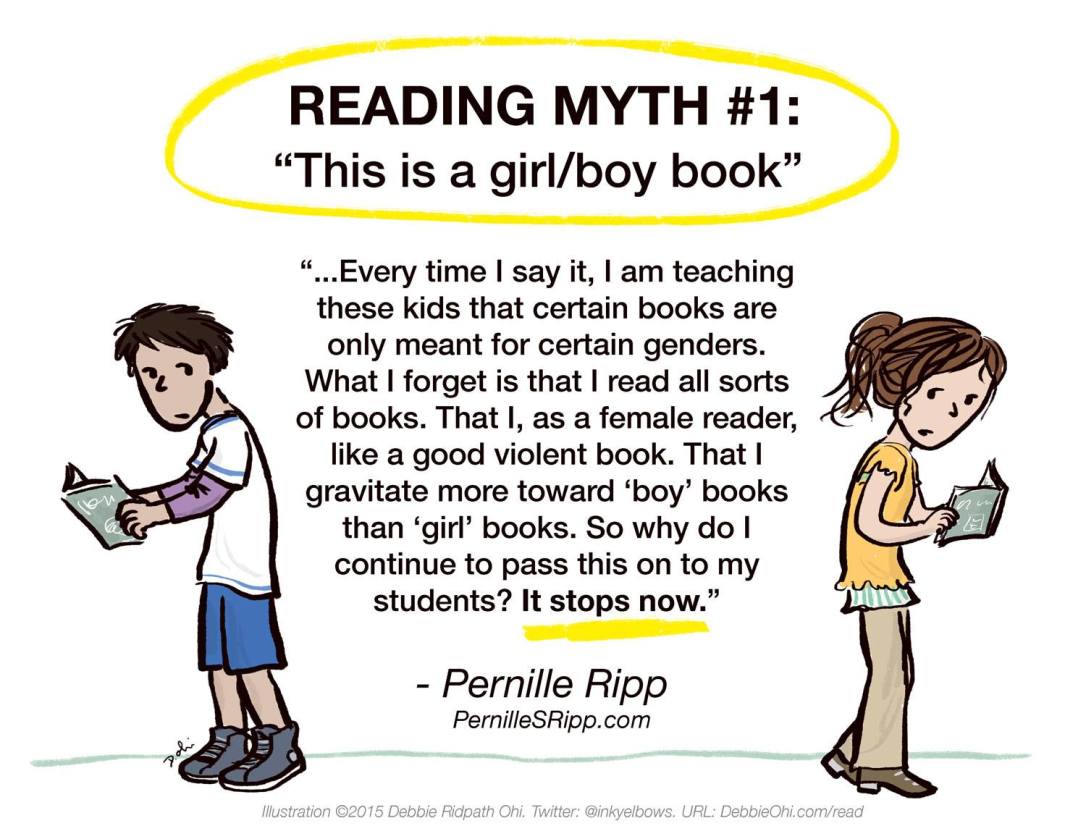
So I am wondering if we for once and for all, can we all agree that there is no such thing as a girl or a boy book?  That kids need to be exposed to characters that inspire them, no matter their gender.  That kids need to be exposed to characters that will expand their worldviews and invite them into new worlds that they knew little of before, no matter their gender.  That kids need to be exposed to great books, without us adults thinking that they will only read a certain type of book based on what we see in front of us.

We must give them a chance to experience more than what they are.  Books allow us to do just that, but not if they never read them.  Not if we never recommend them.  That’s on us, which means we can change it, so let’s do that starting now.

If you like what you read here, consider reading my newest book, Passionate Readers – The Art of Reaching and Engaging Every Child.  This book focuses on the five keys we can implement into any reading community to strengthen student reading experiences, even within the 45 minute English block.  If you are looking for solutions and ideas for how to re-engage all of your students consider reading my very first book  Passionate Learners – How to Engage and Empower Your Students.      Also, if you are wondering where I will be in the coming year or would like to have me speak, please see this page.
being a teacher, first day, students

On the First Day of School

White, Black,  Free Image

Sitting next to the ocean on vacation with three feverish children has given me a lot of time to think.  To relax.  To lay puzzles.  Read books.  Take walks.  Recharge.  I wish everyone could have a quiet time like this.

In the quiet, the new school year sneaks in.  Thoughts and ideas spring forth, the excitement starts to build.  There are changes this year once again; only three classes to teach, each 90 minutes long.  New focuses brought in.  New ideas to try.  A sense of urgency that cannot be replicated.  I cannot wait.

And so I think about the very first day of school.  Of the experience, we will have.  Of the things, we will do together.  But most importantly, how I want our students to feel after they leave our classroom experience together. How I would love for them to feel at the end of the day.  Hopefully excited, hopefully intrigued.  Hopefully safe.  Hopefully accepted. Hopefully wanting to come back.

Because when we plan for the first day of school, that’s what we should be planning for; how they feel after they leave us.

Not just all of the things we need to do, but the very tone we set.  Not just all we have to cover,  but the beginnings of the relationships we will create.

And so I plan for a picture book read aloud.  I plan for book shopping.  I plan for conversation, for the beginning moments of community.  I plan for laughter.  I plan for fun.

The stuff?  The projects?  The nuts and bolts of our year together?  That will come.  But on that very first day, it is not what is most important; our beginning relationship as a community is.  And so that’s what we focus on.

Everything else can wait.

How do you want your students to feel after the first day of school?

If you like what you read here, consider reading my newest book, Passionate Readers – The Art of Reaching and Engaging Every Child.  This book focuses on the five keys we can implement into any reading community to strengthen student reading experiences, even within the 45 minute English block.  If you are looking for solutions and ideas for how to re-engage all of your students consider reading my very first book  Passionate Learners – How to Engage and Empower Your Students.      Also, if you are wondering where I will be in the coming year or would like to have me speak, please see this page.

being a teacher, books, Literacy, Reading

How to Easily Do A Book Talk

5092270077116416.png

One of the pillars of our reading community is the daily book talk.  While I used to do them once in a while, I was spurred on by the wisdom of Penny Kittle to do one every single day, which I have now fully embraced for the past few years.

So in the last few years, I have done a book talk almost every single day right after we finish our independent reading.  It takes less than two minutes and is fairly simple.  I used to plan them out much more but realized that it added another level of work to my already jam-packed day and that it didn’t seem to make a difference to the students whether I did a pre-scripted one or one that was more spur of the moment.  So this is what our book talks look like now.

Preparation:

  1. Pick the text you will book talk – note this can be a chapter book, audiobook, a collection of short stories or whatever you feel like blessing as Linda Gambrell reminds us.
  2. I like to book talk a variety of new books I have read as well as older books that haven’t been discovered yet. One place I look to for inspiration is what my students have recommended in the past.
  3. Decide your angle:  Are you book talking it because you read it and it was amazing?  Because you abandoned it and need someone to prove you wrong?  Because you added it to the library but haven’t read it?
  4. Prepare your visual.  I like to project the cover of the book so that students can easily write down the tile.  I also put any genres abbreviations on the slide and whether or not is a more mature book.
  5. Have the physical book ready to hold up and hand to someone or place on a designated book talk shelf or display.

During the book talk:

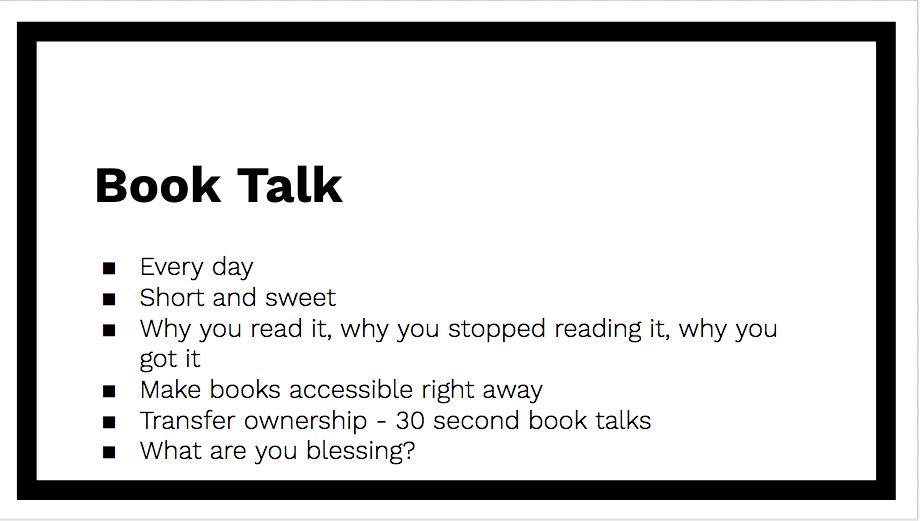
  • Keep it short and sweet.  I tend to say a few sentences about the book and why I liked it/abandoned it/purchased it and then read either the first page, the inside flap or the back cover.  I love these teasers as they are already made for us.
  • Have the book ready to hand out.  The only time I break this recommendation is when I just finished a book and I want to book talk it to all of my classes.  Then I try to find extra copies beforehand, such as from our school library.
  • Students should have their to-be-read list out which is located either in their readers’ notebook or using the Goodreads app.  This is a routine expectation we start with the very first week.

Pointers:

  • Start to transfer ownership of the book talks to students fairly early on, you should not be the only one book talking a book.  I love using the 30-second book talk idea to help students become more comfortable with the format and also ensure that everyone participates.
  • If I am the one doing the book talk there is only one given, if it is students, then there can be up to three depending on their length.  Again, this is short and sweet, not the actual teaching point of the class.
  • If many students want to book talk their book, consider making it the teaching point and dedicate a lesson time for it or have them do a speech about their favorite book.
  • Keep an anchor chart or some sort of visual of which books you have book talked, not only does it provide a reminder to students about the books shared, but it also allows you to ensure that you are providing inclusive book talks that do not just fall under one genre, cultural heritage or some other category.
  • Place book talked book the same place so that students know where to find them.  We have a book tree that serves as everyone’s place to recommend books so that is where they go.
  • Check to see if there are book trailers available.  I still think the book trailer for The False Prince by Jennifer A. Nielsen has convinced more students to read the book than I ever have, and I love that book.

I have loved doing daily book talks and also getting them from students and I now see them as a vital component of any thriving reading community.  When we book talk a book it is the invitation into a relationship with that book for all of our students, what a powerful teaching tool that is.


being a teacher, new year

My Teacher Lesson Planner

Even though September is still far away, my mind has been on my classroom lately.  How can it not be when I am as excited to meet my new students as I am?  This is also the first year that I get to go back to block teaching, but this time in 7th grade, rather than elementary.  To say my mind is swimming with ideas as I sit by the ocean would be an understatement.

I realized that one of the tools I seem to need every year is a great lesson planner.  I have gone through many iterations, none that I truly loved, and yet, as I looked online I felt a little inspired.  You see, those beautiful lesson planners for sale are truly gorgeous, but…I need different things than what they offer.  I need a place to actually plan the different components of my class, a place to keep student birthdays, a place to put my data in when I have it, and so on.

Rather than purchase one of the very pretty, but perhaps not so needed, teacher lesson planners that I see advertised everywhere, I thought I would just make my own.  While it may not be put together for me, I can put this in a binder, add what I need, change the pages I don’t like, and truly make it work for me.

I figure the money I save by making my own I can use on books and scratch and sniff stickers.

So what are the components of my teacher lesson planner this year?  Feel free to use as your own, as some of these I have created and some I have merely found online.  These are the different tabbed components.

Student Checklist.  I use a very easy table that I simply type up every year with the list of student names.  Once I have done that, I can use the table for all sort of things throughout the year.  It ends up looking something like this.

Year overview calendar.  I like being able to see the year at a glance, so I was thrilled to find this school year calendar offered for printing by Vertex 42.  There are also many others out there that you can simply print.

Monthly overview calendar.  My school functions on a black/orange schedule, and while my day doesn’t change, it helps to know which day it is.  I usually print my own school’s monthly calendar but found this option online as well for 2018 and 2019.  This is also where I plan to place student birthdays on so I can make sure to celebrate them in style.

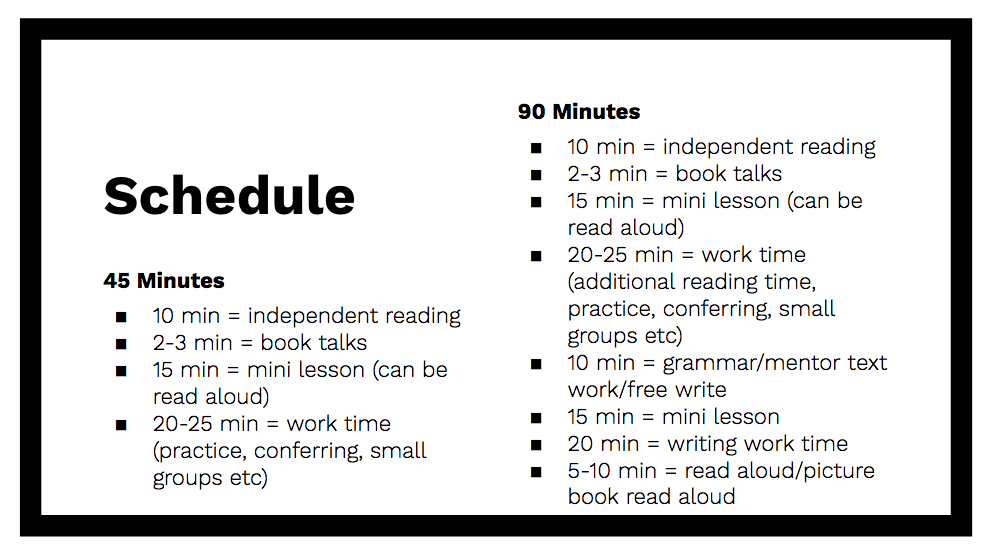
Weekly planner.  This is the document I am still working on as I continue to tweak my 90-minute schedule.  I will write more about this once the year is underway I bet, but for now, this is my working schedule and my weekly plan template. 

5603634788958208.png

Data section.  This is where I like to keep my rosters, my reading data, and also any IEP, 504, ESL,  or health notes.

Standards section.  Our standards have been tweaked every year, so I like to keep a printed copy handy rather than have to look it up each time.

Extra section.  Every year, I have a few paper copies of things I need to keep handy but they don’t really fit under a theme.  That’s where the extra section comes in, use it for notes, for copies, numbers, whatever you need.

All of these sections will be placed in some sort of color binder with some sort of tabs.  I know it’s not as much fun as some of the planners I have seen, but you know what, it works for me.

being a teacher, being me

We Send You Our Best

White, Black, Red,  Free Image

I have shared Thea’s story with school for years.  How our oldest daughter was labeled a struggling reader in kindergarten and has been in intervention ever since.  How she declared that reading was simply too hard in 2nd grade, despite her incredible teachers, but that Dog Man by Dav Pilkey made her believe that she was a reader and that she had always been a reader.

How our oldest daughter was bullied so badly that she asked whether you could survive without friends.  That she ended up changed last year, new pieces of a puzzle that we have yet to figure out how to fit together.

I have shared how we have we searched for answers.  How we have focused on protecting her hope of reading.  Her love of school.  How we have flooded her with books, fought for her right to be safe, and seemingly tried everything we can to make her believe that she has worth.

Thea is a child who tries even when it is hard.  She is our dreams come true.

What I have never shared, fully, is the guilt that comes with having your child identified as someone who hasn’t learned what they should.  The shame in your own parental structures.  The questioning of your own ability to parent successful children who do not need intervention.  Who do not end up being a question mark.

Who do not end up being bullied.  Being the victim of other children’s vicious nature and whims.

Who do not end up being the parents of a child who thinks that she doesn’t deserve friends, because she is lame.

I think of all of those emotions that are tied in with our own children’s journey.  How their journey in school only seems to highlight the failures we have as parents.  As people.  How we blame ourselves when they fail to reach benchmarks.  When they get in trouble.  When they fail to find the community that other children seem to so easily find.  When they make decisions that we seemingly cannot understand and we know that the teachers that teach them may very well think that we are the ones that pushed them in that direction.

How many nights of conversations my husband and I have had about what we were doing wrong.  About what else we could do.  Trying to come up with solutions to a situation we are not sure we understand.  How many nights we have held our tongue and assumed that perhaps a teacher did not see how something affected our child.  How many nights I have cried over how I have failed my own child because of what she has to face.  How I wish I could take her place but that I know that as a parent that is not my role.

I think of how many times I have assumed that a child stood in front of me and acted a certain way because that is how their parents or those at home acted.  That the child in front of me is surely the product of everything those at home failed to do.

I am ashamed of this realization.  Of the judgment, I have so easily passed.  Of the assumptions, I have let shape my decisions in how to work with kids.  In how to work with those at home.  But in shame comes learning.  Comes growth.

Because what Thea has taught me, what all of our children have taught me, is that most parents try their best.  That we send you the very best kid we can.  That we have probably done all of the things that are meant to make our child as successful as they can but it turns out it might just not be enough.

That sometimes even though we follow the rules, take the advice, try all of the tricks, a child, our child, will still confound us.  Will still mystify us.  Will still make us pause as we wonder what else we could have done.

I hope my children’s teachers see us as parents who try.  That they know that sometimes we don’t understand a behavior either.  That we have raised them right but that doesn’t guarantee that they will act right.  That even though we did all the things to raise a reader, our child, who is a reader, may not be able to read well, yet.  That even though we have raised our child to be kind, helpful, and loving, others may not see her as such.

May we all remember how hard it is to send a child to school.  How hard it is to let go and hope that the child that walks through those doors is the child you hoped would show up.  Because we tried.  Because we are trying.  And I hope you see that.  I hope we all remember that.

If you like what you read here, consider reading my newest book, Passionate Readers – The Art of Reaching and Engaging Every Child.  This book focuses on the five keys we can implement into any reading community to strengthen student reading experiences, even within the 45 minute English block.  If you are looking for solutions and ideas for how to re-engage all of your students consider reading my very first book  Passionate Learners – How to Engage and Empower Your Students.      Also, if you are wondering where I will be in the coming year or would like to have me speak, please see this page.
 

being a teacher

On Saying No More

White, Black, Blue,  Free Image

I have realized in the past week that self-care is something I need to plan for. Is something every educator needs to plan for. That no matter what we do, which role we play, we can always feel like we are not enough. Like there is not enough of us. But I have also realized that that is not true.

 There is enough of us but just too much of other things.

 There will always be more coming at us, no matter what we do. There will always be that one thing, that one opportunity, that little thing that someone just would love for us to do and if we could just squeeze it in that would be great.

But I don’t want to squeeze anything in.

I want to be fully present.

To give my best when I am there.

To step away when I am not.

To not apologize for taking care of me.

I have realized that the time you give should be a gift and if whatever you are giving your time to doesn’t feel that way then perhaps you shouldn’t be giving your time to it.

I have been reminded that saying no is not a privilege but a right.

I have been reminded that I am enough, but to stay that way, I need to preserve, reserve, and conserve.

And I have been reminded that too many of us feel the drain, feel the rush, feel the need to be everything for everyone and that we are killing ourselves in the process.

We don’t have to.

We just can’t forget that.