being a teacher, books

How I Am Growing – A Few Professional Development Books to Boost Your Work

Ah, summer.  Lazy days spent at the pool.  Trips and travel.  Sleeping in and ice cream.  Kid movie nights and dates with my husband.  Yet, every educator also knows that summer can mean growth, new ideas, new energy as we unpack the last year and focus on the next one.  Sometimes it comes from stepping away, from reflection, from taking a break from all things education.  Sometimes it comes in the form of a neatly wrapped package, a new book to help us see our world a little differently.  So what am I reading this summer to help me develop my craft?

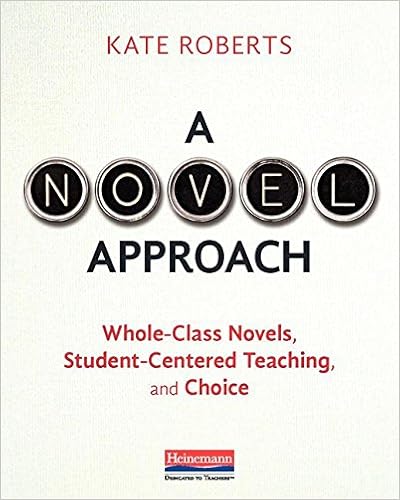
We are toying around with the idea of doing one whole class novel this year so when I saw Kate Roberts’ new book, A Novel Approach – Whole-Class Novels, Student-Centered Teaching, and Choice I knew I had hit the jackpot.  But I am going to let you in on a little secret; you don’t have to even be considering whole class novel for this book to apply to you.  Kate’s wisdom is for all English teachers and her ideas have already shaped my thoughts for the year ahead.

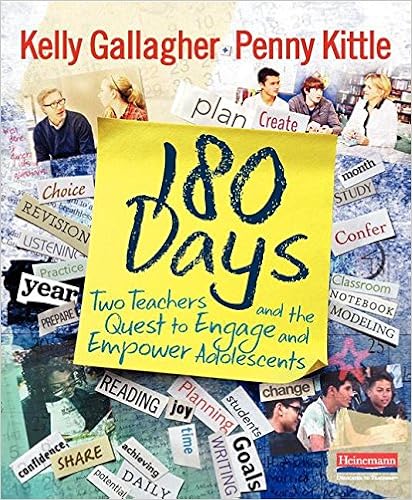
When Penny Kittle and Kelly Gallagher announced to the world that they were working on a book together, I was so excited.  After all, I have looked to their work for a long time as a guide for how to grow my practice.  Now with the release of 180 Days – Two Teachers and the Quest to Engage and Empower Adolescents the wait is over. I get to present alongside Penny Kittle and Donalyn Miller at NCTE this year – yes, really – so I cannot wait to see her discuss these ideas live!

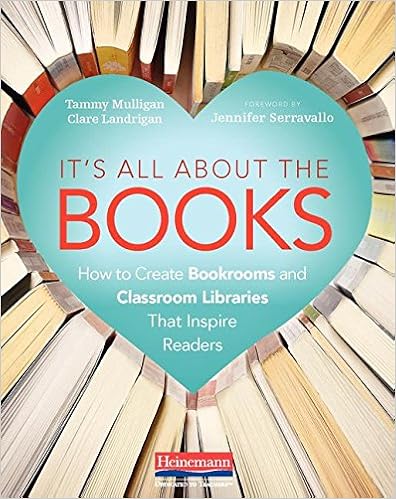
While I love our classroom library and feel like there are a lot of great ideas within it, I am always looking for tips on how to improve it.  Enter Tammy Mulligan and Clare Landrigan who with their new book, “It’s All About the Books – How to Create Bookrooms and Classroom Libraries that Inspire Readers” set out to provide us with just that; more practical ideas for how to utilize the books and space we already have to increase student engagement.

Image result for mechanically inclined

I am not good at teaching grammar, there I said it.  I know how to teach it within one-to-one conferences, but how do you teach it to the whole class so that it actually transfers into their work?  Enter the genius that is Jeff Anderson who had to figure out just that.  Lucky for us, he then decided to write a book about it!  I have heard nothing but positives about Mechanically Inclined – Building Grammar, Usage, and Style into Writer’s Workshop.

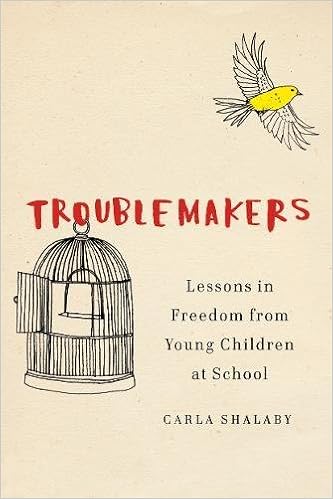
One of my largest areas of growth is centered on equity work and how I can be a better teacher and human being in America today.  I am so grateful for the leadership of Valeria Brown and her group #CleartheAir.  They have recently announced their book club titles for the upcoming year and are starting with Carla Shalaby’s Troublemakers, Lessons in Freedom from Young Children at School.  I cannot wait to unpack this book with them.

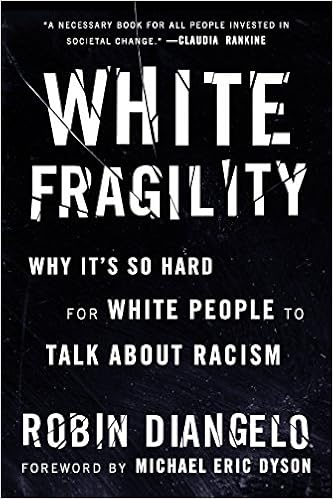
The next book in the #CleartheAir book club is White Fragility – Why It’s So Hard for White People to Talk About Racism by Robin Diangelo.  The power of the title alone means I cannot wait for September to come around.  There is also an October book, but I am not sure I will have time this summer to read it so I will save that title for a later post.  I highly encourage you to join the conversation!

And finally, the book I seem to be recommending the most this summer is still Sara Ahmed’s Being the Change – Lessons and Strategies to Teach Social Comprehension.  This book shaped our entire 4th quarter together and it was incredible.  This book will continue to shape the lessons I do with my students as we unpack our identities and what it means to view the world through the lens that we view it with.

So there you have it.  While I am also reading as many children’s books as I can devour, the growth I need as a teacher is coming from these few titles.  I cannot wait to be changed because of these books!  What are you reading this summer?


being a teacher, being me

In These Divided Times

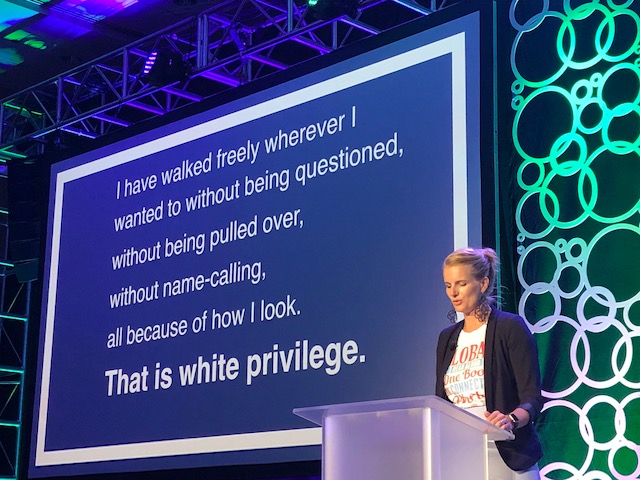
Yesterday, I was given the opportunity to speak for 5 minutes on the ISTE small stage.  I was given five minutes to share something I am passionate about.  Something I care about.  I knew I wanted to discuss technology.  I knew I wanted to discuss division,  I thought I would discuss the Global Read Aloud, and yet as I started writing I realized the inherent opportunity I had been given to speak about something I am still learning about and growing within.  Something I have spoken about before but not at ISTE, not in a tech space.  So yesterday, I delivered the following Ignite to a full room.  I don’t know if my words will matter, I never do, but I was nervous and proud to speak from the heart.  Hopefully, I didn’t screw it up too much.  And while some told me it was a brave speech, I am not so sure about that, after all, I am pretty protected within my privileged place.   It was truly the least I could do as we continue to work toward a better world for all, not just those of us with privilege. 

PS:  Some of the words were repeated from my NCTE speech but they fit here as well.  I also think a video will be made available at some point and will add a link here.  For now, here is a Periscope version of it.


I was clutching the steering wheel.  The red and blue lights behind me flashing.  My heart in my throat. In my head, I kept wondering what I had done.  I knew I had followed the speed limit, used my blinkers. And yet, I was getting pulled over and I was frozen.

As the police officer walked up, I was scared.  Not for fear of a ticket, but because I didn’t have my green card on me.  That little card that grants me the permission to be here as a lawful immigrant.  That little card that I am supposed to carry on me at all times, in case the police, or ICE agents, or even strangers ever question whether I have the right to be in the US.

I didn’t have it.  It was at home. She came up to my window.  “License, registration please, do you know why I’m pulling you over?” My brake light was out.  That was it. Get it fixed or get a ticket – not questioning, not deportation. She thanked me for my time.  And then she walked away.

She never asked about my green card.  She never asked if I was here legally.  She never even thought to ask.

I was raised in Bjerringbro, Denmark, but my mother had a wandering heart and at the age of six, she moved us to inner-city San Francisco.  I navigated not understanding what someone said to me when they spoke. Figuring out how to find the bathroom when you don’t know how to ask to leave, how to make friends when you don’t speak the same language, how to show I was smart even if I couldn’t communicate it.  

And just when I felt like I had mastered this new culture, this new language, this new me,  we went home. Becoming Danish once again, rather than a kid from a foreign country. But when you see me;  Do you see a woman whose first language is not English? Or do you just see my white skin? Hear my American English and assume the rest?  

When I was 18, we moved again.  July 1998, I walked up to the counter in Logan Airport and declared myself an immigrant.  Alone and clutching my sealed papers, the officer took the papers and led me to a small room.  After what felt like forever, he finally handed them back, said; “Welcome to America” as he led me out into what felt like a whole new world.  

For 20 years no one has ever asked me for my papers again.   I have walked freely wherever I wanted to without being questioned, without being asked where I am from, without anyone asking me where I was born, all because of how I look.  That is white privilege,

When I wrote about how I am never assumed to be an immigrant, someone replied; “Well, that is easy to understand, after all, you look like an American.”

Let’s think about that for a moment.  How can I look like an American when I do not have a single drop of American blood in me? How can I look like an American when my first language is Danish and not English? How can this Danish girl be handed so much privilege – my skin of course.

You see, my family and I are so white we are like a caricature of whiteness, blonde, blue-eyed and tall.  I was born white, it is who I am, but I am on a journey to use my innate privilege to be something more. Not just an ally, but a fighter, and technology is my weapon.

My students and I have taken the curriculum that the world has handed us and tried to figure out where we fit into the world.  We have used books and computers to connect to the world. Web cameras, videos, and apps to not just share our work but to learn more.  

Yet when a student asked what does refugee mean and another child answered, it means the enemy, it was a stark reminder of the work that still needs to be done.    On the urgent need to use technology so that we can make our own decisions based on actual experience and not just hearsay and biased opinions. Use it so that those of us, who live with privilege,  can be a part of the fight for a more just world.

Because let’s face it, I am privileged because I get to be afraid of the type of reaction my teaching may cause if I continue to teach about inequity. If I continue to teach what it means to be privileged.  I get to be afraid for my job and I get to choose whether to have these hard conversations or not. But the truth is, there should be no choice. We, as teachers, are on the front lines of writing the future narrative of this country.  Of this world. Ugliness and all. We are the gatekeepers of truth, so what truth are we bringing into our classrooms?

Where is our courage when it comes to being a part of dismantling the fears that drive us apart because It is not enough to bring in devices, the latest gadgets, without using them to learn about others.  To understand others. To have the tools to dismantle our prejudiced world but then choose to do nothing to change the world that we live in.

We, as people with privilege, must use technology to create more opportunities for the students to do the hard work.   To create an environment where they can discover their own opinion. Where they can explore the world, even when it is ugly so that they can decide which side of history they want to fall on.

So look at the power of the tools you have at your disposal.  Look at what you can do with a camera. With a computer. With your voice and your connections.  Look at whose voices are missing in your classroom. Look at who your students need to meet so that they can change their ideas of others.   

We say we teach all children, but do we teach all stories?  Do we teach the whole truth, and nothing but the truth, or just the sanitized version that will not ruffle any feathers?  I can choose to bring others into our classrooms so that their stories are told by them. I can choose to model what it means to question my own assumptions and correct my own wrongs.

What if the next time a child made a statement that divided rather than united, instead of scolding them, we used a camera, a microphone, and others as a way to start a conversation.  What kind of world could we be? What kind of history would we write?


IMG_4855.JPG

being a teacher, Literacy, Reading, Reading Identity

On Real Reading and the Kids We Teach

I asked our oldest daughter, Theadora, how many books she thought she had read this year.  Crestfallen and quiet she answered four.  Four?  I asked, confused.   How can you only have read four?  She reads all of the time, never without a book, always asking to read just one more page before the lights are turned off.

Don’t you mean real books, mom?

Real books? I said.  What are real books?  I mean all books, graphic novels included.

She lit up.  Fifty, Mom, maybe more, at least fifty though.

Fifty books for a child who didn’t think they would ever be a reader because reading was just too hard.

Fifty books for a child who has been in reading intervention for four years.

Fifty books for a child who wasn’t sure that she would ever get through a whole book on her own, at least not one with a lot of pages.

Thea is a voracious reader, and yet, if you were to believe some adults, all of that reading she does doesn’t really count.  If I were to listen to some adults, some teachers, then all of those graphic novels wouldn’t count as real reading because they had pictures in them.  Because they were too easy.  Because they were silly.

I would have to tell Thea that all of those books she loves aren’t real books and that it is time for her to read something real.  To read something hard.  To grow up a little.

Could you imagine?

Yet, this happens to so many kids in so many schools.  When they come to us proudly bearing their Captain Underpants, their Diary of A Wimpy Kids, their manga, we take one look and tell them that in this school, we need to read real books.  That this year, they need to grow as a reader.  That this year it is time to get serious as a reader.

We tell them it is time to try something else or else they will not really grow.

Thea became a reader because of Dav Pilkey.  Because of Dogman.  Because of finding a book where she could decode the images and then decode the words, synthesize the two and come up with meaning.  I will never forget the look on her face when she declared herself a reader.  Her teachers may not know that, there is so much we don’t know,  and I think of how many teachers do not understand the journey that some kids have been on to finally identify as readers.  That some teachers may not see just how big of a mountain becoming a reader has been to climb.  And so we dismiss their journey in the finality of our words as if real reading is only when a book is devoid of pictures or doesn’t make you laugh.

When we tell a child that the book they are reading is too easy, we have no idea how hard it just might be for them.

When we tell a child that the book they are reading is not challenging them, we have no idea just how much work they may be doing.

When we tell a child that it is time for them to try something else, we have no idea just how much they have tried before they finally had success with the book they are reading.

What if we instead reveled in their success?

What if we instead encouraged them to keep reading “easy” books knowing that at some point they will choose something else?

What if we instead told them how glad we are that they know themselves enough as a reader to know that this book, that this series is a great fit for them.

What if we instead gave them more books?  More time?  More appreciation for the work they are doing so that they could see their own success.

We are so quick to tell kids to challenge themselves.  We are so quick to dismiss their entire reading experiences.  We are so quick to tell them that what real readers do without realizing the damage our words may have.  It has to stop.

Thea is still a vulnerable reader.  A reader who finds comfort, courage, and strength within the pages of a graphic novel.  She grows her confidence in bursts and once in a while she branches into a book with no pictures.  She is on a journey.  My job is to support that journey, not destroy it through my well-meaning intentions.

If you like what you read here, consider reading my newest book, Passionate Readers – The Art of Reaching and Engaging Every Child  Also consider joining our book club study of it, kicking off June 17th.  This book focuses on the five keys we can implement into any reading community to strengthen student reading experiences, even within the 45 minute English block.  If you are looking for solutions and ideas for how to re-engage all of your students consider reading my very first book  Passionate Learners – How to Engage and Empower Your Students.      Also, if you are wondering where I will be in the coming year or would like to have me speak, please see this page.


being a teacher, books, Literacy, Reading, Reading Identity

Why We Need to Embrace Book Abandonment

White, Black, Yellow, Red,  Free Image

In the spring of 2016, I asked 1,200 students aged eight through thirteen in North America to explain how they felt about book abandonment.  I was curious because I had realized that working with my own students, that something as simple as letting go of a book in search of another book was not second nature to them.  In fact, many of my students struggled with the notion of letting go of a book even if it meant they were not reading.  Even if it meant they avoided the book.

This struggle had prompted me for years to do an actual lesson on abandoning a book.  On giving all of our students specific permission to step away from a book they had either indicated they wanted to read or actually started reading.  To step away from a book without having to try it for so many pages, for so many days.  To step away from a book even if their teacher recommended it.  Even if their best friend loved it.  Even if they loved it at first.

When I asked those 1,200 students I had an inkling of what they would say and yet I was taken back to see the answers.  Out of 1,200 students, more than 400 of them reported feeling guilty and disappointed.  That’s 33% of the respondents reporting that something as simple as letting go of a book made them feel bad.

My follow up question was why they felt the way they had felt.  There were three main responses.  Some children reported feeling like they had disappointed their teacher, after all, it was the teacher that had recommended the book to them in the first place.  Other’s reported that they were disappointed in themselves for picking a “bad” book to begin with.  And some even reported feeling guilty about not liking the author’s work, as if the author would somehow know that they didn’t like the book.

We know there is a lot of emotion tied up with being a reader, but we should not have guilt be one of them.

Students should rejoice at first when they realize that a book is not for them.  They should celebrate this milestone knowledge and be happy that they have uncovered another part of their reading identity.  And then they should move to not caring. To simply seeing book abandonment as yet another part of being a reader.  Of knowing when to let go.  Of knowing when to search for something better.

Now you may think, but what about those serial book abandoners?  The kids that never finish a book?  That haphazardly pick up a book only to leave it behind seemingly having checked off the reading requirement for a day?  They are a conversation waiting to happen; kids who do not know themselves as readers yet.  For ideas of how to work with them, please see this post. 

And while we need to teach students how to work through challenging text, we also need to give them opportunities to discover what love to read, what they cannot wait to read, what will bring them further into reading.  Book abandonment helps us with that if we embrace it as yet another skill that all readers know how to use.

If you like what you read here, consider reading my newest book, Passionate Readers – The Art of Reaching and Engaging Every Child  Also consider joining our book club study of it, kicking off June 17th.  This book focuses on the five keys we can implement into any reading community to strengthen student reading experiences, even within the 45 minute English block.  If you are looking for solutions and ideas for how to re-engage all of your students consider reading my very first book  Passionate Learners – How to Engage and Empower Your Students.      Also, if you are wondering where I will be in the coming year or would like to have me speak, please see this page.


being a teacher, Literacy, picture books, Reading

Using Picture Books With Older Students – A How-to Guide

I have written extensively about the use of picture books within our classroom and yet there are still questions that keep coming up.  No worries as I realized that I had yet to make a central blog post about picture books and how I use them with older students and so while this post may be long, I hope it is helpful.  Note that really everything I write here about using picture books with older students also goes for using them with younger kids because as we all know there no is no too old for picture books.

I have written before of why I use picture books with my middle school students, the changes it has created for us as we build our community of readers.  I have shared lists upon lists of our favorite books as well, hoping to help others find the very best value in the books they bring in, hoping to inspire others to make them an integral part of their classroom.

How Do I Know Which Books to Get?

I am connected.  I am a proud member of the Nerdy Book Club and through Twitter  I am connected to many picture book loving people; teachers, librarians, parents, and all of the other amazing people out there.  I follow hashtags like #WeNeedDiverseBooks  #Titletalk, #pb10for10 #classroombookaday and #nerdybookclub to stay in the know.  And I tweet out asking for recommendations all of the time.

I keep a written list handy.  I have a journal book with me at all times, and while I often add books to my wishlist on Amazon, I like having the list in my bag.  I am always adding to it and will cross out as I either purchase or reject.  This also makes it easy for me to recommend books to others that they may not know about.

I read them beforehand, most of the time.  Many times we will wander to the nearest bookstore so that I can browse the books before purchasing them.  How do I know that this will be a great one for our room, well there are few things I look for…

Do I react to it in any way?  A picture book doesn’t always have to have a deep message for me to react to it; was it funny, did it make me think, did it leave me with questions?  All of these are things that I look for.

Is it easy to follow?  Sometimes it takes more than one read to really get a book and while I love those books too, most of the time, I am looking for a book that my students will get rather quickly.  At least most of them.  However, I do purchase picture books to use with smaller groups that have layers we can peel away.

Is the language accessible?  Yes, I teach 7th graders but their reading development levels range from 2nd grade to high school, so can all students access the text or will I need to “translate” it?

What purpose does it have?  I often look for picture books that can be used as community builders, self-connections, or conversation starters.  We also use them as mentor texts as we develop as readers and writers throughout the year.  But I also look for picture books that will make my students laugh, make them reconnect with being a little kid again, or help them get out of a bad mood.  I try to get a balance of all of these types of books in the hands of students.

Will we read it more than once?  Because I buy most of the picture books in my classroom, I look for enduring books that we will return to again and again.  Different things make books repeat reads; the illustrations, the phrasing, the story.  Bottom-line: it is a gut feeling most of the time.

Do we have other works by the author?  My students feel closely connected to the picture book authors and illustrators whose books we love so I try to expand our favorite collections as often as possible.  Some of our favorites are Jackie Woodson, Julie Flett, Peter Brown, Mo Willems, Peter H. Reynolds, Ame Dyckman, Jon Klassen, and Amy Krouse Rosenthal.

How Do I Organize our Picture Books?

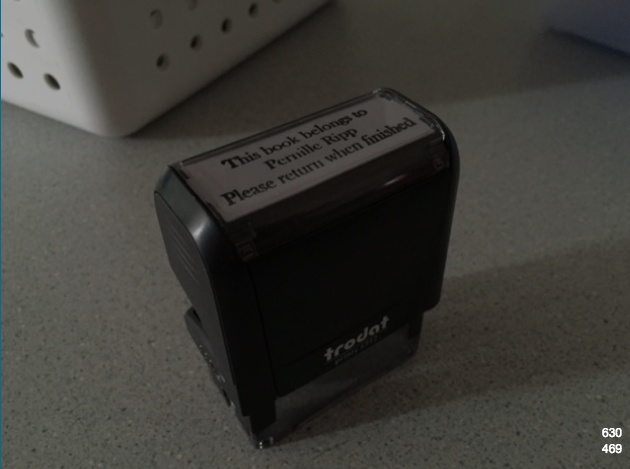
Every hardcover picture book is stamped on the inside with a custom-made stamp from Amazon, which has been easily one of the best purchases I have ever made.
stamp.jpeg

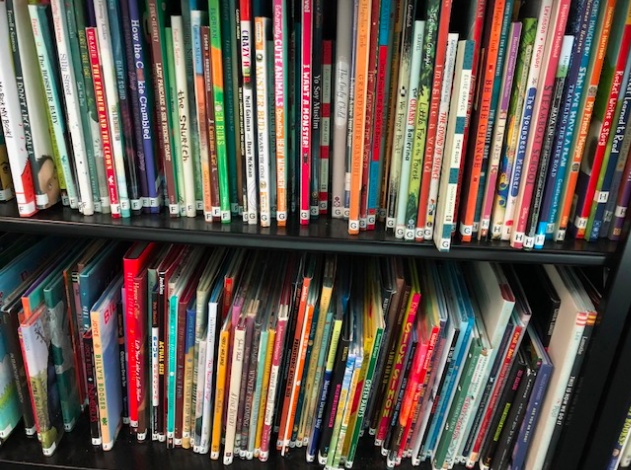
They are then also labeled with the first letter of the author’s last name on their spine.  That way as long as I know the author’s last name, I can quickly pull the book from that section.
shelving pbs.jpeg

Picture books are typically not checked out by students as they are easy to lose, however, others teachers borrow them freely.

Picture books are shelved together in our classroom but not organized by theme or author.  I simply do not have room for splitting up the groups, so I try to display the picture books by theme in our classroom instead.  For example, whenever it is a new month or after a break, our display is always changed out.  I want students to want to read them as much as possible and a fresh new display helps entice them.pbs on display.jpeg
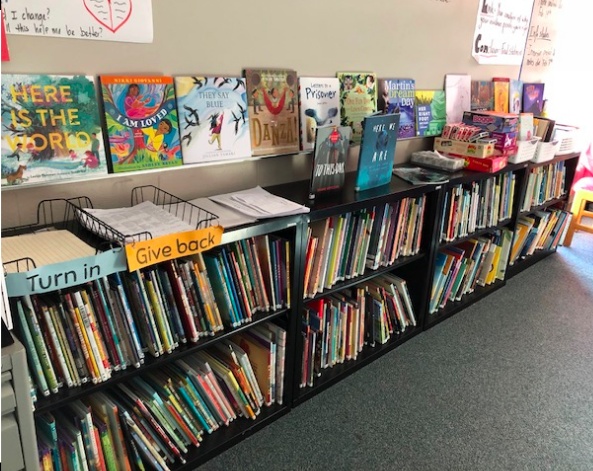
How Do I Select the Book to Use?

I first identify the purpose of the lesson of course and then go through either my lists of picture books or simply flip through our stacks.  As our collection has grown, I have started keeping a better eye on picture books that can be used for more than one purpose.

Which book I choose to share depends on the lesson.  I treat it much like a short story in what I want students to get out of it so it has to suit the very purpose we are trying to understand. I introduce the concept by sharing a story and then I ask my students to come as close as they can to the rocking chair in our corner.  Once settled, whether on the floor, on balls or on chairs, I  read it aloud.  We stop and talk throughout as needed but not on every page, it should not take more than 10 minutes at most to get through an average size picture book.  If it is a brand new concept I may just have students listen, while other times they might engage in a turn-and-talk.   I have an easel right next to me and at times we write our thoughts on that.  Sometimes we make an anchor chart, it really just depends on the purpose of the lesson.  Often a picture book is used as one type of media on a topic and we can then branch into excerpts from text, video, or audio that relates to the topic.

Because I teach the same class multiple times in a row, I often switch out the picture books I use with the different classes.  There are some that you can still love reading after 4 times, while others get to be a bit tedious, so I adjust as needed.  This is why having a lot of great picture books to choose from is something I am committed to.

I do not have multiple copies of really any picture books, I don’t see it as needed.  Instead, I pick the picture book to read aloud and then find “companion books,” other picture books that share the same concept, for example easily identifiable themes. These are spread out on tables, waiting for the students to select them. This way, when I ask students to work with them they are truly testing out the skill and not just whether they can spot the same things that we just practiced together.  Often times, students can choose to work with a partner as they explore their self-selected books.

What Are Different Concepts You Can Use Picture Books to Teach?

Thematic statements

Using a picture book as an example, we read one aloud and work through the example together.  While many of my students can easily pick up on the theme “word” (Death, love, freedom), they have a much harder stretching that into an actual thematic statement.  So rather than just death, they have to write something along the lines of “In the picture book, Ida Always, the text is used to illustrate that the fear of death should not stand in the way of creating lasting bonds.”  While this may seem hard at first, the idea of doing this work with a picture book, rather than a longer book, alleviates some of the stress that my students have with the analytical work being done.  After we write our thematic statement and turn it into a full paragraph, the students are then given a stack of picture books to choose from to practice on their own.  This is, therefore, a way to assess their understanding without having to use a common text.  Students can then either hand in their thoughts as a written piece of work or choose to discuss it with me or record it using their device.

Writers Craft

The writing skills used in a great picture book are worthy of our close analysis.  I love finding a stack of small moment picture books and then having students really take the writing apart.  How did the author move the story along with such few pages?  If we were to remove the images would the story still stand on its own?  Why?  Other questions can be:

  • How does the author transition time or setting?
  • How does the author situate us?
  • How is the character described?
  • How are the words further explained through the illustrations?
  • How does the illustrator deepen the message?
  • How are words repeated?
  • How do we pick out symbolism and what does it signify?
  • How can we introduce all of the Notice and Note signposts through picture books?

These are just a few examples of separate lessons that can be done through a lense of writer’s craft.

Plot and Small Moment Stories

While my students can write stories, they do not always write good stories.  Sometimes they get bogged down in too many details, other times they have too few or their story is simply not interesting.  Using picture books we can study the art of plot, as well as how to encapsulate an entire story in very little language.  These are great primers for students to think of their own story craft.

Non-Fiction Focus

We have written nonfiction picture books in the past and one of my greatest joys is to get students read some of the incredible nonfiction picture books we have in our collection.  I think of books like Pink is for BlobfishGrowing Up Pedro, GorillasGiant Squid, or How to Be an Elephant.  These authors breathe life into their nonfiction texts and so I ask my students to study their craft.  How did they take all of this research and create something so accessible yet information-filled?  It is wondrous to see the lightbulb go off for my students when they can see what I mean right in the text.

Fluency and Expression

One of our favorite units of the year is when all of our students perform plays based on Mo Willem’s Elephant & Piggie books.  It is incredible to see these sometimes very cool 7th graders, truly connect with their silly side and go for it in their performance.  Reading aloud picture books, performing them, and putting your heart into it helps with all public speaking skills.

Introductory texts. 

In order for us to go deeper with text analysis and discussion, I need my students to sometimes gain some confidence.  Picture books are not scary.  They are inviting to kids.  So as we begin the year with an introduction or reminder of the signposts as discussed in the book Notice and Note, I use picture books to introduce every single signpost.  (To see the lists go here).  It helps me break it down simply for kids, to give them confidence, and then also to be able to transfer it into their own reading.

Inferring.

One of my biggest tools for boosting inference skills is to use wordless picture books.  After all, it is hard to read books like Unspoken or The Whale and not have an opinion on what just happened.  Another reason I love wordless picture books is that it levels the playing field for a lot of our kids.  They don’t have to decode the words to get to the story but instead have to decode the images.  I have found that some of my most vulnerable readers are incredibly good at this as this is one of the reading survival strategies they use daily.

Introducing Hard Content

There are incredible picture books that discuss topics such as death, jail, suicide, war, and even drug abuse and so we use these picture books to broach harder topics with students.  Seeing their stories or stories that are incredible foreign to them played out within the pages of a short book really allows for us to open up a discussion as well as connections to the pages.

As you can see, picture books are not just for show, and yet, even if they were, I would be ok with that.  After all, how many times does a child just need to fall into the pages of a picture book to remember the magic that reading itself?  What an incredible gift all of these authors and illustrators give us when they decide to spill their ideas into a picture book.

How Do you Assess Skills and Strategies Through a Picture Book?

Because we are a classroom driven by self-selected reading, it can be hard to figure out what students really know.  Picture books are again a central tenet of this.  Whether I have introduced a brand new skill or simply done a review, I can quickly assess students’ knowledge and use of the skill through the pages of a picture book.  All I have to do is gather up the picture books that all have the skill in them such as character development and then have students read them.  After that, they can either write, discuss, or record a response to show me their understanding.  That way I do not have to know the independent book they are reading but I can still see what they can do.

What Comes After the Reading?

Picture books are not just something we read, we write them ourselves in our epic nonfiction picture book project.  We study them.  We speak about them.   We get ideas and inspiration from them.  We carefully protect the time we have to read them.  They are the mentor texts we shape our instruction around.

What Are Some Current Favorites?

And because I cannot write a blog post about picture books and then not share a few favorites, here are some that I love at the moment.  For “live” recommendations follow my Instagram account. 
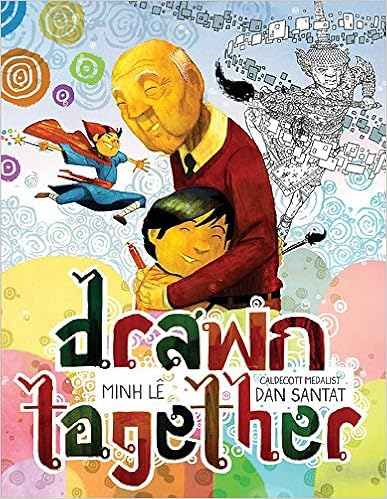
Drawn Together by Minh Le and Dan Santat
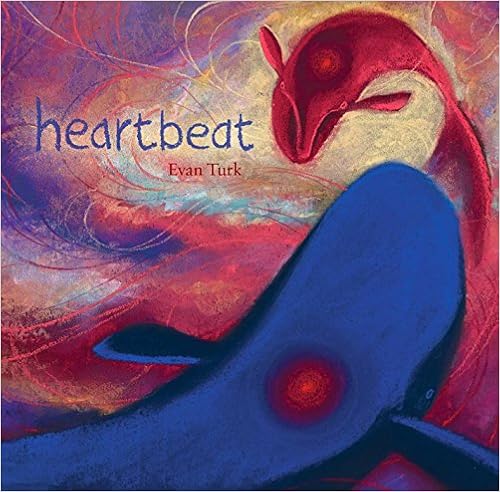
Heartbeat by Evan Turk
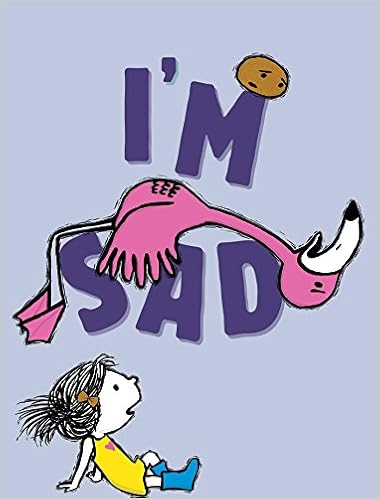
I’m Sad by Michael Ian Black and Debbie Ridpath Ohi
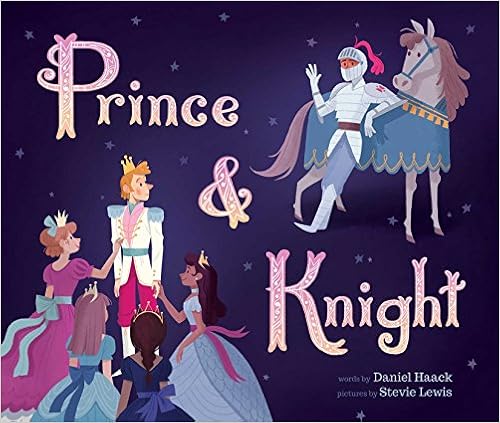
Prince & Knight by Daniel Haack and Stevie Lewis
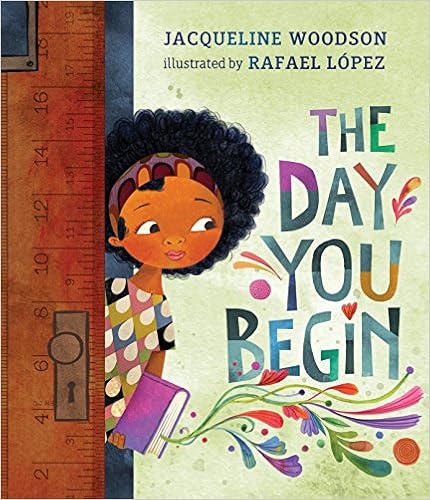
The Day You Begin by Jacqueline Woodson and Rafael Lopez


So there you have it, a little further explanation of how picture books are used in our classroom.  They become part of the tapestry of our room and something the students search out for solace when they need to feel like they are readers again. As one child told me after I had shared our very first picture book, “Picture books make you remember your imagination again.”  And I knew that these kids got it.  That they knew that this wasn’t just me having some fun, but that picture books will teach us some of the largest lesson this year.  That picture books are not just for little kids and laughter.  They are for readers of all ages, and in particular, those who have gotten lost.

If you like what you read here, consider reading my newest book, Passionate Readers – The Art of Reaching and Engaging Every Child  Also consider joining our book club study of it, kicking off June 17th.  This book focuses on the five keys we can implement into any reading community to strengthen student reading experiences, even within the 45 minute English block.  If you are looking for solutions and ideas for how to re-engage all of your students consider reading my very first book  Passionate Learners – How to Engage and Empower Your Students.      Also, if you are wondering where I will be in the coming year or would like to have me speak, please see this page.
Be the change, being a teacher, books, Literacy, Reading, Reading Identity

On Becoming a Reader

My husband is not a reader.

By far, he is one of the smartest people I know.  He can fix anything broken, he can solve any problem.  He can dream and plan and build pretty much anything.  But reading, in the traditional sense of books, nah… not for him.

When I first met him, I couldn’t figure out how someone as smart as him could not see value in books.  How could you live a full life without books?  And yet, in the 17 years, we have been together, he has shown me how many facets there are to a full life.  But now he has been in school for the past two years, getting his degree as a Tech Ed teacher, and the other day after taking a particularly grueling test, he told me how much he felt like he wasn’t smart enough for the test simply because of his reading pace.  You see, the test was timed, and so when the time was almost up, my husband did what many of our students do all of the time; filled in as many unanswered questions with random guesses as he could.  Better answered then left blank.

He told me how he knew he could have answered them right had he had the time.  He told me how he felt this pressure at all times knowing that he wasn’t going fast enough.  He told me that he tried to skim as quickly as he could but then lost meaning and had to read it all over again.

If he had only been a faster reader, he would have been just fine.

It blows my mind still that we equate reading pace with reading comprehension.  That we allow standardized tests to teach our children that if they cannot read quickly, they cannot read at all.  Which jobs require us to read complicated materials within 90 seconds?  But that’s the reality we face and so at the end of our discussion, I gave him my best advice; read more books.  It is the one guaranteed way to increase your reading speed.  Find books you love.  Take the time to read.  And you will see, your reading pace will increase.

He told me how he just didn’t like books.  How he didn’t mind reading technical stuff (which he devours daily), but that books just had never caught his attention.  That they were too slow, too boring, too confusing.  That reading was never anything fun or entertaining but always presented as an assignment; read this book, do this work. Rinse, repeat.  He sounded exactly like my most resistant readers.  The ones we all teach that tell us loudly and proudly that reading is not their thing and we will certainly not convince them otherwise.

And so I did what I do every single day of the year.  I handed him a book, Orbiting Jupiter, and told him to try it.  To give it a shot and if he didn’t like it, tell me and I would try again.

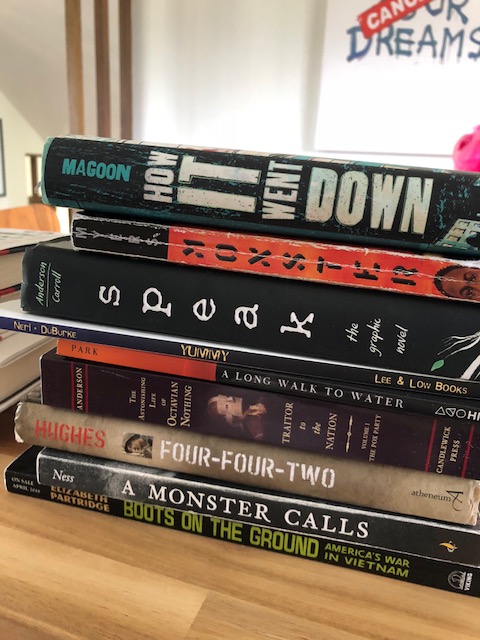
He sat down and read into the night then woke up and finished the book.  He finished the book!  And then he asked me for another.  I handed him How it Went Down.  He started to read.

Today we went to my classroom to grab stuff.  He went to the bookshelves and started to browse.  Grabbed a few books, asked me about others.  Together we book-shopped.  He was open to whatever but had a few ideas, maybe some war history?  Maybe something with a fast pace?  Social justice lens?

IMG_4631.jpg
Brandon’s To Be Read Pile – his first one ever…

I quickly grabbed my tried and true, added them to his pile and realized right in that moment that I was working with him like I would any resistant reader: offer choice, support, time to read, and most importantly communication.  At 41 years old, it seems that my husband is finally going properly through the motions of what it means to know yourself as a reader.  And I couldn’t be prouder.

So often we focus on these aspects of developing reader identify when students are young.  Before they reach middle and high school.  Once they come to us older, perhaps more jaded, more stubborn, we sometimes forget to go back to the basics.  To treat them as we would any developing reader.  To go back to choice, community, access to meaningful books and discovery of who they are as readers.  To find the time to actually help them become the reader they can be.  Too often the content gets in the way.  All of the little things that constitute what teaching sometimes becomes, rather than what it should be.  We assume that someone certainly will figure out how to help this child become a reader without realizing that that someone is us.  That we are the person who needs to somehow reshape the reading experience that they have had until now so that they do not become adults who do not read.

Today, I was reminded of how it is never too late.  How every child that we teach has the potential to see themselves as a reader by the time our year is up.  That even the adults that tell us that they are not readers can still become readers.   But that they need our help, not our judgment, our know-it-betterness, our confusion of how they could live without books.  Instead, they need what every reader needs; choice, books, community, time, personalization, and understanding.

My husband is not a reader, but that doesn’t mean he cannot become one, now.

If you like what you read here, consider reading my newest book, Passionate Readers – The Art of Reaching and Engaging Every Child  Also consider joining our book club study of it, kicking off June 17th.  This book focuses on the five keys we can implement into any reading community to strengthen student reading experiences, even within the 45 minute English block.  If you are looking for solutions and ideas for how to re-engage all of your students consider reading my very first book  Passionate Learners – How to Engage and Empower Your Students.      Also, if you are wondering where I will be in the coming year or would like to have me speak, please see this page.