Be the change, being a teacher, being me

This Is For the Ones

http---www.pixteller.com-pdata-t-l-251424.jpg

This is for the mothers that worry about their children and how they will do in school.  This is for the fathers that lay awake hoping that their children will be loved.  For the grandparents that believe.  For the families that see the good every day, every moment, even when we know we are sometimes fooling ourselves.

This is for all of us that hope every night that tomorrow our child will have the best of days.  That tomorrow their day will be filled with moments where they feel cared for.  Where they feel loved.  Where they feel they belong.  Where they feel that even if they screw up, they will be forgiven.  That even if they fail, they will have room to try again.

That their past mistakes will not chart the path of their future.

That their moments of poor decisions will not define who they are.

That others will see the good like we see the good.

This is for the teachers that ask us parents how they can help rather than judge.

For the teachers who call, not because they want to scold, but because they want to know more.

For the teachers who reach out.  For the teachers who ask.  For the teachers that see every day as a new beginning rather than a continuation of poor past behavior.

This is for you.  For all of you.  For those who refuse to have the outside world shape the narrative of their child.  For those that help us be better so that our kids can be better.

For those who believe that while we cannot change the teachers our children have, we can change the narrative that surrounds our children.  That our words carry power.  That our words are a shield.  That when we speak the truth, even when its ugly, we let others see the beauty that we see in our children, even when they screw up, even when they are less than perfect.

This is for all those former bad kids, whose label preceded them in school.

We have power.  Our words have power.  Let’s never forget that.  Let’s never let our children forget.

If you are looking for a great book club to join to re-energize you in January, consider the Passionate Learners book club on Facebook.  We kick off January 10th.  

aha moment, being a teacher, student choice, student driven, students teach me

Planning for Flow in the Classroom

http---www.pixteller.com-pdata-t-l-250369.jpg

Our classroom has been silent the last few days.  A stillness surrounding the students as they sit in thought, only interrupted by the occasional whisper.  I have felt rather useless, not teaching, barely speaking, and yet.  That stillness has been a sight to behold.  The stillness has been profound as students have sunk deeper and deeper into the work asking me to not interrupt.  Asking me to let them work.  And I have listen, and I have watched, in awe of what has unfolded.

My students have reached a state of flow.  That mental state where you are fully immersed in what you are doing and your brain is working optimally.  That zone that we teachers hope to develop every day so that students can learn deeply.  Yet ask most teachers whether their students reach flow daily or even weekly and they will tell you no.  Their days are too disjointed, we have too much to cover, too many things to do.  It seems as if we don’t have time for deep thinking these days.

So what changed in our room these past few days?  What changed for it to become this way?

I stopped doing an all class mini-lesson.  Instead, I have been pulling kids one-on-one as we work on their specific need.  The children that need extra support sit close by every day so that I can support them whenever they need, others come to me for help or I come to them.  That doesn’t mean there is no need for mini-lessons, just not right now for this unit.

We brought in music.  I always marvel at the students that can work intently while listening to music, yet year after year, I see it happen.  So some students listen to music as they work, submerged into their own world the music allows them to shut everything else off.  It heightens their focus, even though I will never understand how myself.  Music allows works wonders for those that tend to interrupt, they focus on their music rather than others.

They sit where they want and work how they want.  Some students are inn bean bags, others move tables.  I have a students that goes to the team area every day to work.  Some type, others write.  Choice surrounds us as students figure out how they work best and it allows them to get comfortable.

I spoke more quietly.  I can be rather loud as a teacher, so lowering my voice was not something that I often remember to do, but in doing so I have modeled it for my students.  They know to whisper, they know to not disturb others.

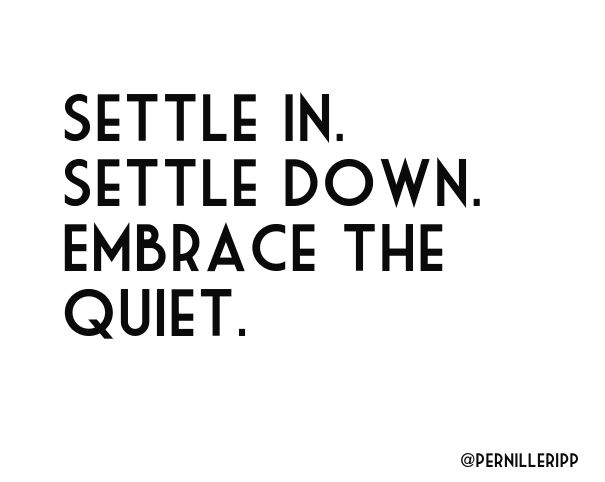
We speak for a few minutes before we start.  As students get ready, as students get settled, instructions and reminders are given.  And then I say, “Settle in, settle down.”  I repeat as necessary, almost like a mantra,  as the quiet slowly takes over the room.

The lights are off or low.  I have the most amazing window that allows a lot of natural light in.  Most days we have no overhead lights on and the simple dimness of the room signals to the students that we are in a quiet work zone.  The feel of the room from the moment they enter allows them to transition into the quiet, into the deeper thinking zone.

I don’t interrupt.  If a child is deep in thought, I think before I conference with them.  Perhaps today is not the day to check in, perhaps a glance over their shoulder is enough?  Too often our helpfulness interrupts flow rather than enhances it.  I leave a note for myself of who I need to meet with and keep track with check-marks.  I confer with every child every few days, sometimes just not on the day I had intended.

The first day we reached the state of flow, I was giddy, and yet also filled with trepidation, would we be able to reach it again?  When it happened again the following day, I started to pay attention.  The words of my students continue to surround me; let us work, give us time, teach us individually if you can.  and I try, and we work, and every day I marvel at the quiet, thankful of the thinking that is happening around me.

Note: I’m co-writing a book with John Spencer about flow in the classroom and student engagement. Go read his blog for great ideas on how to create environments where students are engaged.  Then go and check out any of his projects to be inspired further.  

If you are looking for a great book club to join to re-energize you in January, consider the Passionate Learners book club on Facebook.  We kick off January 10th.  


being a teacher

I Wish, I Wish – A Gift Guide (Or Not) For Teachers

image from icanread

A few years ago, I wrote this blog post by request on a now defunct blog.  Since I was just asked about this again, I thought it would only be fitting to re-post it with a few updates.

Every holiday season without fail I pick up a well renowned women’s magazine and find gift suggestion for teachers.  And every year I am surprised that magazines continue to perpetuate the myth that teachers like apples.  I am not sure what the history behind this supposed infatuation is, but I am here to say it is not true.  I like apples, don’t get me wrong, but I do not like apple-shaped things, no matter how expensive they are.  So upon some pushing from my husband and friends, I present to you some gift ideas for the teacher in your life.

First a note; this does not mean you need to buy teachers gift, I am not advocating that, this is merely a guide for those who do choose to give teachers presents.

First the don’ts:

  • Stay away from the apples.  Some teachers do find apple shaped things cute, most don’t.  I am amazed at the sheer market of apple shaped things that are out there, who would have known that you could get a crystal encrusted hard perfume shaped like an apple for a mere $80.  No thank you.
  • Be aware of scented things.  Some people are allergic to certain scents while others just have incredibly delicate noses, I fall in the latter category.  One year I witnessed a colleague receive an incredible gift set of lotions, candles, and home fragrance stuff, and while she was indeed incredibly grateful, the scent made her sneeze violently so much so that she ended up giving it away.
  • Say no to the lotion – unless you know the brand that they use.  I have been  to a fellow teacher’s house who had an entire cabinet of various lotions, so much lotion that she would never be able to use it all in her lifetime.  I like lotion but I am picky with the one I use, back to the whole scent point, so these crazy gift-sets with all the body goodness?  Maybe not the best idea.
  • Be wary of jewelry.  I know a lot of teacher with nickel allergy, myself included, which means that pretty much any jewelry that is not sterling silver or 14k yellow gold will give us a nasty allergic reaction (because of the nickel mixed in the metal to make it look like silver).  Therefore, jewelry is often not a great idea because we want to wear it to show our appreciation.  I have had friends that have gotten such bad rashes from their gratitude that they had to go to the doctor.

A note on handmade.  I like handmade things, if they are useful.  I once received a pair of hand-knitted socks and I use them every night for sleeping.  These socks remind me of the student and the care that they took to have their grandmother knit them for me.  I love those socks.  Handmade, however, should be something that can be used and not as a decoration.  I have a very sparse home and I feel incredibly guilty when I do not display things that have been made for me, however, I would never be able to relax in my own house if I did.

So then the do’s:

  • Do write a note.  Often this is the best present we can get.  If a teacher has shaped your life somehow or if you like what they are doing – tell them. This present beats all of the other presents hands downs every year.  I have half of a drawer filled with the notes I have received and I pull them out on days when I need a pick me up. .  They are treasured and so is the child or parent who wrote them.
  • Gift-cards.  I know this seems greedy and cold, but the gift-cards I get I most often use for things for the classroom.  Amazon or one to the local independent book store makes me jump for joy!  Target means bins, pillows, and other things to make our room more useful.  Starbucks – yeah that’s to keep me awake and energetic.  And it doesn’t have to be anything big – again, teachers do not expect presents.
  • A Special Book.  One year I was gifted  a copy of a parent’s favorite childhood book as a way to enrich our library.  The note and the book are two items that I still cherish because she wanted future students to fall in love with reading like she had.
  • A Charitable Donation – Times are tough and budgets are slashed everywhere, so how about making a charitable donation in the teacher’s name?  You can pick the charity and just let them know.
  • An Event.  I was once given a free babysitting of my daughter pass so that my husband and I could go on a date – that was incredibly thoughtful.  I have also seen teacher’s receive restaurant gift-cards or massage passes, trust me, those are appreciated so much.
  • Something personal.  I know a teacher that loves Shakespeare so whenever her students’ are able to surprise her with something new for her collection she just beams.  Not all teachers have collections; ask your child if you are unsure.  I love books which I am pretty sure the whole world knows.

Finally, to repeat; teachers do not expect gifts.  Ever.  Some people choose to give gifts and it is for those people this post is written.  I know that my friends often call me to ask what they should get a special teacher in their lives and for them I wrote this post.  Keep it simple, keep it small, and keep it meaningful.

assessment, authentic learning, being a teacher, collaboration, No grades, student choice, Student dreams, student driven, student voice

Ready to Re-Ignite Your Passion? Join the Passionate Learners Book Club

http---www.pixteller.com-pdata-t-l-249506.jpg

With the bustle of December and all of the year-end blog posts starting to be released, the end of the year is fast approaching.  But with that end also comes an inevitable beginning; a January that calls for re-invention, renewed commitment, and also the energy to try new things.  I do so adore January for all of its passion and courage.

It is therefore that I am pretty excited to share that the first ever official book club for Passionate Learners – How to Engage and Empower Your Students will kick off on January 10th.

Join this private Facebook group for a casual and fun exploration of the book, find a community of your own that is trying some of the ideas, or have already implemented them into their classrooms.  There will be reflective questions, helpful resources, as well as ideas shared in the hopes to make this January the best one yet.

In the book club we will discuss how to

  • Build a working relationship with your students based on mutual trust, respect, and appreciation.
  • Be attentive to your students’ needs and share ownership of the classroom with them.
  • Break out of the vicious cycle of punishment and reward to control student behaviour.
  • Use innovative and creative lesson plans to get your students to become more engaged and intellectually-invested learners, while still meeting your state standards.
  • Limit homework and abandon traditional grading so that your students can make the most of their learning experiences without unnecessary stress.

So if you are looking for a way to re-ignite your passion, to meet new amazing educators, and find great ideas for how to engage and empower your students, join this book club.  There is no commitment once you join, pop in when you can and share when you want.

When:  January 10th – February 7th

Where:  Online via a private, closed Facebook group

Cost:  Free

Click here to join the Passionate Learners book club on Facebook.  You will receive a notification from Facebook once you have been added to the group and you can then start posting.  Please contact me with any questions.  You can get your print or e-book copy of Passionate Learners here.

being a teacher, Literacy, writing

Some Rules We Need to Bend As Teachers of Writing

http---www.pixteller.com-pdata-t-l-248852.jpg

I have been thinking a lot about writing.  Call it that time of year, call it seeing a need, call it teaching middle schoolers who either seem to love writing or really really hate it.  But writing is definitely on my mind.  And it’s about time.

You see, I keep fighting with myself and my own expectation of what a teacher of writing looks like.  The poor English teacher hunched over essays, red pen in hand comes to mind, and yet the teachers of writing that I keep learning from, that I emulate are far from that.  They is so much more than a red pen.  Yet, the old expectations, the old rules, of what I should be continue to haunt the corners of mind, trying to sway me to be something I am not.  I cannot be alone fighting all of these expectations.  I cannot be the only one that feels we need to bend some rules.

Rule number 1:  The teacher must read every piece of writing a student creates.

Kelly Gallagher freed me when I heard him say that students must write more than we can read.  Until then I lugged the journals home every weekend.  I wrote back on every piece of writing.  I read and read all of their writing, eager with my comments.  Now I ask the students what they would like me to read.  I invite them to share their work with the expectation that they must share something and then I read, devour, and assess.  It has changed the amount of writing we do.

Rule number 2:  We must know the purpose of a writing conference beforehand.

I used to think that I had to have every conference pre-planned, that every child that met with me I was ready for.  Now students schedule conferences and I ask them what I can help them with.  They tell me what they need and together we look at their world.  The conversations have deepened and their independence as writers has increased.

Rule number 3:  We must publish all finished work.

As writers, we do this all of the time; write more than we publish, write more than what others see.  And yet, in our classrooms we are taught that writing is a social thing, that all writing must be shared with another person.  That it is not finished until it is shared.  However, writing is a personal thing and sometimes that thing we wrote does not need others’ eyes on it, instead it needs to be tucked away, finished but not for the world to see.

Rule number 4:  We must always write for an audience.

I love having authentic purpose, like we have right now, but I also believe in writing for yourself.  Writing for the teacher.  Writing just to write.  And that means that sometimes you have no idea who you are writing something for but just are writing.  That does not make it without purpose, it simply makes it private.

Rule number 5:  All finished pieces must be, well, finished.

How many things have I published on here that were far from perfect?  How many times has a piece only gotten better because others joined in and shared their thoughts?  We do not always have to see a story through to be done with it.  We do not have to write a whole piece to share.

Rule number 6:  We must edit for perfection.

As teachers, we can do great damage with our editing skills; we can edit out the very thing students are trying to protect.  So I have pulled back on what I edit, I ask students what they would like me to help them edit, and I ultimately put the responsibility for most editing back on them; we are not striving for a perfectly edited piece.  We are striving for a better piece.

Rule number 7:  We must have a peer editor.

The peer editor comes up as one of the most hated things my students do in writing.  Often they do not trust the person that is editing their work, or the process itself is not helpful.  Until we teach students to actually edit their own work, we cannot expect them to be able to edit each others.  Until students get to choose who sees their work, they will not trust us in their writing.  So give students the choice and the time to work with someone else, but do not force them to.  At least not every time.

Rule number 8:  Writing must be linear.

Too often we teach students to start at the beginning and “just” write a rough draft, yet often students cannot think of the beginning.  They then stare at the page for days.  But writing does not have to be linear.  Students can start at the end, they can start in the middle, they can start wherever they want, what matters is that they write.  What matters is that they start.

Rule number 9:  Writing must be instantaneous and constant.  

We forget that writing takes time.  That part of writing is thinking.  That part of writing is searching for inspiration.  My students ask for time to simply think, to look for inspiration.  To write a little bit and then be allowed to stop.  Sometimes silence is the biggest friend a writer can have.

Rule number 10:  The writing process is the same. 

If our goal is to create true writers, and not just teach the act of writing, then we must make room for individualization.  That means that students must have choice in how they write, where they write, and also for how long they write.  While students should be exposed to many different writing techniques, processes, and also have time to experiment with them, we need to be careful when we expect them to all follow the same process.  What we should be aiming for instead are students who discover who they are as writers and develop that path.  Not follow the one we have set out for them.

Rule number 11:  Good writers write like me.

I’ll admit it; I have a wonky writing process.  I often do not write until I have the very first line figured out, but once that happens I can write the whole piece or chapter in one sitting.  I cannot read mentor texts for inspiration because they seep into my writing in all of the worst ways.  I work best under pressure, and I must have absolute silence when I write.  This process is not taught in school, but was one that I discovered myself when I got older.  And it would be a horrible process to teach to others.  Yet, how often do we teach students to write a certain way because that is what good writers do?  Instead, we should be focusing our energy on student self-exploration as writers, to give them opportunities to figure out how they write best.  Ask them, give them ideas, give them time and then have them reflect; did that work for them?  Why or why not?  Let them discover their identities now so they can identify as writers, not as students trying to be writers.

I know there are more hidden rules that haunt my classroom.  I know there are more expectations that drive my instruction in all of the worst way.  I know I have so much work to do in how I teach the act of writing, in how my students become writers, but at least this is a start.  Which rules do you think we need to bend?

If you like what you read here, consider reading my book Passionate Learners – How to Engage and Empower Your Students.  Also, if you are wondering where I will be in the coming year or would like to have me speak, please see this page.



being a teacher, being me, Dream

Before I Set Out to Change the World

http---www.pixteller.com-pdata-t-l-246529.jpg

I never set out to be more than a teacher , to be a speaker, an author, as someone who people ask for advice.  In fact, I still find the whole thing confounding, dumbfounded over how in the world I got so lucky to get to be inspired by so many others.  To get to teach teachers, to learn with others, and to bring those things back to the incredible students I teach at the school I call home.  And yet within this awestruck notion of being more is the truth of me; I may be many things, but the one thing I am first is the teacher to my own students.

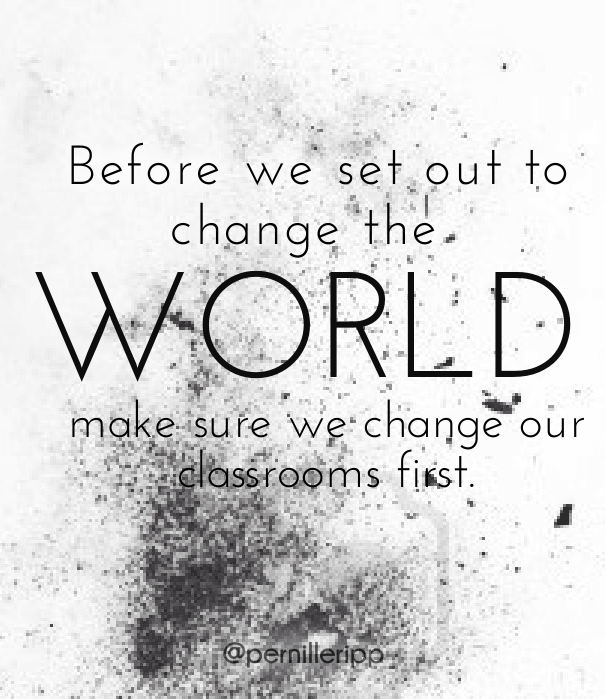
So before I set out to change the world, I must first change the very classroom that I teach in.  I must make sure that what I say I hold so dear is not just a stepping stone for bigger things.

Before I set out to change the world, I must make sure that the very thing that has given me the courage to speak up is still the very thing that gets the best of me.  That the students, whose dreams I am trying to protect, are still the most important part.

Before I ask others to listen to the voice of their students, I must give my own students a place to speak up, to be heard, and plenty of time for them to find the words they need to share.

Before I ask others to change, I must change myself.  Reflect on my own mistakes and become better.  Reflect so I can grow and not pretend that I have all of the answers or all of the power.

Before I set out to change the world, I must make sure that the words I speak are the truth.  That what my students and I do really is making a difference for the better.   That what we say we do is really what we do and not just what we hope to do.

Before I tell others how to teach better, I must make sure I am a better teacher.  That my teaching is not a point on the to-do list, but is the thing that challenges me in the very best kind of way.  That my teaching really allows my students to be empowered, be engaged, be passionate.

Before I give others all of me, I must make sure that I have something to give to my students.  That I take the time to get their lessons right.  That I take the time to make it work for them before I share.  That I take the time to make the time to be present when I teach and not think of the world that lies beyond.  Because in our room, room 235D, I am not the teacher of the world.  I am not an author.  I am not a speaker.  I am not the creator of the Global Read Aloud.  I am the teacher of those 7th grade students that show up to English every day at Oregon Middle School.  And that is the very best thing for me.

If you like what you read here, consider reading my book Passionate Learners – How to Engage and Empower Your Students.  Also, if you are wondering where I will be in the coming year or would like to have me speak, please see this page.