I sat there watching the fish swim in place, barely noticing Augustine’s excited screams. Amazing that a 19th month old toddler pointing, yelling, and even wanting so badly to hit the glass did not shake the fish. They barely moved. And Augustine stood in total awe, oblivious to the world around her.
The fish seemed content. They had clean water, a few rocks, a few fish friends and obviously enough to eat. And yet, they were clearly too large for their tank. There was nowhere to hide, no trees except for the fake ones painted on the back wall. No places to go except hovering right in the middle staring out at a retirement homes’ front entrance. A completely average life for most goldfish I presume.
What if our classrooms are much like that fish tank?
What if that is how we teach out students?
What if we give them enough to just thrive, to be complacent, to be just fine? What if we provide our students with just the necessities in our curriculum and care? We will surely see them grow. They will not wither away. But will we notice when they become too large for our tanks? When they long for more than the artificial experiences we are providing for them? Will we notice when their dreams outgrow the space that we share, the needs we fulfill? And not only will we notice, but what will we do with that knowledge? What will we do to tear down a wall? Give them the world so that the very tanks we keep them in don’t set them on a path toward creativity suffocation?
Sometimes I think that I am doing a just fine job, and I don’t take the time to step away from our room, from the tank to speak, and look at it from an outsiders perspective. It is hard to do when you are the caretaker of a classroom community because you think that you are doing everything you should be doing. Yet the dreams of our students are sometimes so big that we have to unleash them on the world, because if we don’t the dreams will die. We have to be able to create spaces where our students can continue to thrive, not just survive, not just hovering in the middle of the only space they have.
What of our students don’t know that there is more to the world than what we offer them? Then how can we ever expect them to want to change the world?
Who ever thought a too large goldfish would remind me of that?
“This is not a “girl” book even if the cover makes you think it is, boys can love it too…”And I stop myself. And I cringe inwardly. And I want to rewind time for just 10 seconds and tell myself to stop. A “girl” book? What in the world is that? And since when did I label our classroom books by gender?
The stereotypes of reading seems to be a beast in itself. We feed the beast whenever we pass on hearsay as fact. We feed the beast whenever we fall victim to one of these stereotypical sayings without actually questioning it. Through our casual conversation we teach our students that there are books for girls and books for boys. We teach our students that a strong reader looks one way, while a struggling reader (God, I hate that term) is something else. We say these things as if they are the truth and then are surprised when our students adopt the very identities we create.
So what are the biggest myths that I know I have fed in my classroom?
Thank you Debbie Ridpath Ohi for this image
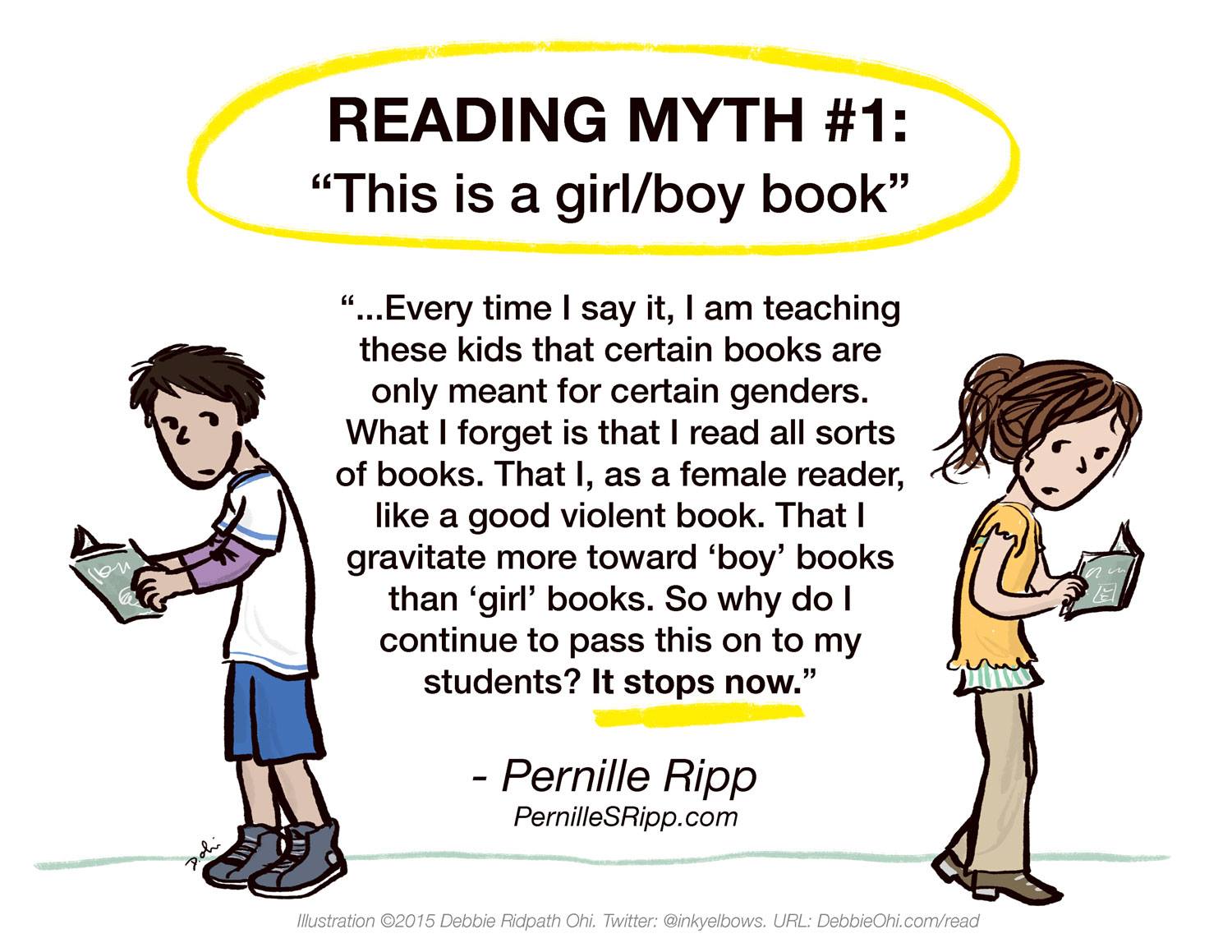
“This is a girl/boy book.” I have said this many times as I try to book talk a book. I say it when I think the boys, in particular, will not give a book a fair chance because of its cover. I say it when I think the girls will find a book to be too violent, to have too much action. And every time I say it, I am teaching these kids that certain books are only meant for certain genders. What I forget is that I read all sorts of books. That I, as a female reader, like a good violent book. That I gravitate more toward “boy” books than “girl” books. So why do I continue to pass this on to my students? It stops now.
“This is an easy read.” Another common statement I have made while book talking. What I mean by it is that for most students the text will not prove difficult to understand, yet I know now that ease of reading looks very different from student to student. That what I may think is easy, even when I pretend to be a 7th grader, is not easy at all. That even if a book is short does not make it easy. Even if a book has a manageable story line does not make it easy. That “easy” means different things to different readers and therefore does not provide a good explanation to anyone. It stops now.
“He/she is a low or high reader.” Our obsession with classifying students based on their data does not help our students, it only helps the adults when we are discussing them. There is an urge in education to group kids according to data points so that rather than take the time to discuss each student, we can discuss them as a group. Yet the terms “low” or “high” make no sense when discussing readers. They make sense when we are discussing data points, but is that really all our students are? How many of us have taught students who were amazing readers, yet scored low on a test? What would we call them? We need to discuss students using their names and their actual qualities, not these shortened quantifiable terms that only box them in further. It stops now.
“Most boys don’t really like to read.” I don’t know how many years of teaching boys I need to finally stop saying this. Many boys like to read – period – but when we say that most don’t, we are telling them that what they love is not a masculine thing to do. That boys loving reading is something strange and different. If we want this to come true, we should just keep repeating this over and over. Our male readers will soon enough get the message that reading is for girls. It stops now.
“The older they get, the less they love books.” I used to believe this, until I started teaching middle school. Then I realized that it is not because students want to read less as they get older, they read less because we have less time for independent reading, and we dictate more of their reading life. Homework builds up as do other responsibilities outside of school. Compare a 5th grader who has 30 minutes of independent reading most days to my 7th graders that get a luxurious 10 minutes – who do you think reads more in a year? Also, I wonder if anyone would want to keep reading if they did not get time for it in school or had choice over what they read for several years? Sometimes I think it nearly a miracle that students’ love of reading can survive what we do to them in some educational settings. It stops now.
“But they are not really reading…” I used to be the hawk of independent reading, watching every kid and making sure that for the entire time their eyes were on the text. If they stopped I was there quickly to redirect. Independent reading time was for independent reading and by golly would I make sure that they used every single second of it. Yet I don’t read like that myself. When I love a book, I pause and wonder. When I love a book, I often look up to take a break, to settle my thoughts. When I love a book, my mind does not wander but I still fidget. That doesn’t need a redirection, that doesn’t need a conversation, that simply needs to be allowed to happen so I can get back to reading. Our students are not robots, we should not treat them as such. Re-direct when a child really needs it, not the moment they come up for air. It stops now.
“They are too old for read alouds…picture books…choral reading…Diary of Wimpy Kid…” Or whatever other thing we think our students are too old for. No child is too old for a read aloud. No child is too old for picture books. No child is too old for choral reading. No child is too old for books like Diary Of A Wimpy Kid. Perhaps if we spent more time showcasing how much fun reading really is, kids would actually believe us. It stops now.
The myths we allow ourselves to believe about reading will continue to shape the reading lives of those we teach. We have to stop ourselves from harming the reading experience. We have to take control of what we say, what we do, and what we think because our students are the ones being affected. We have a tremendous power to destroy the very reading identity we say we want to develop. It stops now. It stops with us.
As promised, I have more great new (to me) picture books to share. This collection of funny, moving, and stunningly beautiful books are a must add to any classroom, not just the middle school one. And yes, I purchased almost all of these myself, and yes, it cost a lot of money, but the experience it will provide my students with is worth it in the end. I only feel bad because I am not sharing them as much with my own kids.
The Day I Lost My Super Powers by Michael Escoffier is a book that tells a familiar tale of childhood imagination. I hope to use this to bring my students back to when they thought anything was possible and to reignite their passion for thinking they have the ability to make a difference in the world.
I love how A Perfectly Messed Up Story by Patrick McDonnell reminds me of Battle Bunny in all the best ways. I love the message of working through adversity and the book is just downright funny. My 3 year olds laughed at it, so I cannot wait to see what my 7th graders will do.
Orion and the Dark by Emma Yarlett is stunning. The story about a boy who is afrid of the dark is sure to elicit conversations about our fears and what we can do to conquer them. I cannot wait for my students to discover all the details of this book.
To the Sea by Cale Atkinson is a book about unlikely friendships and loneliness, a theme that is so important to discuss with students. I love the illustrations as well as they tell the story even more.
In the last 24 hours, we have read Shh! We Have a Plan by Chris Haughton 5 times. I think I loved it more each time. Again the amazing illustrations tell half of the story and the simple language means that my youngest can read it by herself as well while giggling out loud. You know a book is good when the minute you close it, the kids yell “Again!”
Language surrounds us all but by middle school certain words seem to lose their off limit-ness. That’s why I love Little Bird’s Bad Wordby Jacob Grant. This book will give us a way to discuss what our language says about us as people and how our casual conversations can harm others.
I remember seeing a preview for The Cat, The Dog, Little Red, The Exploding Eggs, The Wolf and Grandma by Diane and Christyan Fox a year ago and then promptly forgot all about it. Rediscovering it on my wish list I took a chance and ordered it, and I am so thankful I did. This book is laugh out loud funny, even after you have read it once. It speaks aloud so many of the questions my students have when it comes to the original fairy tales and will be a perfect match with our gruesome fairy tale unit (even though this book is not gruesome at all).
An amazing wordless picture book by Jon Arne Lawson and Sydney Smith that tells the tale of Sidewalk Flowersand what happens when we are too busy to notice the world around us. As we discuss purposes for our devices, this will be a book to facilitate that conversation.
Loving reading, loving books, being a reader, and finding your own books to share are central goals in our 7th grade English classroom. And I spend every waking moment at times it seems trying to find ways for students to find that special book that will make them feel like they are a reader. I spend hours planning, prepping, buying books, and yes, reading them to make sure that I am the best teacher possible for all of my many students. Yet, sometimes we do not need a lot of time, nor a lot of work to inspire a love of reading. So behold, these are my 6 simplest ideas for getting students to fall (a little bit more) in love with reading.
Public Display of Book Affection
I believe in public displays of book affection every single day and on every surface allowable. When students enter into our team area (Go sharks!), they are greeted this year with our giant poster wondering how many picture books we can read in a year (Thanks Jillian Heise for the idea). They can also see what I am reading, as well as what my team is reading. In our room, there are books everywhere. Many are faced out and the displays change depending on our mood. Books are everywhere. Book love is everywhere. I take great pride and care in showing that books are central to our world. There is no willy-nilly displays allowed.
The 1 Minute Book Talk
I will start most classes with a 1 minute book talk highlighting the book I just finished, a book I cannot wait to read, or a book that I purchased for the classroom. As the year progresses I hope to hand this over to students. But think about it? 180 days equals 180 books talks. That’s a lot of exposure. since I have 5 English classes, there will be 5 different book talks every day. Once done, they go on the whiteboard ledge for anyone to grab.
The Repeated Question
I always ask students, current and former, what they are reading. Even when we are not in class. That constant focus on literacy coupled with the innate expectation that they are reading means that students start to think of their answer before they see me. And those that don’t read? Well, this question opens up to a discussion of why not and I can usually sneak them a book recommendation or two as we talk.
The Pushy Book Handler
I am always handing books to students (and colleagues too). Books do not get read by sitting on your shelf. Books do not get discovered by being in a bin. They get discovered and read by someone picking them up, flipping through them, and perhaps reading a few words. So we have to physically hand books to students if we want them to get excited. We do monthly (or sometimes weekly) book shopping in our classroom where piles of great books await the students. With their “To Be Read” list in hand, they take five minutes to browse the piles and find new books to read.
The Getting Out of the Way Trick
Easy access and check out to books is a must. Donalyn Miller and Teri Lesesne told us at ILA that if books are across the hallway they are too far away. We need classroom libraries in every room, not just the English classroom. We needs books at the fingertips of our students so that at any moment they can be inspired to reach out and find a new text. Books are not a distraction, they are a necessity in our classrooms and should be treated as such. This is also why I don’t have a check out system really. To see more about how I organize my classroom library, see this post.
The Guest Book Shopper
If you have that one child that will not read. If you have that one child that keeps reading that one book and not because they love it so much. If you have that one kid that never likes anything you have to offer, this is a great way to spark an interest in them. Simply hand them a book catalog. Get them on Amazon. Take them to a book store if you can and ask them to select a few books. Before the books arrive get them excited about their impending arrival. And then when they get make it a priority to get them to the student that day. It is a matter of urgency now that the books are here, so they should find their home right away.
Those are my top 6 ideas. Very simple indeed and take very little time. What are yours?
I have been immersed in the world of literacy for the past three days at ILA. I have come up to breathe only at night, and my thoughts have not fully found their resting place just yet. For every session I attend, every connection I make, every person that shares their story, the purpose only seems to grows; to change the way we teach reading in our schools. To protect the love of reading. Because right now we are implicit in the killing of the love of reading in our schools and classrooms. We are implicit in raising a generation that sees less and less value in books. We are implicit in teaching students that there are those who are readers and those who are not. But it is not too late to change this.
There are truths that we have to embrace, live by, and preach as we continue on our mission. These truths are not my own but ones that bear repeating.
We must protect and promote choice. There is no faster way to kill the love of reading than to tell a child what they have to read. And this does not just count for elementary but in middle school, high school, and even college. Where is the choice that allows readers to find out who they are? Where is the time to discover their reading identity?
We must withhold our book judgment. Our glances, our purchases, our book conversations all shape the identities that our readers are creating. When we offer a negative opinion, when we purposefully do not purchase book, when we tsk tsk at a certain book a child is reading, we are telling them that their reading identity is not correct. And that is not our job.
We must be readers ourselves. You must know your books and your students so that you can successfully pair them. Children look for adult role models and they needs us as they grow as readers. So share your reading life, hand over book upon book to students. Tell them you thought of them as you read it and then tell them why. Sometimes the biggest sales pitch for a book is not its fancy cover, but the relationship between us and the student.
We must be reading to read. Not for rewards, not for points, not for accomplishment charts, or even to move through levels. We must read to become better human beings. We must read so that we can shape the world around us.
We must label books, not readers. A child should not call themselves by their level, nor by a title manufactured in school conversations. I loved how Fountas & Pinnell stressed this at ILA. And when I say “label books” I don’t mean with reading levels. Instead, label them with stamps to show which bin they belong to, not their reading level. We do not have struggling readers in our classrooms, they are developing. We do not have slow readers, but meticulous ones. We do not have children who read at a level, but books that are at that level. The very language that we use to frame our reading conversation has to change so that it does not become the choke hold on our students’ reading lives.
There are many more truths for us to hold fast to but these are central ones. We must find the courage to forge ahead knowing that it comes down to us to protect the love of reading we see in our students. It comes down to us to be brave.
One of the most asked questions I get wherever I go is; how do you do it all? And by all they mean be a mother, wife, teacher, author, and speaker and still seem somewhat normal. Not dazed, not frazzled, not crazy. I wish I had an amazing answer or a magical formula that would somehow give me more hours in the day and peace of mind to the person asking. But I always answer honestly; I don’t. There’s a balance and sometimes that balance shifts one way or another, but I never lose track of what is most important. Yet, the many times I have been asked that question, I cannot help but wonder; how many times has that same question been asked to my male counterparts? To those male educators that seem to have a million things going on as well. Do they get asked how they do it all, or is it just a female question?
I ask, because this post does not have inspiration or answers, but it does have a lot of questions that I am hoping you will discuss with me. Because I have started to notice that there seems to be a double standard when it comes to female educators in leadership. That females who lead in some capacity are always assumed to be sacrificing something for that leadership, whether it be time with their husband, time with their kids, or time from their job. And that supposed sacrifice means that we should feel guilty (which trust me I do) and at some point we need to apologize for the fact that we sacrificed something in the first place. That we are not supposed to sacrifice time with our children to further our own learning. That we are supposed to become leaders only after our children go to college, not whenever we want to. (Just to make clear, I have no issue with women who choose to wait until later in life, I do take issue with being told I should wait). Not while they live at home. That we tend to say no to opportunities presented to us because we feel bad, and boy, are we good at feeling bad.
So I wonder if this is just a female thing? Do males get asked how they do it all? Are they supposed to feel guilty when they leave their families behind to pursue a leadership opportunity? Or am I biased because I am obviously a female myself.
It is not just because I wonder about the whole notion of feeling guilty when we are away. More importantly though, I wonder if this guilt is stopping us from speaking up, from going to conferences, from taking leadership positions that we know will swallow more of our time? Are we creating a barricade to strong female leadership ourselves? Because it seems like everywhere I go, males are dominating a lot of the leadership roles still. And it can’t just be me, I cannot be the only one noticing this. So I wonder; where are all of the female educational leaders?
Because I am surrounded by them in my daily life. I am surrounded by them at my school, in my district, in my network of people. And yet, the minute we are asked to point out leaders, how many times do our fingers point to males? How many times when we see a new initiative being pushed out is there few females involved? How many pictures of leadership meetings feature mostly males? And what are we doing about it?
So what happens to those women who want to be more than “just” a teacher? “Just” a principal? Are there enough opportunities out there for them? Are we holding ourselves back or is it a societal thing where conference committees, editors, and other people with opportunities tend to gravitate toward males rather than females because there is an assumption that women don’t want these opportunities? Why in a profession that is mostly female are most leaders still male? Did we do it to ourselves? Or am I completely wrong here?




 I remember seeing a preview for

 Pernille Ripp
