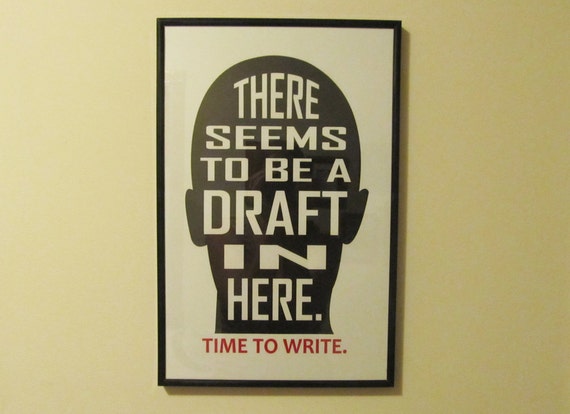
I started my reading transformation 2 years ago, realizing that I needed to create a sense of urgency and passion regarding books in my classroom. I knew I should focus on writing, I knew I should dedicate more time to it, more energy to it, and yet… I just didn’t know where to begin. It wasn’t that I was a bad writing teacher, after all, my students write a lot and often, but my passion just wasn’t there, in the classroom to urge the student so push themselves further. To really find themselves as writers. Yet, here I sit, the author of two books, a blog that is read by a global audience, and barely was that transferring into my classroom. So where was the disconnect. Why did I not turn my students into passionate writers as well as readers?
I knew I had obstacles; a determined curriculum that had us on a breakneck pace. Students at such varying degrees of ability that there didn’t seem to be a middle ground. Things that had to be taught no matter what. And time, never forget time, and just how little we have of it. But still, there has to be a way, within our prescribed curriculums to create excitement and urgency in the craft of writing. There had to be others who had better ideas.
So I turned to Voxer, I have a group there with people I really respect, and they started sharing their ideas. So thank you group, here are some of the highlights for how we can create passionate writers:
Choice in process. We cannot underestimate the power of choice in our writing curriculum and what it means for students to be able to explore their own true writing style. Yet, within a prescribed curriculum, it can seem as if there is no choice. I have found though that I can give students choice of how they write, greater engagement occurs. Sure there is a process, but that process may look different from child to child based on what they prefer. Some will want to type right away, some will stick to a pencil. I have even had students dictate stories to others or to a Livescribe pen. Let them discover how they write best and accomodate as much as you can, then at least they can focus on the writing, not the process,
Choice in topic. Even within a curriculum that tells me what students should be creating, there are many ways to add choice in topic. If the area of focus is argumentative essay, don’t limit what the students can write about. Help them discover something they are passionate about and help them explore.
Choice in audience. This was a great point brought up by Chris Wejr and something I had not considered. I always assume that students want to share their work with as big of an audience as possible, but this may be far from the truth. Students may want to only share with me or a trusted friend. Students may want to publish it for the whole world to see. What we need to do as teachers is figure out what each child would like and then honor that. I would not have wanted the whole world to see my writing as a 13 year old, I bet I have students who don’t either.
Choice in partner. I often have students write together but when I pair kids up I can sometimes stop their writing process. Writing can be very personal, so I often think of what type of writing is occuring and match that to the relationship students need with their partner. Sometimes having your most trusted friend as your writing partner can be a very good thing.
Authentic purposes. Last year I was able to find more authentic purpose in our writing, so when we wrote our op eds, they were for the newspaper to be published, not just me. When we wrote a non-fiction picture book, they were for our 1st grade buddies. When students had a genuine audience and purpose for their writing, they felt more in control because they understood what the task at hand was. They knew they had to write succinctly for the newspaper to publish their words, they knew they had to find an accessible voice for their 1st graders.
Passion. Once again, we have to invest ourselves into writing, whether it be through modeling, discussion, or general excitement. Much like we share our passion for reading by thrusting books into the hands of students for them to have an incredible reading experience, what if we did the same with great writing emphasizing how spectacular it is? What is we start telling students that we thought of them when we read something because it reminded us of their writing?
Minimizing our critique. While I believe we have to teach students to be better writers, I think sometimes our eagerness to help can stymie the process. So figuring out what the best process is for each child to support their growth without killing them with corrections. Sometimes it is okay to just write for the sake of writing. Sometimes it is even ok to share uneditied writing just to show off our ideas. Not all writing has to be finished or polished.
Spontaneity. This great point was brought up by Ben Gilpin and I couldn’t agree more. We should look for the moments in our everyday where we are inspired to write and that does not just need to be within writing time. I get ideas to write all of the time and then try to find the time to actually jot down my thoughts. What if we created environments where journaling and small moment writing was a natural part of our day?
Sharing our writing life. I tell my students all the time about the things I write, but how often do I show them? How often do I write in front of them? How often do I stop and write in the middle of the day because inspiration strikes me? I think much like we showcase our books reads to create a reading community, we have to showcase our writing too.
What other ideas do you have? What did I miss?
I am a passionate teacher in Wisconsin, USA, who has taught 4, 5th, and 7th grade. Proud techy geek, and mass consumer of incredible books. Creator of the Global Read Aloud Project, Co-founder of EdCamp MadWI, and believer in all children. I have no awards or accolades except for the lightbulbs that go off in my students’ heads every day. First book “Passionate Learners – Giving Our Classrooms Back to Our Students” can be purchased now from Powerful Learning Press. Second book“Empowered Schools, Empowered Students – Creating Connected and Invested Learners” can be pre-ordered from Corwin Press now. Follow me on Twitter @PernilleRipp.


 Pernille Ripp