being a teacher

Switching to Remote Learning While Still Offering Choice

Unknown future Design

I have never experienced a world so quiet before. Not for this long. Every day as I look out our window, I am reminded of the quiet that shrouds us all on January 1st where the world holds its breath and we sit with our dreams in hand, hoping for a new start.

Many now sit with fears in their hands instead, a pervasive uncertainty that permeates even the smallest moments. But the hope is still there, a hope for a world that doesn’t quite feel so unwieldy and uncertain. That doesn’t promise us death, financial losses, and long-term fall out.

And so we went into self-isolation the day after I turned 40, trying to do our part to keep the rest of the world safe, while knowing what it would do for our own children to shut the door on the world as much as possible.

On day 1 of isolation, I thought of all the things I would catch up on during this time; sleep! Books! Cooking! Learning how to play guitar! Writing a book!

On day 2, I was reminded of how extroverted our kids are compared to my husband and I. Do they ever crave quiet? (The answer is; not yet…)

On day 3, I realized I needed to take control over my newswatching or my fear for the world would grow. (CNN check in’s only a few times a day as well as with local news and purposeful social media use).

On day 4, I was reminded of how much I love being a classroom teacher because I love the everyday moments, not just the big ones, the check ins, the community, the being able to reach out to make sure a child feels seen and valued. And I miss it a lot, the putzing around, the excitement to see plans come to life, the moments where it doesn’t work and you have to find a solution. I continue to be a classroom teacher because of how much I love the kids.

On day 5, I recognized that we all needed a moment of space. That our schedule works for the most part but who knows how long it will. That while planning it down to the 30 minute mark works for our kids not going crazy, it doesn’t work for us, the adults, and that there needs to be a balance. That my books are calling and so is my creativity at times.

Turns out the new normal is anything but.

And so as we are told by our district to prepare for our remote virtuel learning, knowing how inequitable that is, and also how I am decidedly not trained in online learning, I keep thinking about what our community has been built on the whole year; read aloud, reflection, inquiry and choice. How in this uncertain time, there are certainties I can hold up for our students; that I will do everything I can to support from afar. That I want them to find success not insurmountable challenges, that I want this to work for them in any way I can. That I want them to have each other.

So rather than assigning one thing, they will have different choices for the un-foreseeable future.

All will be asked to please read for 20 minutes every day something of their choice with nothing but joy and value attached to it.

They can choose to read a fiction book of their choice and do some analysis as they progress through it, using an online one-pager assignment. If they have books at home they are set or they can access our Audible account to choose one to listen to. They can record or write their response to the prompts, whatever seems to work for them the best.

They can choose to do an inquiry project into something they want to learn about, craft a learning plan for me to discuss with them and then create a product at the end of it to teach us about their topic. We have done an inquiry into inquiry and also just finished an inquiry into a self-chosen topic for their TED talks. Their final product should showcase their deepened understanding in some ways, ideas will be offered and support will be based around their learning plan.

They can choose to listen to a picture book read aloud every day by a different creator and then record or write a response to the question I will pose along with it. Questions will range from what is the theme and how do you know? What does this thing (insert specific thing) symbolize and how do you know? How would the message of the picture book change if we changed the narrator? Whose perspective is missing and how does that impact the story being told? How did the perspective of the narrator influence their actions in the story? How did the main character change throughout? How does this picture book connect to your world? If you were to teach this picture book, which questions would you ask to start a discussion?

They can choose to write a story, alone or by themselves, working on all of the tools of storytelling we have been discussing through the year. Before they begin, they will be asked to identity how they want to grow as writers, how they will work on that, and then how I can support them (this is what we do throughout the year). The story can be fiction or from their own lives and teaching points will be based on what they are working on.

Throughout the year, we have done a lot of learning, now is simply the next step to put it all into action. Can they use what we have learned on their own? Have the skills been transferred? How can I continue to support them on a meaningful journey that will help them grow while also recognizing the realities of this world we are faced with right now. While also recognizing that right now schools in Wisconsin are closed indefinitely and so I don’t know how long of a timeline I am even preparing for.

Will it be perfect? Absolutely not. Will it be okay? I hope so. After all, that is the best I can do right now. To be here, to keep trying to connect, to reach out and be there for all the kids.

What are your plans?

If you are wondering where I will be in the coming year or would like to have me speak, please see this page. 

Passionate Readers, Reading

Picture Books Read Aloud Videos for Lesson Use

I am at our public library right now and it is deserted. Wisconsin was ordered to close their schools this coming week as more and more cases of Covid-19 pile up. The world is upside down.

As we prepare to switch to online learning, I have been thinking of the power of the read aloud. How having the social connection through shared books can bring us together. How doing a read aloud in this stressful time can calm us. And so as we plan for what we will do, I immediately thought of reading picture books aloud to my students and having them respond to them in a short paragraph through Google Classroom. However, there is one glaring problem; copyright violations, I don’t want to break copyright by reading aloud a book and then sharing it with students. So instead, I compiled as many lists as I could find here featuring the creators reading aloud. Perhaps the list will be helpful to you?

Kate Messner has a post that details which publishers have given limited permission to read their books aloud following their guidelines, see the post here.

Indianapolis Public Library has a compiled list here with more than 100 titles

Storyline online has a compiled list right here with some great titles

Kate Messner is compiling videos right here featuring authors and illustrators sharing their work and resources

Susan Tan has a great video channel featuring writing prompts and read alouds

Kidlit TV has a great compilation here

Harper Kids Has their read alouds compiled here

Vooks Online are offering a free first year for teachers and have videos compiled here

Brightly Online has a compilation here

Storytime with Bill from Little Brown Books can be found here

Mrs. P’s storytime can be found here

Debbie Ridpath Ohi is posting videos of her books as well here

Unite For Literacy has many stories read aloud in multiple languages compiled here

Free Kid Lit Visits and Authors Read Aloud compiled by A.Keene can be found here

Storytime from Space features astronauts reading aloud

I will keep adding resources here as I find them and as they are shared with me. If you know of any more, please share.

Take care, stay safe, and take care of others. We will get through this.

And by the way, if you can’t feed your family in the coming weeks or months, please reach out to me. I will try to send you a giftcard for groceries if I can.

If you are wondering where I will be in the coming year or would like to have me speak, please see this page. 
being a teacher, global read aloud, Literacy, Reading

What Are We Reading Aloud? Survey for K-8 Educators in the United States

I have written before about the read aloud and its power for older students. I have written about how read alouds brings us all together, how they offer us a new language to speak as we build our community. How read alouds allow us to step into a world we might not know or invite others into one that we already live in.

Since founding the Global Read Aloud in 2010, I have been responsible for selecting a read aloud to be shared around the world. The task always feels heavy. The task also brings a lot of joy, but as I have mentioned, the task of selecting the books to be read aloud have also made me curious; what is already being read aloud in the United States? What are the corner texts that, we as communities, keep coming back to year after year? What do our students get to experience from year to year as they travel through our classrooms?

Rather than just be curious, I figured I would ask. So will you help me out by taking this survey and sharing it with others? I tried to make it easy to take but still offer up valuable information. I will share the results once I have enough responses, because once we know more we can learn together.

conferences, connections, Reading, Reading Identity

Reading Action Plans: An Invitation into Further Exploration

This blog has been quiet. Not because life has been by any means but because what we are doing in our time together in the classroom is quiet. It’s not very flashy. It’s not really that new, at least not for us. Every day, the routines we have worked on all year are in place; most students quietly reading during independent reading time, most students finding great books, most students knowing more about themselves as people than they did in the beginning of our journey. Most because not all, not yet any way; some still lament about how they dislike reading, how they do not plan on reading a book over the summer, but many others devour books, seeing their own accomplishments, challenging themselves to grow.

But for those who are not quite there yet, where reading is hard, where reading is not a comfortable activity. For those where reading is something they have spent a lot of time avoiding or simply don’t see the value in yet, at this time of year I add in an extra layer; a reading action plan. A quick invitation into further conversation about their reading life that runs 2 weeks and sometimes more.

I have written about them last year, but the idea is so simple and yet so powerful that I wanted to re-share it. Because all it is is an invitation into conversation every single day for a few minutes about their reading life. No pressure, but instead extra personal support, and an adult meeting them once again where they are at without judgment and helping them along their journey.

The note sheet I use to keep their journeys straight looks like this at the moment, or at least the front does, they change when I don’t see them fitting our purpose. You can see it here. This is not for the students to fill out but for me to take notes, which they can see me take because no one wants another person taking secret notes.

I usually use our reading data (which is just how many pages they are approximately reading within a week by signing in with their page numbers as inspired by Penny Kittle) to see who may be great candidates for some extra care. Who are the kids where reading is still a slog, where they are not really making progress or jumping from book to book? I try to keep it to 3 or 4 kids a class at any given time for a few reasons; I want to make sure I am really focused on them and I also want to be able to still meet with another few kids every day. While we typically start on Monday’s, you can start them any day.

I ask them to meet with me during reading time and explain my idea for some extra attention, I don’t want to force it on them but instead discuss what they could gain from it. This is important because too often when students are vulnerable readers we remove all choice from them which leads to further resentment toward their reading lives. If we are going to meet every day, I like their to be a genuine discussion of why and how it may help them. This is instrumental to everything I believe in; keeping a child’s wellbeing in mind before I implement anything. I can’t do that without conversation. If a child doesn’t like the idea, we come up with something else for them, however, this has not happened in my years of doing this.

The first day takes longer because we discuss their current book. Questions I ask are pretty standard:

  • Which book are they reading?
  • How far are they in it?
  • Why did they choose it?
  • How are they liking it so far?
  • Where will they be in the book in a week?

Then I move down into the notes section, where I ask them about their outside reading life – this is an ongoing conversation throughout the year- and we discuss what their reading plans are for outside of English. My job here is to listen and to ask questions that explain their thinking when it is not clear, not to judge. They also tell me where they think they will be in their book the following day. This is again an important aspect because we so often set the goals for the students and those goals are unrealistic and also have little concern for the reading journey they are actually on. So instead we discuss what is a realistic goal and what the steps are they will take to reach that goal. Some students don’t have any plans to read so we discuss why not and how we can change that. Some have other obstacles in their path and so we discuss those. Whatever is going on, we discuss, and we brainstorm together. Once we have a goal and a plan in place it is time for them to read, so I thank them for their time.

The next day, we meet again, except this time I only ask about how far they got – no judgement – and what their reading life looked like in the past 24 hours. If they read, awesome! If they didn’t, why not? Again, I am not here to make them feel bad but coach and support instead. As we wrap up our quick 3 or so minute conference, they set a goal for the following day and then they are off to read.

And then we repeat that for a week. At the end of the first week, we discuss successes. These range from reading more than normal, to knowing when to abandon a book and picking a different one. From reading at home one night – wahoo – to actually not hating the book. There is no success that is too small to be celebrated, this is important as the goal here is for the kids to learn more about themselves as readers and people, not for me to punish them into reading.

The following week, we continue with our quick check-ins, celebrating successes along the way, and at the end of the week we decide on what the next step should be. There are different options:

  • Another round of daily check-ins for those that are not quite ready to fly on their own.
  • A gradual release to a three time a week check-in for two weeks.
  • A once a week check-in
  • Or released back into the larger pool, which means a check-in every 3 to 4 weeks depending on what we have going on.

Once again the child and I discuss and decide together. So why bother with this? Beyond the obvious of all kids deserving as much as one-to-one time as possible in our limited time with them, you also uncover so much of what is really going on in their reading lives and what they may need to move further in it. From recognizing that some kids simply forget to bring books home – we have plans in place for that – to not knowing how to fit reading into their lives – we have a plan for that – to still not being able to find books they actually like, having a few minutes every day can get them steered back on course in a way that wouldn’t happen unless you had more time.

While I wish I had time to discuss reading with every child, every day, I don’t, but this takes me one step closer to connecting with all the kids, to helping all the kids. It is not anything flashy. It is not anything brand-new, but it works, much like we know it works. Perhaps the idea can work for others as well?

If you are wondering where I will be in the coming year or would like to have me speak, please see this page. 

Be the change, books, kids, Reading, Reading Identity

A High Five For All Of Us

I’m on the road again. February seems to have been a long list of travel. Of packing up the suitcase and saying goodbye to those at home, to the kids in my classroom. Sometimes that is the reality of what I do. It is hard, but worth it.

This week has been one filled with the worry that you get when one of your own children is sick. When they are up for hours at night with a fever so high you think your thermometer is broken as you call the doctor in the middle of the night. Sleep deprivation and the end of February in Wisconsin is a bundle not for the weak.

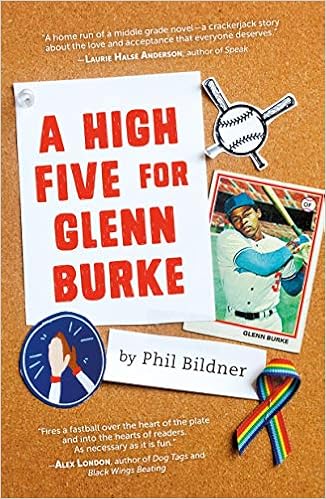
So I packed a book for my flight tonight, after all, the stack of to-be-reads is overflowing. A new book by my friend, Phil Bildner, that even though it definitely was about baseball and I still don’t understand baseball despite my 21 years in America, looked like it would offer me a world that I could sit in for a while and forget about the now two sick children at home, nestled securely in the care of my husband.

And I read, and then I finished the last page, and then tears came, because this book, A High Five for Glenn Burke, is yet another book we have so desperately needed. That our students so desperately need. They they deserve. That I fear will be ghosted by some educators or school districts because it is about a boy who loves baseball above everything else but is also finding the courage to share what he has known for while; that he is gay and he worries how the world will handle his truth and his heart as he bares it all. And this book is written for our middle grade kids. The kids that so often do not get to see themselves represented in our books because a long time ago someone deemed that anything that has to do with sexual identity or gender is “too mature” for ten-year-olds or younger.

I had tears for the kids who tell me their parents don’t understand. And I worry for the kids who tell me that their libraries don’t carry these books because they go against their “values.” And I get angry at the adults who stand in the way on purpose of these books being placed in the hands of children. Children who so deserve to be seen and heard and loved and protected because the world is already cruel enough.

So I write this post to not just highlight the incredible masterpiece that is Phil Bildner’s new book, but for us, the adults, in the lives of these children to understand just how much it matters for our kids to be seen. How much they hope to be represented in our libraries, in our classrooms, in our curriculum, in our teaching staff. That some kids don’t get to be accepted at home so they hope that school is the place where they will be. That some kids face hatred before they come into our rooms and hope that with us they will be accepted for whoever they are, wherever they are on their journey. And they hope but it doesn’t always happen and soon they learn to hide that part of themselves, because it is safer to live half-hidden than be known for all that they are.

So we can say that we value all kids. That our school strives for success for all. That we have high expectations and support for all. But it is a lie when we gatekeep our libraries. When we don’t ban outright but simply never purchase. When we shield ourselves behind doctrines that do not follow one of the biggest doctrines of them all; love others as you love yourself.

Sometimes love comes in the words that we share. Sometimes in the treats. The smiles. The opportunities that we provide after we plan lessons long past our bedtime. But love also comes in the books that we place on our shelves. The ones we talk about. The ones we make a part of our curriculum and ask all of the kids to read, to hear, so that they too can know about each other and so that every child, no matter who they are, will know that with you they are safe because you showed them a book that was about them.

Because your actions will always speak louder than your words.

You should buy, read, and share Phil Bildner’s A High Five for Glenn Burke and many more LGBTQIA+ books, it’s the least we can do.

If you are wondering where I will be in the coming year or would like to have me speak, please see this page. 

being a teacher

Fully Me

I had just turned 18 when I agreed to move to the US. Unaware of what the world would bring, unaware of what else the world could hold. I may have been a mature 18-year-old per regular Danish standards, but I wasn’t quite ready to leave my mother’s side even as my siblings had found homes around the world. The proud teen in me not quite ready to set off on my own rebellion as it was so much easier to fight against the system comfortably nestled within my own zones of safety. For all of my bravado, I was still a child looking to fit in and where else could I best fit in than right with my family, or what was left of it?

I flew across the Atlantic with a suitcase or two, my papers in hand, and muddled dreams that perhaps included going to school at some point but no plan for longevity, no vision for my life beyond this move that would uproot me in the most significant of ways. I was moving, period, but I wasn’t going to stay, surely, my roots where in Denmark after all. In Copenhagen where the university, and an apartment were sure to be in my future.

Perhaps it is the way of the foolish young mind that allows us to jump into situations without seeing the path before us. Of a new home. Of a new identity thrust upon me that I had never embraced before. Of what it would mean to get on that flight, choice already made for the next many years but not realized.

I have now lived in this identity as an inconspicuous immigrant for 21 years.

My Danish language slips through my fingers much like sand, still accumulating but the piles rapidly decrease. I haven’t thought in Danish in many years, nor dreamt in my native tongue. The morning I recognized this, I felt a deep devastation, feeling as if my world tilted as my language was replaced unconsciously. As my brain let go of what has been my voice for so many years.

Sure, I speak English fluently, write it well, and yet within my own home language was everything I held dear to me. I lose words that were once within my grasp. I stick to rudimentary language with my own children as my mother corrects my grammatical inaccuracies. I used to be fluent. I used to speak and write it beautifully. I used to be able to fully say what I wanted to say without the crutches of English to guide me through when the words that used to flow are outside of my grasp. I used to be fully Danish and not an imposter grasping to the things she remembers.

I hold dear to my traditions. To what I believe are my Danish values, but honestly after so many years as an assumed American I don’t know if I get to call myself Danish anymore. If I have been reduced to the shell that so many others use when they trace their proud lineage but are not really seen as from there. From somewhere else. When I am told I look like an American. When I am told I sound like an American. When I am told that I think like an American. When I am told which parts of my identity holds the most weight to others and I wrestle as the biggest part of me, that of Dane, is one that is pushed aside because surely by now I feel more American than anything else.

And nothing could be farther from the truth, but who listens to that?

Because I left my country behind.

Because I left myself at Vestergade 12, 8850 Bjerringbro. In that little red brick house. In the company of my friends. And nothing will ever replace what I once used to be, no matter how many new identities I add to myself.

And I think of how the world views us all as it boils us down to such few elements. At how we treat the kids we teach who are learning English as less than. How we only ask about their traditons but not their mundane. About the daily life that they left behind. About the essence of what made them truly feel like they were the person they were meant to be.

And we boil it down to traditions.

And we boil it down to small phrases.

We boil it down to dishes passed around the table, songs sung on special days.

And we break it down to trips once in a while across the Atlantic so that I can hear my name pronounced correctly and for a few short weeks I can breathe fully again, among the people that I used to call my own.

And we think that is enough. But it will never fully allow us to feel complete as we straddle new cultures, home in neither, but adapting to both.

And so my heart longs to go home. To bring my family with me. To go back to what once was while realizing that it will never be again. But something new could be.

To be fully me again without having to reconcile what I used to be with what I am now.

But until then that dream becomes a possibility, I will continue to to try to define myself as I want the world to see me and give every opportunity for those I teach to do the same. To let them tell me how they want to be seen. To let them tell me what they need. To be fully human as we go on this journey together.

To just be the person we were meant to be and seen for what we would want to be seen as.