authentic learning, challenge

7 games to promote brave questioning

When I first moved back to Denmark, I had the privilege of working in marketing—a completely different field from teaching, but somehow familiar. Everything was new: teams, assignments, routines. It was exhilarating, exhausting, and, unexpectedly, deeply thought-provoking when I considered my work as a teacher.

One of the first things I had to learn, fast, was how to ask questions. I knew very little, every day I was surrounded by people who knew far more than I did, even those fresh out of school. My gut and past experience were all I had to rely on. And so I asked questions—constantly. Not because I wanted to seem smart, but because I wanted to learn, to understand, to avoid assumptions that could lead me completely astray.

Even now, I ask a lot of questions. I would rather ask and realize I already know, than assume and be wrong. It’s a habit I try to bring into my classrooms every day.

We tell our students the same thing: ask questions, share your ideas, don’t be afraid. And yet, we also know it’s not easy. It’s hard to speak up when everyone else is silent. It’s hard to admit you don’t know something, especially when you’re unsure if your peers will be kind—or if they even care. And in a world dominated by AI answers, misinformation, and polarizing rhetoric, the courage to wonder, to experiment, and to be wrong can feel more vulnerable than ever.

This is why we continue to focus on questioning as a core part of learning. Not just the act of asking, but creating spaces where students feel safe enough to risk it. Where curiosity is valued above correctness. Where play and collaboration make questioning something natural, not intimidating. Because the ability to ask, to wonder, and to explore ideas is not just a classroom skill—it’s an essential part of growing up in a world that constantly challenges what we know and what we believe.

So how about a few ideas that do just that?

Curiosity is at the heart of all learning—and asking questions is the brave part of that. When we give students the space to wonder, to take risks, and to speak up, we’re teaching them far more than facts. We’re teaching them how to think, how to explore, and how to navigate a world that often values certainty over wonder.

As teachers, our job is to make that bravery feel possible. By using play, collaboration, and experimentation, we can help every child see that their questions matter, their ideas are valued, and their curiosity is worth showing—even when it feels scary. Because when students feel safe enough to wonder, that’s when real learning happens—and the joy of discovery follows them long after they leave the classroom.

Passionate Readers, Reading, Reading Identity

The First 20 Days of Reading – Free tool to kick off reading for the year

I go back to work tomorrow.

A month off with big plans of all the things I was going to do, and so many things I didn’t. I didn’t plan really. I didn’t read PD books, or watch webinars, or delve into education shorts. I have not stressed, mostly. Instead I have read, I have cooked, I have gardened, I have explored, I have napped – so many glorious naps. And I have been present with people I care about as much as possible. It has been glorious, and oh too short.

But now a new year beckons, and with that I will teach 2 different third grades in Danish. I cannot wait to experience what being a split classroom teacher will be like.

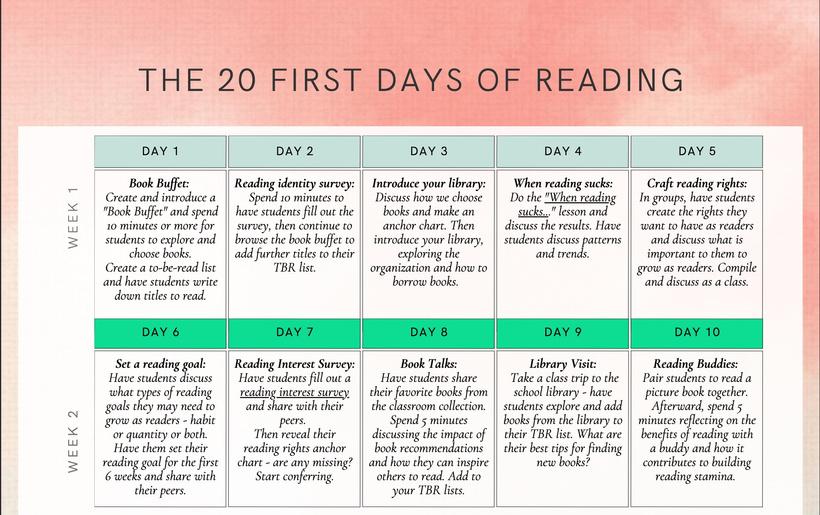
I know many of you are also gearing up to head back. Some of you still have weeks left, others only days. Perhaps like me you are looking for some inspiration of where to start? Two years ago, I created this resource for my Patreon community, and so I thought it might be helpful to share it here- it’s called the “First 20 Days of Reading” calendar, and here is a sneak peek of what is behind the link.

 As many of us embark on a new school year, I believe that fostering a love for reading is one of the most precious gifts we can give to our students. This calendar is designed to build independent reading stamina and cultivate a reading community within our classrooms.

📖 Why the First 20 Days? 📖

Research has shown that dedicating just 20 minutes of daily reading time can have a significant impact on children’s word acquisition, vocabulary, and writing skills. Moreover, creating a positive and engaging reading environment can help instill a lifelong love for reading in our students.

💡 What’s in the Calendar? 💡

The “First 20 Days of Reading” calendar is a curated collection of 20 fun and manageable reading activities, each meant to take little time and be added on to our independent reading time. These activities are designed to introduce reading choices, nurture reading enthusiasm, build reading stamina, and foster reading independence. And of course start the focus on reading identity development.

You can pick and choose between using some of these activities or all of them. You do not need to follow the order precisely either, as always, you know what you need. But I wanted to pull out a timeline approach for all of the components we can introduce when fostering reading culture and give you a placer to hang your ideas. The sky is the limit and I would love to hear what else I could add in.

👉 Access the Calendar 👈

To access the calendar and get started on this reading adventure, simply go here! Feel free to customize the calendar based on your students’ needs and interests. I included links to all the surveys and questions plus more.

So as I pack up my family to head home from a summerhouse, say goodbye to my family visiting from the US – wow is that ever hard – I hope this little post will give you some ideas, maybe save you some time, or maybe be that missing thing that you didn’t know you needed.

I will be sharing throughout the year as I embark on this new school year. Perhaps you will too?

being me, new year

When the Back-to-School Nightmares Start

I had my first back-to-school nightmare yesterday.

Woke up feeling unprepared, heart in my throat, and all sorts of nervous. It was nothing special, the standard one where everything starts off smooth, and then all of a sudden everything falls apart. I am unprepared, lost, and being evaluated. I woke up in high alert, what do I need to do right now in order to not get there.

School starts August 11th in Denmark, and on that day I get to take on the role of homeroom teacher for two 3rd grades. I get to continue with the class that has made me a teacher in Denmark, and then I get to add their neighbor class to be mine as well. And the nervousness is real.

After all, how do you split yourself between two classes like that? How do you make sure that both classes know that they matter? How do you invent, create, reflect, and ponder without overworking yourself? How do you make each kid feel seen when you are split evenly between two communities that both need you in unique ways? How do you show up in the way that you know matters, when these new kids are wondering how much you will be their teacher and whether *you will be with us a lot, Pernille?*

It almost feels like I am welcoming my second child, hoping that my heart will stretch enough to love widely, knowing that it will.

But tell that to my nightmares.

In the past, I would have thrown my into prep wok, spending countless hours planning, conceiving, creating. I would have gone in for hours, trying to get it just so, trying to work my way through my nerves. Making copies until I could feel my anxiety ebb.

But not now. Not anymore. Instead, I garden. I bake. I go to cross fit. I read. And sure, I dream a little. I reflect on how I want that first day to be framed. I consider how I want to get to know them, and how we want to continue to build their community.

So I plan. But differently now, a plan where I don’t drown, and summer just feels like the checklist item to be done before another school year. I plan for presence. For slowness. For the moment when a child looks at me and wonders, Are you really here with us? and I can say yes—not just with my words, but with the way I show up. And to do that I need to not work. I need to not stay in that space where teaching takes up most of me. Because that doesn’t fill me in the ways I need to be filled, in order to go all in.

So I give myself permission to pull back. To trust that stepping away is also a kind of preparation—that rest is not a pause in the work, but part of it. Because when I give myself space to breathe, I make space for them too.

I think about how I want that first day to feel. Not just for them, but for me too. I want it to feel calm. Possible. Like a beginning, not a performance. I want them to know I see them, both classes, both groups of humans who deserve a teacher that isn’t running on empty.

And so, instead of drowning in to-do lists, I remind myself of what I already know: that the magic isn’t in the deeply detailed plans or the laminated name tags – although those will come. It’s in the way we build trust, one small moment at a time. It’s in the way I let my heart stretch and make room—just like it always has.

If you’re waking up from your own back-to-school nightmare, you’re not alone. This time of year is heavy with what-ifs and should-dos. But maybe the work isn’t to prepare more. Maybe it’s to believe more—in who you already are, and the teacher you’re still becoming.

We’ll be ready. Not because we’ve done it all, but because we’ll be there. And that matters more than anything else. We’ll be ready, because that’s what we do.

being a teacher, end of year, reflection

Sliding into break by stopping the teacher thought train

An oldie but a goodie as many start to slide into summerbreak. Here in Denmark we go all the way until the end of June, with “just” a month off, before we head back in August. Perhaps like me, you need to find a way to stop the teacher thought train?

As an educator in the US, it normally took me weeks to finally relax at the end of the year. In the countdown to goodbye, my body took on more and more thoughts, as it got ready to finally have the time to process the whirlwind of a ride I had just been on.

Those thoughts churn into late evening, meticulously turning over the last school year, analyzing needs, reflecting on mistakes, and, of course, planning for the next year. Is a teacher’s brain ever truly at rest?

So while the calendar may finally say break, my body takes a long time to believe it.

A few years ago, I realized that if I was ever going to get to a point of relaxation faster, I needed to somehow stop this process of thought pile-up my brain otherwise jumped into. And so I started reflecting in a way that felt opposite of how I normally reflected. In a way that focused on reclaiming my identity beyond  teaching, as a way to find a better footing when, inevitably, the rush of the school year would swallow me whole again.

It didn’t always work and I go through many questions, sometimes they work, other times they don’t. Perhaps a silly exercise, but in so many ways these questions allow me to recenter, give myself permission to say “good enough” and also make some promises to myself about how I want to face another year that is bound to be even crazier than the last (at least, if the last couple of years have been an indicator).

So here are a few I have tried that seem to help me unlatch from the mania of teaching. That allow me to find myself again as my kids wait for me to become present once more. Perhaps they can help you as well?


Perhaps you have your own to share?

PS:  I don’t always write the answers down. These can also be used in  discussion or simply thinking about them. If writing feels like more work then I don’t do it.

being a student, being a teacher, reflection, Student Engagement, Student-centered

Would I like being a student in my own classroom? A reflection tool

One of my driving questions for the past 15 years has been a simple one; at the end of the day, would I like being a student in my own classroom? And as I have one month left of school, I feel the question pressing in on me as I think of next year and both the joy of continuing with my current class, as well as becoming the classroom teacher for a different class.

Would what we do make me feel safe? Help me engage? Make me feel like my voice was heard and respected? Would the way we learn, grow, discuss, and assess make sense to me?

This question is a conversation starter, an invitation into meaningful reflection where you get to craft the path for what you may need to shift or tweak your day-to-day practice.  Because ultimately it is about creating conditions for shared power as a way to show children just how much power they can have over their own bodies and minds, even within the confinements of a publicly mandated and government decided educational system.

In fact, this question is at the core of my newly published book, Passionate Learners – How to Engage and Empower Your Students, now in its 3rd edition! But it’s not the only question, I ask. In fact, the books has more than 100 reflection questions embedded throughout, some big, some small, all meant for you to carve your own path into a more sustainable, meaningful practice.

But as a way to get you started, I decided to pull together a reflection sheet for you, modeled after questions in chapter 2 of the book.  It’s 3 pages with 12 questions, that can be used by itself, as part of a larger reflection, or a book study, individually or with others. You can do some of the questions or just a few. You can write, discuss, or simply think. It’s a tool, use it as such and make it work for you. 

👉 Link to the tool right here

And if you are interested in diving deeper, I highly recommend my book. I poured my heart into it, making it a practical invitation into co-created spaces that are not exhausting to be in. And right now, it is on sale.

The book is written as a companion to the practice you already have. It is not meant as a long list of abbreviations or new systems, but instead a way to help you reflect, while also offering up a major array of practical strategies and tools that you can use the very next day.  It is meant as an affirmation, while also giving you access points to grow your practice so that you may feel better about the time you spend teaching, the students feel like what you do together matters, and that everyone is given tools to continue being critical questioners and thinkers outside of your learning space.

Is it worth it? You can see the reviews from other educators here

Whether you buy the book, or simply follow my work on Instagram or Facebook, just know that I am here to help.

👉 Access the PDF right here

assessment, feedback, grades

Rethinking Feedback: Shifting the Power to Students

We know feedback matters. I think of all the ways I have grown because my students, my husband, my editor, and so many others have bothered to share their wisdom with me. Sometimes it stings. Sometimes it sits in the back of my mind, waiting for the right moment. And sometimes, it changes everything.

And yet, when it comes to students, we often act as if feedback is something we do to them rather than with them. We spend hours writing comments, circling errors, suggesting revisions. But how often do students actually use it? How often does our feedback feel more like judgment than guidance?

Maybe it’s time to rethink who gives feedback, how it’s given, and why it even matters. And maybe we can shift our feedback practices in ways that actually work for kids—without adding more to our plates. Here are four shifts that put students in charge of their own growth.

1. Ditch the Teacher-Only Feedback Model

We shouldn’t be the only ones giving feedback. In fact, we might be the worst at it—too rushed, too generic, too focused on what we think matters instead of what they care about.

💡 New idea: What if students got more feedback from peers, younger students, real-world audiences, and even AI tools—and less from us?

👉 Try this:

  • Have students share their writing with a younger class. It’s wild how quickly they’ll simplify, clarify, and revise when they realize a first grader is their audience. I have done this for years with speeches and even our nonfiction picture book unit, it alters the entire process.
  • Use AI to generate feedback alongside human feedback—then have students compare. What’s useful? What’s missing?
  • Create a “feedback portfolio” where students collect and analyze all feedback received (not just yours) and decide what’s worth acting on.

2. Scrap the Grade—But Not for the Reason You Think

We talk about “going gradeless” to reduce stress, and to make learning more meaningful, but removing grades doesn’t matter if students still see feedback as punishment.

💡 New idea: It’s not about eliminating grades—it’s about making assessments feel like coaching instead of judgment.

👉 Try this: Instead of “no grades,” try collaborative grading. Sit down with a student and decide their grade together based on evidence of growth. Let them argue their case. Shift the power.

I have done this for many years, not just with student self-assessments but also their report cards. The conversations you end up having as a way to figure out where to land offer immeasurable insight into how kids see themselves as learners.

3. Let Students Give YOU Feedback First

What if every piece of feedback we gave students had to start with them giving us feedback first?

💡 New idea: Before turning in a project, students answer:

  • “What’s the best part of this work?”
  • “Where did I struggle?”
  • “What specific feedback do I want from you?”

👉 Try this: Make a rule: no teacher feedback without student reflection first. If they can’t identify a strength and a challenge, they’re not ready for feedback yet.

4. The One-Word Feedback Challenge

Ever spend time crafting detailed feedback, only to have students glance at the grade and move on?

💡 New idea: What if our feedback had to fit in one word? Instead of writing long paragraphs that students ignore, we give a single word that sparks curiosity: Tension. Clarity. Depth. Risk. Precision.

👉 Try this: Give students one-word feedback and make them consider what it means. Have them write a short reflection: Why did my teacher choose this word? How does it apply to my work? This forces them to engage with feedback before receiving explanations.

Feedback shouldn’t feel like a dead-end—it should be a conversation. When we shift the balance, when students take ownership, feedback stops being something they receive and starts being something they use. And isn’t that the whole point?