Be the change, being a teacher, Literacy, Reading, Reading Identity

On Creating Reading Experiences

They groan when I tell them about the Signposts.

“Another thing to write about, Mrs. Ripp?”

“Do we have to?”

“Why can’t we just read?”

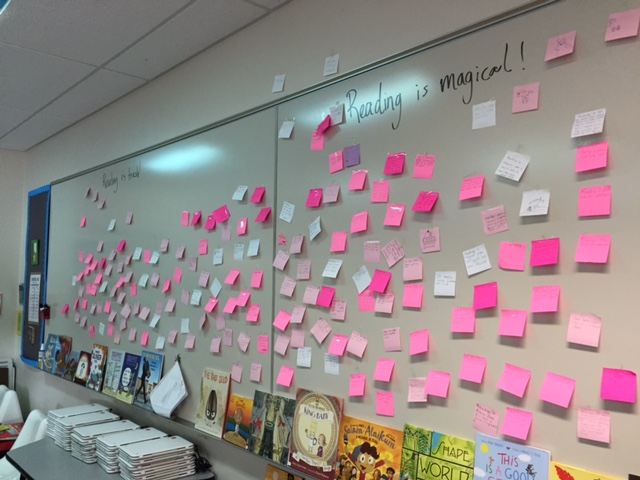
Their post-its hang behind me, reminding me of all they have said about what kills their love of reading.

And I get it, we, meaning educators, have written reading to death.  With every post-it, every jot, every stop and think, every time we ask them to do more work and forget about the virtues of aesthetic reading as discussed by Louise Rosenblatt, we make them dislike it more.  In our eagerness to help kids become better readers, we have made the kids drown in their post-it notes.  We have broken meaningful stories into such small tasks so that the very meaning that made the story worth our time is gone.  We have forgotten about the purpose of all this instruction it seems; to create literate human beings that can grow from what they read, both intellectually, but also on a heart level.

Yes, we need to teach skills, of course, we do.  But we also have to let the kids use those skills in meaningful ways.  We have to let them practice too without telling them to use post-its, without telling them to write down, without telling them to look for specific things, because if we don’t, we don’t know if they will ever be able to do it without our prompts, our scaffolds, our tasks.  We have to remind them, and ourselves, that when we read it is not just to complete a task attached to it.  That the task is just a practice for the real deal; for when we read and we have an experience with the text.

So I tell them not to worry.  The signposts, or any other skills we review or learn are just tools.  Tools to use when it makes sense.  Tools to use so they can complete the tasks that we do need to do at times.  Practice them so they become habit when we need them but that it is also okay to just read and let the movie flow in our heads to the point where the rest of the world falls away and all we can focus on is how close we are getting to the end of the book.

So let your students experience meaningful words, not just more reading tasks.  Let them experience what it means to read and then feel something.  Let them experience what it means to read and sit in silence.  Let them read and get to the end and then discuss what the text made them think of, not just a few skills you have just taught, not just the repertoire of tools they may have.  Balance is needed in all of our classrooms for the purposes of reading, our students are telling us this loudly if we will only listen.

If you like what you read here, consider reading my newest book, Passionate Readers – The Art of Reaching and Engaging Every Child, out August 2017.  This book focuses on the five keys we can implement into any reading community to strengthen student reading experiences, even within the 45 minute English block.  If you are looking for solutions and ideas for how to re-engage all of your students consider reading my very first book  Passionate Learners – How to Engage and Empower Your Students.      Also, if you are wondering where I will be in the coming year or would like to have me speak, please see this page.


Be the change, being a teacher, Literacy, Reading, Reading Identity, student choice, Student dreams, student driven, student voice

Why Reading Sucks…

A couple of years ago I asked my students to tell me why reading was amazing.  When Jack whispered to Michael that “Reading sucks…” the rest, they say, is history.  Inspired by Jack’s words of truth, I have asked students for years now to tell me their reading truths and not hold back.  I cannot be the kind of teacher I would like to be if I don’t get to know them.  The real them.  Not the school-primed, sanitized version.  Not the kid that knows how to play the game.  Not the kid that says whatever they think we want to hear so they start off on a good foot.

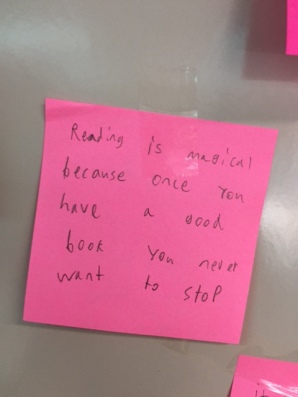
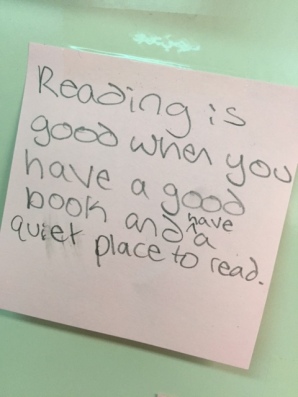
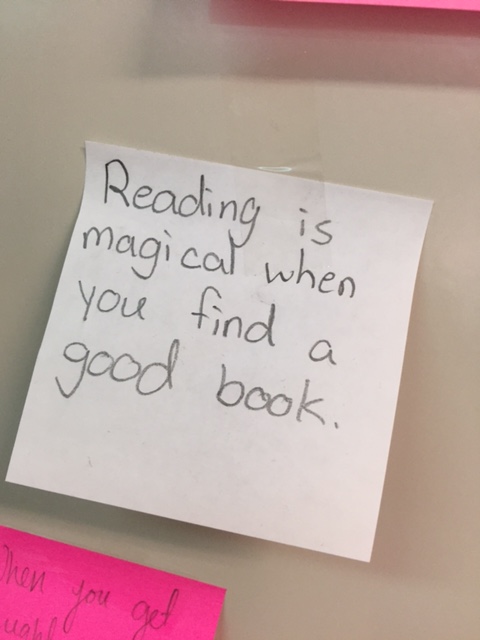
So on the third day of school this year, I told the story of Jack. Of how I had been doing that lesson where I talk about the magic of reading.  How he had dared to whisper those words.  Some of the students laughed, they remember the lesson I was referring to, as they have also head about how amazing reading is for years.  And then they got quiet as I asked them so when is reading not magical?  And when is it?

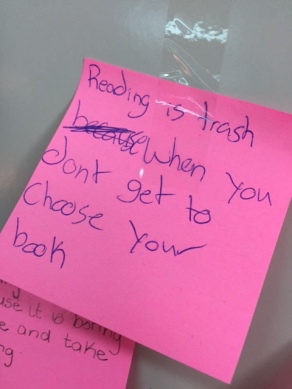
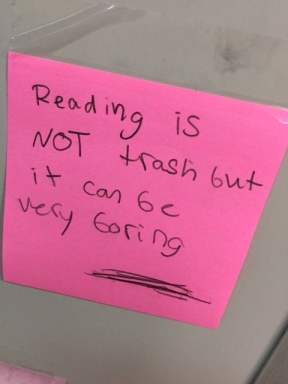
I wrote in big bold letters “Reading is magical” and then asked them what to write on the other side.  “Reading is trash!” they said as they chuckled, not quite sure, I am sure, of what to make of all of this.

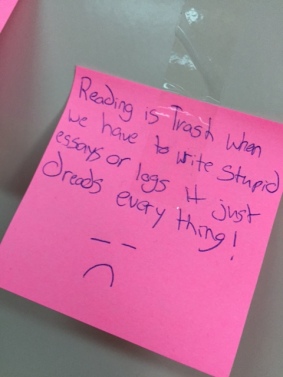
They grabbed as many post-its as they could and then started to write their reasons.  Please tell me when reading is amazing.  Please tell me when reading is trash.  Tape your post-its to the board so they stay up.  Sign your name if you want.  And then step back, read the post-its.  What do you notice?

IMG_7092.JPG

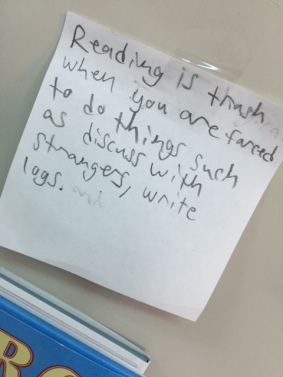
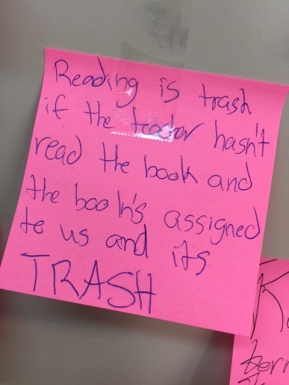
Over and over their words joined together to form the same patterns I see year after year.  The same things I have done to kids through the years.  The same things many of us educators are told to do every year by well-meaning administrators who are led by an expert curriculum that someone told them to purchase to raise test scores.

No choice!

Boring books!

Too much writing!

Tests!

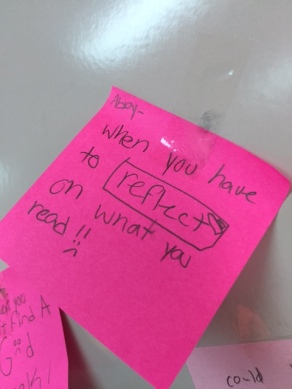
Forced reflections!

Sitting still!

Their words glared at us.


IMG_7087.JPG  IMG_7083.JPGIMG_7078.JPG IMG_7079.JPG IMG_7080.JPG IMG_7088.JPG

But wait?  When is reading magical?  Again a pattern that we all know.

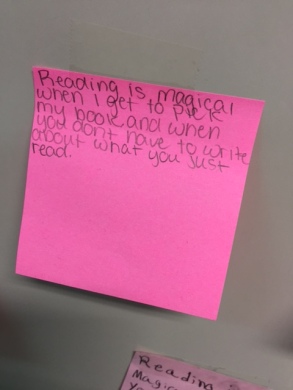
When I find the right book!

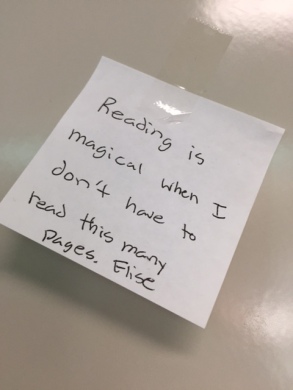
When I am given time to read!

When I find a great series or author!

When it is quiet!

When I am allowed to just read!

IMG_7070.JPG  IMG_7071.JPGIMG_7072.JPG  IMG_7073.JPGIMG_7074.JPG

Their words have carried us into our beginning reading conversations, into our analysis, into our very community.  They have guided us as we start to figure out where reading fits into our lives and whether we can protect or promote a strong and personal relationship with reading.  They have guided us as they have mentioned the amazing experiences they have had with their previous teachers, and the ones they wish that had not had.

We fret so much over what curriculum we should use, how we should teach, and how we should grade, yet sometimes the biggest impact we can have with kids is simply when we stop and ask them for their truths.  Do you know what your students would say?

PS:  This lesson and the others that surround it are all discussed in my new book, Passionate Readers.  Passionate Readers.  

If you like what you read here, consider reading my newest book, Passionate Readers – The Art of Reaching and Engaging Every Child, out August 2017.  This book focuses on the five keys we can implement into any reading community to strengthen student reading experiences, even within the 45 minute English block.  If you are looking for solutions and ideas for how to re-engage all of your students consider reading my very first book  Passionate Learners – How to Engage and Empower Your Students.      Also, if you are wondering where I will be in the coming year or would like to have me speak, please see this page.
 

Be the change, being a teacher, Literacy, Reading, Reading Identity

When We Make a Child a Level

Pardon my passion for a moment, but a few things need to be said.

When we make a child a level we diminish the entire child. Levels tell a child that they are not worth us getting to know them.  That we don’t have time to take the time we need to help them better.  That their entire reading identity is the same as every other child that is at that level.

When we make a child a level, a letter, or a number, we are telling them that that is all they need to know.  That that is all we need to know.  That they do not know how to shop for books, that they can rely only on outsiders who have determined what is best for them.  Thet their level speaks for them and that our conversations need to be about comprehension and skills, rather than who they are as readers.

When we make a child a level, we can teach more.  We can do more.  We can match kids up more easily.  We can rely on others to do the hard work of getting to know the very child that is in front of us and help them discover who they are as readers, as human beings.  And we can go home, lulling ourselves into thinking that we actually helped that child by telling them to only pick from certain levels of books because that is what the research told us to do.

But that is not what our reading instruction is only about.  It was never JUST about matching kids to text.  It was never JUST about finding the right fit book.  It was never JUST about 99% comprehension rates, good fit books, or the five finger rule.  It was never just about the quick solution or the short-term fix.  In our obsession with getting things done, we have forgotten that it takes time to develop a reader, it takes time to become a reader, it talkes trial and error, and it takes discovery.  Levels can take that away from us all.

It is about discovering why reading matters.  Why reading makes us better human beings.  Why they should leave our classrooms, our schools, and find more books so that they can continue to wonder, to search, and to feel something.

So when we make a child a level, ask yourself this; who is that level really helping because it sure isn’t the child in the long run.

PS:  I was quoted today in a discussion piece in School LIbrary Journal, about how leveling disempowers children, other smarter people are quoted as well.

If you like what you read here, consider reading my newest book, Passionate Readers – The Art of Reaching and Engaging Every Child, out August 2017.  This book focuses on the five keys we can implement into any reading community to strengthen student reading experiences, even within the 45 minute English block.  If you are looking for solutions and ideas for how to re-engage all of your students consider reading my very first book  Passionate Learners – How to Engage and Empower Your Students.      Also, if you are wondering where I will be in the coming year or would like to have me speak, please see this page.
 

Be the change, being a teacher, first day, first week, new year

A Sign to Welcome Them All

I have been in my current classroom for three years, about to begin year number four.  Never have I stayed in one classroom for so long and so my room, well, it is looking like I have been there a while.  Everything has its place, everything is where it feels comfortable, but comfort doesn’t equal excitement, so in order to show off the excitement I have for this new batch of students, I want to change it up a little bit.  As much as I can anyway with all of our book shelves, with all of our tables and chairs. And where does the change begin?  Right as they enter the door.

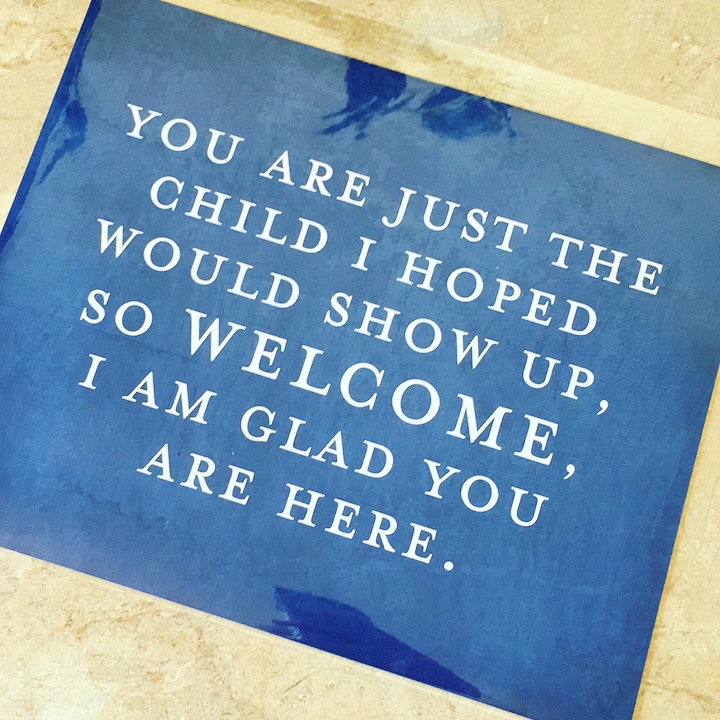
One of the biggest components of our classrooms is the need for students to feel like they belong so I knew I wanted something to signal how glad I am that they, the very child they are, showed up.  I also wanted something to communicate that all children are welcome, no matter their identity, no matter how they view themselves or are viewed by others.  I kept coming back to a blog post I wrote in the aftermath of some of the hateful acts here in the USA and realized that I knew exactly what the sign should say.  So here it is, I am so excited with how it looks, feel free to use the saying but please give credit.  I used Jenna Sue Design on Etsy because I have used her before and love her style.

IMG_6705.JPG

Change starts with us and so does safety and feeling like you belong.  I am glad this sign will be the first thing students see when they come through the door of our classroom.

If you like what you read here, consider reading my newest book, Passionate Readers – The Art of Reaching and Engaging Every Child, out August 2017.  This book focuses on the five keys we can implement into any reading community to strengthen student reading experiences, even within the 45 minute English block.  If you are looking for solutions and ideas for how to re-engage all of your students consider reading my very first book  Passionate Learners – How to Engage and Empower Your Students.      Also, if you are wondering where I will be in the coming year or would like to have me speak, please see this page.


Be the change, being a teacher, first day, first week

On the First Day

On the first day of school, how will the students be greeted by you?  Will you stand by the door, saying hello, welcoming them in, or will you be busy with last minute preparations for the kids who already showed up?

On the first day of school will the kids be told where to sit or will they be given choice right away?

On the first day of school will the rules already be posted?  The expectations already made?  Or will you have that discussion with the kids so they can be involved in how they want to feel?

On the first day of school will the whole year have been planned out already or will you wait to see who these kids are and what they need?  Will their voices be used to shape the curriculum or has that been done for them already?

On the first day of school will you be excited to start another year?  Will you be honored to be a teacher?  Will you be aware of the immense responsibility and opportunity that comes with what we get to call a job?

On the first day of school will you worry more about all of the information that you have to share and the things you have to get done, rather than how the students feel as they leave your classroom?

On the first day of school will you plant the seeds of the future learning that will take place?  Will your students’ voices be heard already or will the day be dominated by yours?  Will the work you do be meaningful or something just to get through?

Will you be honored to meet each child?  Will you welcome each one, no matter their past, no matter their needs?  Will you face your own fears and teach courageously so we can begin to right the wrongs in this world?  Will you find your own voice to start courageous conversations?

On the first day of school will you be glad you showed up, perhaps exhausted at the end, yet happy or will you dread the year that has just started, unsure of why you chose to come back?  Will the students leave thinking that perhaps this year will be amazing, that perhaps they will be interested, that perhaps they will be challenged, that perhaps you will care about them?  Or will they drag their feet and answer “fine…” when their parents ask them how the first day was.

On the first day of school will you know that this year will be worth it?  That this will be an opportunity to grow?  That yes, there may be hard days, but there will also be so many great ones?  Will you tell the kids thank you when they leave and mean it?

On the first day of school, we set the tone for the learning that will happen the rest of the year.  For how kids will feel when they enter our learning spaces.  For how we will be viewed as a new adult in their life.  Let’s do it right this year.

If you like what you read here, consider reading my newest book, Passionate Readers – The Art of Reaching and Engaging Every Child, out August 2017.  This book focuses on the five keys we can implement into any reading community to strengthen student reading experiences, even within the 45 minute English block.  If you are looking for solutions and ideas for how to re-engage all of your students consider reading my very first book  Passionate Learners – How to Engage and Empower Your Students.      Also, if you are wondering where I will be in the coming year or would like to have me speak, please see this page.


administration, Be the change, being a teacher, first day, first week, new teacher, new year

On In-Service and Back to School Training

For many of us, it has been a summer of learning.

For many of us, it has been a summer of renewal.

Of finding new ideas

Of tweaking the old ones.

Of refocusing, re-thinking, and perhaps even re-committing.

We eagerly await the arrival of those kids, we hope will become our kids, and we dream of the year to come.

But before the first day of school there is bound to be training.  There is bound to be new programs, new initiatives, new things added on to our already heavy shoulders in order to make this year the possibly best year we have ever had.  And I try to be excited and I try to be ready and I try to be open-minded, but I realize now that while the program may be amazing.  While the research may be compelling.  While the intentions may be the best, it doesn’t really matter.

You could bring us the very best program in the world, but it may never be enough.

Because school is not really about implementing programs.  School is not really about the lesson plan.  Or the curriculum.  Or even about the research.  It is about the kids, of course.  We say it all the time.  And yet, where is the time spent in our back-to-school days?  What are our discussions centered on?  What do we walk away from our in-service days knowing more about?  The program or the kids?

I for one hope it is the kids, but often see them left to the end, brought up as data points and survey results.  Brought up in lofty dreams and grand ambitions.  Why not make in-service about the very kids we teach and invite a few in?  Why not interview them to ask about their hopes for the school year?  Why not have them craft questions or areas they would like us to get better at.  Why do so many of our decisions that center around kids never involve the kids?

So if you are in charge, if you are the one making the agenda, bring in the kids.  Add their voice.  Add their presence.  Let us focus not on the training of more curriculum implementation, on all the new initiatives, at least not the entire time, but instead on the problems the students challenge us to solve.  Let us focus on what we say we are really there for; the kids and let them guide us into making this the best year yet.

If you like what you read here, consider reading my newest book, Passionate Readers – The Art of Reaching and Engaging Every Child, out August 2017.  This book focuses on the five keys we can implement into any reading community to strengthen student reading experiences, even within the 45 minute English block.  If you are looking for solutions and ideas for how to re-engage all of your students consider reading my very first book  Passionate Learners – How to Engage and Empower Your Students.      Also, if you are wondering where I will be in the coming year or would like to have me speak, please see this page.