Be the change, being a student, being a teacher, being me, Student dreams

The Least We Can Do

What follows is my ITEC Ignite…

On December 19th, 2013, our youngest daughter, Augustine, was born almost 10 weeks early.  She came so fast that there was no doctor in the room, just the nurse.  She came so fast that I now know what the big red emergency button in a hospital room does.  She came so fast that I did not see her.  I did not hold her.  She did not cry.  For the first minute of her life, I did not know if she was alive.  It wasn’t until my husband, Brandon, told me she was breathing that I think I took a breath.  That life started up again because for that longest minute of my life, with no wailing to calm me down, I had no idea if I was still the mother of three or the mother of four.

They whisked her away from me into their machines, into the equipment that would help her tiny body breathe, stay warm, and her heart keep beating.  See when babies are born that early they need help with everything.  And we can prepare all we want but it is not until they actually arrive and we see how much they need us that we realize that all of a sudden we have started a new journey, one that will take us down a perilous path where we might not be able to see our destination for a long time.

In the week leading up to her much too soon arrival, I was in the hospital waiting.  Willing my body to slow down.    We were not ready.  She was not ready.  One night a doctor from the NICU visited me to help me prepare for what would happen in case she came.  His words has stuck with me all of this time.

He said, “When she comes we will be ready.  We will have the machines that will help her breathe.  We will have the machines that will keep her warm.  We will monitor her heart and we will be by your side.  We will do everything in our power to keep her alive, to keep her safe, to help her no matter what.  While we can help her with her needs, we will not know about her brain.  We will not know what long term effects being born so early will have on her learning.  We will not know if her brain will be damaged,  we will not know until she grows, until she reaches her milestones.  We will not know what her future path will look like when it comes to learning but we will be ready.  We will be by her side because that is what we do.”  That is what we do…

As I held Augustine for the very first time more than 24 hours later, I held all of our dreams for her as well.  As we sat in the quiet, listening to the alarms and the beeps on her monitor, I knew that her future was now in my hands as well, and that all we could do now was our best.  That all we could do now was to be by her side and hope that her future teachers would see her for the miracle she is and not just a child who might have difficulties learning.

16848553711_55192d39bb_o.jpg

Every year as the new year awaits, our students arrive in all of their glory.  They arrive with all of their dreams, their hopes, and their needs.  They show up whether we are ready or not.  And so we prepare, we plan, we dream over the summer that this will be the year that we reach every single child we teach.

We do not pick who we teach.  We do not pick who shows up.  We do not pick who these kids are that we are supposed to have life-changing experiences with but instead we stand by our doors  like the Statue of Liberty and say; “Give me your tired, your poor, your huddled masses yearning to breathe free …”

We can prepare all we want as teachers.  We can create classrooms where most of our students will thrive.  We can plan for fictitious children and hope they will fit into the boxes we create.  Or we can teach the kids that come.  We can create classroom experiences that center on the kids that actually show up instead of the kids we hope to teach.  


We can open our classroom doors wide to make sure that every child that enters, that every child that shows up, know that with us they will learn, with us they will create, with us they will matter.  Because they do.   And we can ask those kids how we can be the types of teachers they need.  We can ask those kids how they would like to learn and then we can listen to their truths and become the teachers they need.

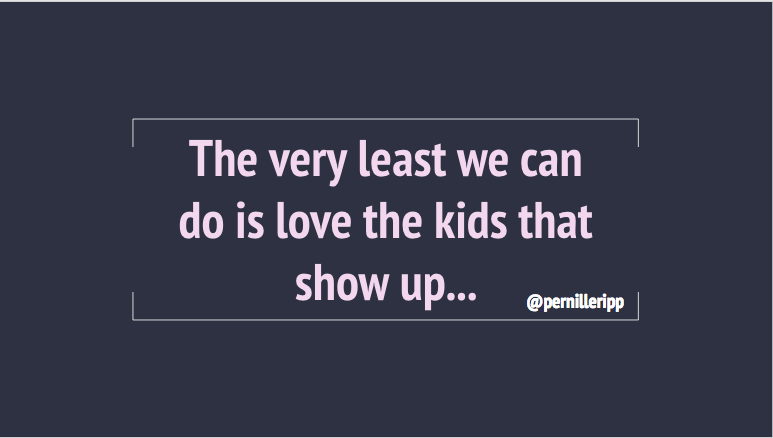
So we can take them all and we can love them all because that is the least we can do.  We work tirelessly every day so that those kids that become our kids know that with us they belong, that with us it does not matter what their start in life was because in here they have a chance at success.  That with us it does not matter whether they were born 10 weeks early, don’t have a good home life, or have never liked school.  That with us all that matters is that they showed up.


Augustine did not ask to be born early, she did not ask to have such a hard start in her life.  She did not ask to have harder path than our other kids.  The kids that come to us with their broken dreams and their battered hearts, didn’t ask for that either.  Didn’t ask to have a different life than so many others.  So our job is to teach.  Is to love.  Is to be by their side.
ITEC Ignite The Least We Can Do - Google Slides.clipular.png

This summer, as Augustine went to her NICU check up appointment, we heard the sweetest words.  “Your daughter is perfectly average…” and while her path is still unwinding and we are not in the clear just yet, we see hope with every word she learns, every task she accomplishes.  We see her for the miracle she truly is, a child that would not have lived not too many years ago.  So may we all see the miracle that is the child that enters our schools.  May we all know just how lucky we are to teach these kids, even when our days are long and our lesson plans are broken.  Even when we feel we are not enough, may we still try.

As teachers, we were never promised it would be easy.  We were never promised that our jobs would be effortless.  Or that our hearts would stay protected.  But we were told that it would be worth it.  That this may be one of the hardest jobs and yet also the most rewarding.  So every day as we welcome the kids, make sure it is every child we welcome, not just the easy ones, the ones that barely need us.  Make sure your classroom is a place for any child to succeed.  No matter their start in life.  Because much like the NICU doctor told me almost three years ago; we are ready, we are here, and we will stay here until you no longer need us.  It is the very least we can do…

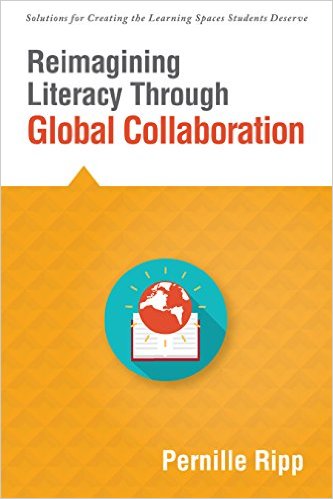
I am currently working on a new literacy book.  The book, which I am still writing, is tentatively Passionate Readers and will be published in the summer of 2017 by Routledge.  I also have a new book coming out January, 2017 called Reimagining Literacy Through Global Collaboration, a how-to guide for those who would like infuse global collaboration into their curriculum.    So until then if you like what you read here, consider reading my book Passionate Learners – How to Engage and Empower Your Students.  Also, if you are wondering where I will be in the coming year or would like to have me speak, please see this page.
 

Be the change, being a teacher, books, global, Literacy

Reimagining Literacy Through Global Collaboration

Since 2010, my students and I have been bringing the world in.  We have asked others to be our teachers, whether authors, experts, children.  We have asked others to share more of their world with us so that we could make more sense of our own.  We have created, we have become experts.  We have made the world smaller by becoming a moving piece of the world, and we have grown.  In our literacy collaborations and creations, we have become authors, poets, performers, and teachers.  We have become more than what we started as.

So when I was asked what I would propose to make school different, the answer came quickly; besides empowering students, I feel an urgent need to infuse global collaboration throughout our literacy instruction (or any subject matter for that sake).  That in a world that seems so divided at times, where we seem to be hellbent on finding each others differences and using them to distance ourselves, we need to actually know our similarities.  We need to bring the world in to make the world smaller, kinder, more empathetic.  Have students create so that they can become the person they envision rather than just pretend.

I have written this book three times over.  Starting over every single time because it was not good enough.  Within the span of sixty pages I get to plead my case for why doing global collaboration is an urgent endeavor.  For why it is easier than you think to bring the world in.  For why it should be at the top of our lists when we plan our literacy instruction. And the how.  How can you do it, what are ideas, what does it look like.  By opening up my own classroom practices, as well as other educators, I hope to inspire those that need ideas or a boost to jump in.   To create another consideration as we plan our school year and our learning adventures.  And now, it is ready for the world.  My newest book Reimagining Literacy Through Global Collaboration is out for pre-order with a birthdate of January 20th, 2017.  I cannot believe it is almost here.

cover

I hope you find it useful, that is truly my biggest dream for this book.  That you will learn something, that it will inspire you to try and to change in ways that are meaningful to you.  It may have been a long process to write this book, sometimes that is how it goes, but the words are genuine.  We need to create classrooms where students learn with others, for others, and through others.  And our literacy instruction time gives us the perfect conduit for just that.  Welcome to the world.

To see the book on Amazon, go here.To see the book on Amazon, go here.To see the book on Amazon, go here.

I am currently working on a new literacy book.  While the task is daunting and intimidating, it is incredible to once again get to share the phenomenal words of my students as they push me to be a better teacher.  The book, which I am still writing, is tentatively Passionate Readers and will be published in the summer of 2017 by Routledge.  So until then if you like what you read here, consider reading my book Passionate Learners – How to Engage and Empower Your Students.  Also, if you are wondering where I will be in the coming year or would like to have me speak, please see this page.
 

aha moment, Be the change, being a teacher, homework, no homework, Student dreams, student driven, student voice

Are You Doing Your Own Homework?

itec-passionate-learning-environments-google-slides-clipular

This summer as I saw my niece, who is now a sophomore, we inevitably spoke about her reading life.  She used to be a voracious reader, we could not get enough books in her hands.  Then she came to the whole class novel, which inspired this post, and since then her reading life has been limping at best.  This summer I asked, as usual, “What are you reading?”  She told me The Kite Runner and then scoffed.  Surprised I asked why the reaction.  She then told me that she had read the book and loved it but now had to reread it to annotate it.  “The whole book?”  I asked.  “The whole book.”When I asked her why she was not quite sure, perhaps they would use parts for discussion.

I wondered then, as I often do, when I come across homework assignments that appear nonsensical, whether her English teacher had done their own homework?  Whether they had taken the time to annotate the entire book themselves.  Whether they understand the labor that was involved with that task and how it would take away from the enjoyment of the book.  It seems to me that once again something that is meant to teach kids how to better thinkers, instead is implicit in the killing of their love of reading.

Several years ago I started to do my own homework.  From the stories we wrote, to the essays, to the speeches, and to the presentations.  I started to experience what I was putting on the shoulders of my students and I quickly realized that what I thought would just take a few minutes never did.  What I thought would be easy hardly ever was.  What I thought would be meaningful sometimes wasn’t.  So I stopped giving homework, except for reading.  I stopped going by the formula of grade times 10 minutes.  I stopped handing out packets and instead vowed to stop talking so much and instead spend the time in class on discussion and work time.  I expected pushback or concern, but have hardly gotten any in the last six years.  Most parents express relief instead.

So every year I make a deal with my students; if you work hard in our classroom, you should not have to do work outside of English.  If you give me your best then besides reading a good book you don’t have to give me anything more after you leave our classroom.  And for most it works.  Most of my students come ready to work, ready to learn, and they hand their things in.  Not everyone, just like when we have homework we have those kids that do not get it done, I also have kids that do not use their time wisely.  So I work individually with them, after all, the acts of a few should never determine the conditions of the many.

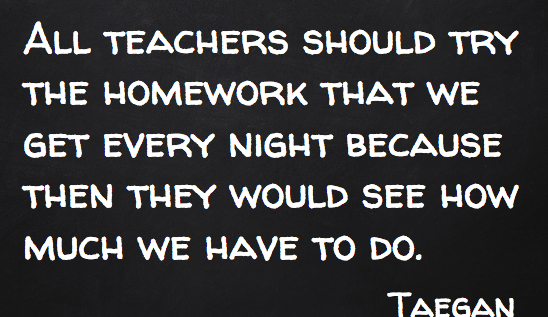
So if you are still giving homework, I ask you for this simple task; do it yourself.  Go through the motions as if you were a student and then reflect.  Was it easy?  How much time did it take?  What did you have to go through to reach completion?  In fact, if you teach in middle school or high school, do it all, truly experience what we put our students through on a day-to-day basis. I would be surprised if the process didn’t shape you in some way.

I still do my own assignments, although I have been slacking lately.  Whenever I do, I am reminded of just how much time homework swallows.  Of sometimes how little actual practice it gives, or even learning.  How homework is unfair because we have already been given hours of their time in school.  How those who really need the practice do not need it at home, but instead with us as support in our classrooms.  Do your homework, tell your students, and see how they react.  Then ask them how they feel about homework.  Let their thoughts shape you as a teacher, I promise you won’t regret it.

I am currently working on a new literacy book.  While the task is daunting and intimidating, it is incredible to once again get to share the phenomenal words of my students as they push me to be a better teacher.  The book, which I am still writing, is tentatively Passionate Readers and will be published in the summer of 2017 by Routledge.  So until then if you like what you read here, consider reading my book Passionate Learners – How to Engage and Empower Your Students.  Also, if you are wondering where I will be in the coming year or would like to have me speak, please see this page.


Be the change, being a teacher, books, Literacy, picture books, Reading, Reading Identity

If Not Us, Then Who?

http-www-pixteller-com-pdata-t-l-541830

When I was 17 years old, my history teacher pulled me aside and told me tone it down.  “It” being my opinion in case it intimidated others.  “It” being speaking my mind because sometimes I would come across so forceful that others did not want to engage.  So I stopped speaking in his class.  I stopped jumping in, afraid that I was going to rock the boat or upset the other students.  I knew I had opinions, but I didn’t want to be known as someone who did not make room for others.

A long time ago I decided that staying quiet would not get me anywhere.  That hoping that someone would understand what I needed without me actually speaking up was a delusion.  That I could no longer wait until someone spoke the words that burned within me so I could quote them and pretend I hadn’t thought the exact same thing.  I started writing, speaking, and teaching as the whole me, rather than the 17 year old girl who had been told to tone it down.  It has been quite a journey since then.

As educators we speak up all of the time.  We speak up for ourselves when changes need to be made in our schools.  We speak up for our students when they need us to advocate.  We speak up for our own needs and hopefully for the needs of our students.  We speak up when we see injustices that need to be righted, when our teacher stares are not enough.

So I think it is time for us to speak up and let our voices be heard because when I look at my classroom library, when I really study the books I am able to put in the hands of my students, I cannot help but wonder; where are the books from non-white authors?  Where are the picture books that center around kids that are going about their every day life that look like some of my students?  Where are the holiday books, the birthday books, the first day of school books, the books that share small slices of life that have characters that are not white?

While I buy the ones that I know of thanks to blogs like Reading While White, We Need Diverse Books, and the Nerdy Book Club, I am constantly reminded of how few there are out there for us to purchase.    When I receive a package of books I am constantly reminded of how often the kids in the books look just like my own kids in all of their whiteness.  How my kids must take it for granted that, of course, the books they read have people in them that look like them.  That I do not have to scour the internet to find books that remind them of themselves because those are the majority of books out there.   That in book upon book being white as a character is the standard not the exception.

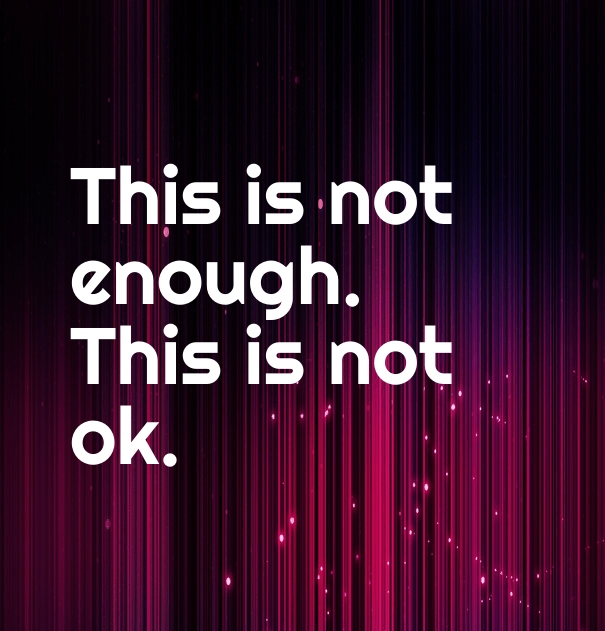
We need diverse books.  We need own voices books.  We need more than what is out there and so we need to raise our voices.  There will be no change if we do not say loudly; “This is not enough.  This is not ok.”

So as educators we can speak up.  We can reach out and demand better.  We can spend our precious budgets on books that do not just offer up more white narratives, but actually mirror the diversity that we are surrounded by.  We can tell publishers that we need books that show all of the kids we teach.  We need books about Native American written by Native American, or other #OwnVoices authors.  We need books that go beyond the standard stories being shared so that when all of my students open up a book they can find a character that looks like them.  Or when my own white children read a book, they will see a character that does not look like them and understand that that too is the norm.

For too many years we have waited for publishers to notice the major gap that has been created, and while changes are under way, the process won’t speed up until we speak up.  So use your voice, use your connections, use your money to show the world that when we echo that “We need diverse books!” it is not just because it is a catchy phrase, but is the truth.

I am currently working on a new literacy book.  While the task is daunting and intimidating, it is incredible to once again get to share the phenomenal words of my students as they push me to be a better teacher.  The book, which I am still writing, is tentatively Passionate Readers and will be published in the summer of 2017 by Routledge.  So until then if you like what you read here, consider reading my book Passionate Learners – How to Engage and Empower Your Students.  Also, if you are wondering where I will be in the coming year or would like to have me speak, please see this page.

Be the change, being a teacher, global, global read aloud

On Global Collaboration and Projects You Can Join

I started the Global Read Aloud in 2010 not knowing what it would become, not knowing how it would truly make the world smaller, connect many children and change my own life.  I started it with a simple need in mind; more global collaboration and connections for the students I was teaching.  I knew that the power of a great read aloud could not be disputed, I knew what a read aloud could do to to foster community.  I knew what the right read aloud would do for us as readers, as thinkers, as human beings.  And so I started a small project that since 2010 has taken on a life of its own.

This Monday we kicked off the 7th annual Global Read Aloud.  It was the day that I gave up on my Twitter account pretty much.  There simply was no way for me to keep up.  With more than 937,000 students participating this year, give or take a few, I do believe we may be one of the largest, if not the largest, globally collaborative multi-day student project in the world.  I cannot help but stand in awe of the number.  Stand in awe of this little idea that grew into something more than I could imagine.  But not just for the sheer number of children involved, but more for the lives that it is changing.  For the experiences it is creating.  I stand in awe of the invisible lines stretching around the globe as students connect, discuss, and share who they are with others who happen to be reading the same book as them.  Imagine a world that is truly becoming more connected and you have the vision of what the Global Read Aloud is doing for the world.  And my project is not alone.  Other dreamers and thinkers are seeing the need for projects to unify children around the world, for better learning opportunities that include bringing the world in and the students out.  We can certainly create our own, I do all of the time for the sake of my students, or we can join in on these pre-existing projects to make the world smaller.  To make the world kinder.  To make the world more empathetic.

Global collaboration and the way it shapes student learning experiences should not be something we just do once in a while, it should be often, it should be meaningful.  It should be something our students come to expect not as something new and flashy but as something necessary for them to discover who they are as learners.  Our students have a voice, they have a need to learn about others, they have the right to not just experience our differences but to know what makes us all so similar.  Global collaboration provides us with our starting point, these projects become our starting point as we try to bring the world in.

To see the global projects I know of and that others have graciously shared, please access this padlet.  If you know of others that should be on here, please add them.  At least this is a start for what is out there.


Be the change, being a teacher, being me

One Small Act


In this world that seems more divided than ever.

In this world where headlines scream more about the bad than the good.

Where stories of goodness and kindness seem so far and few in between.

Where we read of suicide caused by bullying, of children that feel so lonely.  Of adults who are not sure where they fit in so they stop trying altogether.

In this world where wherever we turn we seem to be reminded of all that is wrong with the world, we need our classrooms more than ever.

We need spaces where kids feel that they belong, feel that they the prevalent voice is one of kindness, not of tearing apart.

We need opportunities to make the world smaller, more understanding, more of all of the good.

Today, in our classroom, as a child stood frozen in fear of public speaking, another child got up quietly and stood right beside him.  Stood there and coached him gently, let his presence be known and tried to speak him out of his fear.  I stood there with tears prickling my eyes, knowing that no one had told that child that to be a friend meant to stand beside someone, to be a friend meant to be there in times when we might not seem as needed.

As the rest of the class sat quietly, we moved on to another thing.  But this moment of a simple act of kindness is one that I will remember for a long time.

This world may seem like it is slowly self-destructing, but our kids, our future, they can still change it; one small act of kindness at a time.