Be the change, being a teacher

Lessons from the “Bad” Kids

White, Black, Yellow, Red,  Free Image

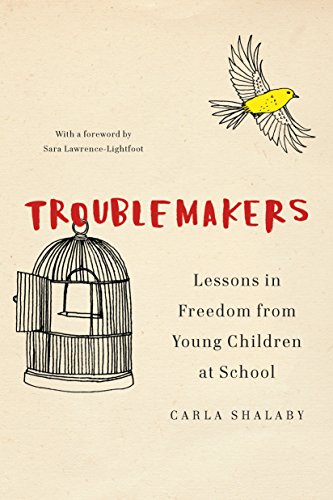
“I think of the children who make trouble at school as miner’s canaries.  I want us to imagine their behaviors – which are admittedly disruptive, hypervisible, and problematic – as both the loud sound of their suffering and a signal cry to the rest of us that there is poison in our shared air…”

These words from Carla Shalaby’s phenomenal book Troublemakers have haunted me since I read them.  I think I have shared these words with other educators more than anything I have ever shared from a book.  This book is a book that will influence my teaching for years to come.

The image of these kids that so desperately need school to work for them as the canaries is one that I cannot get past.  Is one that we all need to unpack.  What if we saw their behavior as an alert to how our schools are not working, rather than think that they do not work in our schools?  What if we treated each high flyer, each challenging kid, as what they are – spotlights on what we are actually asking kids to do all day; sit still, comply, listen, only do what we tell them to and then realize that just perhaps this is not what every child needs.

What if we unpack our own values and not the ones we claim we have, after all, I have yet to meet an educator who says that making children hate school is part of their job description, but the ones that our actions show us we have.  Who do we listen to?  Who do we praise?  Who do we give positive attention to?  Who do we highlight as valued members of our classroom?  And who do we not?  These actions speak louder than the things we say we value.

And I speak from my own history; for several years, I wielded exclusion and public shaming as my primary tool of control.  So what if other students saw kids move their sticks or put their name on the board, after all, they had been there to witness the behaviors.  So what if the same kids were sent out of the room; to think, to take a break, to go to the principal’s office.  So what if the same kids were “otherized” every time they failed.  Every time they screwed up.  Every time they weren’t “good” students.  They would just have to learn how to adapt, how to fit the mold of school, how to fit “our” classroom and not the other way around.

A few years in, I realized what I was doing.  How I was part of the problem of schools failing kids, how public shame has no place within our classrooms, how exclusion is often the worst long-term solution because it isn’t really a solution at all.  How relationship, giving students power and giving them a way to speak their truths was what I needed to pursue instead, even if it meant more time, more work, and yes, more frustration at not having a quick answer.

Within that revelation I had to uncover a hard truth; that I was the reason that some kids were otherized.  As I was writing Passionate Learners, a book focused on how we change the way we teach to give control back to our students, I asked my students, “How do you know who the “bad” kids are?”  Their answer shook me to the core.

“The teachers tell us…”

So simple and yet so hard to digest.

We, the adults in the room, are the arrows that point out the bad kids.  Are the magnifying lenses.  Are the ones that show that it is okay to exclude others.  That it is okay to police others who step out of line.  That there is such a thing as “good” kids and “bad” kids.

And that is something that needs to change.  We can do better.  We must do better.

So as I prepare for our students to come to school, I think of what I need to do to ensure there are no “bad” kids in our room.  That all kids are truly valued.  That all kids get what they need.  Lofty?  Sure, but it shouldn’t be.  It should be the right of every child to be seen as a valued member of our schools, even if they make their presence known loudly.
Be the change, being a teacher, Literacy, Reading, Reading Identity

On Tier 1 and 2 and 3

4867979838488576.png

For years, I couldn’t understand why my own students weren’t growing as readers.  Why the same names showed up at our data meetings as kids who were failing to progress.  Why some kids made the yearly growth and others sat stagnantly.   I was trying, using the framework of balanced literacy, yet I didn’t see how my own lack of knowledge, my own lack of tools, was directly leading to them not growing.  How, although I had the components in place, there was so much more I could be doing for all of the kids. Instead, I looked outward hoping that surely someone else; special ed, reading specialists, ESL support, someone must know how to reach these kids.  How to teach these kids.

I am a classroom teacher. Every day, I am responsible for not just the literacy lives, but also the well being of more than 100 students.  Every day, I am expected to provide the very best instruction that I can to every child that walks through our door.

Despite their mood.  Despite their situation.  Despite their past interactions with our educational system.  Despite their life circumstances that may or may not stand in their way.

I am the facilitator of what is meant to be meaningful literacy experiences that will suit all of their needs.  Every day.  Every class. Every child.

My job is no different than so many others.  This is what I became a teacher to do, I am supposed to provide my students with what we know works within literacy instruction: time to engage with meaningful reading and writing, including time to read and write, supported and explicit instruction, personalization to meet their needs through one-on-one conferring or small group instruction.  Utilizing an inclusive classroom library filled with books that I have read, coupled with visits to the school library (with a certified librarian).  I am supposed to develop my skills so that every child has a chance to not just survive but succeed within our classroom.  That’s my job.  That’s our job.

And yet, in many classrooms, kids are not getting these foundations of literacy.  They are not getting time to read.  They are not surrounded by books.  They are not being provided personalized instruction to suit their needs.  Instead, they are forced to sit in front of computers who quiz them on their skills, read through basal texts that allow for little to no personalization, told that only books that fit their level is allowed reading material.  Taught by teachers who are trying so hard yet are meeting resistance every step of their way, whether from the systems, the decisionmakers, or even their own lack of training.

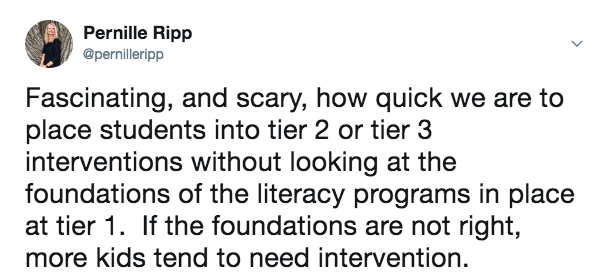
And then we wonder why so many kids end up in tier 2 or tier 3 interventions?

So this year, I will continue to examine my own practices as the teacher of Tier 1.  I will make sure that the instruction I am providing is effective, focused, and research-based.  I will make sure that my foundations are in order and also well-taught so that kids have a chance to grow in our classroom.  I will disseminate my own practice before I look outwards.  And I encourage other teachers, other decisionmakers, other schools to do the same.  If too many kids are in intervention, then foundations are missing in our classrooms.  If too many kids are not making growth, then we look at what is happening with us first.  And we look at it from a systems place.  Are systems in place to support kids on their reading journey?  Are systems in place to helps kids develop their reading identity?  Are systems in place to teach the joy of reading and not just the skills?  Which systems stand in their way of success?  Which systems harm rather than help?

And that’s where we start. Not with pull-out, but with better in class instruction.  Not with intervention, but with reexamination.    With a commitment to the best classroom instruction, we can provide, supported by the administrative decisions that are being made.  Perhaps a lofty dream, but a dream worth pursuing nonetheless.

If you like what you read here, consider reading my newest book, Passionate Readers – The Art of Reaching and Engaging Every Child.  This book focuses on the five keys we can implement into any reading community to strengthen student reading experiences, even within the 45 minute English block.  If you are looking for solutions and ideas for how to re-engage all of your students consider reading my very first book  Passionate Learners – How to Engage and Empower Your Students.      Also, if you are wondering where I will be in the coming year or would like to have me speak, please see this page.


Be the change, being a student, being a teacher, books, Literacy, Reading Identity

On Boy Books and Girl Books

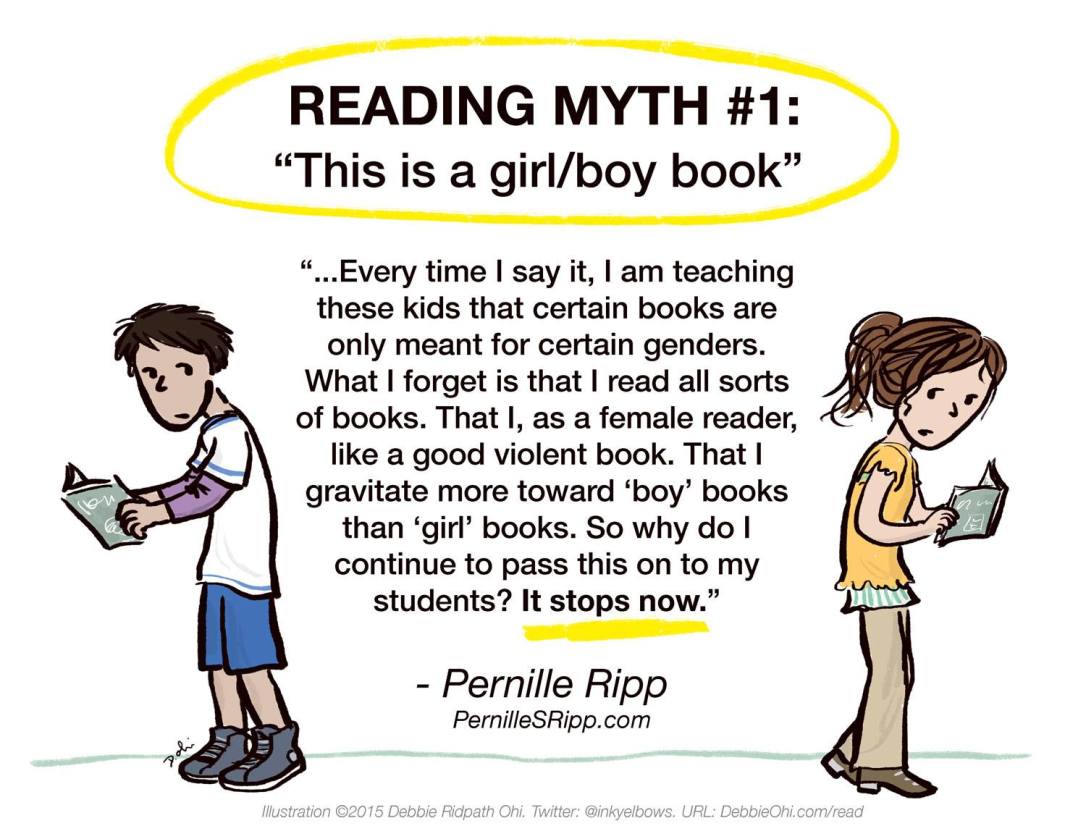
Image result for pernille ripp boy books

I get asked for a lot of book recommendations, I think it comes with the territory when you share the love of books.  And while I love pairing books with potential readers, I have also noticed a pattern that causes me to pause, that should cause all of us to pause.

I get asked for a lot of books featuring male lead characters for male readers.

When I ask why the need for a male lead, I am often told that “they” just don’t think a boy will read a “girl book.”  That a boy will not like a book about feelings.  That a boy only wants books that have action.  That have other boys in it.  That feature characters that look just like them or at the very least think like them.

As if every single boy thinks alike.

When written like this it is easy to see the problem; when we assume that there is such a thing as books for girls and books for boys, we are continuing a tired and sexist narrative that has only furthered the power inequity that already exists within our society.  We are creating a new generation of mansplaining, of groupthink, of toxic masculinity.  Of girls only liking one thing, and boys liking another.  Of men and women being from different planets.  Of readers being shaped more by their assigned gender than their actual interests.

We are furthering the stereotype that boys don’t like to read about girls because they see little value in what girls do.

We are furthering the stereotype that boys don’t like to read about feelings because they are somehow above all of that.

We are furthering the stereotype of what it means to be a boy which translates into what it means to be a man and not seeing the incredible harm in that.

Because what about the boys that love a good tearjerker?  What about the boys that don’t like sports?  What about the boys that love to experience the emotional development of a character?  What about the boys that love a great female lead character?  What about the girls who don’t fit into the opposite boxes?  Do they not deserve to have books suggested to them, no matter the gender of the protagonist?

And I think of my own children, my three girls and one boy, whose reading interests are as varied as their personalities.  Sure there are Minecraft books being read by Oskar, but not until Thea reads them first.  Sure there are unicorn books with pink sparkly covers being read by Augustine but not until Oskar sees if the unicorn gets rescued first.  I would hate for anyone to assume that they knew who they were as readers based only on their gender.

So when we claim that a read-aloud featuring a female protagonist will likely not catch the attention of our boy readers, we have whittled the male reading identity down to practically nothing.  Males – good.  Sports – good.  Action – good. We have diminished what it means to be a reader who develops with the books they read.  We have diminished what it means to identify as male.  We have diminished their chance to learn from a perspective that may at first seem foreign but in the end may just be more similar than they ever thought.  We have effectively boxed our boys in only to then wonder why they may act a certain way.

How often does this thinking then translate into the very books we recommend to the boys we teach?  To the girls?  How often do our assumptions about their needs as a reader surpass what they actually need?  How often does this translate into the read alouds we choose?  The texts we bless by spending our time on them as a community?

And I realize that I don’t get asked the opposite very often.  That often when I am asked for a recommendation for a female reader, the gender of the protagonist is hardly ever brought up.  That instead the most common descriptor is a strong story development, a story that will hold their attention.  Why do our boys not deserve the same?

So I am wondering if we for once and for all, can we all agree that there is no such thing as a girl or a boy book?  That kids need to be exposed to characters that inspire them, no matter their gender.  That kids need to be exposed to characters that will expand their worldviews and invite them into new worlds that they knew little of before, no matter their gender.  That kids need to be exposed to great books, without us adults thinking that they will only read a certain type of book based on what we see in front of us.

We must give them a chance to experience more than what they are.  Books allow us to do just that, but not if they never read them.  Not if we never recommend them.  That’s on us, which means we can change it, so let’s do that starting now.

If you like what you read here, consider reading my newest book, Passionate Readers – The Art of Reaching and Engaging Every Child.  This book focuses on the five keys we can implement into any reading community to strengthen student reading experiences, even within the 45 minute English block.  If you are looking for solutions and ideas for how to re-engage all of your students consider reading my very first book  Passionate Learners – How to Engage and Empower Your Students.      Also, if you are wondering where I will be in the coming year or would like to have me speak, please see this page.

Be the change, being a teacher, books, Literacy, Reading, Reading Identity

On Becoming a Reader

My husband is not a reader.

By far, he is one of the smartest people I know.  He can fix anything broken, he can solve any problem.  He can dream and plan and build pretty much anything.  But reading, in the traditional sense of books, nah… not for him.

When I first met him, I couldn’t figure out how someone as smart as him could not see value in books.  How could you live a full life without books?  And yet, in the 17 years, we have been together, he has shown me how many facets there are to a full life.  But now he has been in school for the past two years, getting his degree as a Tech Ed teacher, and the other day after taking a particularly grueling test, he told me how much he felt like he wasn’t smart enough for the test simply because of his reading pace.  You see, the test was timed, and so when the time was almost up, my husband did what many of our students do all of the time; filled in as many unanswered questions with random guesses as he could.  Better answered then left blank.

He told me how he knew he could have answered them right had he had the time.  He told me how he felt this pressure at all times knowing that he wasn’t going fast enough.  He told me that he tried to skim as quickly as he could but then lost meaning and had to read it all over again.

If he had only been a faster reader, he would have been just fine.

It blows my mind still that we equate reading pace with reading comprehension.  That we allow standardized tests to teach our children that if they cannot read quickly, they cannot read at all.  Which jobs require us to read complicated materials within 90 seconds?  But that’s the reality we face and so at the end of our discussion, I gave him my best advice; read more books.  It is the one guaranteed way to increase your reading speed.  Find books you love.  Take the time to read.  And you will see, your reading pace will increase.

He told me how he just didn’t like books.  How he didn’t mind reading technical stuff (which he devours daily), but that books just had never caught his attention.  That they were too slow, too boring, too confusing.  That reading was never anything fun or entertaining but always presented as an assignment; read this book, do this work. Rinse, repeat.  He sounded exactly like my most resistant readers.  The ones we all teach that tell us loudly and proudly that reading is not their thing and we will certainly not convince them otherwise.

And so I did what I do every single day of the year.  I handed him a book, Orbiting Jupiter, and told him to try it.  To give it a shot and if he didn’t like it, tell me and I would try again.

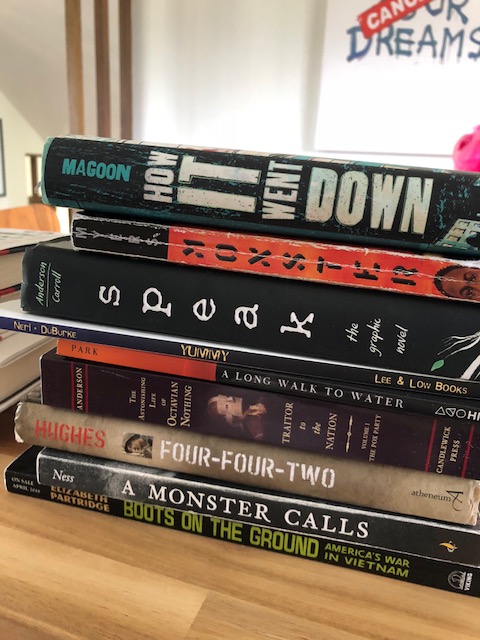
He sat down and read into the night then woke up and finished the book.  He finished the book!  And then he asked me for another.  I handed him How it Went Down.  He started to read.

Today we went to my classroom to grab stuff.  He went to the bookshelves and started to browse.  Grabbed a few books, asked me about others.  Together we book-shopped.  He was open to whatever but had a few ideas, maybe some war history?  Maybe something with a fast pace?  Social justice lens?

IMG_4631.jpg
Brandon’s To Be Read Pile – his first one ever…

I quickly grabbed my tried and true, added them to his pile and realized right in that moment that I was working with him like I would any resistant reader: offer choice, support, time to read, and most importantly communication.  At 41 years old, it seems that my husband is finally going properly through the motions of what it means to know yourself as a reader.  And I couldn’t be prouder.

So often we focus on these aspects of developing reader identify when students are young.  Before they reach middle and high school.  Once they come to us older, perhaps more jaded, more stubborn, we sometimes forget to go back to the basics.  To treat them as we would any developing reader.  To go back to choice, community, access to meaningful books and discovery of who they are as readers.  To find the time to actually help them become the reader they can be.  Too often the content gets in the way.  All of the little things that constitute what teaching sometimes becomes, rather than what it should be.  We assume that someone certainly will figure out how to help this child become a reader without realizing that that someone is us.  That we are the person who needs to somehow reshape the reading experience that they have had until now so that they do not become adults who do not read.

Today, I was reminded of how it is never too late.  How every child that we teach has the potential to see themselves as a reader by the time our year is up.  That even the adults that tell us that they are not readers can still become readers.   But that they need our help, not our judgment, our know-it-betterness, our confusion of how they could live without books.  Instead, they need what every reader needs; choice, books, community, time, personalization, and understanding.

My husband is not a reader, but that doesn’t mean he cannot become one, now.

If you like what you read here, consider reading my newest book, Passionate Readers – The Art of Reaching and Engaging Every Child  Also consider joining our book club study of it, kicking off June 17th.  This book focuses on the five keys we can implement into any reading community to strengthen student reading experiences, even within the 45 minute English block.  If you are looking for solutions and ideas for how to re-engage all of your students consider reading my very first book  Passionate Learners – How to Engage and Empower Your Students.      Also, if you are wondering where I will be in the coming year or would like to have me speak, please see this page.

Be the change, being a teacher

What We Can Give

Today, we gave our 141 students a brand new book.  As a way to entice them away from the dreaded summer slide.  As a way for them to relax. As a way to thank them.  Thank them for all they gave us this year, for all that they brought to us.  While we gave them just a book, there is so much more that we, as educators, can give our students every year.

We can give them our time.  Always when they want it and sometimes when they don’t.

We can give them our respect.  Always when they earn it and even when they don’t.  Apologize when we need to and set high expectations for all.

We can give them our trust.  Always when they prove it and sometimes when they don’t.

We can them give room to grow, to try, to not succeed at first and to stretch themselves into the bigger version that they hoped to be.  Give them space to be challenged, let them in on the process, and then listen to them as they give us their feedback so that we can grow right alongside them.

We can give them our love.  Even those who swear that they will never want to willfully be a part of our classroom, sometimes, we love them just a little bit more loudly.

And we can give them all the benefit of our doubt.  A clean slate for the next class, for the next day, and for the new year.  Sure, give us tips about the incoming students, but don’t tell us what they can’t do.  Tell us what they can.  Tell us how they have grown, their strength and what they are still working on.  Don’t tell us, “Good luck…” or “Good riddance…”

We can give them our very best, even when it is hard, even when they are hard.  Becuase didn’t we all become teachers to do just that?  Be better than what we were before?  What better way to prove it than to grow.

If you like what you read here, consider reading my newest book, Passionate Readers – The Art of Reaching and Engaging Every Child  Also consider joining our book club study of it, kicking off June 17th.  This book focuses on the five keys we can implement into any reading community to strengthen student reading experiences, even within the 45 minute English block.  If you are looking for solutions and ideas for how to re-engage all of your students consider reading my very first book  Passionate Learners – How to Engage and Empower Your Students.      Also, if you are wondering where I will be in the coming year or would like to have me speak, please see this page.


Be the change, being a teacher, being me

Lessons From Ten Years of Trying….

first year.jpg
The night before my very first day as a teacher.  This is what terrified looks like.

Ten years ago, I said thank you to my very first class of 4th graders.  Thank you for their dedication.  Thank you for their persistence.  Thank you for their love.  I know I cried as I hugged each and every one of them, thanking them for our year.

Today, I will hug as many 7th graders as I can.  I will thank them for a year filled with laughs.  With challenges.  With growth.  With love.  Teaching is by far the best thing I can do with my professional time.  When I look back on ten years of teaching, I cannot help but think of all the things I have learned.  Of how I have grown.  Of how I am still growing.  There is so much to learn, still.

But ten years has also taught me a lot about what it means to be a teacher.  What it means to get up every morning and do this job.  Not just because you have to, but because you can.  And as always, the kids I have had the privilege of teaching are the ones who have taught me the biggest lessons.  The ones who have made me who I am today.  They taught me…

That’s it’s not about me.  That the needs of the students should always be my focus.  That when I am wondering what I need to change, they are where I start.  That my assumptions, while sometimes on point, will never be as accurate as what they will actually tell me.  That their advice, if we only take it, will transform our teaching for the better.

…but sometimes it is.  Sometimes I am the problem.  Sometimes I am the reason a child hates school.  Sometimes my decisions, even if made with the best of intentions, will harm rather than build.  It is my job to make sure that I know that.  That I realize the immense power that we have over the future of the very children we teach.  That I ask the hard questions in order for me to grow and to create an experience that works for every child as much as humanly possible.

They have taught me…

That a smile will always go further than a well-developed lesson plan.  That my attitude when it comes to the very kids I get to teach is a choice.  That saying hello, that smiling, that telling them how much I love this job, how much I love them, will make a difference.  Even to those who push the hardest.

….but sometimes a well-developed lesson plan can move mountains.  When students plan lessons with us, offer up their ideas, and invest their energy, we are already further than we could be without them.  That lessons need choice, relevance, and challenge.  That every child deserves to be held to high expectations, and every child needs a second chance when something doesn’t work.

That those who push you the hardest, leave the biggest marks.  That often those kids who see no value in school, no value in you, are the ones you will fight the hardest for.  That it is not your job to save them from their lives, themselves, or their circumstances, but that you are there to love, to offer up ways to navigate their lives, and to remind them that they have worth.  That in this world, they matter.

…but sometimes they don’t want you to be in their corner.  And that’s ok, too.  We can try to connect with every child we teach, knowing that for some we may be exactly the type of teacher they do not want.  The biggest gift we then can offer up is, besides not giving up, to help them forger connections with others.  To help them have someone they connect with, so they know that they are not alone.

They have taught me…

That I don’t know it all.  Especially the more I teach, I realize how little I know.  Ten years ago I didn’t think about my privilege.  I didn’t think about how marginalization hurt the very kids I taught.  How inequitable our school system is.  How white skewed my classroom library was.  How I didn’t know everything.  But I grew, and I will continue to grow.  I will continue to admit when I screw up, and it happens a lot, and I will continue to apologize, to use the power I have been given to fight for others and with others.

…but I do know some things.  I know that love matters.  That research matters.  That conviction matters.  That sometimes being the sole voice for change is scary, but necessary.  That we grow best through kindness, but sometimes kindness will not tear down walls.  That what we believe in directly influences how we teach, but that our bigger job is not to give students our opinion, but instead make space for them to develop their own.  That every day I get to work with kids is a better day.  That there is hope.  That this new generation of kids we are raising are changing the world.  That I would rather be a part of the fight, then safe on the sidelines.

I became a teacher because I hoped to make a difference.  I hoped to create a classroom where every child felt safe, where every child felt loved.  I don’t know if I have succeeded, but I do know that teaching has changed me.  That I would not be the person I am without the influence of the many incredible children I have taught and who have taught me.

I came into this profession to make a difference but in the end, it was the kids that made the biggest difference to me.

If you like what you read here, consider reading my newest book, Passionate Readers – The Art of Reaching and Engaging Every Child  Also consider joining our book club study of it, kicking off June 17th.  This book focuses on the five keys we can implement into any reading community to strengthen student reading experiences, even within the 45 minute English block.  If you are looking for solutions and ideas for how to re-engage all of your students consider reading my very first book  Passionate Learners – How to Engage and Empower Your Students.      Also, if you are wondering where I will be in the coming year or would like to have me speak, please see this page.