Be the change, being a teacher, Literacy, Reading, Reading Identity

What Does Student Independent Reading Look Like? A Whole District Audit

  Instagram · Square,

For a long time, I felt like an oddity within my reading beliefs: provide students with independent reading time every single day, provide a fully-stocked culturally relevant collection of books, remove all of the reading projects that stood in the way of reading joy, focus on reading identity at all turns. But then I discovered others who shared those same beliefs, who had held those beliefs long before I had reached them, who had pioneered the work spreading the word around the globe. The relief and power that finding others provided is one that cannot be underestimated. The strength that comes with working for a district that shares these beliefs is a blessing.

And yet, I know there are many others that have felt and do feel like the oddities in their school. Who constantly have to defend why self-selected independent reading is a cornerstone of their work. Who have to explain why they continue to spend their own money, ask for money, write grants and do anything they can to purchase more books. Who spend so much time trying to keep up with new books, who weed and discard books that do not have a place in their collection. Who feel alone but might not be.

An incredible honor for me is when I am asked to work with a district or school who is on a journey of trying to reach their readers in a more significant way. Who knows they have work to do and who are ready to take the next step. Who are not afraid to reflect and change even when change is hard. When I am asked to do this work, I always have many questions; what does reading look like now? Which experiences are each reader guaranteed as they go through their journey? What are the rights of your readers when it comes to book choice, independent reading, and reading identity? These questions lead to many discussions, many aha moments, and provide a road map for change. Much like we need to give students the space to create their rights a readers within our community, we need to also create our expectations and rights as a district. What are the experiences that each reader is guaranteed at each level of their schooling beyond the curriculum we use? How can we then make curricular and business (because let’s face it part of schools’ direction is determined by the business aspect) decisions that protect and further these rights? How can we offer training and funding to support these rights? Hw can we invite the community into this conversation? How can we embrace antiracist principles and establish an emphasis on the individual’s rights and needs?

In the spirit of this pursuit, I offer up several questions that should be asked at a district level or at the very least, school level, in order for student reading rights to be protected. After all, if our goal is for students to leave our care not only being able to read well but also find an inherent human value within reading then we need to create experiences that safeguard that.

So please start asking…

How much time is each child guaranteed for self-selected independent reading time each day?

Too often we see independent reading get cut due to fewer instructional minutes, particularly as students get older and we bring in more whole class novels or book clubs. We also see it limited for students who are in intervention or have other needs. Yet, if students are not offered up time to independently ready every single day, how can we then support them in their reading?

What are students “allowed” to read?

While the answer should be “anything they want” this is often not the case as choice is often limited due to well-meaning intentions. Students who read below grade level are often given the least amount of choices, in order to help them have more successful reading experiences, yet within the helpful intent of that we can end up doing real damage. Can you imagine always being told what to read and never being able to work through a book of your choosing? What we should be focusing our energy on is how to help students navigate the choices they make as well as develop better book selection habits.

Where and how can students access books?

A well-developed school library with a librarian should be a right for every child, as should a well-stocked culturally relevant classroom collection curated by a teacher who reads. We need books to entice every reader at all turns, so asking this question can open up discussions of inequitable access, culturally insensitive books, gaps in collections, as well as the need for teachers who teach reading to be readers themselves. How is funding appropriated for books? How are collections developed? How are books placed in the hands of kids?

What are students expected to do once they finish a book?

So often, and in my own experiences, we have a lot of work lined up for kids once they finish a book all in the name of accountability. Whether it be forced book talks, book reports, summaries or readers’ responses, reading logs or other tools that involve counting minutes and needing signatures, or having to take a quiz on a computer, we are so busy policing the experience of reading that we forget to look at what we, as adults, want to do when we read a book. These accountability practices can do a lot of damage, particularly if students are exposed and expected to do them year after year. By asking this question, we can start to look at long-term experiences and how that may be impacting reading identity throughout our years together.

What does reading “homework” look like?

While currently in my own classroom, students are expected to try to read at least 2 hours outside of English class every week, this is not how it used to be. I had packets and worksheets lined up for their reading, as well as small summaries, and book talks with friendly adults who had not read the book. This question goes hand in hand with the previous one as it looks at the components we attach to reading, as well as potential inequities within our practices. What are we tying in with the homework being completed or not? Not all kids are in a position to read outside of school, not all kids have access to what they need or are in a place in their journey where they see enough value to dedicate outside class time to reading.

Who are kids expected to read?

While this is a question that speaks to a much larger issue surrounding the canon and who we, as educators, constantly expose students to as literary masterminds, it is also important that we locally audit across grade levels to see who is being shared and more importantly who isn’t. Often we base our read alouds, book clubs, and text selections on our own favorites with little thought to what has come before and what will come after for our students, but since publishing skews heavily white, cisgendered, and heteronormative, this tends to become the reading experience for many students as well, particularly those within white majority districts or taught by mostly white educators. Diving into this questions can and should fundamentally change the canon we present to students year after year.

While there are many other questions to ask, the few shared here will offer up a path way to further investigation into the reading practices embedded within a district. It is definitely a conversation that is needed and should be pursued on an ongoing basis. After all, if we don’t ask the questions and reflect on the journey we place students on, how will we ever change?

If you are wondering where I will be in the coming year or would like to have me speak, please see this page. If you like what you read here, consider reading my latest book, Passionate Readers – The Art of Reaching and Engaging Every Child.  This book focuses on the five keys we can implement into any reading community to strengthen student reading experiences, even within the 45 minute English block.  If you are looking for solutions and ideas for how to re-engage all of your students consider reading my very first book  Passionate Learners – How to Engage and Empower Your Students

authentic learning, being a student, being a teacher, being me, Personalized Learning

Re-thinking Our Learning to Infuse More Joy and Choice

One of many things I love when on break is the chance to simply reconnect with amazing people, and when said amazing people are fellow educators, you can bet that it doesn’t take long for the conversation to turn to how to make the educational experience better for all kids.

After dinner, I was left thinking about how often we get so caught up in all that we need to do that so many of those grand ideas, the ideals we dreamt up this summer or whenever we have room to be inspired seem to be forgotten as the year starts and the pressure resumes. That while we implement many things, tweak many others, there are many notions and ideas that simply don’t happen. And who can blame us? There are so many days that I am just keeping my head afloat trying to stay a few steps ahead of the students in order to create and sustain relevant educational experiences.

Last night, the conversation turned to joy and play. How little there seems to be purposefully implemented throughout especially older students’ daily routines in school. How the minute they come to us in the upper years there are few opportunities for infusing joy and allowing more creative approaches to learning. And while both of those concepts are foundations of learning I hold dear, I also look back at my own curricular choices for the year and see how easily those two tenets of learning get siphoned away as I feel the need to do more, dig deeper, and make sure that the learning is “serious.” However, the siphoning itself relies on a untruth – joy and creative choice does not equate easier learning and is serious business, in fact, often purposefully creating moments for joy and creative choice requires a broader commitment and self-reliance within the learning happening. So with this in mind, I have done some restructuring of a few upcoming units and also rededicated efforts in other places, so what might that look like coming up in room 203?

The main questions I focused on in my reflection is: how might this spark joy and engagement and how do students have creative choice?

Re-committing to picture books. I usually read a lot of picture books aloud to my 7th graders and also use them in a variety of ways throughout our curriculum and yet, this year, I feel like with the busyness of it all, picture books have been less of a central tenet to us. It’s time to change that. In a little more than a week we kick off our Mock Caldecott unit for the year, a two week investigation into twelve incredible picture books for the year that will lead into a persuasive speech in which students will try to sway others to their choice of winner of the Caldecott. Reading picture books together is something that we already see as joyful and doing it in small groups will hopefully bolster that. Creative choice comes in how students want to persuade their peers – how will they deliver a message that is persuasive in nature and which tools will they use?

Bringing back our immersion project. Two years ago, I did an extended genius hour project in which students got to pick something to learn for themselves in order to teach others about it through a mini-lesson. This consisted of identifying an area to immerse themselves in and then spending time figuring out how to create an enticing lesson for others to learn from them. The topics were broad: How to do a card trick properly, what integration methods are necessary to integrate any function and how are they used, how do you play guitar and so on? These were all catered to student interests and were very broad on purpose. We then infused note-taking skills, how to find sources to teach them how to do the skills, and how to engage an audience in order to help them understand a concept, as well as created a speech rubric in order to practice public speaking. This year, I will finetune it with a few more scaffolds for those who are not sure what they would like to teach, as well as opportunities to tandem-research. This project sparked a lot of joy the first time we did it because students got to self-select their learning, immerse themselves into something they found relevant, as well as show off their knowledge in a fun way. There was a lot of natural choice embedded throughout.

Re-thinking our TED talk unit. Every year, the students get an opportunity to create a TED talk on a chosen topic and then give it to the class, and while the unit itself is solid, I want to spend more time helping students choose topics that they are invested in already. This year many of our students have expressed a deep interest and commitment to social justice work, as well as the overlooked history we have explored. This will, therefore, be my starting point in reminding students of what they already know and which questions they may have to push their thinking further. So often we push students into new learning without realizing how much work it is to research and then synthesize and process all of the information into a brilliant short speech. With the re-introduction of our immersion project, I want to implement more time for students to dive into their identity and what they are already interested in so that their TED talk work can be more focused on filling in knowledge gaps, rather than starting all over with research. This will also be an opportunity to jump into persuasion, how advertisement plays on our biases, and how we are influenced by social media. Choice plays into topic, as well as the angle they want to take in their talk.

Asking for more student input and taking the proper time for it. In the Enriched English class I teach, we have 6 vocabulary lessons consisting of 25 vocabulary words each that we need to somehow process, understand, and implement into our vocabulary. While I have gamified it in the past and also allowed for choice in how students show mastery, I have never really loved what we did. The words seem like a chore no matter how I spin it This year, I plan on showing students the vocabulary and then having them come up with opportunities for how we can learn it together. While there will undoubtedly be traditional methods for students to choose from such as rote memorization with a quiz, I also want to give them the opportunity to come up with other methods for learning that they will be able to choose from as we move into the vocabulary. While I already try to get as much student input as possible, I feel it often gets rushed, so this is a reminder for me to slow down and let it take the time it takes, and this goes for all classes, not just the Enriched English class.

Re-committing to free writing. We have been dabbling with free-writing throughout the year but due to book clubs in December, we changed our process. While students continued to write on their own, the community piece was lacking and so as we enter into January, I want to bring back the prompts and self-selected choice and the time to then share the creations we have. I also want to bring back the notion of playing with writing that so often gets lost as we write. Students so often fear that they have to write great pieces every single time which is an incredibly damaging notion for anyone trying to work through the emotions of writing and so I want to model my own not-so-great writing that tends to happen when we do a free-write. Students don’t need perfect role models, they need real ones.

Skyping with authors. Talking with actual authors is magical at any age and the advent of World Read Aloud Day reminded me to sign up to bring authors into our classrooms more. This is something I used to do a lot but once again seem to have gotten away from. I cannot wait for students to hear from Kevin Sylvester, Juana Martinez-Neal and Ishta Mercurio as they discuss their writing process.

Participating in Global School Play Day again. I love this initiative created by Scott and Tim Bedley with the idea to infuse more play into schools again. I have done this day before with 7th graders and while I am not able to do it the day it is scheduled for this year, I will do it instead on February 7th where students will get all of English to simply play with each other. You should sign up as well.

While this is not an exhaustive list, I am glad to be bringing this lens back to our work together this year to hopefully create experiences where it is not just students learning from me, but more from each other. Where there is more cooperative problem solving, more relevance, and more choice. Where maybe, just maybe, students can think of English class as a class that is meaningful to them beyond developing a love of reading and writing and helping them find themselves. Who knows, but I will keep trying.

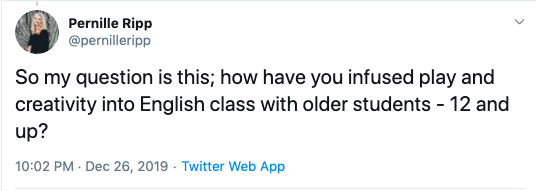
I posted the following question on Twitter last night and the responses are definitely worth checking out – so many great ideas for infusing more play and creativity into our work.

And now I ask you as well; how will you restructure or continue to reinforce the notion of play and creative choice in your class these upcoming months?

If you are wondering where I will be in the coming year or would like to have me speak, please see this page.. If you like what you read here, consider reading my latest book, Passionate Readers – The Art of Reaching and Engaging Every Child.  This book focuses on the five keys we can implement into any reading community to strengthen student reading experiences, even within the 45 minute English block.  If you are looking for solutions and ideas for how to re-engage all of your students consider reading my very first book  Passionate Learners – How to Engage and Empower Your Students

being a teacher

I Forgive

A personal post as the break offers time to ruminate on the ways I live my lives. Moving these thoughts out into the universe so that I can return to regular thoughts on this blog.

I never assumed perfection and yet in looking back I see the strive for it every day. How hard I have fallen on myself whenever I have made a mistake. How I have carried these burdens with me as if they were a weight to carry. Held them up at every opportunity where happiness clouded my vision and I felt so undeserving.

I have done my best and yet I know how often I have screwed up, how I have said it the wrong way, how I have offended, not done enough, not been enough. I can look back at my path and see it through the lens of failure, revisit every pot hole, every blockade. Can’t we all? Those words that cut and thrown my way have become my skin for so many years that there is little left over.

And I have allowed myself to continue on a path of accumulating disasters. Of accumulating failure. Of seeing myself through a lens of never enough, of not good enough, of not deserving the happiness that surrounds others. Of holding my breath because sure, soon, so soon, the happiness I do have will be taken away. Reallocated to someone who should have had it in the first place. The feeling of fradulence seeping through my pores.

How dare I take up space?

How dare I raise my voice?

How dare I ask more questions?

How dare I think that I am okay?

But these words have become too heavy to carry, the mirror become too big and I hear ir reflected in the voices of my students whose pasts haunt chase them into our classroom. Who tell me that for them there is no future, that what lies ahead has already been determined. That despite the proof in front of them, they will never be smart, they will never be good, they will never be anything because failure is what is familiar. Failure and fear are their constants.

And I see the harm. And I get exasperated. And I speak louder and more insistently trying to help them rewrite their narrative because they are so much more than that. And yet they smile, shrug, and repeat once again, “I am nothing…” but we tell them, “you are so much more than that…”

I am so much more than that.

So for this Christmas I forgive myself. Not because I am perfect but because this is not the way to live. This is not the way to learn.

I forgive myself for the past mistakes I have carried with me for so long. Forgive, but not forget, the ways I have needed to grow so that I can be better.

I will unwrap the moments that shaped me and redistribute their weight.

I will be grateful for the long path I still have to walk and make room for all of the moments still coming my way.

I will reclaim my space so that my kids can see what it means to be strong, and sure, and also human.

And I will be okay. Not because I finally deserve it but because I have been okay all along, just not able to see it.

These words will be empty until I live them, but they are being put out in the universe in case others need to hear them too.

Forgive.

Redistribute.

Embrace.

Breathe.

Live.

Repeat.

being a student, being a teacher, Reading, student choice, student driven

Stepping Into Inquiry – How to Use Google Search Better and Whose Voices are Missing?

Note: This is a continuation of the blog series I am doing detailing the work I am doing with students in an inquiry project into how to research better. The first post detailing the set-up and our first module, How to Write an Inquiry Question, can be found here.

Module 3 was a big one for us, spread over two days, not so much for the tips on how to use Google Search better although they were helpful, but more because we wanted our students to think about the types of sources they were finding, as well as whose voice was missing from their sources, so they could consider the impact of those missing voices.

This question; whose voices are missing, is a question we center our work around all year. Throughout the year, I have been actively trying to expand students’ historical knowledge of the world using an “overlooked history” segment every Friday for discussion and reflection, as well as spending a lot of time selecting the media that our students will be immersed in, in order for them to experience as many voices as we can. So we knew that searching for reliable sources to use would be a brilliant opportunity to put this more into their hands as our students don’t automatically consider whose voices they are using an dhow that will impact the knowledge they gain and the direction they take.

There are so many tips for how to use Google Search better, many can be Googled, so we wanted to introduce just a few that would potentially limit their results and bring them more specific results. We watched a video together that discussed some of the limiters, I didn’t love it and will probably search for a better video for next year. The students continued to practice their note-taking skills along with the video and then I walked them through a search so they could see how my results changed.

The limiters we decided to focus on were:

  • Using quotation marks for an exact phrase
  • Using boolean operators.
  • Eliminating unnecessary words.
  • Excluding words.
  • Including year range.
  • and using specific sites to limit their search – this one we just showed but didn’t expect them to use.

Teaching slides day 1

Then they started their work in their student slides (note, there are duplicate slides in here because I was out with sick kids and so they worked through slides I would have taught otherwise). We wanted them to specifically consider:

  • What they actually were searching for, so to clarify their inquiry question.
  • Which types of sources they would search for, we reminded them that video, infographics, and podcasts can also make for excellent resources.
  • We discussed the difference between primary and secondary sources in order for them to think of whose voices they should be listening to.
  • Then led a specific conversation about whose voices they would search for urging them to think of how someone’s perspective is going to change based on many factors such as their economic situation.

Once they had found the sources they wanted to use, they needed to consider whose voices were being represented so they could think of whose voices were missing. You could see a lot of aha moments here as students considered their sources and how they were incomplete. Then they had to consider whose voices they needed to add as well as the the impact those missing voices would have on their research. Honestly, this is the largest point I wanted students to walk away; getting to think about whose voice holds power and who is not represented. My teaching slides for day two had introduced this concept more fully and many students were spot on in theirintial analysis of whose voices were missing and why they needed to find better sources.

For my 2nd day of teaching, I had specific discussion points about changing perspective and why it is so vital we recognize our limitations of what we know and then try to learn more. This was a great discussion supported by the teaching slides and set them up for further work within their own slides.

Day 2 Teaching Slides

Reflection Back

I am still pondering what I need to change as there were many things I liked and some I didn’t. Like I said, I need to find a better video for them to take notes on. We also had our small groups work together on one inquiry question and find sources together for that question, but I don’t love how that limits their choice when it comes to what they are pursuing. Some of the limiters were not particularly helpful and actually increased their results rather than decreased them. But the conversation about perspective, missing voices, and the impact it will have on our knowledge were powerful and will be continued throughout the year because the few days of work we did around it here is simply not enough. It was a taste and something I am still actively working through as an adult.

The one area I want to work on through discussion is why we should be worried about whose voices are given authority and how power is given to certain voices and not others. While I touched on it, it was not enough (I am not sure what “enough” would look like), so I am mulling over how this can be added further.

Note: The unit after this was a lesson on how to use databases led by our librarian so I will not be sharing those slides as they are not mine to share.

After that came another big one: How to check reliability using the CRAAP method.

If you are wondering where I will be in the coming year or would like to have me speak, please see this page.. If you like what you read here, consider reading my latest book, Passionate Readers – The Art of Reaching and Engaging Every Child.  This book focuses on the five keys we can implement into any reading community to strengthen student reading experiences, even within the 45 minute English block.  If you are looking for solutions and ideas for how to re-engage all of your students consider reading my very first book  Passionate Learners – How to Engage and Empower Your Students

being a student, being a teacher, questions, Reading, student choice, student driven, Student Engagement

Stepping Into Inquiry – How to Write an Inquiry Question

Last year, after we finished our first read aloud, we released our kids into their first inquiry project. While we had scaffolds in place, there was plenty of choice, and also specific lessons targeting research skills, my special ed teacher, Kelly, and I still stood back and felt like what we were doing was simply not enough. Or perhaps that it was too much. That somehow we were simply pushing kids through research and yet there were so many executive functioning skills and also simple research skills that we were assuming kids already had a handle of. And yet, they didn’t not all of the kids, despite the wonderful teaching that had happened before 7th grade. We saw it fall apart a bit when kids were really worried about the end product but not focused on what they were learning throughout the unit and they weren’t fully grasping the research skill lessons we were teaching because there was this larger pressure to produce a speech answering their inquiry question.

So this year, we knew we had to do something different. Rather than have students do a full inquiry project into a topic tied in with The Bridge Home, our read aloud, we wanted to create an inquiry project into the art of research itself, not worrying about a final product but instead walk students through specific research skills in separate modules. Sounds great, right? Yet what we quickly were reminded of was that the art of research itself is vast, which we knew, so we had decisions to make; which 7 or 8 research skills did we really want to focus on as a baseline for the kids as we introduced 7th grade inquiry skills.

Knowing that this was a great chance to cross-collaborate between other subject areas , we did just that; surveyed other teachers to see what they thought was important to establish a baseline in, as well as brought it up as a problem of practice in our consultancies with colleagues. The results were clear, we would love 7th graders to be able to have an initial understanding of:

  • How to write an inquiry question
  • How to take notes using the Cornell Method of notetaking
  • How to cite their sources using Easybib – MLA
  • How to avoid plagiarism and understanding what plagiarism was
  • How to use Google Search better
  • How to use our databases
  • How to potentially revise their inquiry question
  • How to use the C.R.A.A.P method to check for reliability
  • How to check for bias in their sources
  • How to find the main idea and supporting details
  • How to synthesize their information into original thought – a primer
  • How to evaluate whose voices are missing and how do those missing voices impact the validity of the research

But that’s a lot so how do we do all that without losing kids in the process? Enter in discussion with my new wonderful colleague, Chris, my fabulous literacy coach, Andrea, and also our incredible librarian, Christine. With the help of them I was able to synthesize some of the thoughts we had about what kids would be able to do as, well as look at which standards this would even cover because we would also need to find a way to assess what kids were doing. After looking at all 9 standards for the year, we pulled the following standards out:

  • Standard 2:  Draw and cite evidence from texts to support written analysis.
  • Standard 3: Write informative/explanatory texts to examine a topic and convey ideas, concepts, and information through the selection, organization, and analysis of relevant content.
  • Standard 5: Evaluate claims in a text; assess and express the soundness and relevance of reasoning.

Knowing this led us to creating 8 different modules for students to work on throughout the month of November. We knew we wanted choice throughout and also for students to feel supported and not feel ashamed if they wanted to work in a small group with the teacher and instead embrace the knowledge that they knew what they needed at that time to be successful.

So the final modules with their standards assessed became:

  • Module 1: How to formulate an inquiry question – Standard 3 
  • Module 2: What is Plagiarism and How to Do Citations – Standard 3 
  • Module 3: How to use Google Search better – Standard 3 and 2
  • Module 4: How to use our databases (taught by our librarian) – Standard 2 and 3
  • Module 5: How to assess the credibility of a source – CRAAP method ALSO Do you need to revise your inquiry question  Reg – Standard 5, Enriched Standard 2
  • Module 6: How to recognize bias – Standard 2 and 5 
  • Module 7: How to pull out a main idea and supporting details that tie in with your inquiry question – Standard 3
  • Module 8: How to synthesize information without plagiarizing – Standard 3

We launched the inquiry unit while still immersed in our read aloud, The Bridge Home by Padma Venkatraman. While we did a lot of reading work, we also kept an I wonder page that we would visit now and again. We wrote down large questions we had about society as it tied in with the story we were listening to and moved away from predictions.

Sample wonderings included:

  • What do parents do when their children run away?
  • How does being homeless affect your mental health?
  • Who started the idea of landfills?
  • How can we reduce our waste as a family?
  • Which types of diseases affects children living on the streets of India?

Then it was time to launch our very first unit and what better way than to use a picture book?

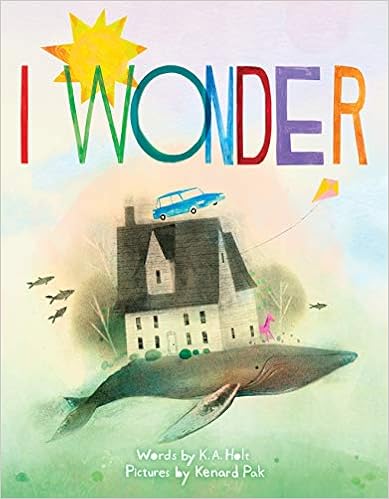
Bringing us together with our readers’ notebooks we laughed at the whimsy within the pages and then I asked; what do you wonder about within the pages of our read aloud? As students shared, I encouraged others to write down the questions they also had as potential inquiry questions. I love when students nodded and agreed that they had questions about something similar. This also afforded me an opportunity to reiterate that their inquiry question should somehow be connected to the read aloud but should not be answered by the book, but that they instead needed to do research in order to come up with their own answer. We also stressed the importance of this being of interest to them, and while we had potential inquiry questions ready for those who refused or found it hard, we have found we haven’t needed them. This discussion then planted the seed for how to come up with a proper inquiry question.

Our next component of the day was taking notes on a video using a modified version of the Cornell notetaking method. We wanted to introduce kids to a way of taking notes that they can easily use in other classes and also encourage them to make them their own. Rather than do a stand alone lesson, my colleague, Chris, suggested having students take notes throughout as an integrated part of the units which is what we did. This has worked really well and much better than if I had done a separate unit on just note-taking. I explained how to set up their notebook and we watched the first video, How to Develop an Inquiry Question, uploaded to Youtube by Kansas State Libraries. The video was a good introduction to why developing a strong inquiry question was important before kids went any further with their work. We took some notes throughout as I paused the video and then introduced the final component; the reflection questions.

One of the things we discussed in our planning was that a major reason for this unit was for students to understand the transfer of these skills to other subject areas, and also to life outside of school. However, this doesn’t always happen without the proper time and reflection. Therefore, our students have four questions to answer every time they finish a module. They are collected in a packet that I hold on to for ease:

  • What do you think you will remember learning from this module?
  • How is this skill useful to you in life?
  • How is this skill you useful to you in school?
  • How could you use what you have learned in this module in geography/STEAM/or science when you have to do a research project?

After this, we released students into their student module 1 – note this was over the course of two days with 90 minute blocks of English and each student was given a copy of the slides to fill in. The student module 1 allowed them to watch another video that discussed the levels of inquiry questions, look at examples of inquiry questions, and then write different levels of inquiry questions. At the end, I asked them to please come up with a potential level 3 inquiry question that they would be interested in pursuing the next few weeks and then submit it to me. And then I held my breath, how would it go?

Reflection back:

After my first ELA block, I tweaked the student slides to make them easier for them to use and took out some unnecessary steps. There was general confusion between level 2 and 3, which I had suspected would happen and so we discussed as needed and I stressed that as long as they were out of “level 1” territory then I was happy. Some kids created much too broad or much too narrow questions and so I left them feedback or had conversations as needed, however, this is also something that will be assessed more in module 5.

One major thing we are still working on is overall time management, some kids are using all of their time well and thus working through everything with time to spare while others are not. Starting tomorrow, I will be asking students to join me in the small group to do the slides together in order for them to stay on track and not fall further behind.

I also tweaked my teaching slides, in order to get to their work time faster and not have so much talking from me.

Teaching Slides Day 1

Teaching Slides Day 2

The next module is Module 2 – What is Plagiarism and How to Do Citations – a one day module, hopefully.

I will continue to share as I work through all of this, the sharing helps me reflect on what I am missing and at times others share great resources as well, so feel free to ask questions or share resources.

If you are wondering where I will be in the coming year or would like to have me speak, please see this page.. If you like what you read here, consider reading my latest book, Passionate Readers – The Art of Reaching and Engaging Every Child.  This book focuses on the five keys we can implement into any reading community to strengthen student reading experiences, even within the 45 minute English block.  If you are looking for solutions and ideas for how to re-engage all of your students consider reading my very first book  Passionate Learners – How to Engage and Empower Your Students

being a teacher, Reading

Our Mock Caldecott Picks for 2020

Warning: I may change my mind…

For the past 5 years, I have done a Mock Caldecott unit with students as we come back to school in January. And while January is far away, the year is quietly winding down which means the reflection begins on which illustrations took my breath away. And there were many. Last year, I ballooned my choices but it turned out to be too hard to get through for my students. So this year there are a few changes.

One, I am reading all of these books aloud in the weeks leading up to our unit. While the students will still read them in their group, they will have experienced the full text with us all first.

Two, I am limiting our choices to 12. That way we can leasurely work through the unit, savor the illustrations, and give it the time it needs rather than skim through pages in order to come up with a winner.

Three, each group will pick their winner. Every year we have had a vote for class pick, but this year, I will let our groups select and root for their individual winners. We will, however, vote for an overall winner in all of my English classes combined.

The lessons will not change much; I use previous winners to discuss the different components of the award and then students grab the books they will discuss that day and rank. Each group gets a packet with the titles and a voting sheet. The slides I use are here and are pretty straight forward. The voting packet I use is here each group gets one and it helps them keep track of their scores.

So which books have I chosen for the year? (Not that I matters because we almost never pick the winner, ha)

Two potentials that I may add but I haven’t quite decided yet because then I am over 12 and I don’t want to be over 12 hmmm

What are your Mock Caldecott choices?

If you are wondering where I will be in the coming year or would like to have me speak, please see this page.. If you like what you read here, consider reading my latest book, Passionate Readers – The Art of Reaching and Engaging Every Child.  This book focuses on the five keys we can implement into any reading community to strengthen student reading experiences, even within the 45 minute English block.  If you are looking for solutions and ideas for how to re-engage all of your students consider reading my very first book  Passionate Learners – How to Engage and Empower Your Students