being a teacher, books, Literacy, picture books, Reading, Reading Identity

It Was Never for the Adults

http-www-pixteller-com-pdata-t-l-540912

On the very first day of book shopping this year, with the piles of brand new books waiting on the tables.  Sharpened pencils ready, to-be-read lists in hand.  Time set aside to meander.  Books displayed and discussed.  On the very first day of book shopping, two kids refused to even look.  One sat in a corner, hood up, eyes down.  Another child, more than an hour later, but this time at a table, arms crossed, no to-be-read list, no pencil, not even a word.

I approached both with caution, sometimes children who so actively refuse to even pick a book remind me of a wounded animal.  They are someone who clearly has not had a good experience with books.  Someone who must be treated with the gentlest of hands, because otherwise, it will just become another power struggle and one that I will never win.

As always, I asked quietly; What is wrong?  How may I help?  Then wait, hold my breath, and soon the refusal.  Soon the dismissal, “Leave me alone, I don’t like books, I don’t like reading.”  Whatever the words, the stories always so familiar.  The emotions raw, the conversation careful, and yet unexpected.  It happens every year.  So after a few gentle moments, I pull out my secret weapons; my graphic novels and my picture books.  I grab a pile of those perpetual favorites or some brand new ones, I place them in front of the child and I walk away.

It happens without fail, a few moments later, a page being turned, a book being read, the angry stance in the shoulders gradually fading away.  Books change minds.  The right books change lives.

Yet if I were to take the advice of some.  If I were to listen to the words of those who say they know better.  If I were to be a “real” teacher of English, those books would not have a place in my classroom.  No more Captain Underpants, Where Is My Hat, or Diary of a Wimpy Kid.  No more Tales from the Crypt, the graphic novelization.  No more rows of picture books waiting to be read and shared.  Those books that many of my students think they are too old to read.  Those books that some might think are not appropriate for a student to read.  Those books that some deem too easy, not enough, not real reading.  Those become the books that capture my hardest students.  Those become the portal that lead them back into believing that they too can be readers.  That reading can be for them.  That reading is something that matters.

So when I see a call for censorship, for teachers telling students what they exactly need to read.  When I see a call for parents to study our classroom libraries to make sure that the books we have are not inappropriate, too emotional, or lord forbid too fun.  When we are once again told that something that is too easy for our kids, not challenging enough, not enough of whatever the right thing is.  That is when I am reminded of who I serve.  That is when I am reminded of who my library is for.  Because it was never for the adults of those children I teach.  It was always for the kids.  And those kids need all of the great books we can hand them.

I am currently working on a new literacy book.  While the task is daunting and intimidating, it is incredible to once again get to share the phenomenal words of my students as they push me to be a better teacher.  The book, which I am still writing, is tentatively Passionate Readers and will be published in the summer of 2017 by Routledge.  So until then if you like what you read here, consider reading my book Passionate Learners – How to Engage and Empower Your Students.  Also, if you are wondering where I will be in the coming year or would like to have me speak, please see this page.

Be the change, being a teacher, global, global read aloud

On Global Collaboration and Projects You Can Join

I started the Global Read Aloud in 2010 not knowing what it would become, not knowing how it would truly make the world smaller, connect many children and change my own life.  I started it with a simple need in mind; more global collaboration and connections for the students I was teaching.  I knew that the power of a great read aloud could not be disputed, I knew what a read aloud could do to to foster community.  I knew what the right read aloud would do for us as readers, as thinkers, as human beings.  And so I started a small project that since 2010 has taken on a life of its own.

This Monday we kicked off the 7th annual Global Read Aloud.  It was the day that I gave up on my Twitter account pretty much.  There simply was no way for me to keep up.  With more than 937,000 students participating this year, give or take a few, I do believe we may be one of the largest, if not the largest, globally collaborative multi-day student project in the world.  I cannot help but stand in awe of the number.  Stand in awe of this little idea that grew into something more than I could imagine.  But not just for the sheer number of children involved, but more for the lives that it is changing.  For the experiences it is creating.  I stand in awe of the invisible lines stretching around the globe as students connect, discuss, and share who they are with others who happen to be reading the same book as them.  Imagine a world that is truly becoming more connected and you have the vision of what the Global Read Aloud is doing for the world.  And my project is not alone.  Other dreamers and thinkers are seeing the need for projects to unify children around the world, for better learning opportunities that include bringing the world in and the students out.  We can certainly create our own, I do all of the time for the sake of my students, or we can join in on these pre-existing projects to make the world smaller.  To make the world kinder.  To make the world more empathetic.

Global collaboration and the way it shapes student learning experiences should not be something we just do once in a while, it should be often, it should be meaningful.  It should be something our students come to expect not as something new and flashy but as something necessary for them to discover who they are as learners.  Our students have a voice, they have a need to learn about others, they have the right to not just experience our differences but to know what makes us all so similar.  Global collaboration provides us with our starting point, these projects become our starting point as we try to bring the world in.

To see the global projects I know of and that others have graciously shared, please access this padlet.  If you know of others that should be on here, please add them.  At least this is a start for what is out there.


Be the change, being a teacher, being me

One Small Act


In this world that seems more divided than ever.

In this world where headlines scream more about the bad than the good.

Where stories of goodness and kindness seem so far and few in between.

Where we read of suicide caused by bullying, of children that feel so lonely.  Of adults who are not sure where they fit in so they stop trying altogether.

In this world where wherever we turn we seem to be reminded of all that is wrong with the world, we need our classrooms more than ever.

We need spaces where kids feel that they belong, feel that they the prevalent voice is one of kindness, not of tearing apart.

We need opportunities to make the world smaller, more understanding, more of all of the good.

Today, in our classroom, as a child stood frozen in fear of public speaking, another child got up quietly and stood right beside him.  Stood there and coached him gently, let his presence be known and tried to speak him out of his fear.  I stood there with tears prickling my eyes, knowing that no one had told that child that to be a friend meant to stand beside someone, to be a friend meant to be there in times when we might not seem as needed.

As the rest of the class sat quietly, we moved on to another thing.  But this moment of a simple act of kindness is one that I will remember for a long time.

This world may seem like it is slowly self-destructing, but our kids, our future, they can still change it; one small act of kindness at a time.

being a student, being a teacher, student choice, Student dreams, student driven, Student Engagement

Some Ideas for Channeling High Energy Needs Into Better Learning Opportunities

I have the honor of teaching an incredible bunch of very energetic kids this year.  Their kinesthetic energy level is high throughout the day, couple that with some also voicing loudly how bored they are in school and I have the best kind of challenge ahead.  This will be a year to remember.

So I have been googling, I have been asking, and I have been spending a lot of time trying to think of ways to channel their energy into something great.  Not to get them to quiet down necessarily but to get to a place where their energy is a tool rather than a hindrance.  I have a lot to learn still, but a few things I have tried I thought I would share with others who may have the same awesome challenge we do.

Yoga balls.  I have invested in 18 yoga balls and while the bouncing drives me a little bit nutty at times, I cannot help but marvel at the sight.  After all, if this is what the kids need even right away in the morning then I cannot imagine putting them in regular chairs.  Sure we have popped a few in the 6 months I have had them but when I am at a super store I pick up a few more just in case.  Note; I have not switched all of my chairs for yoga balls because for some kids they are a nuisance or a distraction.  Besides paying attention to their preferred seating arrangement is also giving me clues to their personality.  We also have other alternate seating such as bean bags, exercise bands around the chair legs, office chairs and regular old chairs, but the yoga balls have made the biggest difference.

IMG_1355.JPG

Switching up seating arrangement.  I am a huge proponent of “choose your own seat” but this year in a few of my classes I have been doing a little bit of seat arranging to spread the energy.  You see, when I have one really high energy cluster they may get really sidetracked but when I disperse the kids throughout the classroom their energy transfer to the new group.  This does not always work and I am still tweaking it to get it right, but I like what I am seeing so far.

Picture book read alouds as calming tools.  I end my days with a group of amazing boys.  They are bouncing off of the walls by the time they get to me so sometimes trying to teach them is like a game of who can interrupt the most.  Not because they are rude but because they are wired and excited.  Today I had them sit on the floor with me, away from anything they could fiddle with and then read them Where the Wild Things Are in honor of Banned Books Week.  I read it in the most soothing of voices, even when the Wild Things roar, and it was incredible.  Immediately their demeanor changed, their voices hushed and for a few moments we got to work at a level of concentration and focus that I had not seen for a while.  There is something incredible about the power of a great read aloud.  There is something incredible about story time on the floor.

The turn and talk.  When I teach my kids, i know I cannot be the only voice in the room so very little of our discussion is done in whole group, instead we utilize the turn and talk almost constantly.  My students want to share, they want to discuss, they want to participate and so I need to make sure they all have the chance.  Not just those that have enough courage to raise their hands in the air.

Incorporate brain games.  I work with really smart people and one of them suggested I use some of the same brain games that another colleague had used.  Genius.  So in some of my classes, when we have worked for 15 to 20 minutes, the students will get 3 to 5 minutes of brain game time.  All of our brain games are cooperative not competitive.  All of them have very few props and are easy for kids to participate in.  We play tri-bond, we build card houses, stack cups, hit a ball through the air as many times as we can without it falling to the ground and we do riddles.  I am searching for more brain game activities to do with the kids as I see the benefit of them using their brains in a different way after working hard for awhile.

Writing before speaking.  My students all process at different speeds and some times the very first thoughts that come to mind are not always the deepest.  So we have started a write before we speak routine whenever they are doing formal discussion.  It is simple; each child has access to a whiteboard (or they write right on the tables covered in whiteboard contact paper) and before they discuss something they take a few moments to write down their thoughts.  Having these few minutes to gather their wits, channel their energy and also come up with something interesting to say means that all of the students have a better chance of being a part of the learning.

The right to move.  Students in our classroom have the right to move as they learn.  They are not asked to sit down; they can stand, nor are they are asked to sit still.  As long as their movements do not distract others, they are perfectly fine.  This is important because for some of our kids they listen better when they are in movement.  They learn better when they have control over their bodies.

I know I need more ideas than this.  I know I am only scratching the surface as far as incorporating more movement into our days but at least this is a start.  This is a way for me to think more consciously about the need for movement and to embrace needs of all of the children that enter our classroom rather than just the quiet, compliant ones.  So if you have more ideas please let me know, I would love to be inspired by your great ideas.

I am currently working on a new literacy book.  While the task is daunting and intimidating, it is incredible to once again get to share the phenomenal words of my students as they push me to be a better teacher.  The book, which I am still writing, is tentatively Passionate Readers and will be published in the summer of 2017 by Routledge.  So until then if you like what you read here, consider reading my book Passionate Learners – How to Engage and Empower Your Students.  Also, if you are wondering where I will be in the coming year or would like to have me speak, please see this page.

being a teacher, Literacy, picture books, Reading

My New Favorite Picture Books, September 2016

Oh September, with back to school excitement here in Wisconsin and seemingly so many new books to explore.  This has been a great month for picture books in our classroom as we started to build our reading community and discover how meaningful reading can really be.  Yesterday as I decided which new picture books to put on display, I realized that surely I must highlight a few of them to others, because I cannot be the only one obsessing over all of these picture books.

If you would like to see what else I am reading, follow me on Instagram, I highlight the best books that I read on my account.  Now is also the time I start to think about our Mock Caldecott unit, and some of these highlighted here are definitely on that list.

61oel-5aafl-_sy498_bo1204203200_

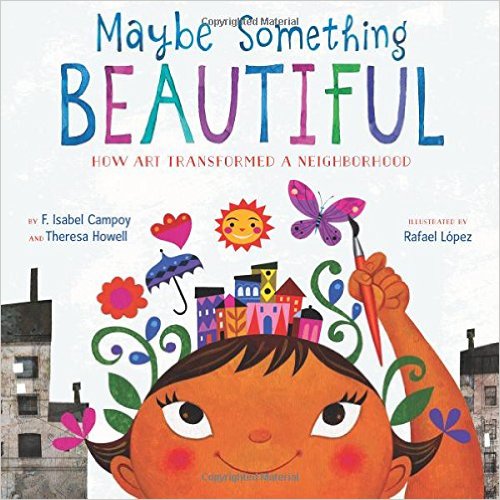
Maybe Something Beautiful written by F. Isabell Campoy and Theresa Howeel and illustrated by Rafael Lopez is well, beautiful.  The story of how a neighborhood was changed from adding art to the gray buildings is also one that is inspirational.  I love how this can inspire conversations about the small changes we can make that will have a great impact.

61nvrg0xzol-_sx410_bo1204203200_

I love informational picture books because of our epic non-fiction picture book project.  Gilbert Ford’s The Marvelous Thing That Came From a Spring is not just a great story, the illustrations are fantastic in it with their mixed media form.  This is a book I will use as an example of how you can write great informational text that reads like a story.

615dgyu4hml-_sy431_bo1204203200_

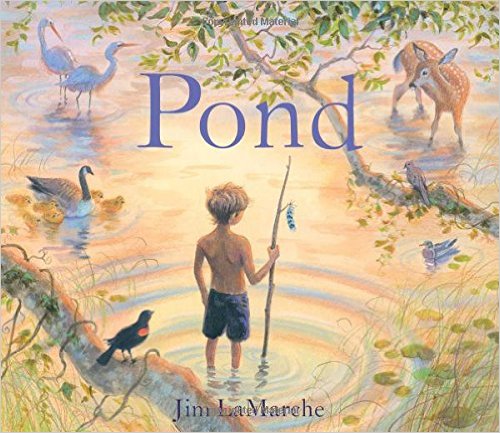
I am always on the look out for small moment picture books because they are such great teaching tools, in fact, soon an entire post will be dedicated to these picture books.  So Pond by Jim LaMarche is a welcome addition to our classroom as it follows Matt and his friends’ dedication to bringing the pond back to life.

61emcgtb2bdl-_sy498_bo1204203200_

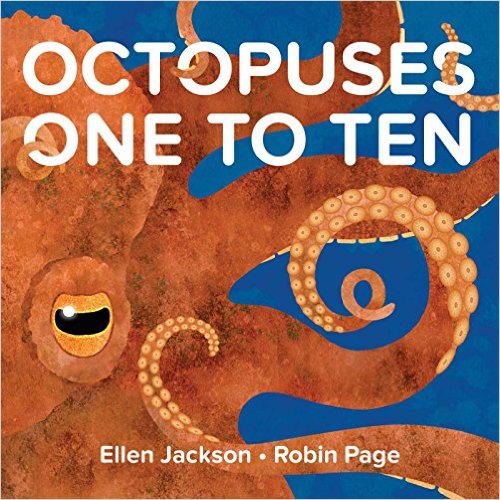
Another fascinating picture book for how to write great informational text is Octopuses One to Ten By Ellen Jackson and Robin Page.  You do not have to love octopuses to be in love with this book and how they weave fact upon fact into a counting book.

41lzmdufadl-_sx366_bo1204203200_

I know I am lucky that I have already received this book.  This is one of those books that we eagerly await and I am so excited to share it with my class.  Jon Klassen’s hat books are on numerous other lists on this blog and he does not disappoint with the final book in the trilogy We Found a Hat.  


61y6jpnp7ml-_sx384_bo1204203200_

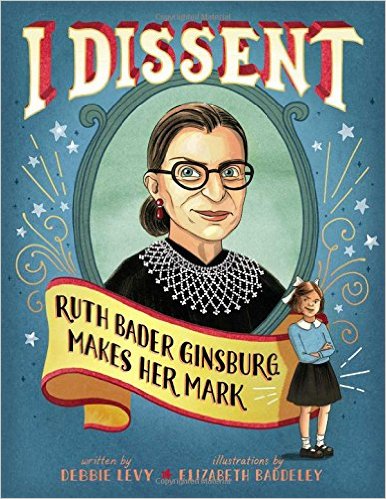
I have loved Ruth Bader Ginsberg and her take on the Constitution for a few years but it was an absolute delight to find out more about her in the new picture book about her life.  In I Dissent: Ruth Bader Ginsberg Makes Her Mark written by Debbie Levy and illustrated by Elizabeth Baddeley we really get to understand why RBG is such an important part of our judicial and political history as a nation.

51ouya5gt8l-_sy457_bo1204203200_

Oh what can I say about this stunningly beautiful book?  The Uncorker of Ocean Bottles written by Michelle Cuevas and illustrated by Erin E. Stead is everything that I love about picture books; a moving story, beautiful illustrations, and a message that stays with you long after you have read it.

51wkgfohktl-_sy477_bo1204203200_

What happens when the Snurtch keeps ruining your day?  How many kids can relate to the picture book The Snurtch by Sean Ferrell and illustrated by Charles Santoso.  This is a great picture book to talk about figurative meaning as well.

61vshege6bl-_sy481_bo1204203200_

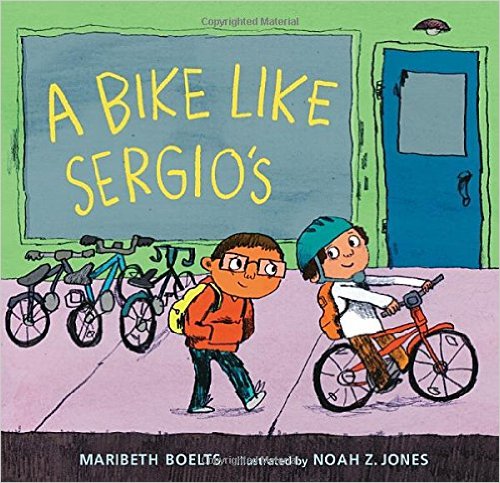
A Bike Like Sergio’s written by Maribeth Boelts and illustrated by Noah Z. Jones was a hit at our house.  So much so that we read it once and then my oldest asked me to read t again.  It is a book with a great message that can inspire conversation about how to do the right thing even when it seems like it would be better to not do the right thing.

Just a few new favorites.  I will also be updating my lists for Picture Books that Celebrate Books and Libraries, as well as the post Great Picture Books to Spark Imagination.

being a teacher, Reading, Reading Identity

When the Book is Just “Ok”

fullsizerender
“Once I find a book it’s fun but it doesn’t happen often” says one of my students.

I have been spending little time in official reading conferences so far this year. These reading conversations that are the foundation of how my readers grow are far and few in between.  But it is not from being forgotten, it is because of how many students have needed help finding a book.

We start every class with 10 minutes of glorious independent reading.  As students read, the quiet settles over them, and I observe, ready to confer, but also ready to help out.  This year I have noticed just how many kids are clearly not into their book, whose eyes shift restlessly from book to page, who are still on the same book they picked up on September 2nd.  So I ask them, “Do you like your book?” and without fail they answer, “It’s ok…”

Only ok.  Not great, not amazing, but ok.  A 6 out of 10 at most.  They are content with a mediocre book because then at least it looks like they are reading.  It looks like they are following the guidelines set forth and perhaps I, the teacher, will leave them alone.  Yet this is so far from ok.  Reading only “ok” books is not what will make reading better for our kids.  Reading only ok books will not inspire further reading, nor will it change their minds that reading is actually worthwhile.  In this instance being ok is not ok.

So we book shop together, immediately, for this is a reading crisis that deserves urgency.  We discuss when the last time was that they read a book they really loved (sometimes never) and we pull book after book after book off of the shelves so that the reading experience they will embark on is as far from ok as we can get it.

I could wait, of course, see them muddle through the pages and perhaps finish a book in a few weeks.  Glad to have one read.  I could hold back and tell them to book shop by themselves, let them explore the shelves and hopefully find something worthy of their investment.  Yet, the problem with the “ok” book lovers is that if they stay on this path, with no help from others, they will remain ok until they are not.  They will remain ok until they finally do give up fully and reading is no longer something they are willing to even attempt.

So when we have kids in our rooms that do not like reading, we must be urgent in our reading approach.  We must talk up reading in such a way that there simply is no way around it.  We must emphasize every day that reading in here matters and that you should only be reading great books.  That you should not be satisfied until you find a really good book.  That we will support the abandonment of books until a really great book is discovered because in here reading is meant to be more than ok.  In here, we should all be trying to find our new favorite book, not just settle for whatever we grabbed when the teacher told us to find a book.

I am currently working on a new literacy book.  While the task is daunting and intimidating, it is incredible to once again get to share the phenomenal words of my students as they push me to be a better teacher.  The book, which I am still writing, is tentatively Passionate Readers and will be published in the summer of 2017 by Routledge.  So until then if you like what you read here, consider reading my book Passionate Learners – How to Engage and Empower Your Students.  Also, if you are wondering where I will be in the coming year or would like to have me speak, please see this page.