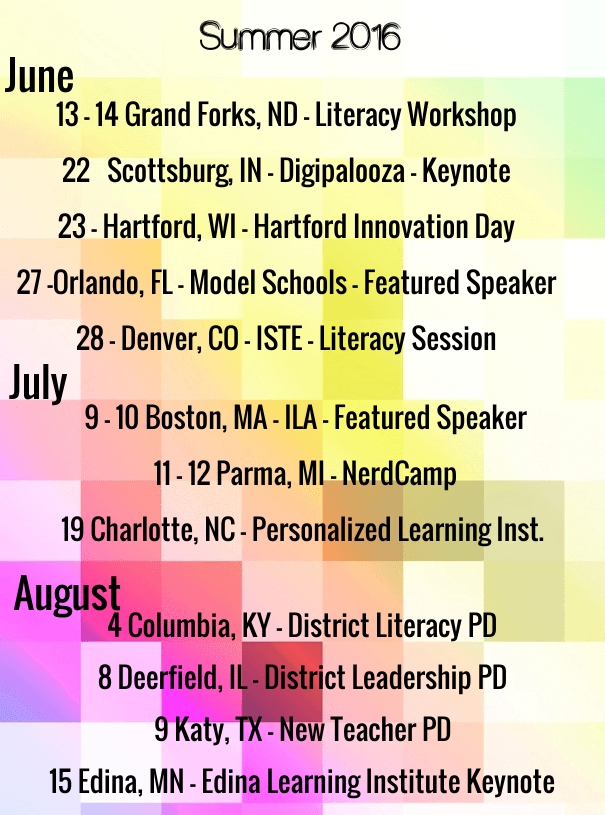
I hope that our paths will cross this summer as I get to meet and learn with so many educators.
Teacher. Author. Creator. Speaker. Mom.
I hope that our paths will cross this summer as I get to meet and learn with so many educators.

I have taught children who have never owned a home. Or some who own several. Who have lived solely on the generosity of strangers. I have taught children who have watched their parents get arrested. Children who have watched family members drink until they passed out, shoot up, or take pills. I have taught children whose earliest memories were of a parent walking out on them. Children who have found God, or Allah, or nothing at all. I have taught children who believe that family matters above everything else and some who do not know what family means. I have taught children who from an early age knew they were not straight or the gender they were born with. Every year I teach a new child, whose story breaks my heart and makes me question humanity. We probably all have, whether we know it or not.
We wear so many hats as teachers, as parents. Sometimes we wear many at ones, our roles always fluid, striving to do the very best we can for every child that is in our care. We carry so many words with us that our students entrust us with. Snippets of their life stories as they try to realize who they want to be while they grow up in our classrooms. As they try to accept themselves and the person they see themselves becoming.
This is why one of the biggest responsibilities we have is to offer a safe environment for students to explore their identity, no matter the age of a child. To create an environment where students can relate to each other, even if their lives seem very different. To create an environment where every child can find out that they are good enough, that they are smart enough, that they are not broken. To create a community where all children are accepted, no matter their background, their race, their religion, or any other identifier that may shape their lives.
We can do this through the very books we place in our libraries. Through the very experiences we share as a reading community. Our classroom library spans age groups, it spans ability levels, and it spans topics that may not be suited for all but are certainly suited for some. Because the students I teach deserve to have a library that will allow them to explore topics that matter to them. Because the students I teach deserve to have a library that will allow them to feel found. Because they deserve to have a library that is not based on what I think they need, but rather on a myriad of books that may bring topics into their lives that they need to learn about. That they may already know about but no one else does.
We teach children whose lives we can never imagine. Who may go home to a life that looks nothing like the one we thought they had. We teach children who are curious by nature, whose curiosity may lead them down a path that is destructive unless we somehow find a way to warn them. We teach children who have so many questions about the bigger world but no idea how to answer them. Books help us reach these children. Books that may not work for all children, but may work for some. So when we censor the books we allow into our reading communities we are telling some of our students that the story they live every day is not suitable for the rest of the class. That the life they lead is not meant to be discussed by us. That the experiences they have had is so different/hard/awful/mature that we will not allow a fictional character to experience it along with them, to allow them to feel less alone, less scared, and less broken.
So while we , of course, should read the books in our libraries as there are books better suited for some age groups, we should do everything we can to make sure our library is for all of the children we teach. That our library becomes a way for students to discuss and explore things that they may not be exposed to yet, but that they should know about. That our libraries become opportunities for students to learn about other ideas, beliefs, or lives that may seem foreign from their own. Our job was never to censor, but always to educate. Make sure that your library is for all of the children you teach, and not just those whose story mirrors your own.
PS: Kate Messner, an author I greatly admire, was recently dis-invited from a school visit due to the topic of her newest book The Seventh Wish, a middle grade novel that deals with the effects of drug addiction on a younger sibling. This book should be in our libraries for all of those kids whose reality mirrors that of the main character. To read about what happened and to show your support, please go here.
33% of my 118 7th graders told me they had not read a single book last summer. That books were just not their thing or they were simply too busy. 33%…Many of them told me they had read the book club books they had been assigned the year before but not that much else. Some told me they had fake read most of their way through years prior, averaging 1 to 2 books a year if even. Some told me how much they loved books, that their summers were spent with their nose in pages because what else would you do when you have all of the time in the world
Teaching 7th graders has taught me many things, but one of the biggest is the incredible need to inspire a larger love of reading in more of their lives. Not because teachers before them haven’t, but because for some reason it hasn’t completely stuck for all of them. So that becomes our mission; for the students to fall in love with reading or at the very least hate it less.
When I read the Book Whisperer by Donalyn Miller, it significantly changed my reading instruction as a teacher. Coupled with other landmark books for me such as The Daily Five by The Two Sisters, and also Mosaic of Thought by Elin Keene and Susan Zimmerman, I finally felt like I had a path I could follow when it came to the aspiration of reading. It was as if I did not know how high of expectations I could hold my students to until after I read these books. Donalyn’s 40 Book Challenge became a central tenet of my instruction, not as a requirement, but as a way for my students to challenge themselves. While I made tweaks because that is what reflective teachers do, I stayed true to its original intent; to challenge my students to read voraciously, based on the research that Donalyn cites in her book that kids who score in the 90th percentile of reading tests read between 30-40 books a year. I did not offer incentives. I did not do logs. I did not tell my less developed readers that their goals should be less because there was no way they could accomplish 40 books. I asked them to shoot for 40 or more and then helped them reach their goals by giving them time to read, time to book shop, and support as they needed. Some kids made their goals, others did not, but they all read more than they had before.
I knew that when I moved to 7th grade I wanted to do the 40 Book Challenge but I was also faced with the incredible limitation of 45-minute instructional blocks. 45 minutes to do everything. 45 minutes that only allowed me to give them 10 measly minutes of reading, rather than the 30 we had enjoyed in 5th grade. After my first week with my 7th graders, I decided to change the language of the challenge in the beginning to 25 books rather than the 40, not because I did not believe that my 7th graders could not read 40 books, but because for some, simply saying 40 in the beginning seemed completely un-doable, especially because I could only give them 10 minutes of reading time every day. However, if I had 60 minutes or more, I would still start with 40 books, after all with that amount of time kids should be given at least 20 minutes of reading every day. But the idea remained; this was a challenge, something to strive for, something to work toward, and something that I believe all of my students can reach if we help them have successful reading experiences.
It appears that some believe that because I have called this the 25 book challenge in the past that that means I want my students to only read 25 books. That somehow the original 40 book challenge is too hard for kids. Neither of these statements are true. All kids should be challenged to read 40 books or more. I believe all of my students can read more than 25 books, my job is often to help them believe it too. But just as in the original, it is not really about reaching the quantity set, it is about having incredible reading experiences.
As the year goes on we, therefore, adjust our goal, some continue to focus on the quantity while others change their focus either to different genres, harder vocabulary or even formats that they have not dabbled in before. While some kids continue to focus on quantity, and for them we do the following breakdown for how books count, for others the challenge morphs into figuring out how they can push themselves as readers beyond a quantity standpoint. (To see more about this read about the reading identity challenge).
I do not ask them to read certain genres but instead take this as an opportunity for them to explore themselves as readers and figure out what they love to read. I constantly book talk books, as do they once we get rolling, and I am constantly sharing recommendations to individual students. We practice free book abandonment, making sure that the books we read are books we actually want to read, and we book shop monthly if not more. Our to-be-read lists are extensions of our reading life and are used weekly, if not daily.
After three years with 7th-grade book challenge, I can tell you, it works. I am not surprised, after all, Donalyn Miller and her ideas have never let me down. While not all kids reach their goals, many do, and many of those who did, never thought they would. Yet the biggest success is not just the kids that reach their goal but within the kids that don’t. As one child told me on his reading survey, “…I even read a book at home for fun, I had never done that before.” That child’s number? Five more than the year before. Five more great books that he loved so much he book talked them to others. Books that gave him such a great experience that he continues to chase that feeling again.
I will not pretend that it worked for everyone, there are always kids that issuing a challenge will not work for, where what we did together was not enough, but there are so many that it made a difference for. Where the expectation to read every single day and reach a certain goal that mattered to them meant that they turned up their reading, that they selected their books more carefully, that they spent a longer stretch reading then they normally would have.
So for the 118 7th graders that I teach, I am so grateful that they believed me when I told then, “Yes, you can read more books.” But do not take my word for it; let these pictures show you what it looks like when 7th graders read and become readers. Let these pictures show you that yes we can get kids at this age to read, that just because a child is going through huge personal development reading does not have to become not lost. What matters is the reading community we create. And the high expectations we have for all of our kids. 
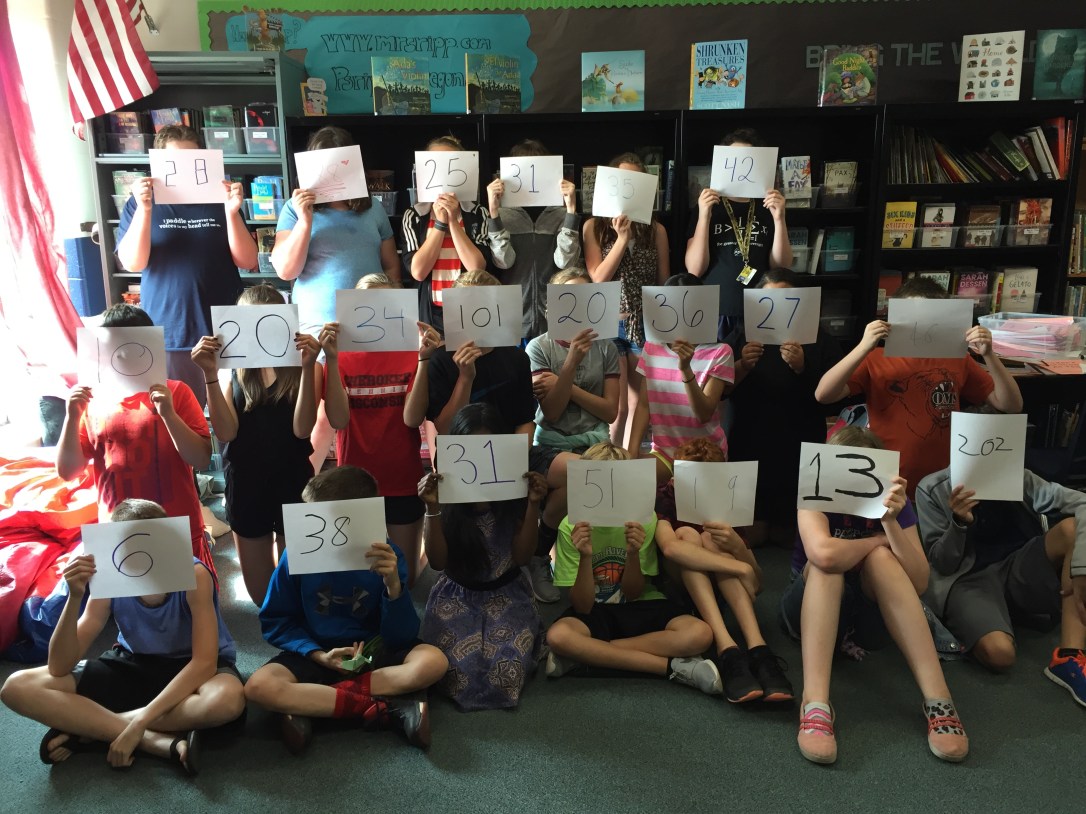


And in case you are wondering, that is 4,357.5 books. Not bad for how many kids told me that reading was not something they felt like doing.
If you are wondering why there seems to be a common thread to so many of my posts as of late, it is because I am working on two separate literacy books. While the task is daunting and intimidating, it is incredible to once again get to share the phenomenal words of my students as they push me to be a better teacher. The first book tentatively titled The Global Literacy Classroom is scheduled for release November, 2016 by Solution Tree. The second, which I am still writing, is tentatively Passionate Readers and will be published in the summer of 2017 by Routledge. So until then if you like what you read here, consider reading my book Passionate Learners – How to Engage and Empower Your Students. Also, if you are wondering where I will be in the coming year or would like to have me speak, please see this page.

I have not hidden the fact that my oldest daughter has been a developing reader for the past 2 years. That something that came so easy for me, has been a fight for her, where the words stammered and stuttered and her frustration grew. But. We just received word from her teacher that she is at grade level as she finishes 1st grade. That all of her (and their) hard work has paid off. That it now is up to us to keep her reading to keep building on the momentum she is on.
Thea is lucky. She has been in a school where they value creating reading experiences above everything else. Where they work with each child at their level and try to keep reading magical. Where each child is given time to read self-chosen books, receive one-to-one or small group instruction, and the emphasis is on reading for fun, not reading for requirement or prizes. As a school, they have said no to so many things we know can harm the love of reading.
Our role as parents has been to uphold the expectations they have created; reading for fun, reading as a natural part of our day, reading as something that becomes part of the conversations we have every day. We have gladly embraced it. We have not had to protect our daughter’s burgeoning love of reading from some of the practices such as reading logs, reading for rewards, AR, or forced daily reading reflections we see around schools, but what if we did? What can we do then?
We can ask questions. I think of all of the well-meaning things I did my first years as a teacher that I thought would help children read more that I now cringe at; reading logs, rewards, book reports and projects, reading reflections every night and so on. No parent ever asked questions because they assumed I knew what I was doing, but the truth is, I was still developing and learning. I did these things because I thought that is what good teachers did. Whenever parents ask questions, it may at first be off-putting, but in the end it always helps me grow. It always offers me a chance for genuine reflection, a chance to re-visit the components that I teach. This is never a bad thing even if it feels that way at first.
We can share the research. These ideas of protecting a love of reading are not just based on momentary whims. Research has shown time and time again how for example external factors such as points, scores, or even food negatively impact a child’s desire to read. (For a great article on reading logs see this). If a school has misguided practices in place, then perhaps they have not seen what is out there that can help them grow? There are nice ways to present research that doesn’t involve chastising other people, especially since it is not always the choice of a teacher to do some of these things, but instead that of a well-meaning district. So share research and don’t be disappointed if it makes no difference, sometimes even the best research only plants a seed that we will not see come to fruition for a long time.
We can lie. I know that sounds terrible, but as far as Thea’s kindergarten reading log, I decided to sign it every night and not show her. She didn’t need to know that she was working toward anything, nor did she need to know that I had to keep track. So I didn’t tell her and I didn’t keep track, instead I rummaged through her backpack every night and simply signed so her teacher could in turn sign off every morning. Thea was a reader but even readers take a night off her and there.
We can say no. No one wants to be THAT parent but sometimes we have to be. Saying no to a school-wide practice such as reading logs or the use of AR can be a daunting task, but we have to remember the bigger picture; protecting a child’s love of reading. In Thea’s first kindergarten class, she was presented with a reading log on the 2nd day of school, all in order to be included in a pizza party. When I asked questions about it, I was told that in later years the reading log would be a part of her grade for reading and that if she didn’t do it, her reading grade would suffer. Her grade! While, at first, this startled me I soon realized that I was fine with that. So be it if her grade was lower because she didn’t participate. Her grade didn’t matter as long as she found reading enjoyable and not something you did to earn something. Sometimes change will not come until parents speak up, so be the voice of reason and if you see something changing your child’s reading habits for the worse, then do something about it. Don’t just expect it to be ok in the end. Protect your child’s love of reading as you would their health; it is vital for a happy life.
We can create our own enjoyable reading experiences. Sometimes we have to be the counterpoint to the environment our children are in. If we know that self-selected books are a major component to creating pleasurable reading experiences then that is what we should strive for. While the parent in me often felt panicked that Thea was not making the necessary gains as a reader, the teacher in me knew that it simply would take time. That forcing her to read more books every night, or even write more about her reading, would only make the experience miserable for her. So keeping reading fun, making it a family event (see this blog post for lots of summer reading experience ideas) and making it a natural part of your day are all choices we can make, whether or not our child’s school believes in it.
We have been so lucky as we look back on Thea’s short reading life. As she switches school this coming school year, I can only hope that it will continue. We may sometimes wonder about the policies that directly influence our children, but we should never feel powerless. As parents, we have a right and a responsibility to protect our child, we must ever forget that.
If you are wondering why there seems to be a common thread to so many of my posts as of late, it is because I am working on two separate literacy books. While the task is daunting and intimidating, it is incredible to once again get to share the phenomenal words of my students as they push me to be a better teacher. Those books will be published in 2017 hopefully, so until then if you like what you read here, consider reading my book Passionate Learners – How to Engage and Empower Your Students. Also, if you are wondering where I will be in the coming year or would like to have me speak, please see this page.

I asked my students what made the biggest difference. I asked them what I should tell other educators as I ready myself for speaking this summer, honored to be invited to so many great states. I asked them what they wished every teacher would do, if they had to pick one thing, what would it be? Answer after answer, paper upon paper, they told me their one thing. And while I wasn’t surprised, I had not expected it to be so frequent. I had not expected it to show up on so many independently answered surveys. I had not expected it to be the ONE thing so many times.
Please tell them to give us time to read. Please allow us at least 10 minutes. Please tell us to read. Tell us to read only great books. Give us the time so we can fall back in love.
The time; that was the most important.
I have started almost every single day with a sacred 10 minutes of reading. Not enough, I know, but when I only get 45 minutes to teach English, it is more than 1/5 of our time. Every day I have expected all students to read and to read a good book. Every day I have expected students to fall into the pages that they chose and only come back up when the timer sounds and the rest of our class begins. I was scared of what we would lose in our curriculum by giving them so many minutes. I was scared that I would not be enough of a teacher by telling them that for those 10 minutes I would only interrupt a few of them every day, but mostly they would be left to read. I have read the research, of course, that speaks of the power of 10 minutes. As a teacher I believe in it, but to have it come straight from the very students it effects? That is powerful. That is something worth sharing.
When we hope for a reading miracle, when we hope for the one thing that will make a child a reader, it seems like this is it. That independent reading of self-chosen books is truly what will help all of our readers, whether dormant, resistant, or already in love, develop into readers who will leave our classrooms knowing that books have a place in their life.
So as we teach the older students, those students that might not have the luxury of longer literacy blocks. Who may not have the luxury of reading work shop. Who may not have the luxury of choice. I implore you to please take my students’ advice to heart; give them time to read, even if only for 10 minutes. Give them time to read a book they choose. Make it the expectation and not just once in a while, but every single day. I promise it will make the biggest difference. At least it will, according to my students.
If you are wondering why there seems to be a common thread to so many of my posts as of late, it is because I am working on two separate literacy books. While the task is daunting and intimidating, it is incredible to once again get to share the phenomenal words of my students as they push me to be a better teacher. Those books will be published in 2017 hopefully, so until then if you like what you read here, consider reading my book Passionate Learners – How to Engage and Empower Your Students. Also, if you are wondering where I will be in the coming year or would like to have me speak, please see this page.

There seems to be no greater rush in school then these last few precious days before we say goodbye, before our time is up. I look at my own to-do list and wonder just how much will actually get to done. The pressure of it all nips at my heels as I wonder whether my students could possibly speak a little bit faster as they deliver their end of year speeches. Will we get through them all? We have so much to do still.
Yet, as I listened today to a boy share his message of hope and forgiveness. To another who shared the value of friendship. To one who decided to challenge our racial beliefs, and one that made me cry (actually two did) because they stood up there and spoke their truth, I knew what I had forgotten. To take the time.
To take the time to say goodbye the proper way.
To take the time to laugh.
To share memories and stories. To take the time and not feel guilty all of the time for all of the things we didn’t get to do.
Take the time to remember all of the great and all of the not so great.
Take the time to remember the very best books, projects, or whatever else you may have shared.
To take the time to ask just a few more questions so that you can grow over the summer.
To take the time to thank you students for the journey you have been on.
May we never forget to be grateful for the things we take for granted, for the community we create, for the memories we make.
May we never take for granted that our year, while tough at times, was still a success and that all of those students did actually grow, even if it was not as much as we had hoped.
May we never forget that for a brief moment in time we were a part of the future by being a part of a child’s life.
So take the time to say goodbye and don’t worry so much about the to do. Because in the end it is not what we got done that matters, it is how we felt doing it. SO take the time to take the time and don’t let your guilt consume you.
If you like what you read here, consider reading my book Passionate Learners – How to Engage and Empower Your Students. Also, if you are wondering where I will be in the coming year or would like to have me speak, please see this page.
 Pernille Ripp