being a student, being a teacher, student choice, student voice

When We Forget to Ask – On Student Privacy and Sharing All the Good

http---www.pixteller.com-pdata-t-l-314014

I was schooled in student privacy the first time I asked to take my students online.  Protect, teach, and keep them safe were drilled into me as we connected and explored the online world.   I thought I pretty much  knew what I couldn’t share; all the sensitive or bad stuff, and thought I knew what I could share; all the good stuff.  I thought all of my students wanted to share their blogs.  That all of my students wanted their accomplishments made public.  That when they did well they, of course, they wanted the world to know.  After all, we are a culture driven by success stories.

Yet, year after year my thinking has been challenged.  First by a 4th grader who told me she had no need for a certificate stapled to her math test as it made something private public.  Then by a 5th grader that dared to ask why I assumed he would want his blog to be public.  And finally, last year by a 7th grader who told me to tell the world that no one else had the right to know that she was on the honor roll.

Every time a student has challenged me, I have learned something.  Every time they have stood up for their own privacy, I have been reminded of my own flippancy.  Every time, I feel the urge to share all of the good I remember that I do not automatically have the right, that the students also have the right to say no, that that is not just something we leave up to parents.

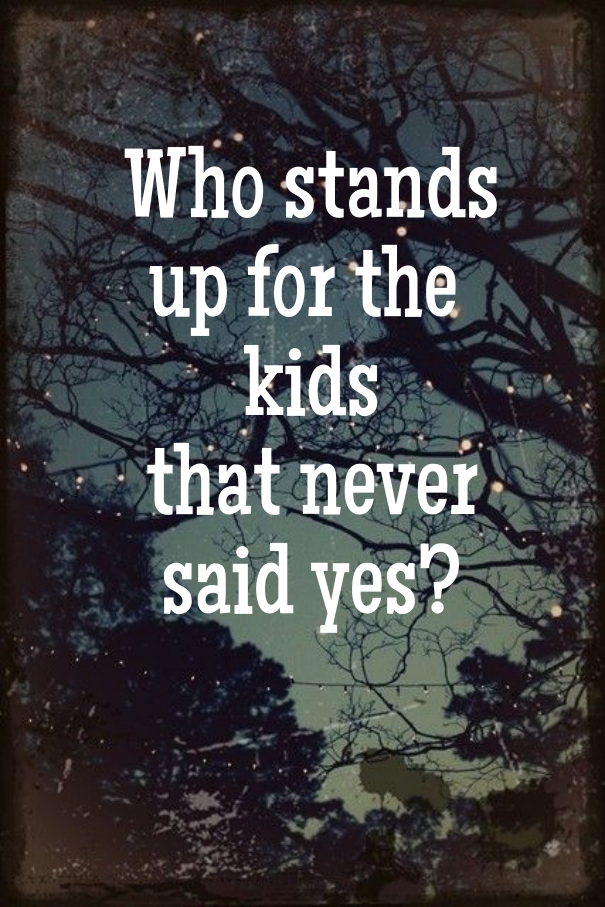
So I speak for my students who challenged me to rethink my stance in privacy.  I speak for those kids that asked me to think before I shared.  Not just for the parents who said no, but for the kids that never said yes.

So before you publish that honor roll.

Before you make that blog public.

Before you move their clip to the positive zone or give them that point (“Ding!”) or hand them that award.

Before you tweet that picture, or print it, or email it, or share it with the world.

Before you use that student example (name redacted of course).

Before you share that great learning moment with the world.

Before you share what a kid has done.  Even if it was amazing.

Please ask them if you may.

Please ask them if they would be alright with the whole world (potentially) seeing their thoughts, their work, their accomplishment.

Please ask them if they would like the attention that may come from it or if they would rather not be celebrated publicly.

And if they say no, respect it.

We assume that every kid wants to be praised in public.

We assume that every kid wants to be honored in public.

We assume that every kid wants to share their great grades in public.

But we don’t know every kid.

So ask them first.

Their answer may surprise you.

I know it certainly surprised me.

If you like what you read here, consider reading my book Passionate Learners – How to Engage and Empower Your Students.  Also, if you are wondering where I will be in the coming year or would like to have me speak, please see this page.
 

administration, Be the change, being a teacher, being me

When A School Becomes Toxic – What Can We Do to Change School Culture?

http---www.pixteller.com-pdata-t-l-311457

When you walk into a school you can usually feel the culture right away.  Is this a building where teachers love to teach?  Where students thrive?  Is there a feeling of family in the air or something else?  A building’s culture is often invisible and yet it can be one of the most important components of what makes a school great.  In fact, I fell in love with Oregon Middle School because of the feeling of family I encountered in my very first interview.

So what happens when a school’s environment turns toxic?  Where mistrust and anger become commonplace?  What do we do when we find ourselves in the type of school where all we want to do is shut the door and teach in peace, too tired to deal with everything else?  Well, there are a few things we can do.

We can make sure we are not the ones being toxic.  Yes, it is hard to let go of anger.  Yes, it is hard to not get upset.  And yet, we also make a choice every day of whether or not we want to add more negativity or not.  We make a choice, it is not made for us, and sometimes we have to make it again and again throughout the day as we try to stay positive.

We can build others up.  Why not point out the positive that you see.  Just as negativity is contagious, so is positivity.  You may be the only one noticing great things but give a compliment, leave a note, do something that shows you notice the great that is happening around you and speak up.

We can choose to trust a new person.  We often only extend the trust to those we know well and everybody else in a building we are not quite so sure of.  But how about we assume that there must be more people in the building that are there because they also love teaching and kids?   Purposefully extending your circle of trust means that your “inner” circle will grow, which means there are more people you can vouch for internally.  It may not seem important but it certainly is.

We can watch each other teach.  I know nothing about what goes on in other classrooms but instead of being ok with that, I have asked if I can come watch others teach.  I have also opened up my door to anyone that would like to come in.  Yes, it is hard to feel like you are being judged but we can also assume positive intent.

We can have courageous conversations.  If someone is seemingly negative at all times, ask them why.  Yes, this may be super uncomfortable for all of us but a simple question can go a long way.  Often we establish a pattern of unhealthy venting and don’t know it ourselves.  Someone calling us out, even gently, can be all we need to see our habit.

We can focus on what we can change.  There are many things in my state that upset me, there are even decisions in my district that I may not agree with, and yet, when I cannot change things I let them go.  Why anyone wants to carry anger with them every day they teach beats me.

We can make new friends.  Often we stick to the same people in our teaching circle at school, why not extend that circle right along with the trust?  Stop by someone’s room and ask them a question, seek out someone new to sit by at the staff meeting, volunteer for a new committee.  Something to meet new people.  A toxic environment often comes from not knowing each other, so break that barrier down one person at a time.

We can refuse to give power to the toxicity.  In our silent agreement, when we nod, when we spread the stories that tear others down we are complicit in spreading toxicity.  When we agree rather than ask questions, when we stand and listen, we are complicit in the spread of toxicity. So walk away, don’t agree, speak up.  If you do not want a toxic environment then do something about it.  Shutting your door is the easy way out.

Sometimes the toxicity comes straight from the top, so administrators, this is for you.

You can be the voice of reason.  Seek out both sides of the story before you judge, don’t have favorites, and leave your own emotions out of it.  Just like teachers at times will side with students that they like, so will administrators, and that sends a very strong message to everyone in a school.

You can check your own interactions.  If the interactions you are having with teachers are more negative than positive, think of how that affects the students.  While there are always tough conversations to be had, how they are approached can make or break a school culture.

You can be positive.  I work for one of the most positive administrators I have ever met.  Every day, no matter what, she has a positive attitude, even in the hardest situations.  This makes a difference and it sets the tone.  Our culture is one where people welcome and teachers feel valued.  If an administrator always looks mad, tired, or stressed it spreads to everyone else.

You can respect privacy.   As an administrator, you probably have way more information than any teachers and especially about other teachers.  That is part of your job, and so part of your job should also be to keep that private.  I have heard horror stories of administrators sharing private things that greatly influenced how others saw a teacher.  Be mindful of what you share and who you share it with.

You can initiate hard conversations.  I think too often administrators are not quite sure how to approach a toxic person or situation, and I get it, it can get really messy really quickly.  But at the end of the day, if we don’t talk about a problem it will never get away.  So we can allude, circle, and kind of talk about it, or we can face the problem head on and try to get somewhere with it.

You can ask for feedback.  My administration just held a two-day listening session where anyone was welcome to come and discuss whatever they wanted.  That sets the tone for the level of trust they place in us; they want to hear what we have to say even if they have no solution.  Simply opening up the door and asking for genuine feedback sends a powerful message about where you are in your administration journey; are you trying to grow or are you good with where you are.

A toxic culture can arise quickly but can take years to combat.  And while it would be nice to simply point the finger to one person and accuse them of being the main culprit, we all have a role in it.  From those that continue to spread negativity by venting their frustrations, to those of us that choose to shut our door and forget about the rest of the school; we are all complicit.  So take a long hard look at yourself, after all that is the only person we can control, and make sure that what you bring to your school is really what you meant to bring.  I know we all have bad days, but some times those bad days become bad years without us even realizing it.  A school’s culture is never too late to fix; but it does take a decision to do something about it.  And that decision can be made by us. Every single day.


If you like what you read here, consider reading my book Passionate Learners – How to Engage and Empower Your Students.  Also, if you are wondering where I will be in the coming year or would like to have me speak, please see this page.


Be the change, being a teacher, being me

How to Break Free of the Dreaded Teacher Slump

http---www.pixteller.com-pdata-t-l-310596

It never seems to fail; February hits and gone are our dreams of changing the world, of reaching every student.  Instead it seems that in the long  days of winter in North America our moods mirror the darkness and negativity slowly creeps in.  The dreaded slump month is upon us.  But it does not have to be that way.  Much like having hope is a choice we can make, so is reveling in the negative.  Much like we can choose to believe in the possible, we can also choose to believe it will never make a difference, that this year is lost already.  Yet we have 4 more months of school to go.

Many of us are worn out at this time of year.  Minor ailments, lack of sleep, and the urgency of the year because how will we ever teach them everything seems to pull us down leaving us with little energy.  So before we give up or give in here are some ways we can boost our energy again.

Make a little extra time for you.  This is the time of year to grab a cup of tea with a friend and perhaps not talk about teaching, to watch a funny movie, or read an amazing book.  Color some pages or go for a walk.  When the weather is colder here in Wisconsin I tend to withdraw from the outside yet the sunshine that surrounds us on even the coldest days (right now it is 1 degree Fahrenheit) should be enough to boost our mood, but we have to notice the sunshine first and make a choice.

Look at how far they have come.  Yes, we may not have solved every single problem, we may not have reached every kid yet or helped them grow in the way we hoped, but the year is not over.  Rather than dwell on all the things students have yet to master or the ideas that have failed, purposefully look at how far they have come, how far you have come.  Even the hardest kid has probably made some progress.  Even the hardest situation has probably improved.  We just have been to busy to realize it.

Decide if you are a part of the problem.  We all have those days where we need to vent, I get it, but is your venting bringing someone else down?  Are you approaching the day like a great challenge or a hardship?  Your words and your actions directly influence others and sometimes we forget that.  So before you spill all of your frustrations think about how it feels for others to listen to it.  Are you looking for help or are you looking to get it off your chest?  Be mindful with your words.

Ally up.  Find someone who is also feeling the slump and build each other up.  Confront the fact that you are feeling worn out and then decide to try to cheer each other up.  Make it productive and find ways to boost each other’s energy throughout the day.  We laughingly spoke about doing P90X after school last night but now I am thinking that might actually be a really good idea.  Find your people and make a pact; no more down, only up.

Embrace this stretch of time.  I love this long stretch of time that we get with students between winter and spring break because we can really do some deeper learning and exploration with the students.  This uninterrupted stretch of time is not something to despise but something to embrace.  What can you invest your time in because you have the time?

Try something new.  Now is the time to dust off that crazy idea you learned about this August and try it with students.  If you are feeling worn down, think of how the students are feeling.

Smile.  It is so easy to get worn out but a lot harder if you smile.  I try to smile every single day because smiles are contagious.  Even if I don’t feel like it because even though I am sleep deprived thanks to my kids, even though I am sick thanks to this cold, even though I am feeling like not so great of a teacher, I still have the very best job in the world and that deserves a smile any day.

Clean the classroom.  Our classrooms seem to gather a lot of things throughout the months so now is a great time to change things up.  Wipe everything down, re-arrange, bring in a plant, change your book display, do something to make it feel welcoming and alive again.

Look for solutions rather than problems.  This is a mindset change and it can take a lot of effort to do it, but when problems are discussed try to bring up possible ideas rather than add more details about the problem.  The way we approach a situation is a decision not something that is forced upon us.

Read a great book.  I am currently reading Book Love by the incredible Penny Kittle and I cannot emphasize how much of a difference it is making for my mindset.  Penny’s enthusiasm for great literacy instruction mirrors my own but I needed to hear her words right now.  We just finished the first ever Passionate Learners book club and the community is still thriving, so read a book and join a book group to get support.  You are more than welcome to join ours.

We can give up and assume that this slump is inevitable or we can fight it with everything we got.  Becoming aware that we are part of the problem is the first step to fixing it.  I made my choice last night as I sat among colleagues laughing so hard I cried.  It doesn’t have to be this way.  It doesn’t have to be inevitable.

If you like what you read here, consider reading my book Passionate Learners – How to Engage and Empower Your Students.  Also, if you are wondering where I will be in the coming year or would like to have me speak, please see this page.


being a teacher, books, Literacy, picture books, Reading

Some Picture Books to Discuss Courage

Have I convinced you yet that there is a picture book for every occasion?  Whether it is to build empathy, spark creativity, or in this case build courage, picture books are my go to text for almost anything.  These picture books are the ones I pull out when we need a little bit of boost, when we need to remember that we can change the world, when we need just a boost of courage as we try to navigate what it means to be a middle schooler.

Malala, a Brave Girl from Pakistan/Iqbal, a Brave Boy from Pakistan: Two Stories of Bravery by Jeanette Winter.  I have used this book on many different occasions but having courage in the face of danger is major topic for social advocacy.  I love this book so much. 

Jacob’s New Dress by Sarah and Ian Hoffman, illustrated by Chris Case.  being yourself can be hard when you society will judge you but this book is a must add for any classroom.  When we speak about needing diverse books we need books that not only a provide a mirror for our students but also a window to quote Jacqueline Woodson.  While we may have no students that we think need this book, all of our students really need it.

First Day Jitters by Julie Danneberg and illustrated by Judy Love.  Sometimes kids think that adults have no fears but this book reminds them that we get scared too.  A lighthearted read that is sure to be a great conversation starter.

Mr. Tiger Goes Wild by Peter Brown.  Staying true to yourself takes courage and Mr. Tiger is a good teacher of that.

Drum Dream Girl by Margarita Engle and Rafael Lopez  A beautiful book from this prolific author that is all about following your own dreams and not letting others box you in.

Nightsong by Ari Berk and illustrated by Loren Long.  Venturing out on your own is never easy especially when the night is dark.

I’m Trying to Love Spiders by Bethany Barton.  How many of us have tried to break our own fears?  This is a laugh out-loud book that will make us think about the fears we need to work through.

The Man Who Walked Between the Towers by Mordecai Gerstein.  This has been my chosen read aloud for many years on 9/11 because ti allows us to open up a hard conversation by remembering something beautiful.  Now with the movie The Walk out, students know this story even better.

The Heart and the Bottle by Oliver Jeffers.  This book is beautiful and the message that it carries of not being afraid to love is one that will resonate with may readers.

I am Rosa Parks by Brad Meltzer and illustrated by Christopher Eliopoulos  I could have picked any of the books in this series, they all have wonderful message sof staying true to yourself and finding your own courage.

To the Stars!  The First American Woman to Walk in Space by Carmella Van Vleet and Dr. Kathy Sullivan, illustrated by Nicole Wong.  What is your dream adn how will you achieve it?  Sometimes you have to dream bigger than the rest of the world wants you to.

Walk On!  A Guide for Babies of All Ages by Marla Frazee.  Even babies need courage.  We all take so many things for granted that took a lot of work to do, this book is a great reminder of how far we have all come.

The Yellow Star by Carmen Agra Deedy and illustrated by Henri Soerensen.  While the story is not completely true it does speak to how one person can inspire courage for many.


I know there are many others out there, which picture books do you gravitate toward when you need students to find some courage?

To see the list of more of our favorite picture books, go here.

being a teacher, books, Literacy, picture books, Reading

Some Picture Books on Friendship and Loneliness

It never fails, there always seems to be that moment where we with heavy hearts turn to our book shelves to find the perfect book to talk about loneliness.  When we search for a book that will say the words that we seem unable to find ourselves.  Teaching children means that there is a constant stream of friendships, both good and bad, and the heartaches that can sometimes come with growing up.   So I scoured my bookshelves looking for some of our favorite books to talk about friendship, loneliness, and what it means to find your place in the world.  Here are some of our favorites in room 235D.

The Seeds of Friendship by Michael Foreman is a new book to our room that tells the story of how coming together around a common purpose can inspire community.

I do not hide the fact that I think Meg Medina is a writing genius and her latest picture book, Mango, Abuela, and Me illustrated by Angela Dominguez is a must add toy our collection.  I loved that the story centered on the loneliness we can feel when we do not know how to connect with others different than us, even when they are supposed to be alike.

I do not know how many lists of picture books I have placed The Invisible Boy by Trudy Ludwig illustrated by Patrice Barton on, but I am sure it is many.  I have used this book with several different age groups and they all get it, they can all connect, they have all felt invisible at some point.

Amy Krouse Rosenthal was the 2015 choice for Global Read Aloud’s picture book author study and she was amazing.  Having 3 little girls means that unicorns are a regular topic of conversation and so when Uni the Unicorn illustrated by Brigetter Barrager came out it was a natural fit in our household.  But it is not just a book for little girls, but rather a book that can remind all of us of what it feels like to be longing for one thing you are certain is out there, even when no one believes you.

What happens when a book is not read anymore, the same as when a child feels lonely.  The Lonely Book by Kate Bernheimer and illustrated by Chris Sheban is a great conversation starter fora complex topic of loneliness and feeling forgotten.

What happens when a dog is unappreciated by those who own him; the dog names himself Sad.  Sad the Dog written by Sandy Fussell and illustrated by Tull Suwannakit is a great example of how we can find our place among friends even if we start off wrong.

The Only Child illustrated by Guojing shines a light on the deepest kind of loneliness where a child flies into their imagination to combat the hours where they are alone.  This is also a great wordless picture book to have students think of China’s one child policy which is the inspiration behind the story.

The Adventures of Beekle – the Unimaginary Friend the Caldecott medal winning book from 2015 by Dan Santat also speaks of loneliness and finding that one person that makes it all better.  This book has also shown up on many of our lists and with good reason.

Say Hello by Jack & Michael Foreman shows what can happen when a simple hello is said.  This is a great book for middle schoolers as they sometimes don’t see the world as it passes them by.

An Angel for Solomon Singer by Cynthia Rylant and illustrated by Peter Catalanotto is a must add for any picture book loving classroom.  The story about Solomon who lives in a shelter and the small interactions that change his perspective is one that invites further reading and discussion.

A Piece of Home written by Jeri Watts and illustrated by Hyewon Yum is not published just yet, but can be pre-ordered and it deserves to be.  The story of how a boy moves from his home country and tries to make new connections is one that many of our students can relate to and one that is sure to prompt students to share their won stories of feeling out of place.

Leo: A Ghost Story written by Mac Barnett and illustrated by Christian Robinson is a book that I love as long as I don’t think about why Leo is a ghost.  Once again it speaks of loneliness and the lengths we go to to try to make a friend.

Be A Friend by Salina Yoon is at the top of my mock Caldecott list for 2017.  Through its sparse text and beautiful illustrations it tells a familiar tale of what can happen when we stay true to who we are.

There are so many picture books out in the world, which do you love for starting conversations about loneliness and friendship?

To see the list of more of our favorite picture books, go here.


Be the change, being a student, being a teacher, projects

The 2030 UN Challenge – A Social Advocacy Project

In my district we are well aware of our demographics.  How we mostly teach one demographic students, and while these students span an enormous socioeconomic range, they look a lot like each other.  How sometimes our world can seem protected with only the biggest stories slipping through.  I also teach 7th grade where the rest of the world tends to slip away as the students are focused on their own social development and their own place in the world, rather than the world that surrounds them.  Yet, we try.  We constantly try to engage the students in projects that will bring the rest of the world in, start conversations, and ultimately lead to change.

When AJ Juliani first posted about the 2030 UN Challenge I didn’t much notice it.  He has a lot of great idea but this one slipped by until my awesome colleague , Reidun Bures, brought it up to me again.  We decided that this was the perfect opportunity to collaborate between our classes, but more importantly to simply make our students more aware of the major challenges that faces our world.

So for the past 3 weeks, we have combined classes and worked on the 2030 UN Challenge.  Students watched the video listing the 17 goals that the UN has set for the next 15 years (it came out in 2015) and then decided which goal they would focus their project on.

TheGlobalGoals_Logo_and_Icons

Once their “lens” had been chosen, they had to narrow their scope.  Where in the world would they focus their research knowing that they had to present their information in an infographic to the rest of the class.  Some chose to focus locally in our very county or state, while others went to far-flung regions that sought their attention.  Students then spent five 90-minute blocks, every other day, researching  their “problem.”  Examples were racial inequity in Dane County, water quality in the United States, gender inequity in education in Pakistan, the extinction of sharks due to shark fin soup, the gender pay gap in the United States and so many other projects.  We were blown away by the passion they had for their problem.

But we didn’t just want to them to become aware, we wanted them to realize that they could make a difference.  So part of their project became an advocacy piece as well; either highlight a group that is already working to solve the problem such as Black Lives Matter, the Water Project, or Second Harvest Food Bank, or come up with actual things that your fellow students can do.  It was amazing.

On the final day of the project, students had to present their infographic and their advocacy piece to the class.  As one student said, “Can I present more than once because I really want people to hear this.”  It was clear that many students were passionate about their project, wanted others to hear them, and wanted to make a difference.  But even more importantly the knowledge that crept into the consciousness of the minds of our students was unmatched.  They may not all go on to change the world but at least they have heard what some of the major challenges that affect us as a human race are.  At least they have had a window opened once again to the world, supporting what our other amazing teachers try to do, hopefully inspiring them become more aware.  It was more than once that a pair of students called us over to share a fact with us, disbelieving that it was true.

So why share?  Because this small projet has made a difference and has made an impact on us that we were not expecting.  So we hope you will take the pledge; do the 2030 UN Challenge in whichever way suits your kids and open up the world more.  Go here for more information or check out the original post from AJ Juliani.

Part of one student’s infographic.

Also if you are looking for another small global project, join the 1 School 1 World project on February 22nd, where classrooms around the world will share a picture of what their learning environment looks like using the hashtag #1S1W – for more information and to sign up, go here.

To see more of the how-to of what we did, go here.