books, Literacy, notice and note, picture books

Great Picture Books to Use For Memory Moments – Notice and Note

One of the main texts we use to guide our reading instruction is the amazing Notice and Note: Strategies for Close Reading by Kylene Beers and Robert Probst, and I have loved gathering all of these picture books to be used with this amazing book. This is therefore the last installment of these posts,  Please keep sharing your ideas in the comments because I know many are looking for great picture books to use with these deeper reading strategies.

The first post was on Contrast & Contradictions, then followed Aha Moments,Tough Questions, Words of the Wiser,  Again and Again, and now, finally, the last one for Memory Moments.  Here I really tried to find picture books that have a true memory moment, which means a character stops the story to share a memory, these can be harder to find.  Happy reading!
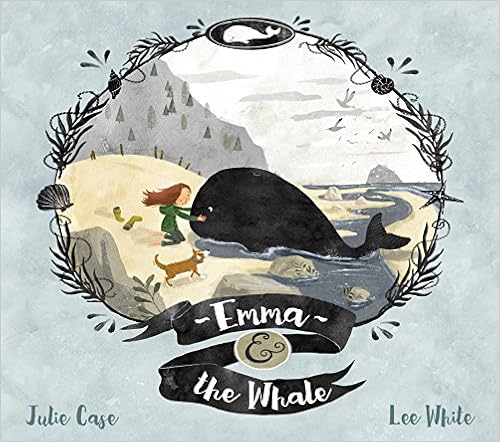
Emma and the Whale by Julie Case and Lee White has two flashbacks in it that can be considered brief memory moments.
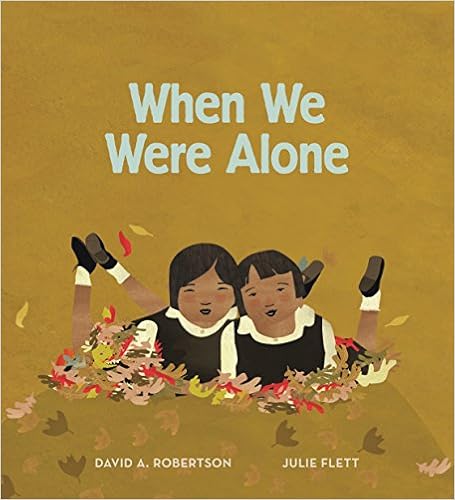
An incredible picture book, When We Were Alone by David A. Robertson and Julie Flett have a memory moment every time the grandmother answers her grandchild’s questions. Powerful message that will capture curiosity.  This is the book I will use with my 7th graders.
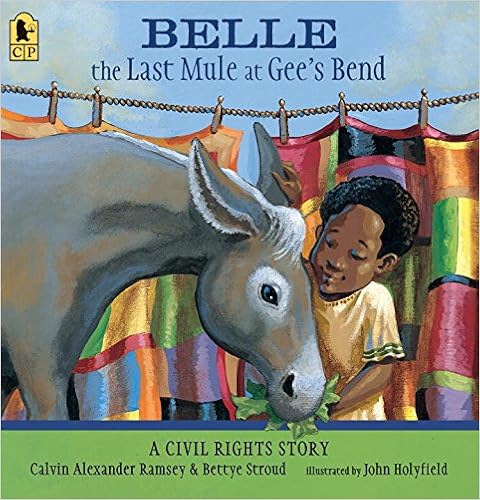
 

Belle the Last Mule at Gee’s Bend by Calvin Alexander Ramsey & Betty Stroud, illustrated by John Holyfield tells the true tale of one of the mules that carried the coffin of MLK Jr.  Told through memory moments as a child asks about the mule, this is a great picture book to teach an untold story as well as memory moments.
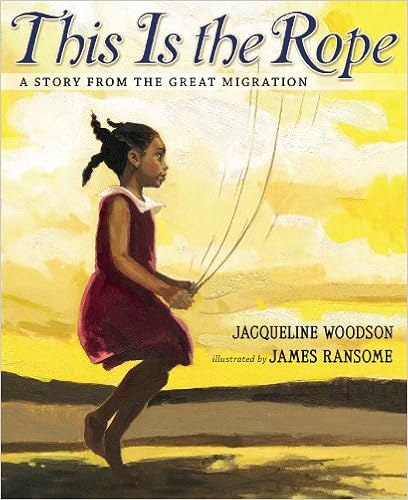
Both The Day the Crayons Quit and its follow up The Day the Crayons Came Home by Drew Daywalt and illustrated by Oliver Jeffers have great memory moments as the crayons tell Duncan how they were used and what they remember.  Considering these are must have picture books for any classroom, since there are so many things you can teach with them, I am thrilled that both can be used for this strategy as well.

The retelling of the story of King Christian X in The Yellow Star by Carmen Agra Deedy and illustrated by Henri Sørensen is an example of a memory moment in the lesson that we are all to glean from it.  The fact that the story is not true does not hinder its deeper meaning.

The books of Peter H. Reynolds has been featured in all of my signpost picture books, and it speaks to their incredible versatility.  You and Me written by Susan Verdi and illustrated by Peter H. Reynolds is a memory moment from the start as the characters reminisce about what would have happened had their day not unfolded the way it did.  A beautiful story of friendship and serendipity.

A beautiful memory moment exists in the pages of A Chair for My Mother by Vera B. Williams as we learn the story of the chair.

Memories abound as the Wolf shares the story of what really happened with the pigs in Tell the Truth B.B. Wolf by Judy Sierra and illustrated by Jotto Seirold.

As always, I turned to the awesome Notice and Note community on Facebook and asked them to share their favorites as well.  Here they are.

Storm in the Night by Mary Stolz and illustrated by Pat Cummings.

Tough Cookie by David Wiesniewski

Christmas Tapestry by Patricia Polacco.

Wilfred Gordon McDonald Partridge by Mem Fox and illustrated by Julie Vivas

When I Was Young in the Mountains by Cynthia Rylant and illustrated by Diane Goode.

Saturday and Teacakes by Lester Laminack

A Christmas Memory by Truman Capote

Train to Somewhere by Eve Bunting and illustrated by Ronald Himler

As always, please add your favorites for Memory Moments in the comments.  Also, did you see the new Notice and Note for Nonfiction?  I am so excited to read it.
being a teacher, being me, books, picture books, Reading, students

The Things That Matter the Most

http---www.pixteller.com-pdata-t-l-222659

I have spent a week listening to my students as they told me what they were proud of and how I could change to make 7th grade English a better class for them.  Child after child.  Conversation after conversation, and although my brain is tired from all this sitting, and I am ready to go back to working with all of them, I could not help but notice the things that kept coming up in as we spoke.

They told me that they are becoming stronger readers.  That they have these goals that they need to accomplish, perhaps with some help from me.  That class is fun (at times).  That it is not as bad as they thought it might be.  And over and over and over they tell me about the things that have mattered the most to them…

Having books in our classroom.  They know that when they finish a book, another one is  right there.  That if they need to abandon the one they have selected, that many others await.  That they love our school library but are so thankful for the library we have as well.  The books seem to call out to them as they sit in our room asking to be read.

Having time to book shop.  Once every few weeks we spend half a class simply book shopping.  We lounge in our time with the new (and old) books waiting for us on the tables.  I book talk a few and then watch as they meander along the piles, picking up book upon book and gazing at the pages.  Writing a few down, sharing them with others.  Book shopping is an event, something to look forward to and they ask for it as they see the piles of books grow by my table.

A list of books to be read.  We have several pages in our readers notebook dedicated as our to-be-read list.  The students are now getting in the habit of using it whenever they need a new book.  They are sharing them with each other too, “Did you add this book yet?  Oh, we have the same book listed.”  They do not forget about the books they are waiting for (right now Orbiting Jupiter and Crenshaw have a very long wait list) and with their list in hand they always find their next read.

A shared love of picture books.  All students are accomplished readers in our room because they can all pick up a picture book and “get it.”  They can all discuss the problem of Mustache Baby.  They can all discuss the theme of Unicorn Thinks He’s Pretty Great.  They can all learn about courage from Malala and Iqbal.  Because those stories are found within picture books.  Because picture books allow us to love reading.  To access complex texts that no one has ever told us is not at our level.    To remember that reading is meant to be fun, even if it is a sad book.

And finally, they told me that the teacher matters.  That they need a teacher that does not judge.  A teacher that loves books.  A teacher that reads.  A teacher that does not give up.  A teacher that hounds them at times and holds them accountable.  A teacher that sees them, even when they try to be invisible.  A teacher that I try to be, even when I feel I fall short.

And those are the things that mattered the most.

If you like what you read here, consider reading my book Passionate Learners – How to Engage and Empower Your Students.  Also, if you are wondering where I will be in the coming year or would like to have me speak, please see this page.

aha moment, being a teacher, being me, books, Literacy, Passion, students

A Story of A Boy and a Book

http---www.pixteller.com-pdata-t-l-222284

This originally was posted on The Reader Leader Blog from Scholastic.  You should really see the other posts on the blog!

He came to me with anger seeping out of every pore, a cloud of dismay surrounding him. Looking at us with eyes that told the world that he was not afraid, that he knew that we could not make him do whatever it was we intended to ask. That he would fight us with every cell in his body just to stay in control. Yet, for all of his anger, for all of his glances directed my way, he wasn’t one of mine. I didn’t have the pleasure of teaching him. He was in a separate English class, trying to be taught all of those things he had missed because of his anger and outbursts.

He wasn’t afraid of me, nor very angry. I posed no threat since I was not one of the ones asking him to please do, please sit, please stop. So every day I greeted him, smiled when our paths crossed, and told him that all of those books I had in my classroom could be his if only he wanted to read one. That even if he wasn’t mine, those books were still meant for him. Every day, he smiled and went on his way, seeing little need for any of the books I might have to share. As the weeks passed, he grew. He pushed his boundaries as children can do so well, always inching along that very fine line of control and struggle. I watched from afar; after all, he was not mine, so all I could do was smile and nod and remind him of the books that awaited.

One day, he didn’t just smile, but instead asked in all earnestness, “When can I be your student? When can I come to your class?” It wasn’t because he didn’t like the class he was in, or the teacher who taught him, but the books were calling, as they often do to so many kids that feel lost. I smiled and shrugged, repeated that the books were there for him whether he was mine or not. For weeks this played out until one day, he entered our classroom and I held my breath; after all, now he was mine, now I was one of the ones that would ask him to stop, to sit, to do. And I was scared of what would happen.

He sat quietly that first day in class. Bent his head and wrote ever so slowly, picking out his words with care, wanting so much to fit in and not just be known as that kid with anger issues. As the other students cleared out, he lifted his head, looked at the clock and asked, “Is it now? Can I pick my book now?” And he walked to the shelf of the book he had eyed and grabbed it, holding on to it as if I would ask him to put it down. “What do I do now?” he asked. “You read it,” I said, “And then you bring it back.” “That’s it?” “That’s it.”

So he left that morning, clutching Amulet: Book 1 to his chest as if it were a safety blanket. And I figured that the minute he left our classroom, that book would be forgotten; his day would develop, and soon our conversation would be a distant memory as his ingrained behaviors clouded his judgment once again. So I wasn’t surprised when at lunch he walked up to me and handed me back the book. “Did you not like it?” I asked, already running a possibility of other titles in my head that I could offer him. “I am done,” he said. “Done? But I thought you were so excited to read it?” I asked, my voice laced with confusion. “I did…I loved it…Can I have the next one please? I promise to bring it back.” He had read it already. He had fallen in love with a book. He was ready for the next one. For one moment in that day, he was just a kid who loved a book, just a kid like all the other kids, asking for the next book in a series that had spoken to him. So we walked into our classroom, found the next book and he left, clutching it to his chest once more, ready to wrestle anyone who would try to take it away.

We fall in love with books when they speak to us. When within their pages, we find a piece of ourselves we didn’t know we were missing. We clutch these books to our chests long after we have stopped reading them as a way to shield us from a world that we sometimes do not understand. Books become absorbed into our identity and allow us to risk, to love, to care about something even when we feel the most vulnerable. Even when we feel the world is not for us, we can find safety within the pages of a book. That is why my classroom is filled with books–so that every child has a chance to find a piece of armor, so that every child has a chance to find a vessel that will hold his dreams and protect them when they need to be.  My students may not understand each other’s pasts, each other’s behaviors, but they understand books, and so when a child falls in love with a book and it becomes part of him, it builds a bridge for others to understand that child better. For others to be let in.

Books provide us with the magic that we dream of as teachers. Books, whether fiction or non, chapter or picture, give us the building blocks that we need to connect with our hardest students. To connect with those that we sometimes feel at a loss to reach.  That boy didn’t stop being angry. He didn’t stop feeling that the world was out to get him, but he did start believing that somewhere in the world was a place for him to fit in. That he too could be a reader, that he too could belong. That his anger would not be the only thing that defined him, even when it spoke the loudest. That boy knew he had a home with us whenever he needed it. He still does, even though he is no longer around. My door is always open, the books always calling out for anyone who needs to belong, if even for a moment. I will never forget that boy and his book.

If you like what you read here, consider reading my book Passionate Learners – How to Engage and Empower Your Students.  Also, if you are wondering where I will be in the coming year or would like to have me speak, please see this page.

aha moment, being a teacher, books, Literacy, Passion, student voice

Then It Just Doesn’t Matter

http---www.pixteller.com-pdata-t-l-217249

I have some staunch book haters this year.  Some kids who really hate reading.  Some of them hate writing as well.  And  not just in a “7th grade trying to be cool” kind of way, but in a deep-seated notion that rules their decisions, their actions, and their days.  They hate reading.  And they are telling me loudly.

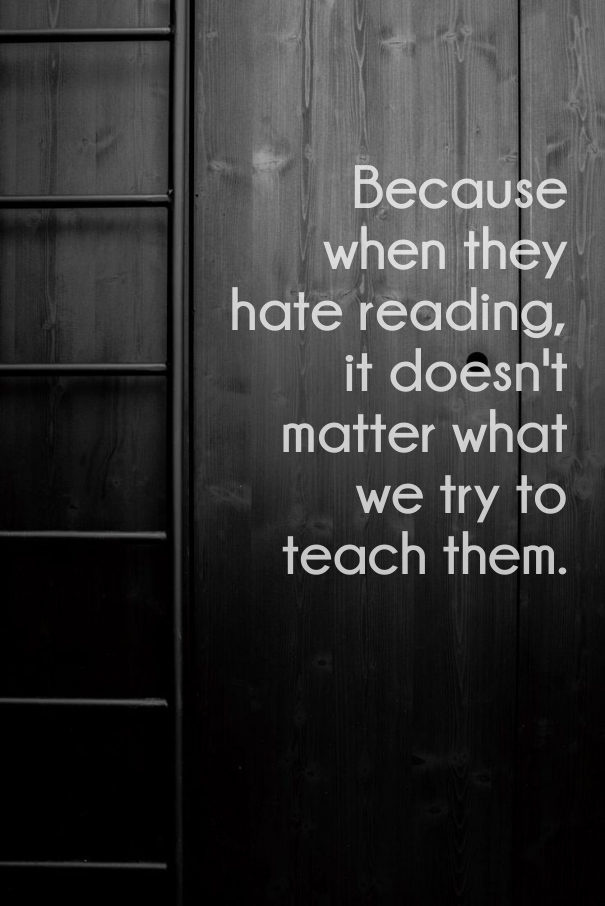
They are pushing me to think about what I do in our classroom.  How I try to wrap them up in the excitement, how my own relentless quest to find that perfect book along with them is one that deserves the time it gets.  That the very act of loving reading (or writing or math or science) is something that we must find the time to cultivate in our schools.  Even when I feel the pressure of the year and the deadlines looming over me.  Because when they hate reading (or insert whatever school related subject here) then it just doesn’t matter what strategies I try to teach them.

When they hate reading then it just doesn’t matter that I am trying to teach them how to think deeper about text.

It just doesn’t matter that I am trying to teach them to find the signposts.

It just doesn’t matter that I am trying to teach them how to write about their thoughts.  How to access harder texts.  How to understand text features or write a summary.  How to analyze rather than paraphrase.

When they hate reading then that is all they can think about.  They refuse to access the skills that they need to practice because everything we do is attached to something to something they hate.

And I get it, why would you want to do more with something you despise?

So when they hate reading we must attack that first.  Not the strategies, not the skills, but the emotion that is attached to everything we are trying to do.  We must dig and dig and dig to find out why.  And we must ask, and we must talk, and we must give them a chance to change their mind, if even just in the slightest way, as we create classrooms that are run on a culture of love for our subject, rather than a need to cover curriculum.

We can assume that they hate it because it is hard.  We can assume that they hate it because they find it boring.  That they hate it because they have to sit still, because they cannot focus, because they would rather be doing so many other things.  But we won’t know until we ask.  We wont know until we acknowledge the hatred or whatever emotion they carry so that we can do something about it.

Too often we barrel on, hoping that within our teaching something magical will happen.  Yet within our race to teach to the standards, to explore the strategies, to cover, cover, cover, we cannot forget to develop the love, develop the relationship that students need to have with what we teach so that can become invested, even if just a little bit.

So when they hate reading, or whatever other thing they loudly proclaim to hate, don’t just teach.  Listen.  Ask.  And then do something about it.  And not just by yourself, but with them.

If you like what you read here, consider reading my book Passionate Learners – How to Engage and Empower Your Students.  Also, if you are wondering where I will be in the coming year or would like to have me speak, please see this page.

books, Literacy, picture books

Great Picture Books to Use for Again & Again – Notice & Note

One of the main texts we use to guide our reading instruction is the amazing Notice and Note: Strategies for Close Reading by Kylene Beers and Robert Probst.  This book provides us with the foundation for having deeper reading conversations and a common language as we develop our thoughts.  While the book has excellent text ideas to use as mentor texts, I thought it would be nice for my students  to use picture books on the very first day of a new strategy before we delve into the longer text excerpts.  I have therefore looked for picture books I could use with the different strategies and will publish posts as I have them for the 6 different strategies since I cannot be the only one looking for ideas.

The first post was on Contrast & Contradictions, then followed Aha Moments, Tough Questions, Words of the Wiser, and now comes a tougher one to find picture books for Again and Again.

NEW Additions:

Brick by Brick by Charles R. Smith Jr. and illustrated by Floyd Cooper tells the little known story of how slaves were part of the construction of The White House.  Powerful read and powerful Again and Again moments.

Back of the Bus  written by Aaron Reynolds and illustrated by Floyd Cooper tells the story of Rosa Park’s act of courage from the  perspective of a little boy on the bus.  Powerful again and again when students notice the symbolism of the marble.

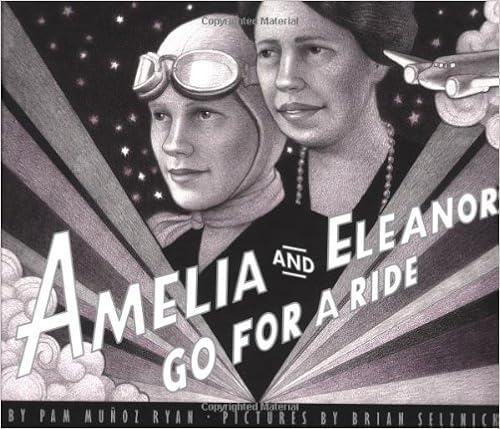
Amelia and Eleanor Go For a Ride written by Pam Munoz Ryan and illustrated by Brian Selznick has a few subtle Again and Again’s and may therefore be better suited for when students have had some exposure to the strategy.

I admit that The North Star by Peter H. Reynolds was the first one that came to mind for this strategy of noticing when something is repeated again and again.  Why?  Because the cat becomes a symbol for so many things in this book and is something that my students often notice.

With the simple line “Winter is coming” this picture book aptly titled Winter is Coming by Tony Johnston and illustrated by Jim LaMarche is great for just starting out with the strategy since the line is easy to spot and will lead to good discussions about how the book changes even though the line stays the same.

The Big Box by Toni Morrison and Slade Morrison illustrated by Giselle Potter has a lot of repetition making it an ideal candidate for again and again.  Because the words do not seem to mean much until you really start to think about their meaning.  What is the symbolic meaning of the big box?

One of the most beloved picture books in our 7th grade classroom is I Want My Hat Back by Jon Klassen which due to the hat and the repeated phrases of the bear and the rabbit are great for inferring based on the again and again moments.

Another favorite is Wolfie the Bunny by Ame Dyckman illustrated by Zachariah OHora when Dot the Rabbit keeps repeating that Wolfie will eat them all up.  This leads to some great discussion of why she would keep saying that and how we do the same as people when we judge.

The again and again moment may be a little harder to find in the classic Where the Wild Things Are by Maurice Sendak but kids always recognize it when they reach the final page and the supper is still hot.  Why does this matter and how does it link in to earlier events?

A Sweet Smell of Roses by Angela Johnson is a beautiful picture book and the again and again lies in the use of the color red as well as the phrase “Sweet smell of roses…” throughout the book.

this beautiful new picture book, My Two Blankets by Irena Kobold and Freya Blackwood keeps eluding to a blanket.  I love the metaphor that the blanket (s) represent.

Blue on Blue by Dianne White and Beth Krommes has a fantastic again and again in the way the color words are used.  While not as obvious as an again and again moment, I am looking forward to seeing if students can discover the pattern.

We are about to start our nonfiction focus for the year so I am so glad I found some great again and again moments in The Boy Who Loved Math by Deborah Helligman with pictures by LeUyen Pham.  The way the numbers are colored throughout the pages will definitely catch the eye of students.

As always, I turned to the awesome Notice and Note community on Facebook and asked them to share their favorites as well.  Here they are.

Show Way by Jacqueline Woodson.

Frog on a Log? by Kes Gray and Jim Field.

Little Elliot Big City by Mike Curato

By Frog and Mouse by Deborah Freedman

Something Beautiful by Sharon Dennis Wyeth

Shortcut by Donald Crews

Chrysanthemum by Kevin Henkes.

The Hat by Jan Brett

The Other Side by Jacqueline Woodson

The Big Orange Splot by Daniel Manus Pinkwater


As always, please add your favorites for Again and Again in the comments.  Also, did you see the new Notice and Note for Nonfiction?  I am so excited to read it.
books, Literacy, Passion, picture books, students

Great Picture Books to Spark Imagination

Whether it is to become less lonely, to find a friend, or to simply create – imagination is a huge theme of many amazing picture books at the moment. Behold some of my new, and not so new, favorites for inspiring students to use their imagination.  Beware; these tend to spark great conversations.

51zlodanbol-_sx417_bo1204203200_

What to Do With a Box by Jane Yolen and Chris Sheban is excellent in its simplicity.  Think of all of the things we can do with just a cardboard box.

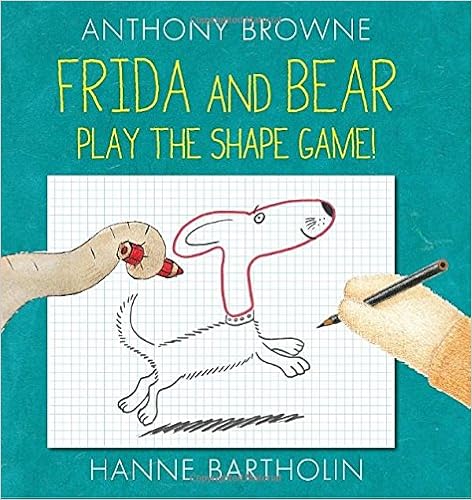
Frida and Bear Play the Shape Game by Hanne Bartholin is sure to inspire doodlers and anyone else who just wants to draw.  I loved how my own daughter right away wanted to do exactly what the characters in the book did.

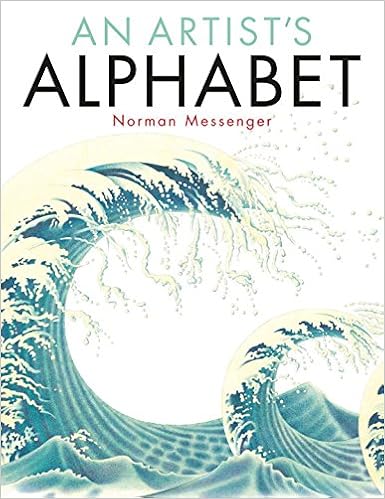
An Artist’s Alphabet by Norman Messenger is stunning.  I would love to see what types of letters kids would create after reading this book.

51xqlq2bjvpl-_sy480_bo1204203200_

I don’t know how I could have left off Peter Reynolds’ Creatrilogy from this list.  The godfathers of all creativity books these are must haves in your classroom library.

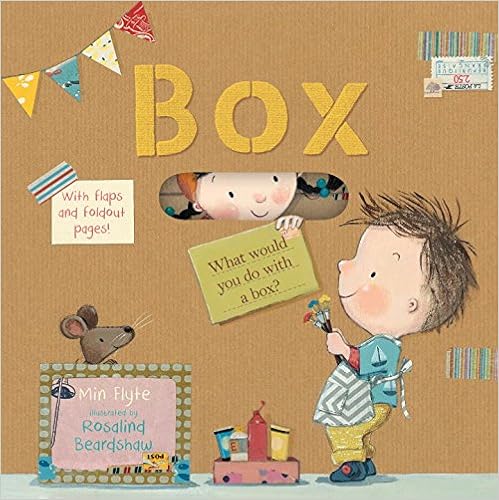
Box by Min Flyte and illustrated by Rosalind Beardshaw is a fun read with its fold out and flaps.  Yet the message is powerful, again, think of all of the things we can do with just a few items and out imagination.

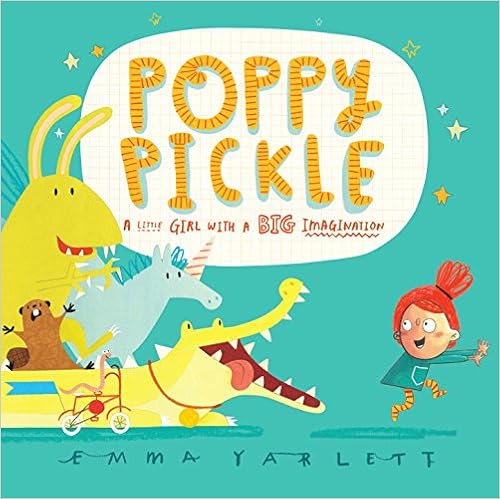
Poppy Pickle: A Little Girl with a Big Imagination by Emma Yartlett is such a fun ride.  I love poring over the pictures to see all of the mischief that happens.  What a great way to talk about what we can imagine.

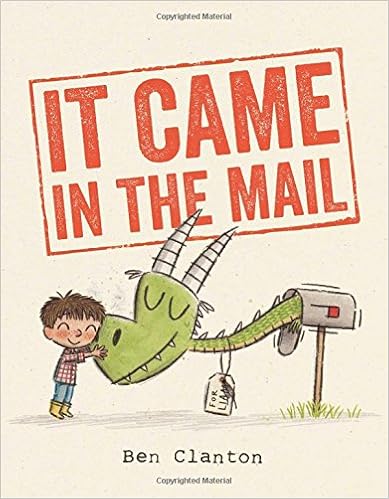
It Came in the Mail by Ben Clanton is another great mentor text.  I wonder what students would have come in the mail if they could and what the consequences would be.

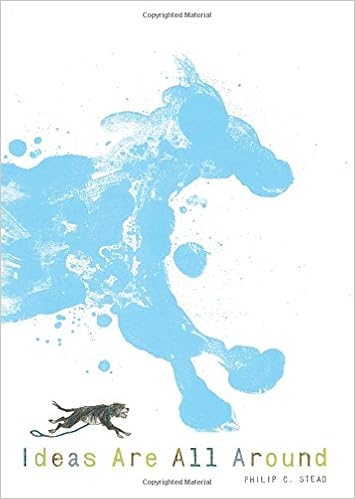
Ideas Are All Around by Philip C. Stead is a beautiful example of what happens when we are trying to write a story but seem so very stuck.  What a great book to share when we discuss writing process, how to find inspiration, and how to look for stories.

Imaginary Fred by Eoin Colfer and illustrated by Oliver Jeffers packs quite the punch on the theme of friendship, loneliness, and also what the power of finding a friend can be.  I love how it also shows what can happen with determination and once we feel we find our place in the world.  I love how it is not just the “real” people that can use their imagination to fit in.

A common theme of many of these picture books is how visually stunning they are.  Beyond the Pond by Joseph Kuefler speaks of a boy and what happens when he explores beyond the pond.  I love the vastness of the book and the journey he goes on.

I almost wrote a picture book post on powerful books about loneliness because I wanted to share the beauty of this book Lenny and Lucy written by Philip C. Stead and illustrated by Erin E. Stead somehow.  While that post will be written at some point, I also think this picture book fits quite nicely here.  Lenny and Lucy is about using your imagination to conquer your problems, and that is a powerful message indeed.  On a side note; Erin E. Stead is a contender for the Global Read Aloud 2016 picture book study!

Again the power of an imaginary friend and how having someone no one else can see cam become a problem.  I love the book We Forgot Brock by Carter Goodrich because of the friendship it portrays.

the illustrations in Imagine A World by Rob Gonsalves are astounding.  I loved reading this with my own children as well as with my 7th graders because of their reactions.  This definitely sparks ideas in students!

I love Mr. Cornell’s Dream Boxes by Jeanette Winter for how it can inspire children to use their imagination when it comes to making and creating.  By taking seemingly simple things and turning them into works of art, Mr. Cornell changed the world of art.

91IfBNII3DL

Draw! by Raul Colon is a masterpiece when it comes to explaining how an artist mind works.  I love seeing the reaction when students get to the final page and discover what the meaning behind the book is.

Papa’s Mechanical Fish by Candace Fleming and illustrated by Boris Kulikov is a book I turn to for many things; theme, perseverance, conflict, and also imagination, because it si only with imagination that the father of the book solves his problem.

How can your imagination save the most boring story?  I love the message of Battle Bunny written by Jon Sciezka and Mac Barnett, illustrated by Matthew Myers.  And I also love the students’ reaction when they first start to read it, someone always comes to report that the book has been defaced.

Only their imagination can save the kids in Chalk by Bill Thomson.  Another great wordless picture book to add to your collection.

Both Journey and Quest by Aaron Becker speak to the power of a girl’s imagination and the adventure that can unfold.  I also love how these books challenge my students’ imagination as they try to decipher what is really going on.

There are a few of our favorite books to spark imagination.  Please add those I missed in the comments.

To see the lists of other favorite books and picture books, please see the collection here.