being a teacher, books, Literacy, picture books, Reading

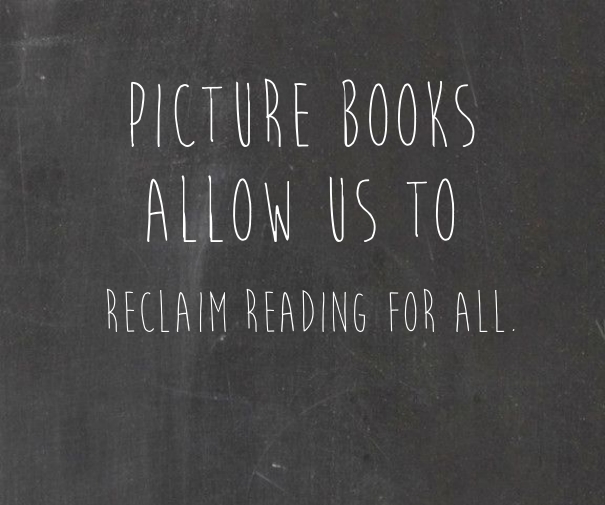
Picture Books in the Middle School

http---www.pixteller.com-pdata-t-l-281872.jpg

I feel like a broken record lately.  Always replying with the same answer as if I cannot think of anything else to say.  Yet it is not because my brain is broken or because I do not know enough about teaching English.  The truth is that when most people ask me how to teach something in reading or writing, my answer continues to be, “Have you tried a picture book?”

Picture books have become the foundation of the 7th grade English classroom that I am a part of.  They are the ice breakers that provide us with the sense of belonging, the sense of community, the sense of wonder that should always surround books and literacy.

They are the life lines I give to students when their day is on the wrong track or they simply need a break.

They are the tool I use to teach close reading, to work through Notice and Note.  They are our mentor texts for writing, for how to capture  fickle audience and keep their attention while still going deep.   They are the springboard into longer texts, the spark that gets us going.

They are the texts I reach for when I do intervention, allowing a child to not fear the text we will discuss  so we can focus on the skills we need to work on.  They are the texts that surround us when our brains are overwhelmed and we need to just take a moment to get into the groove of learning.

When a child speaks limited English, we reach for wordless books where they can practice inferring without being stumped by the language they are learning.

When a child does not understand what it means to analyze, we reach for familiar texts so we can get to the heart of the story.

Picture books disarm.

Picture books charm.

Picture books teach students that they can be successful readers with meaningful texts.  That they can write serious pieces in short bursts.  That there is no such thing as too old for a book.  That the skills they need to develop can be found within the pages of something that looks like it is just for little kids but clearly is for all.

So when you enter our classroom you will see them beckoning to be read, to be shared, to be contemplated and to be used.  You will feel the pull of the books as they call to you, begging you to be read.  And so we do, and we grow, and we laugh, and we share these stories that mirror our own or bring us into a new world.

So why picture books?  Because they have made the single biggest difference in the life of this teacher.  Because my students no longer fear reading, nor can they hate it nearly as much.  Because without them I would be constantly scrambling for a short text that we could read in our limited time together and still leave time for discussion.

Who would have thought that all of these things could be taught through the pages of a picture book?

To see which picture books we love, go here.

If you like what you read here, consider reading my book Passionate Learners – How to Engage and Empower Your Students.  Also, if you are wondering where I will be in the coming year or would like to have me speak, please see this page.

being a teacher, books, Literacy, picture books

Great Picture Books for Martin Luther King Jr. Day

Martin Luther King Jr day, held on the third Monday of January every year, is rapidly approaching.  This year, I will be in class teaching, last year I was not.  And while I believe that we should not just teach about MLK Jr or any other history related to the civil rights movement on this day, I find that many look for resources for this day in particular.  I, of course, have been searching for picture books to use with my students as we try to learn more about our country’s past and think of the changes we can make right now.

Some of these I already have, others are on my much too long wish list.  One day they shall all find their rightful place in our classroom.  Some of these are directly related to the life of MLK Jr, others are related to the movement, but they will all add to our knowledge of America then so we can better understand America now.

From Amazon:

It was February 1, 1960.
They didn’t need menus. Their order was simple.

A doughnut and coffee, with cream on the side.

Sit-In: How Four Friends Stood Up By Sitting Down by Andrea Davis Pinkney and illustrated by Brian Pinkney is a celebration of the 50th anniversary of the momentous Woolworth’s lunch counter sit-in, when four college students staged a peaceful protest that became a defining moment in the struggle for racial equality and the growing civil rights movement.

From Amazon:

It’s December 1, 1955.

A boy and his mother are riding the bus in Montgomery, Alabama like any other day—way in the back of the bus. The boy passes time by watching his marble roll up and down the aisle with the motion of the bus…

Until a big commotion breaks out from way up front.

With simple words and powerful illustrations, Aaron Reynolds and Coretta Scott King medalist Floyd Cooper recount the pivotal arrest of Rosa Parks at the dawn of the Civil Rights Movement.

I have cherished my copy of A Sweet Smell of Roses by Angela Johnson and illustrated by Eric Velasquez  for years.  This is also a great picture book for teaching theme and inference.

From Amazon:

There’s a sweet, sweet smell in the air as two young girls sneak out of their house, down the street, and across town to where men and women are gathered, ready to march for freedom and justice. Inspired by countless children and young adults who took a stand, two Coretta Scott King honorees offer a heart-lifting glimpse of children’s roles in the civil rights movement.

I stumbled across Child of the Civil Rights Movement by Paula Young Shelton & Raul Colon and have used it with the students as a way to discuss perspective.  I loved the “regular” side of MLK Jr that it presents.

From Amazon:

In this Bank Street College of Education Best Children’s Book of the Year, Paula Young Shelton, daughter of Civil Rights activist Andrew Young, brings a child’s unique perspective to an important chapter in America’s history. Paula grew up in the deep south, in a world where whites had and blacks did not. With an activist father and a community of leaders surrounding her, including Uncle Martin (Martin Luther King), Paula watched and listened to the struggles, eventually joining with her family—and thousands of others—in the historic march from Selma to Montgomery.

This post would be woefully incomplete without the magnificent picture book Voice of Freedom: Fannie Lou Hamer: Spirit of the Civil Rights Movement written by Carole Boston Weatherford and illustrated by Ekua Holmes.  Stunning is a good way to describe and the awards on its cover backs me up.

From Amazon:

“I am sick and tired of being sick and tired.”

Despite fierce prejudice and abuse, even being beaten to within an inch of her life, Fannie Lou Hamer was a champion of civil rights from the 1950s until her death in 1977. Integral to the Freedom Summer of 1964, Ms. Hamer gave a speech at the Democratic National Convention that, despite President Johnson’s interference, aired on national TV news and spurred the nation to support the Freedom Democrats. Featuring vibrant mixed-media art full of intricate detail, Voice of Freedom celebrates Fannie Lou Hamer’s life and legacy with a message of hope, determination, and strength.


Can there be a picture book list without Jacqueline Woodson’s work on it?  The Other Side illustrated by E.B. Lewis is sure to start a poignant conversation with kids.

From Amazon:

Clover’s mom says it isn’t safe to cross the fence that segregates their African-American side of town from the white side where Anna lives. But the two girls strike up a friendship, and get around the grown-ups’ rules by sitting on top of the fence together.

March On!  The Day My Brother Martin Changed the World by Christine King Farris and illustrated by London Ladd is on my wish list as well.

From Amazon:

Martin Luther King, Jr.’s, sister remembers the March on Washington.

From Dr. Martin Luther King’s sister, the definitive tribute to the man, the march, and the speech that changed a nation.

White Water by Michael S. Bandy and Eric Stein, illustrated by Shadra Strickland is a picture book I have used several times with students as we have worked through our Notice and Note sign posts.  This is another powerful story that lead to more questions that answers.

From Amazon:

It’s a scorching hot day, and going into town with Grandma is one of Michael’s favorite things. When the bus pulls up, they climb in and pay their fare, get out, walk to the back door, and climb in again. By the time they arrive in town, Michael’s throat is as dry as a bone, so he runs to the water fountain. But after a few sips, the warm, rusty water tastes bad. Why is the kid at the “Whites Only” fountain still drinking? Is his water clear and refreshingly cool? No matter how much trouble Michael might get into, he’s determined to find out for himself.

Another eye opening book for students is Ruth and the Green Book by Calvin Alexander Ramsey with Gwen Strauss and illustrated by Floyd Cooper.  

From Amazon:
Ruth was so excited to take a trip in her family’s new car! In the early 1950s, few African Americans could afford to buy cars, so this would be an adventure. But she soon found out that black travelers weren’t treated very well in some towns. Many hotels and gas stations refused service to black people. Daddy was upset about something called Jim Crow laws…

Finally, a friendly attendant at a gas station showed Ruth’s family The Green Book. It listed all of the places that would welcome black travelers. With this guidebook–and the kindness of strangers–Ruth could finally make a safe journey from Chicago to her grandma’s house in Alabama.

Another Jacqueline Woodson book that has been well loved in our library, This is the Rope always makes me think.  Illustrated by James Ransome I love the simple but oh so powerful story it tells of the rope passed through generations, witness to their history.

From Amazon:

The story of one family’s journey north during the Great Migration starts with a little girl in South Carolina who finds a rope under a tree one summer. She has no idea the rope will become part of her family’s history. But for three generations, that rope is passed down, used for everything from jump rope games to tying suitcases onto a car for the big move north to New York City, and even for a family reunion where that first little girl is now a grandmother.

I may as well add one other of my favorite Jacqueline Woodson books; Show Way illustrated by Hudson Talbott.  As a mother, I cry when I read this picture book and think of the generations that have passed before us and the injustices some have faced.

From Amazon:

Soonie’s great-grandma was just seven years old when she was sold to a big plantation without her ma and pa, and with only some fabric and needles to call her own. She pieced together bright patches with names like North Star and Crossroads, patches with secret meanings made into quilts called Show Ways — maps for slaves to follow to freedom. When she grew up and had a little girl, she passed on this knowledge. And generations later, Soonie — who was born free — taught her own daughter how to sew beautiful quilts to be sold at market and how to read.

One of our top picture books of 2015Lillian’s Right to Vote by Jonah WInter and Shane W. Evans is story telling at its finest.  In fact, I used this as a mentor text for when my own students wrote their picture books to show how many facts can be woven together.

From Amazon:
An elderly African American woman, en route to vote, remembers her family’s tumultuous voting history in this picture book publishing in time for the fiftieth anniversary of the Voting Rights Act of 1965.

As Lillian, a one-hundred-year-old African American woman, makes a “long haul up a steep hill” to her polling place, she sees more than trees and sky—she sees her family’s history. She sees the passage of the Fifteenth Amendment and her great-grandfather voting for the first time. She sees her parents trying to register to vote. And she sees herself marching in a protest from Selma to Montgomery.

There are so many more that could be highlighted but I wanted to leave it up to others to share their favorites.  We have a moral obligation in our classroom to discuss the past of the United States and these picture books help us start those conversations.

Leave it up The Nerdy Book Club to add more books to my wish list.  The First Step by Susan E. Goodman and illustrated by E.B. Lewis just came out last week and looks like a must add to any classroom library.

From Amazon:

In 1847, a young African American girl named Sarah Roberts was attending a school in Boston. Then one day she was told she could never come back. She didn’t belong. The Otis School was for white children only.

Sarah deserved an equal education, and the Roberts family fought for change. They made history. Roberts v. City of Boston was the first case challenging our legal system to outlaw segregated schools. It was the first time an African American lawyer argued in a supreme court.

These first steps set in motion changes that ultimately led to equality under the law in the United States. Sarah’s cause was won when people–black and white–stood together and said, No more. Now, right now, it is time for change!
being a teacher, Literacy, picture books, Reading

And the Winners Are…Our Mock Caldecott Predictions 2016

It has been an incredible week diving into the world of the Caldecott with my students.  Every day, we have taken time to discuss amazing picture books, vote for our favorites, and remember what reading is all about falling in love with incredible books.  While I will do a more detailed post on how we did the unit later, I couldn’t wait to share our predictions as we eagerly await for the awards.

To see how I did the unit, follow this link for my very basic planning document with resources that were shared to me by the incredible Mock Caldecott group I was included in on Voxer.   

I did not have a beginning list of picture books for the students to choose from, but instead pulled all of my 2015 picture books for them to browse through.  I had also searched online for buss books and then either purchased those or requested them from my library.  They therefore had about 200 books to start with and yes, they said it was hard to narrow it down.

My first hour class chose….

Honor (a tie between two books):


Boats for Papa – Art and Story by Jessixa Bagley

Marilyn’s Monster – story by Michelle Knudsen, Art by Matt Phelan

Honor:

Strictly No Elephants – Story by Lisa Manchev, Art by Taeeun Yoo

Medal:

My third hour class…

Honor:

Elwood Bigfoot: Wanted Birdie Friends – Story by Jill Esbaum, Art by Nate Wragg

Honor:

Waiting – Story and Art by Kevin Henkes

Medal:

The Night World – Story and Art by Mordicai Gerstein


My fifth hour class…

Honor:

If You Plant A Seed – Story and Art by Kadir Nelson

Honor:

To the Sea – Story and Art by Cale Atkinson – Sadly this one turns out to be ineligible.  While my students were in charge of vetting the illustrators, this one slipped through the cracks.

Medal:

The Night World – Story and Art by Mordicai Gerstein

My sixth hour class…

Honor:

Growing Up Pedro – Story and Art by Matt Tavares

Honor:

If You Plant A Seed – Story and Art by Kadir Nelson

Medal:

Water is Water – Story by Miranda Paul, Art by Jason Chin

My seventh hour class…

Honor:

Beautiful Hands – Story by Kathryn Otoshi, Art by Bret Baumgarten

Honor:

Toys Meet Snow – Story by Emily Jenkins, Art by Paul O. Zelinsky

Medal:

The Night World – Story and Art by Mordicai Gerstein

And finally, my own predictions…and since it is my blog, I get to pick more than 2 honors.

Honor:

Lenny and Lucy – Story by Philip C. Stead, Art by Erin E. Stead

Honor:


Waiting – Story and Art by Kevin Henkes

Honor:

Voice of Freedom: Fannie Lou Hamer: The Spirit of the Civil Rights Movement – Story by Carole Boston Weatherford, Art by Ekua Homes

Honor:

Finding Winnie: The True Story of the World’s Most Famous Bear – Story by Lindsay Mattick, Art by Sophie Blackall

Honor:

Wolfie the Bunny – Story by Ame Dyckman, Art by Zachariah OHora

Medal:

Last Stop on Market Street – Story by Matt De La Pena, Art by Christian Robinson

being a teacher, books, Literacy, picture books, Reading, student choice

Our Top Picture Books of 2015

For the past 3 days, my 7th grade students have been furiously discussing the their favorite picture books as we get ready for the Caldecott awards.  While we have not voted for our top 3 yet, I thought it would be worthwhile to share our all of our favorite picture books from 2015.  What I love the most is the care that the students are putting into their conversations surrounding their selection, looking beyond the “What a great story!” and really searching for picture books that will leave a long lasting impression instead.  Note, some of these are sadly ineligible for the award since the illustrator does not reside in the US, nor are they a citizen.  So if you are looking to boost your picture book collection, start with some of these incredible books.

The Skunk – story by Mac Barnett, Art by Patrick McDonnell

Strictly No Elephants – Story by Lisa Manchev, Art by Taeeun Yoo

Strictly No Elephants Art and Story by Jessixa Bagley

Drum Dream Girl – Story by Margarita Engle, Art by Rafael Lopez

Frederick’s Journey: The Life of Frederick Douglas – Story Doreen Rappaport, Art by London Ladd

Sidewalk Flowers – Story by Jon Arno Lawson, Art by Sydney Smith

Sad, the Dog – Story by Sandy Fussell, Art by Tull Suwannakit

Marilyn’s Monster – story by Michelle Knudsen, Art by Matt Phelan

I Don’t Like Koala – Story by Sean Ferrell, Art by Charles Santoso

The Night World – Story and Art by Mordicai Gerstein

Lenny and Lucy – Story by Philip C. Stead, Art by Erin E. Stead

Waiting – Story and Art by Kevin Henkes

Little Bird’s Bad Word – Story and Art by Jacob Grant

I’m Trying to Love Spiders – Story and art by Bethany Barton

To the Sea – Story and Art by Cale Atkinson

Elwood Bigfoot: Wanted Birdie Friends – Story by Jill Esbaum, Art by Nate Wragg

Float – Story and Art by Daniel Miyares

The Bear Ate Your Sandwich – Story and Art by Julia Sarcone-Roach

Henry Hyena, Why Won’t You Laugh? – Story by Doug Jantzen, Art by Jean Claude

Beautiful Hands – Story by Kathryn Otoshi, Art by Bret Baumgarten

If You Plant A Seed – Story and Art by Kadir Nelson

Pom Pom Panda Gets the Grumps – Story and Art by Sophy Henn

Growing Up Pedro – Story and Art by Matt Tavares

Voice of Freedom: Fannie Lou Hamer: The Spirit of the Civil Rights Movement – Story by Carole Boston Weatherford, Art by Ekua Homes

Water is Water – Story by Miranda Paul, Art by Jason Chin

Last Stop on Market Street – Story by Matt De La Pena, Art by Christian Robinson

Toys Meet Snow – Story by Emily Jenkins, Art by Paul O. Zelinsky

Finding Winnie: The True Story of the World’s Most Famous Bear – Story by Lindsay Mattick, Art by Sophie Blackall

The Only Child – Story and Art by Guojing

I cannot wait to see which books are in the top!

To see other favorite books in our classroom, go here

being a teacher, books, Literacy, picture books, Reading

10 More Picture Books to Add to Your Collection

I cannot do a best of the year book list.  There are too many that I have loved.  There are too many I have yet to discover.  A book always gets left off and I wonder why I forgot it.  So instead, I will continue my tradition of offering up some great new additions to our classroom library.  I have been on a year long mission to get as many great picture books into the hands of my students, and so here is the latest batch that we have been reading aloud, discussing, using, and sharing.

When I wanted to send a picture book to Australia, I knew that I wanted to send one by Wisconsin native Pat Zietlow Miller.  So I sent the  book Wherever You Go.  Not only does it have the best message, but I have also found that every age group I have read it to has loved it.  It is a new classic in my opinion.

My school is very focused on creating an inclusive environment for all students and so I have been on a mission to include more picture books that speak to all of my students.  Jacob’s New Dress by Sarah and Ian Hoffman is a book a child may need, I don’t need, but in case they, I want it to be there for them.

As my students created their own non-fiction picture books I needed strong mentor texts to show them just how amazing this genre can be.  Growing Up Pedro by Matt Tavares is an incredible example of a sports focused nf picture book that does not read like a long list of facts.  This is a book that will be read and used for years to come.

The same goes for the historical nf picture book Lillian’s Right to Vote by Jonah Winter and Shane W. Evans.  In it we learn about the fight for voting rights for African Americans as Lillian walks up the stairs to cast her vote.  Masterfully told, this one moved me to tears.

Picture books don’t usually make me cry, but this one did as I read it aloud to my own children.  Eve Bunting is a master storyteller, Fly Away Home is a book I have used many times.  The pairing here in Yard Sale with Lauren Castillo’s beautiful illustrations is really out of this world, and the conversations, the inferring that can happen because of this book is powerful.

Can Kadir Nelson do anything wrong?  If You Plant A Seed not only has a great message for all ages, but the illustrations are breathtaking.

Groundhog’s Dilemma by Kristen Remenar and illustrated by Matt Faulkner is not just a book for Groundhog’s Day.  It is a book for all ages that need to discuss what peer pressure can do to you and how to navigate friendships.

This one, Once Upon an Alphabet by Oliver Jeffers, is the reason Oliver Jeffers is a Global Read Aloud Contender for the picture book category.  While perhaps hard to read aloud in one sitting, it is definitely still worth sharing with others as each little story will make you laugh or wonder.  I also cannot wait to see what type of writing might be inspired by this book.

I love a narrator that speaks to their reader, it gets me every time.  Snappsy the Alligator (Did Not Ask to Be in This Book) by Julie Falatko and illustrated by Tim Miller is laugh out loud funny, and yet, is bound to also lead to a great conversation about how to deal with others.  How many of our students could need a little with that?

How many of us have taught students whose parents or other people they know are in jail?  Visiting Day by Jacqueline Woodson once again means that we have a book that can start hard conversations.  That students can find themselves in even if they do not want to share about their own experiences.

There are always more books to highlight, to share, but for now I will leave it at these 10.  To see other lists of favorite books, go here, I try to share as much as possible.

being a teacher, collaboration, global, Literacy, MIEExpert15, picture books, projects, Reading, skype, student choice

Our Epic Nonfiction Picture Book Project Take 2

For the past few years, my students have written nonfiction picture books for younger audiences around the world.  Last year, I decided to share the lesson plan to serve as inspiration for those who wanted it, and this year I thought I would do the same.  While the foundation is the same, the process has been tweaked a bit for a more meaningful experience for the students.

The goal of the project is rather simple; create a 15 to 25 slide/page nonfiction picture book meant for a 2nd or 3rd grade audience on anything you wish to write about.  Throughout this project we have been able to successfully marry tech tools with writing, as well as use Skype, Padlet, Twitter and other interactive tools.

Why this project?  Because within it we have been able to work on:

  • How to take organized notes in a way that works for them.
  • How to write a paragraph and all of the myriads of lessons that are attached to that.
  • Grammar!  Spelling!  Punctuation!
  • How to find legal images.
  • How to cite sources, including images, books, and websites.
  • How to uncover reliable sources (yes, there is a place for Wikipedia in our research).
  • How to search the internet better.
  • How to conduct market research using Skype to ask 2nd or 3rd graders what they want to read and how they want to read it.
  • How to rewrite information in our own words.
  • How to do design and layout on a page to make it inviting.
  • How to create good questions.
  • Exploring our own interests.
  • How to write assessment rubrics.
  • How to work as a peer mentor group.
  • How to monitor self-engagement.

So a few details about the project:

  • This is a 3-week long project, anchored by a 10 or so minute mini-lessons every day and then work time the rest of class.
  • Mini-lessons have centered around how to take notes ( I showed them 3 different ways), how to research well, how to write paragraphs, how to rewrite information, and anything else we have had to address.
  • Students were able to ask questions to 2nd and 3rd grade classrooms via Skype to do market research, and incorporate that feedback into their project.
  • I am using this blog and Facebook to find classrooms that will assess the final product.  If you would like to be one, please fill out the form at the end of the post.  Those that sign up to give us feedback, fill out this Google form.
  • Students create their books in Google Slides for easy access for all (we check out Chromebooks), as well as easy design and layout.

Major Changes for this year:

The addition of Google Classroom.

This year we have been using Google Classroom to post tools, create the project, as well as use as a gathering point.  This addition has made it much more manageable as far as giving students the information they need, as well as seeing where students are.  If you have not looked into Google Classroom, this is a great project to use it for.

The Peer Mentor Group.

Students are in peer mentor groups as of today.  These groups are meant to be support groups that also help hold each other accountable.  Students gave me three names; a friend they know well, someone they kind of know, and a name for someone they would like to know.  I then made the groups puzzling out their requests.  Groups are between 2 and 4 people are will be used almost every day as an informal check-in.

The shortened timeline.

Last year we did this project for 6 weeks and although the students stayed fully engaged, we shortened it to 3 because we realized we could achieve the same deep engagement with a shortened product.  It also means the students are using their time better because they know every minute counts.

The actual lesson plan:

Expectations:

  • Finished product should be a 15 to 25 page book, created in Google Slides,  that not only includes 4-5 or so “chapters/sub-topics” but also has a glossary, table of contents, works cited, front and back cover, as well as an about the author.
  • Font size of text should be at least 20.
  • Students will use at least one print research material and supplement with reliable internet sources.
  • We will use the website Easybib.com to cite all of our sources which will be done in conjunction with tech tools.  Cross collaboration is a great idea here.
  • We will spend time in class researching, writing, as well as sharing our work.  Students should be able to finish this in class if time is spent wisely.  

Sample:  Will be shown in class and linked to here.

Modifications/Support provided:

  • Some students will be invited to work in small groups with me and/or support teachers.
  • Graphic organizers and templates can be provided for those who need to follow a format.  To access them, please go to this Google presentation and make a copy as needed.

Mini-Lesson Materials:

Every day, we will focus on a mini-lesson meant to bolster the skills and needs of the students.  The following mini-lessons will be taught (in order):

  1. Exploring NF picture books; what are their text features and why are they important?  Template for this discovery can be found here.
  2. What do you want to teach the world?  Narrowing down topic and finding research materials.  Brainstorming research questions to guide their reading.  
  3. Who is your audience?  What do we know about 2nd and 3rd graders? Preparing for our market research Skype call.  Creating a Padlet with what we think we know about 2nd and 3rd graders reading preferences.  An example can be seen here.  Students also meet in their peer mentor groups to share their topics, their questions and what they are excited about.  
  4. Skype call to classrooms, during the call students will take notes for themselves and afterwards we will update our Padlet with what we know now.  Research time reading their books.
  5. Taking 3 column notes in notebook or Google docs.  Example template can be found here.  More information on this type of note-taking can be seen here
  6. Taking notes on notecards and providing graphic organizers for the notes.  (I glued 6 envelopes into Manilla folders and then laminated them many years ago.  These work well for students because they can use them to organize their notes in sub-topics and can write on the folders using dry erase markers.)  Here is what I share with them as an example.
  7. Using Diigo as a way to take notes (refresher from Tech tools).
  8. Unscrambling a paragraph – parts of a paragraph  (example taken from here)
  9. Fill in the main idea and conclusion – found here
  10. Informal to formal paragraph – found here Alternate is writing a sample paragraph
  11. Teach to your partner, checklist can be found here
  12. Table of contents – what does it do, what does it need?
  13. Glossary – what does it do, what does it need?
  14. Self-assessment, peer edit if they want to and review, checklist can be found here
  15. Turn in 

That’s it, pretty much.  Feel free to modify/adapt/share.

If you would like to receive some of our finished picture books to give feedback on and your teach 4th grade or younger, please fill out the form.  Picture books will be shared at the end of December and you will have until mid-January to provide the feedback.