A month off with big plans of all the things I was going to do, and so many things I didn’t. I didn’t plan really. I didn’t read PD books, or watch webinars, or delve into education shorts. I have not stressed, mostly. Instead I have read, I have cooked, I have gardened, I have explored, I have napped – so many glorious naps. And I have been present with people I care about as much as possible. It has been glorious, and oh too short.
But now a new year beckons, and with that I will teach 2 different third grades in Danish. I cannot wait to experience what being a split classroom teacher will be like.
I know many of you are also gearing up to head back. Some of you still have weeks left, others only days. Perhaps like me you are looking for some inspiration of where to start? Two years ago, I created this resource for my Patreon community, and so I thought it might be helpful to share it here- it’s called the “First 20 Days of Reading” calendar, and here is a sneak peek of what is behind the link.
As many of us embark on a new school year, I believe that fostering a love for reading is one of the most precious gifts we can give to our students. This calendar is designed to build independent reading stamina and cultivate a reading community within our classrooms.
📖 Why the First 20 Days? 📖
Research has shown that dedicating just 20 minutes of daily reading time can have a significant impact on children’s word acquisition, vocabulary, and writing skills. Moreover, creating a positive and engaging reading environment can help instill a lifelong love for reading in our students.
💡 What’s in the Calendar? 💡
The “First 20 Days of Reading” calendar is a curated collection of 20 fun and manageable reading activities, each meant to take little time and be added on to our independent reading time. These activities are designed to introduce reading choices, nurture reading enthusiasm, build reading stamina, and foster reading independence. And of course start the focus on reading identity development.
You can pick and choose between using some of these activities or all of them. You do not need to follow the order precisely either, as always, you know what you need. But I wanted to pull out a timeline approach for all of the components we can introduce when fostering reading culture and give you a placer to hang your ideas. The sky is the limit and I would love to hear what else I could add in.
👉 Access the Calendar 👈
To access the calendar and get started on this reading adventure, simply go here! Feel free to customize the calendar based on your students’ needs and interests. I included links to all the surveys and questions plus more.
So as I pack up my family to head home from a summerhouse, say goodbye to my family visiting from the US – wow is that ever hard – I hope this little post will give you some ideas, maybe save you some time, or maybe be that missing thing that you didn’t know you needed.
I will be sharing throughout the year as I embark on this new school year. Perhaps you will too?
How many times have we heard a child say, “I’m not good at reading”? Or watched one put a book back on the shelf, saying, “This is too hard for me,” even though we suspected that they could read it — if only they would give it a shot?
Lately, I’ve been thinking a lot about what stops kids from fully stepping into their reader identity. About the stumbling blocks that are, indeed, man-made. It’s not always decoding or fluency or stamina. Sometimes, it’s internal.
After reading Anne-Laure Le Cunff’s powerful piece on intellectual self-doubt, I couldn’t stop seeing the connections. The very patterns she outlines in adults show up, in different ways, in our students’ reading lives. Because while every reader is on unique path of discovery and reading exploration, there are similarities in how they interact with books when they don’t feel like a reader, and those we can look more closely at.
We know that the act of reading is wrapped in emotions. That self-worth and social hierarchy placement can be closely linked to your perceived skills as a reader. That being a reader or not being a reader can be anchored in childhood as an adult identity-marker. And so it makes sense that our students want to shield themselves from perceived hardship or failure – don’t we all? And so we often see a form of “reading resistance,” which to some may come across as laziness or avoidance. But what if instead we viewed as a form of imposter syndrome? Then we can enter the conversation in a different way, while bringing the readers in our care along.
Here’s how these patterns might show up in our classrooms — and what we can do to help.
Support: Model messy reading. Think aloud when you mess up. Celebrate effort over perfection. Give them low-stakes spaces to take risks — silly poems, decoding games, or buddy reading with younger peers where they feel competent.
The Reading Perfectionist
Potential underlying imposter syndrome: “If I don’t get every word right, I’m a bad reader.”
🧠 Manifests as:
Whispering or mouthing words when reading aloud, avoiding risk of error.
Fixating on misread words or “getting stuck” and refusing to continue.
Asking repeatedly, “Is this right?” before turning the page or writing about a book.
Getting upset during assessments even with high accuracy.
Support: Model messy reading. Think aloud when you mess up. Celebrate effort over perfection. Give them low-stakes spaces to take risks — silly poems, decoding games, or buddy reading with younger peers where they feel competent.
💡 Further ideas:
“Mistake of the Day” Club: Make small decoding or comprehension missteps a shared, safe laugh — create a space where every reader can submit one and reflect.
Sticky Notes of Bravery: Let kids mark pages with a note like “I wasn’t sure, but I tried.” Celebrate risk-taking during sharing.
Co-created anchor charts: “What Good Readers Do When They’re Stuck” — keep it visual and student-owned.
The Natural Genius Reader
Potential underlying imposter syndrome: “If this book is hard, it means I’m not a good reader after all.”
🌟 Manifests as:
Makes vague claims like “This book is boring” or “I already know what’s going to happen.”
Rapid early reading growth, followed by a plateau and sudden disengagement.
Avoids challenging books after one or a few “failures” (can’t pronounce, understand, or keep up).
Prefers familiar series or picture books they can master easily.
Support: Teach struggle as normal. Share your own stories of books that stumped you. Use “just right struggle” texts and help them see confusion as part of deep reading. Introduce the idea that strong readers ask questions — and don’t always know the answers.
💡 Further ideas:
“Struggle Stars” wall: Post quotes from students about books that challenged them. Normalize confusion as part of growth.
Teach the “Reader’s Curve”: A simple visual model showing early success → plateau → productive struggle → breakthrough.
Reading Journals with “Stuck Points”: Instead of summaries, have them record where they don’t understand — and celebrate re-reading or asking for help.
The Solo Reader
Potential underlying imposter syndrome: “If I ask for help, it proves I can’t read.”
🚪 Manifests as:
May quietly resist support or conferencing.
Hides books behind desks or reads in isolation.
Avoids joining book clubs, doesn’t volunteer to partner read.
Says “I’m fine” or “I like reading alone” but rarely talks about books.
Support: Normalize collaboration. Use pair shares, peer book recommendations, or “reading buddies” where asking questions is expected. Let them be the helper sometimes too — it builds trust. Shift the narrative: strong readers talk about books together.
💡 Further Ideas:
Invisible Book Clubs: Let kids respond to the same book on post-its or Flip videos without needing to talk face-to-face at first.
“Ask Me Later” buttons: Offer students a nonverbal way to defer help — gives autonomy without removing support.
“One Book, Two Readers” challenge: Quiet students read the same book as a peer — then choose their own way to share (drawing, writing, or private discussion).
The Super Reader
Potential underlying imposter syndrome: “I have to read more than everyone else to prove I’m a real reader.”
🏁 Manifests as:
May use reading to seek validation, not joy.
Logs 30+ books per month, but gives vague or superficial summaries.
Gets anxious when “behind” on reading goals.
Chooses quantity over quality: “easy wins.”
Support: Slow them down. Invite reflection. Use journals, book talks, or drawing to process books in new ways. Help them find balance by honoring books that move them — not just books they finish.
💡 Further Ideas:
“Read Slow” Challenges: Celebrate books that take a week or more to finish. Offer awards for “most thoughtful pause,” “best reread moment,” etc.
“This Book Changed Me” board: Help them reflect on impact, not volume.
Weekly Deep Dive: Once a week, they must pick just one book to discuss in detail — what moved them, surprised them, challenged them.
The Expert Reader
Potential underlying imposter syndrome: “I need to understand everything before I can say I read it.”
📘 Manifests as:
May demand “correct” interpretations from teachers. Freezes up during book discussions, afraid of being wrong.
Asks few questions, fearing they’ll reveal gaps in knowledge.
Abandons texts quickly if meaning isn’t immediate.
Support: Emphasize curiosity over correctness. Use “I wonder…” prompts. Let them see you grappling with questions too. Build habits of metacognition — maybe through post-its, wondering journals, or group discussions where questions are more valued than answers.
💡 Further Ideas:
“Wonder Logs”: Replace standard comprehension questions with “I wonder,” “I noticed,” “I’m confused by…” logs.
“One Word Summaries”: Ask students to capture a whole chapter or character using one word — forces synthesis, not certainty.
Un-Googleable Questions Wall: Collect and explore deep, complex questions that have no single right answer.
Bonus Tip: Support All 5 with Metacognition Mini-lessons
Build in weekly reflection that honors emotional and identity aspects of reading, not just skills:
“What kind of reader were you this week?”
“What made you feel confident — or not?”
“What book surprised you?”
“What was hard… and what did you do about it?”
So where do we go from here?
We remind ourselves and our kids: doubt is normal. Growth is messy. And identity — especially a reader identity — isn’t something we give them. It’s something they build, slowly, with support, belonging, and choice.
We can’t eliminate their reading struggles, but we can reframe them. We can help them see effort not as evidence they’re failing — but as proof they’re learning.
Like Anne-Laure writes, the most successful people (and readers!) aren’t those who never doubt themselves — but those who learn to keep going with the doubt.
In my Patreon community, a fellow educator recently reached out with a growing concern: their district has mandated the exclusive use of Lexile-leveled texts in English classes. That’s right—only texts that align with students’ grade-level Lexile scores are now considered acceptable. The frustration in their message was tangible. Texts that students love, that have sparked rich discussions, and that they’ve built curriculum around are now off-limits because they don’t “fit” the approved band.
I’ve long raised concerns about the over-reliance on Lexile scores. Like many of you, I’ve seen firsthand how these measures, while perhaps well-intentioned, can be wielded in ways that do real harm to reading joy, choice, and depth. So, if you’re facing increasing pressure to center Lexile in your classroom—if you’re trying to navigate a system that keeps narrowing what “counts” as appropriate reading—I hope these thoughts and ideas help.
Limitations of Lexile
Limited Understanding of Text Complexity
Lexile scores are essentially math. They rely on sentence length and word frequency—quantifiable features that can be measured by an algorithm. But we all know that complexity is never just about numbers. A book like Night comes in at a relatively low Lexile level, and yet its themes of loss, isolation, and moral ambiguity leave readers shaken. A text might be “simple” on paper but profound in practice.
Instead, try:
Use a text complexity triangle (quantitative, qualitative, reader & task) when planning. Bring students into that process—ask, What makes this book challenging? What makes it powerful?
Encourage student reflection journals or book clubs where kids identify their own “hard” books—not based on Lexile, but on how the text made them think, feel, or struggle.
Create classroom charts that define complexity through student terms: “Books that made me cry,” “Books I needed to reread,” “Books I’ll never forget.”
Considerations:
How does Lexile account for the cultural and historical significance of a text?
What qualities of a book matter most to your students?
How can we expand students’ definition of what makes something “challenging”?
Exclusion of Inclusive Texts
One of the most heartbreaking outcomes, and oft-overlooked aspects, of Lexile-only policies is the quiet erasure of culturally rich and relevant literature. Books written in vernacular, verse, or translanguaged text often get pegged with a low Lexile, despite their emotional and intellectual heft. That means fewer books by authors of color, fewer windows and mirrors for our students, and fewer moments of deep connection.
Instead, try:
Curate parallel text sets: pair a high-Lexile nonfiction article with a lower-Lexile but deeply resonant novel or memoir. Let students draw connections between form, voice, and truth.
Push back by documenting engagement: show how students are thriving with texts “below level” by collecting writing, discussion notes, and self-reflections.
Use picture books and graphic novels with older readers—these often get dismissed due to low Lexile, yet offer rich analysis opportunities and accessibility.
Considerations:
What culturally relevant texts are missing from your curriculum because of Lexile?
How can student voices help you advocate for broader criteria?
How do we make the case that what students read matters more than how difficult it is to decode?
Narrowing Students’ Reading Choices
If we want kids to love reading, we have to let them choose what they read. That means trusting them with books that fall outside their “band.” Lexile-driven mandates send the opposite message: we don’t trust your choices, your interests, or your readiness. But reading joy isn’t built through constraint. It’s built through access, autonomy, and meaningful support.
Instead, try:
Build “just-right-for-me” libraries where students classify books based on interest, not level. Include sticky notes with peer reviews and genre tags.
Hold 1:1 conferences where students reflect on how books make them feel, not just how hard they are to read.
Share stories of your own reading life: books you loved that were “easy,” books you gave up on, books that changed you. Model complexity in decision-making, not just content.
Considerations:
What happens when we let students build their own definitions of “good reading”?
What are the long-term consequences of only offering scaffolds instead of skills?
How do we teach students to be readers without us?
Ignoring Individual Student Needs
Teaching is about relationships. About knowing the kid who hides behind her hair and always picks dog books. About the one who just discovered he loves horror. About the quiet student who will read 600 pages if you don’t make him write a log. Lexile scores can’t know them—but we can.
Instead, try:
Use Lexile as one data point—alongside student interviews, running records, self-assessments, and your own observations.
Let students set reading goals that reflect their identities: “I want to finish my first series,” “I want to read a book by someone like me,” “I want to try nonfiction.”
Co-create book stacks that mix comfort reads, stretch texts, and “wild cards” just for fun.
Considerations:
How can we restore the nuance of teaching in a data-driven system?
What tools do you use to get to know your readers deeply and personally?
How can you document growth in ways that go beyond numbers?
I’m not anti-data, far from it. But I am against any system that flattens our readers and limits our reach. We deserve better tools. Our students deserve broader definitions. Reading instruction should be built on relationships, curiosity, and choice—not compliance.
So when Lexile threatens to become a gatekeeper, let’s push back. Let’s expand what counts. Let’s keep joy at the center. And let’s keep sharing what works—not just because it sounds good, but because we’ve seen it in action.
I’d love to hear how you are navigating this. What has worked in your district? How are you reframing conversations about levels, choice, and rigor? Let’s keep this conversation going.
Last week, I was surprised to be asked to speak at another Danish school about the joy of reading to their 4th-9th grade students. Surprised because I am not really anyone who is invited to anything here in Denmark. And also; when was thelast time I went out to speak to students that weren’t my own?
At first, I was pumped. Getting to talk reading and sharing book joy is something that keeps me smiling. But then, as I thought some more about it, I realized that I was the wrong person to bring in.
Not because I couldn’t do the talk. I can. But because the work that might need to happen is work that needs to happen before someone like me comes in. I don’t believe that an outsider – even someone like me who lives and breathes books – can create the lasting impact they’re hoping for. A spark yes. Inspiration ,yes. But without a foundational change in how we view reading in our buildings, all I will be, is a flash. Someone who (hopefully) created joy, but didn’t really impact the culture, at least not yet.
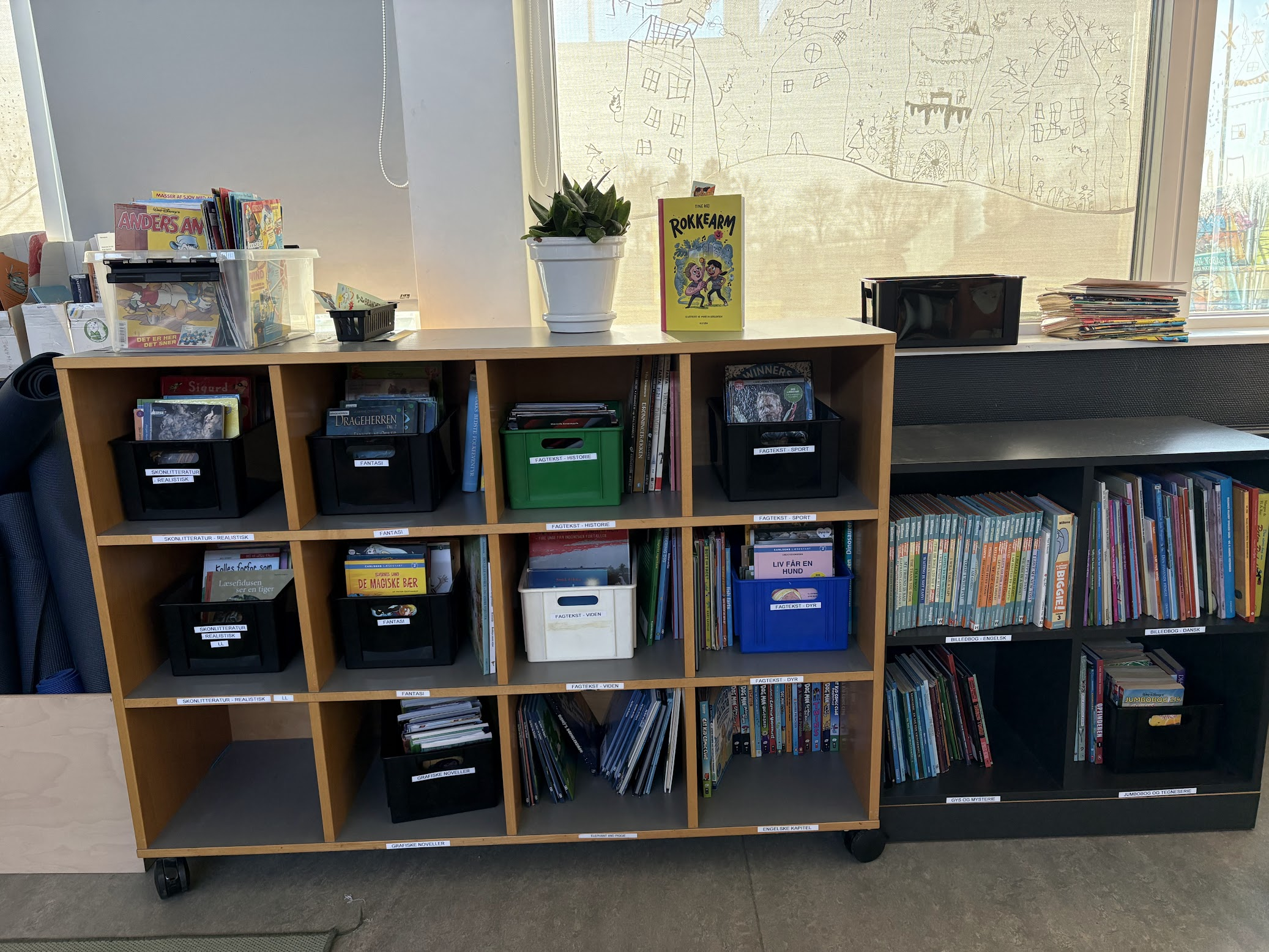
Instead, I believe the real magic happens when we co-create a shared reading culture within your own school walls. When time is specifically made to decide o which type of reading culture you want to have, and we then take the time not only to protect what is already working, but also create new initiatives.
The best reading culture doesn’t come from one-off visits, but from sustained, daily practices that live and breathe in your classrooms and hallways. It’s about fostering local reading connections: Who are your reading role models? Who will lead the charge and share their own reading journeys, not just during a special event, but every single day?
This is why when we want to build reading joy and ownership among students, it’s essential to think beyond a single day or a single guest speaker. While guest speakers and single days can create the momentum, we need more to keep it going. We need to invest in the small, consistent acts that make reading feel alive, relevant, and shared.
So, what does that look like in practice? Here are some ideas for how you might get started – but don’t forget to also include your students. What would they say the focus should be? What would they say is working? What would they say needs to change?
Readers as Role Models and Community Builders
Student reading ambassadors: Choose students who can share book recommendations, host quick booktalks, or lead reading events across grade levels. Their excitement will hopefully spread.
Staff reading showcases: Create a “We’re Reading…” wall where teachers and staff post photos with their current reads, along with a short note about what they love about them. Let students see that reading isn’t just for kids – it’s for everyone. Or do it individually, I have shared my “Mrs. Ripp is currently reading and loving…” wall many times.
Cross-grade reading buddies: Pair older students with younger ones. Let them read aloud, share favorites, and have conversations about books. It’s about connection and mentorship, not just fluency.
Teacher Reading Swap: Each month, two or three teachers “swap” their current read and do a short booktalk for the other’s class. It’s a great way to cross-pollinate reading excitement and show that adults read widely too.
Surprise Guest Readers: Secretly invite parents, local authors, or even the school custodian to pop into classrooms to read a short passage from a book they love. Let them share why it matters to them – it builds authentic connection.
Digital Book Shoutouts: Start a “Reading Reel” on your school’s social media: teachers and students record 30-second videos sharing a book they’re obsessed with. It’s quick, it’s relatable, and it makes reading feel cool and visible.
Classroom “Book Pods”: Instead of traditional reading groups, let small student “book pods” form around a shared interest (like graphic novels, sports, fantasy, etc.). They self-organize discussions, book swaps, or mini-displays.
Celebrations and Rituals Around Reading
Reading Ritual Starters: Start or end the day with a tiny “bookish moment” — a teacher shares a one-minute excerpt from what they’re reading, or a student shares a sentence they loved from their book. A quiet, daily sprinkle of reading.
Bookmarks of the Week: Students create bookmarks with a favorite quote or character from what they’re reading and swap them with classmates. A small but personal way to celebrate reading lives.
Window Wonders: Encourage classes to decorate a window or small bulletin board with their current favorite reads. It’s not about big displays — it’s about little visual peeks into reading life, shared daily.
Quiet Reading Buddies: Once a week, two students pair up and read their own books side by side, no talking. Just sharing quiet reading time — the focus is on the joy of reading with someone, even in silence.
One New Word: Each day, invite a student to share one interesting word they came across while reading. It’s a micro-moment of wonder and wordplay that sparks conversation without taking over the day.
Mini-Postcard Reviews: Students write a tiny “review” (one or two sentences) on a sticky note or postcard for a book they finished. Collect them in a communal jar or box — a low-key, ongoing celebration of finished reads.
Reading Stretch: Between transitions, teachers read a single sentence from their current read aloud. It’s a way to infuse reading into those spare minutes, normalizing it as a shared part of school life.
Collective reading challenges: Instead of focusing on individual reading logs, have classes or teams set collective goals – like reading enough to travel (on paper) to a new city or country. Celebrate their journey together.
Reflection and Building Reading Identity
“My reading life” maps: Have students draw or write about when, where, and how they read, and what reading means to them. These reflections can be surprisingly powerful.
Reading Time Capsules: Have students create a “reading snapshot” – what they’re reading now, their current favorites, and one book they hope to love next year. Seal it and revisit at the end of the year.
Bookish Mood Boards: Instead of just writing about books, let students create mood boards (digital or physical) to capture the vibe of their current favorite read – colors, textures, images.
“Why I Abandoned This Book”: Normalize that not all books work for everyone. Students can reflect on a book they didn’t finish and why and create a bulletin board. It’s a great way to build critical thinking and give permission to stop reading what doesn’t click.
Reading Playlist Pairings: Invite students to create a short playlist that pairs with the vibe of a book they’re reading. Share the playlists with classmates – a creative, multimedia way to share bookish identity.
“Who am I as a reader?” activities: Structured exercises where students think about their favorite genres, their reading goals, their best reading memories. This builds ownership and identity.
Meaningful reading goals: Move beyond page or book counts. Encourage goals like, “I want to find a book that makes me think,” or, “I want to reread an old favorite and see if it still feels the same.”
Saying no to the speaking invitation wasn’t easy, after all, who knows if I will ever get a chance like that again. But without the other work happening, I am just not enough to create a culture shift for students. Not yet anyway. After all, a reading culture isn’t something you import – it’s something you grow together.
I think we are all really good at setting goals. But goals that we actually attain? Those are harder. So when I think of the reading goal work I do and have done with students, there is a small tweak that has made a big difference: including the why. And not in teacher lingo, but in the everyday kid language that shows us this is something they have truly reflected on.
Why have they chosen what they chose? What should the end result be?
Does it even align with who they are and what they have the capacity for right now?
This small tweak can lead to a deeper understanding of how they want to grow overall and move goals from being checklist items to meaningful pursuits. It can also show us which kids are just setting goals to please the adults or get it off their to-do. There is a lot of parroting that happens in schools, kids know what we teachers want to hear and so often when it comes to setting learning goals, kids tell us what we want to hear. Asking them to pause and add on an answer to “in order to” gives us a chance to open up for much broader conversations, and also continue our focus on developing readers and not “just” reading skills.
I have shared my reading survey before, but here is my 6 week survey that I use every 6 weeks to check in with students. This is where they set new goals and it has been updated with this addition.
Another post first shared on Patreon, but one that is oh so relevant as we continue to attempt to build meaningful reading relationships.
I came across a fascinating article that discussed the three pillars of self-compassion and how actively developing it can help us alleviate anxiety and depression. Immediately, my mind jumped to reading identity and overall school affinity for students. How does self-compassion and seeing your own worth tie in with how we develop and what we are willing to try?
So I have a few ideas for how we can take this work and bring it into our classrooms as a part of what we already do. In my experience, some kids who hate reading have this reaction because of how reading makes them feel; worthless, and so when we focus on developing self-compassion, they can sometimes shift their mindsets into one of awe rather than disappointment.
Reading is an incredibly complex brain capability. It is not something that just happens, but something we have to train our brain to do, thus the need for specific reading skills teaching, as well as positive reading experiences. When kids don’t develop as easily as they see others do, they often turn that inward, seeing themselves as less-than, rather than recognizing that many components need to be in place to develop as a reader and that we inherently develop at different speeds. And we can try to speak this out of existence, but we all know that ultimately the deeper realization needs to come from the child themselves.
Adding these ideas into the reading conferring that hopefully is happening provides us with an opportunity to dig deeper into how kids view themselves as readers, and the next steps they can take in their journey. So it is not that it is one more thing to do, but rather a new lens and line of questioning we can explore with those kiddos who despite all our attempts still hate reading.
I use a lot of surveys with kids in order to see how they view themselves as readers. My beginning of the year one – which can be used any time – can be accessed here but sometimes a quick survey like this one can also be a great way to check in and deepen conversations.
I would love to know your thoughts on this. Do we even have time for this? How do we make the time? What are the conversations we can have with kids that help them take over the ownership of their reading development?