Reading Identity

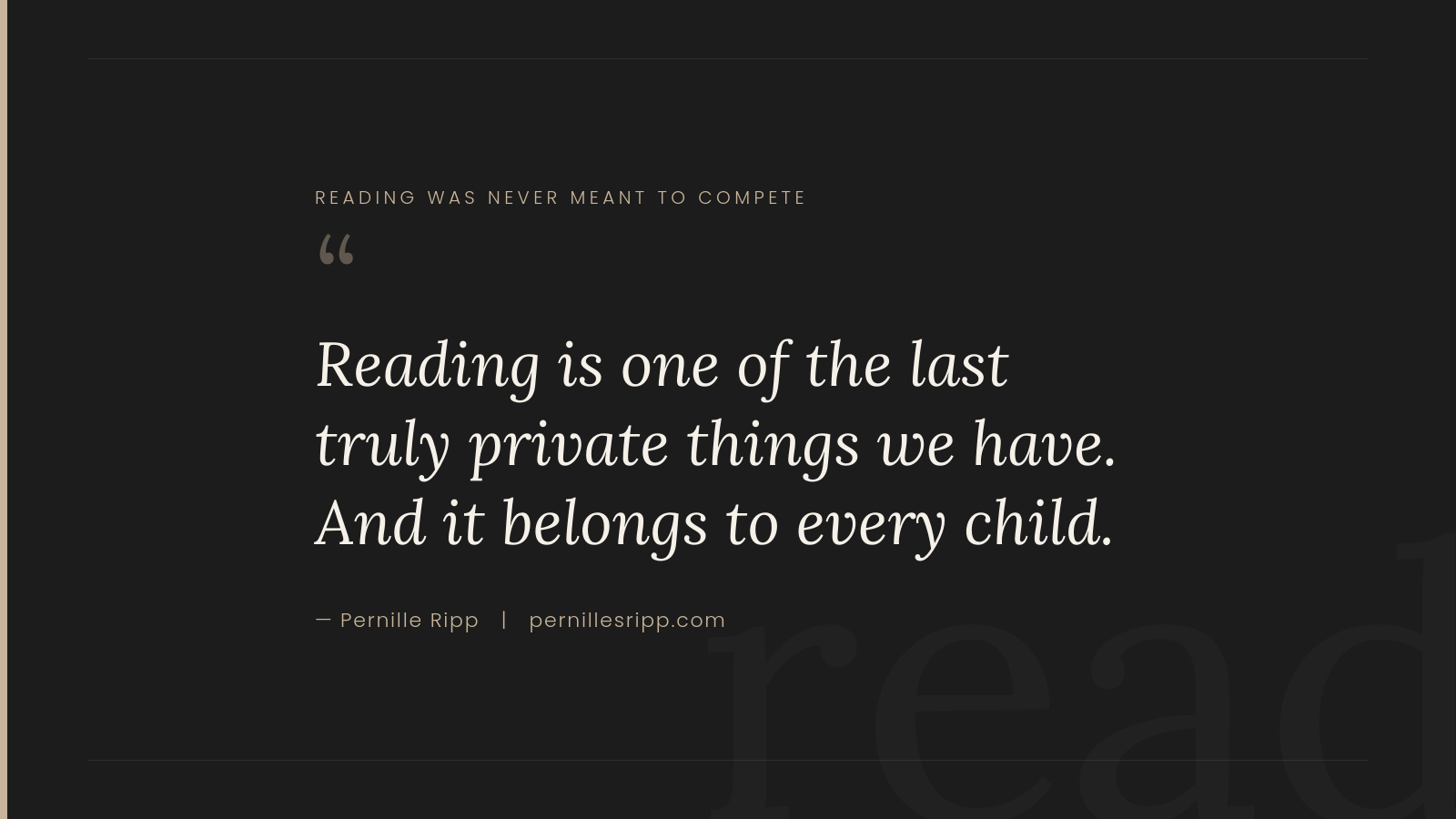
Reading Was Never Meant to Compete

We talk about reading as if it is in a race. As if every time a kid picks up a phone instead of a book, reading has lost a point. And I understand why we frame it that way. The competition feels real. YouTube, social media, every platform built around the endless scroll, they are extraordinary at what they do. The additives of a phone and everything that comes with it, the brain chemistry they tap into, the way they are engineered to keep you coming back, it’s a losing race, we cannot compete with that.

But here is the thing. Reading was never supposed to compete.

It is not a faster, quieter version of TikTok. It is not trying to win your attention the way an algorithm does. Reading is its own thing entirely. And the moment we stop treating it like a competitor and start presenting it to kids as something categorically different, something that exists in a completely separate space from their devices, everything about the conversation changes.

Reading offers quiet. It offers balance in a world that is otherwise relentlessly loud. It offers the health benefits we know are real, focus, empathy, stress reduction, the slow building of an inner life that is completely our own. But more than any of that, it offers something increasingly rare: A place where we do not have to perform.

How often does that happen?

With a book, no one is watching. Well, unless you are reading in public, of course. There are no likes, no comments, no version of yourself being constructed for an audience. You get to just be with a story. Not be judged. Not worry about what anyone thinks. That is a selfish indulgence, and I mean that in the best way. In a world that is constantly asking us to consume, to engage, to spend more time on their platforms, reading quietly says: this is for me. Just me. And the way it restores me is something I can’t let go of.

Giving kids the gift of reading is one of the few things we can offer them that pushes back against all of of the consumption and production. Not by banning phones or lecturing about screen time. But by showing them that reading exists in a different category altogether.

If we want kids to see reading as its own thing and not as a lesser version of entertainment, we have to change how we talk about it.

Stop framing it as the alternative to screens. When we say “put down your phone and read,” we immediately set up a competition reading will lose. Instead, talk about reading as something you do for yourself, not something you do instead of something else.

Talk about the privacy of it. Kids live remarkably public lives, even at young ages. I don’t envy my own children in any way when I think of the type of teen years I had, I am so glad there were no cameras ready to record at any moment. The idea that reading is a space that belongs entirely to them, where no one can see what they are thinking or feeling or imagining, is genuinely powerful. Name that out loud.

Celebrate the selfish part. Reading is one of the few things in a child’s life that is purely for them. Not always to improve their grades, not just to make a teacher happy, not to perform for anyone. Let them hear you say that. Reading is something you do because it feels good and it is yours.

Model the quiet. Let kids see you read. Not as a lesson, but as something you genuinely want to do. When they see an adult choose a book, not to be productive but simply to be still for a while, that lands differently than any message we could ever deliver. This is yet another reason to make your reading life public in some way.

Connect it to who they already are. Reading identity is not built through assignments. It is built through the experience of finding a book that reflects something true about you, or takes you somewhere you wanted to go, or makes you feel something you could not name before. Our job is to help kids find those books and then get out of the way.

The algorithm wants our attention and it is so easy to fall into. Social media wants your engagement. Every platform is designed to want something from you.

Reading wants nothing. It just waits.

That is not a weakness. That is exactly what makes it worth protecting and worth giving to the young people in our lives as the gift it truly is.
being a student, books, Reading, Reading Identity

Lessons in Genre—and in Failure

We have been studying genres in 3rd grade.

Something so simple, and yet such a powerful key to unlocking yourself as a reader. For some students, these classifications are crystal clear; they already have the language that wraps around them as readers. For others, the designations are murky at best—confusion between fiction and nonfiction (which I completely understand in this day and age), and even what it means for something to be a genre at all.

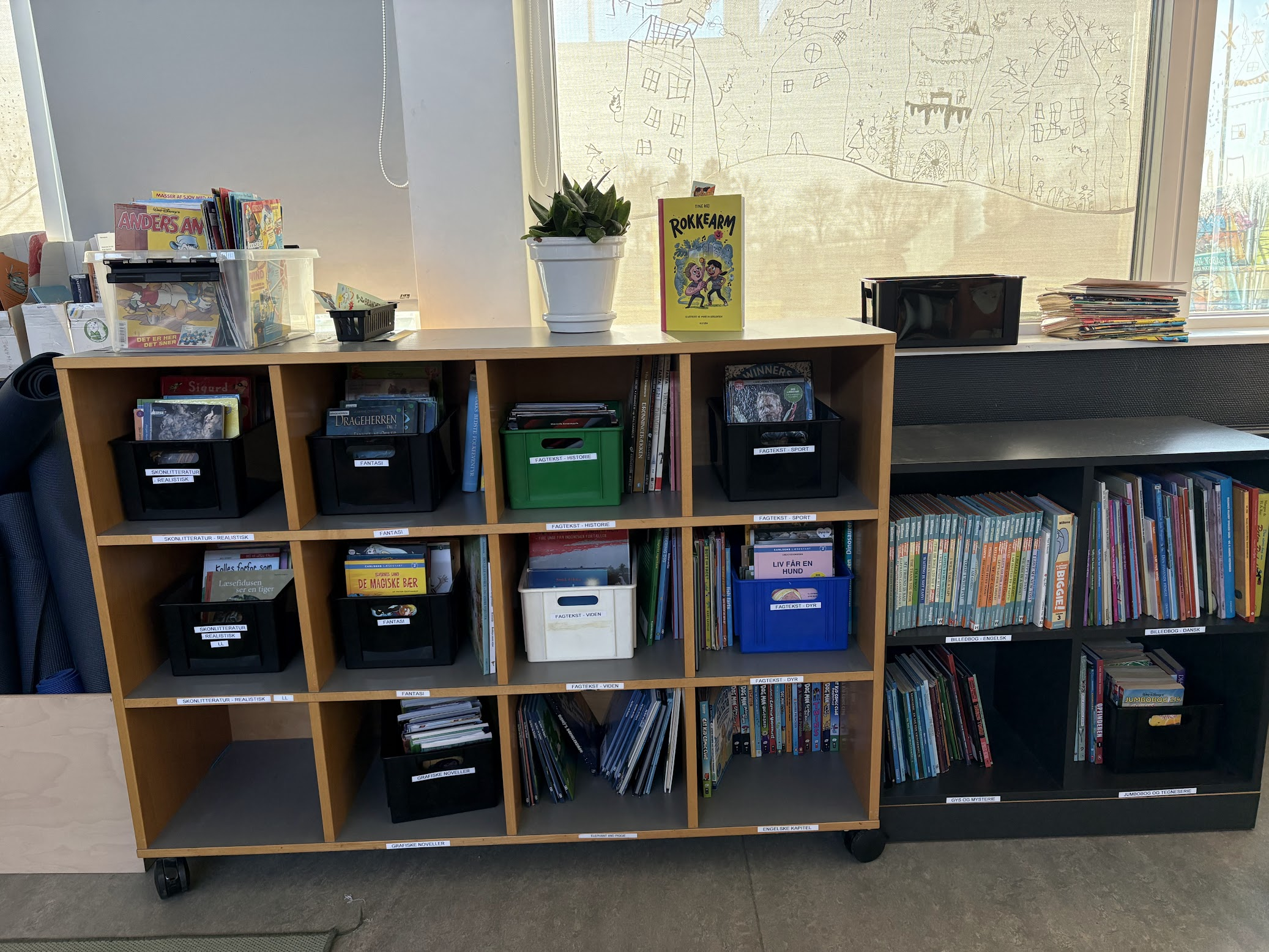
It’s also a practical challenge: how do we turn a messy classroom library into something students can actually navigate? Sorting books by genre is a powerful way for students to deepen their understanding of different types of texts and make the library itself more accessible. It is something I have believed in for years.

And so, we persisted in the work. We sorted texts and discussed what makes something realistic fiction, fantasy, horror, or nonfiction. What separates fantasy from a scary story? How do we know realistic fiction isn’t just fantasy in disguise? Their questions were legitimate, and they shaped the work we did.

To truly see their comprehension in action, we turned to our modest classroom library. Those who have followed my work from before my move to Denmark may remember my vast classroom collection—books spanning walls, even rooms. I left that library behind for the teacher who took over my classroom, knowing it would have more use in the United States than it would here.

But that also meant starting over.

Books in Denmark are expensive—often more than 200 kroner (around $20) even for an easy reader. Classroom libraries are not seen as a priority. School libraries aren’t either in some places. So building a collection has been slow, relying on goodwill finds, donations from our amazing librarian and some families, and a few contests won along the way. It is nothing impressive. It may never be. But it is real, and it reflects the reality of many educators.

And it is a place to start.

I teach two 3rd-grade classes in Danish: one I have been with since 1st grade, and another added this year. With my “old” class, the task was simple. After our genre lessons, I introduced the project: let’s sort and categorize our classroom library using the knowledge we now have. We decided on which genres and even subgenres we thought we would have, discussed their abbreviations and then launched into the process itself; I would hand them piles of books, they would sort them by the genre or format they believed they belonged to by creating piles on tables, I would create labels, and together we would shelve them.

It took two lessons, but by the end our classroom library was mostly sorted correctly, and the students were eager to dive back into books they had discovered along the way.

Buoyed by this success, I brought the same process to my new class. I knew they might need a little more guidance, but surely my well-planned lesson would be successful.

It was not.

It was frustrating, confusing, and messy—and through no fault of the children. They tried their very best to figure out what we were doing and to do it well, as they always do. But the pieces they needed simply weren’t there yet.

So I took time over the weekend to think it through and quickly recognized my mistakes. They needed far more scaffolding. They needed the work to stop feeling like a competition over who could get through the most books. They needed to lean on each other for guidance. They needed explicit permission, as always, to ask questions and to not be sure out loud.

On a day when I knew I had them for three periods in a row, I knew we could afford to get messy. I reintroduced the concept and explained the new plan.

Two students, who seemed to have genre determination skills firmly in place, sat at the lead table. Their job was to decide whether a book was fiction or nonfiction and to venture a guess at its genre or format (graphic novels and comics were sorted onto their own shelf). They passed their books to three other students, who double-checked the decision and delivered them to the appropriate genre table. Each genre table was staffed by a student whose job was to agree—or disagree—and send the book back if needed.

I placed students based on their perceived strengths within a genre. Some worked alone. Some sat near related genres so they could support one another. And then we began.

At first, there was hesitation. Were they really sure that a certain book belonged in a certain genre? How could they even tell again?

But as the process continued, their confidence grew. Their decisions became more certain. Help was offered more freely. It was still messy. It was still a bit chaotic. But the process worked.

Not because I taught it better—but because I reconsidered my scaffolding. I reconsidered the conditions. I stepped away from my own attachment of feelings to a lesson—failure—and recognized that this, too, was success: realizing, once again, what didn’t work and adjusting the conditions., with the only failure being to not do it again.

In the end, this wasn’t really about genres, or even about sorting a classroom library the “right” way. It was about slowing down enough to notice where my teaching had raced ahead of my students, and choosing to meet them where they actually were. Understanding didn’t come from efficiency or speed, but from time, conversation, and the safety to be unsure out loud.

The messiness didn’t disappear when I changed the structure.

The noise didn’t go away.

But what did change was who carried the thinking. Students leaned on each other. They questioned, disagreed, and revised their ideas together. And in that space, comprehension began to take root.

We now have a tiny little classroom library, where the gaps in what we don’t have are stark, and yet the hope of finding books to read feels big. Students get to look at the bookstacks and decide which books to keep and which to let go.

It’s a small piece, but one that further cements their identity as readers—students who now know that if they understand the genres they enjoy, they can seek out those books first. Students who have taken a big step toward knowing who they are, and perhaps even more importantly, who they want to be as readers.

It may have taken longer than expected. It may have veered off course. But those hours spent were hours I know were worth it.

So for now, the reading continues.