being a teacher, Reading, Reading Identity, student choice, Student dreams, Student Engagement

Growing Readers Past our Classroom Walls

I recently had the gift of being observed by teachers outside of our district.  Our students are used to it and go about their regular ways, no putting on a show for strangers here.  I always get nervous because while I think our community it magical, I am not sure what it looks like to outsiders.  Do they see all of the growth?  The work?  The small routines and decisions that go into creating the learning community we have?

During our conversation, a fellow teacher asked me how I help our students read outside of our classroom, after they leave, either for the day, the week, or even the year.  And while I am not sure all of our students do, I have seen the change once again this year.  I have seen many students read more.  I have seen more students embrace books and reading.  I have heard kids who told me they hate reading also have a favorite book to share when asked.  Knowing that there is a change afoot,  made me realize that once again, this subtle difference of not just wanting to read inside the classroom, but outside of it, is something we accomplish through a lot of small steps and not just one thing.  And that as always many of the ideas I have come from others who have graciously shared their ideas such as Penny Kittle, Nancie Atwell, and Donalyn Miller with a few tweaks thrown in just for us.

It starts with a fully stocked classroom library because I need our students surrounded by books at all time.  I need them to see the importance of always having a book ready, of always picking their next read.

Then it becomes where else do you get books from?  We use our school library but also talk about all of the other books are present.  Where can they access books beside our room?  Where will they get books from over the summer? If they can’t get to a library, I will gladly lend them some.

It starts with the creation of a to-be-read list and while some readers already have these in place, many don’t.  Many also don’t see the need and fight me for a long time about it, usually dismissing it with the idea that they already have a book to read.  Yet, we make one and then we use it, day in and day out as I ask them to please open to it when we have a book talk in the room.

Then it becomes a tool they adapt to use on their own.  So we start with one way to keep track but then we discuss how else they can have a list.  Is it on their phone? Is it their Goodreads account?  Is it the never-ending wishlist on Amazon?    What will they actually use so that they always have ideas for what to read next?  It cannot be my system because they will never maintain it once I am gone.  And so when they ask me what they should read next my first reminder is always to check their to-be-read list, to start there so they remember all of those books they thought might be worth their time.

It starts with book talks by me.  Every day, every class.  Students get used to the routine and write down titles they are interested in.

Then it becomes book talks by students because little beats a recommendation from a fellow student.  Whether it is through unofficial moments where I ask students to share a recent favorite read, our more structured thirty -second book talks where they actually write down what  they will say and I have the covers ready to project, or to their end of year “Best book of the year” speech, they get used to discussing books, sharing favorites and not so favorite, of speaking about books without me.

It starts with book shopping with them, we set up our routine together the first week of school remembering how to book shop.  Discussing how it is totally fine to judge a book by its cover as long as we look at other things as well.  Then we book shop as a class or I help a child who needs it with one-on-one guidance.

Then it becomes them book shopping with friends.  Rather than book shopping with me, I step further in the background, not highlighting as many books and also looking around for a peer for them to book shop with rather than me.

It starts with me being a reading role model.  And being an obvious one.  While I always say this is “our classroom,” it is my books read covers that grace our walls, and my book talks that dominate at first.  However, that is not good in the long run because we don’t set students up for continued independence but instead further their reliance on us.

Then it becomes students as reading role models.   And so, giving the conversational space back to students to make sure they know each other as readers, while they learn about themselves as well is a main focus for us. Students not only reflect on their own reading habits but also share with each other. They not only recommend books but also discuss reading plans. And while I certainly share my own as well, I am only one voice of many.

It starts with a discussion of summer reading and it’s importance.  Casual comments made about keeping the reading spark alive, of discovering who they are as a reader.

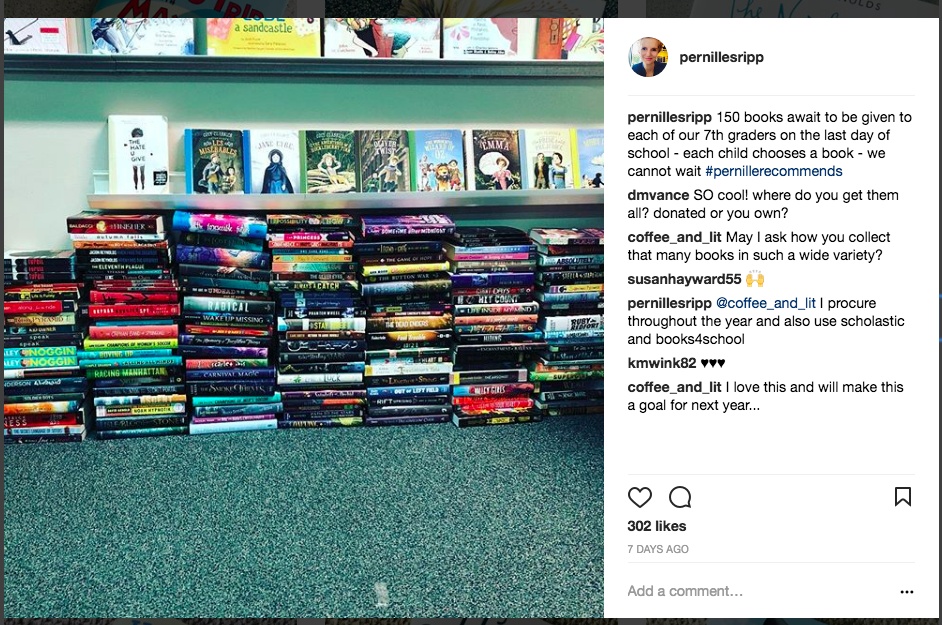
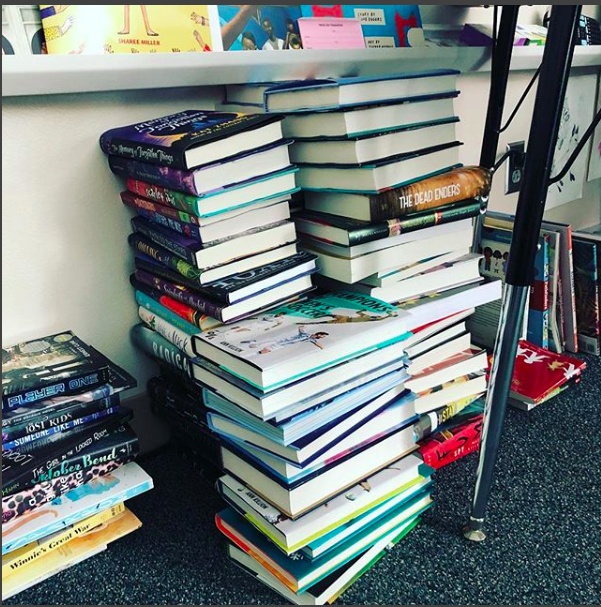
Then it becomes making plans.  Actually discussing how they plan on continuing their reading after they leave our classroom.  They share ideas, I share ideas, and we discuss why it matters.  We discuss the books they want to read.  We take pictures of their to-be-read list and email it home.  They borrow books from me and share their favorite reads.  This isn’t a one day lesson, it is a lesson that evolves, that crops up when needed, that is repeated more urgently as the year winds down.  After all, it took some of our students a long time to become readers, why should staying one take less time?

when I look at the reading community I get to be a part of every day, I cannot help but notice how the power of it always lies within the small details; the books, the displays, the conversations and yes, the patience and persistence that it takes to help build a reader.   None of that happens overnight.  None of that happens with just one book.  Or just one person.  It takes a community, it takes deliberate action, and it takes an endless amount of belief that every child can have positive experiences with reading.

If you like what you read here, consider reading my newest book, Passionate Readers – The Art of Reaching and Engaging Every Child, out August 2017.  This book focuses on the five keys we can implement into any reading community to strengthen student reading experiences, even within the 45 minute English block.  If you are looking for solutions and ideas for how to re-engage all of your students consider reading my very first book  Passionate Learners – How to Engage and Empower Your Students.      Also, if you are wondering where I will be in the coming year or would like to have me speak, please see this page.

Be the change, being a teacher, Literacy, Reading, Reading Identity

On Certain Books for Certain Kids

We spend a lot of time in bookstores and libraries.  So much so that my own children at the moment are playing library downstairs.  We go for the inspiration, for the support of booksellers, to find new must-have purchases.  We go as a family to recommit to reading, to get excited about what it means to be a reader.

But once in a while, something strikes me as out of place even in a bookstore.  Today it was this sign at our Barnes and Noble.

IMG_3364

I fixed it for them on my Instagram account.

IMG_3365

And yet, all jest aside.  These small signs.  These sections of libraries.  These displays that cater to only one identity, only one culture, only one representation.  They may seem trivial at first and yet they add to the continued perpetuation that some books are for some kids.  That some books will only be liked by the people it is directly marketed to.  This is problematic because it once again speaks to certain books being for certain kids.  It speaks to certain stories being the ones worth publishing.  It speaks to how we only want diverse books if those books are diverse in the way we see fit.  (Just like what the NY Times wrote about here.)  It speaks to how we only display books celebrating African American history when February reminds us too.

We wonder why some of our students have stigmas when it comes to the books we read, and then don’t think to look at our own learning spaces to see where those stigmas are created.

But we have to do better than this.  We have to do more, and it once again starts with the small details that we do have control over.

We have to first question how we use the word “Diverse” as Chad Everett cautions us to do in his blog post, where he reminds us all that the minute we call something diverse we are once again establishing whiteness as the norm.

We have to question the divisions we create in our classroom and school libraries.  When we hand boys “Boy books” and don’t book talk a book to the whole class because it really is just meant for the “girls.”  When we describe certain books as girly or fluffy and then hand it to a female.

When a child needs our help with book shopping and in our eagerness to help that child “see” themselves in books we only hand them books that feature characters that look like them.  We have gotten better at handing white, hetero, cisgender kids window books, but don’t other identities deserve that too?

When we invite female authors to our schools and then only invite the girls to see them because boys might not understand or be engaged with the message.

When we create displays that honor African Americans and only pull out books that feature them marching or Civil Rights or in chains as enslaved people.

When a child tells us they loved a certain book and we assume we know why and don’t ask them what they loved it so we can help them find a better book, not based on our assumptions but actually on their desires.

When we only purchase books from the large publishers and don’t seek out the independent ones like Lee and Low who have been focused on creating a better world through books for many years.

When we herald big publishers creating special imprints to honor the voices of those who have been traditionally left out from their publishing houses, but we don’t question why they were left out in the first place.  Why not publish them within their traditional branch?

When we are quick to “otherize” books and then hand them to kids as something that they can only identify with because of a shared trait, we are quickly teaching kids that they should only care about those that they share those same traits with.  That unless they can find a surface commonality with someone then their time is not worth investing.

And so we must continue to do better.  We must evaluate our learning spaces, our books, our displays, our book talks, and even who we hand which books to so that we can do better.  We must continue to push for better representation and for an end to the notion that certain books are for certain kids, rather than just waiting to be discovered by everyone.

If you like what you read here, consider reading my newest book, Passionate Readers – The Art of Reaching and Engaging Every Child, out August 2017.  This book focuses on the five keys we can implement into any reading community to strengthen student reading experiences, even within the 45 minute English block.  If you are looking for solutions and ideas for how to re-engage all of your students consider reading my very first book  Passionate Learners – How to Engage and Empower Your Students.      Also, if you are wondering where I will be in the coming year or would like to have me speak, please see this page.


being a teacher, Literacy, Reading, Reading Identity

Some Small Ideas to Help Students Self-Select Books Better

I was asked this morning on Twitter how we move students beyond wanting hand-picked recommendations every time they book shop.  How do they move beyond needing someone, typically, the adult or trusted reading role model to help them find the next book to read?

The truth is there is no simple answer, however, there are things that we can do starting on our very first day that starts this process of independent book selection that will last beyond our classroom experience.  And while it certainly starts on the first day of school, there is no “too late” for this to be implemented.  These ideas make a difference no matter when, so it is not too late (nor too early) to start working toward student independence in self-selecting texts.  So where do we start?

We build our libraries, both whole school and classroom libraries. 

In fact, we need to become advocates for our school library and our certified librarians to make sure that everyone knows just how much they matter to our school and to our reading lives.  (If you need to see research on the importance of school librarians, here is a great place to start).  And then we build our own classroom libraries as well, filling them with a wide representation of topics, readability and format that fits all of our readers and not just a few.

In fact, we must bring classroom libraries into every classroom so that children can see that reading is something that can happen in any subject area and not just English.  While supporting classroom libraries and school libraries may seem costly, they make a difference, in fact, Morrow and Neumann both report that children read 50-60% more in classrooms with libraries in them than those without.  And we must think of the books that we surround our students with asking ourselves not just WHO is represented, but HOW are they represented and also who is NOT represented?  Students must be able to find themselves but also see others in the very books we place in front of them.

We carefully craft our book displays.

I was at my public library yesterday, a beautiful building that has a dedicated library staff, and yet their teen section is bland and boring.  Every time I go there, I wonder why?  Why not pull books and put them on display?  Why not use the power of visual representation to pull our readers in?  Why not show off the hottest new reads and help kids find the books they may not know they want to read?  SO in our classroom, the displays are always changing.  The books facing out rotate through.  Our book tree where students and I showcase our favorite books is always being reworked.  Books surround us because they need to be staring at us, calling to us at all times.  And I place books knowing where they will catch the eyes of students so that they want to grab them.  Not in haste, but carefully so that students feel the urge to read.

We have a to-be-read list.

This simple list in our reader’s notebook is our someday list to quote Nancie Atwell.  The books that perhaps we want to try reading.  The books we are enticed to read but may not have time to read just yet.  The book list is always growing and it is a must for all students to have it in some form, whether on paper or on their device.  Whenever a child book shops, I ask them to pull out their to-be-read list so that it becomes a habit.  Whenever a book talk happens, I ask them to pull out their to-be-read list so that they remember they have it.  We discuss them, we share them, and we remember that they should be filled with maybe books because they know that some of those books they will abandon.  This list is also sent home with students on the last day of school physically, and an image of it is emailed home or shared in some other way.

We book talk books almost every day.

I start every single day with 10 minutes of independent reading unless we are in book clubs where the time comes later in the period.  After this sacred ten minutes, it is time for a book talk, first by me and then by others.   I keep my book talk short and sweet, holding up the book and showcasing an image of the cover behind me so that students can write down the title.  If it is a student doing a book talk I quickly find the cover to project behind them as well. I remind students to write the title down if they are enticed by it, otherwise, many will forget to do this simple step.

When students do book talks, we either do it on the fly, asking simply if someone has a book they want to recommend or I have them fill out a notecard with a 30-second book talk and then give them their notecard when it is their time to recommend.  I will have the book cover images ready to project as well.

We do lessons on how to book shop.

One of the first lessons I do in the year is how to book shop, while this may seem crazy, I teach 12-year-olds after all, I have found it to be a necessary reminder.  Kids will tell you they know how to bookshop but then they simply go through the motions, not actually looking at the books or even finding any they want to read.  So we break it down into a whole lesson, described more in detail here so that students know what I am expecting and are also reminded of what they should do while browsing books.  Before we head to our school library every other week, they are also reminded of how to book shop down there, transferring their skills to a different environment as practice, because this is what they need to do once they leave us.

We just say no.

Many of my students would rather I book shop with them at all times, and while I will gladly support this in the beginning of the year, as the year progresses I pull back that support.  I tell them they have to book shop on their own, show me their pile, and then I can certainly help out after.  While it depends on the child, some get the idea pretty quickly and develop that independence, while others need repeated experiences.  While I feel bad telling a child “No,” I also see the necessity of it; if we never say no, they will never stop asking, because, let’s face it, it is much easier just to ask an adult than do the work themselves.  We have to teach children to not be helpless in our classrooms, and that includes when they select their next book.   If we never give them the opportunity to try to figure it out themselves then they will not have grown like they should have.

We dive into their reading identity.

If a child does not know how to self-select a text, independent of Lexile, levels, or other outside systems, then they do not know themselves as a reader.  So this becomes our mission throughout the year; having students reflect on who they are as a reader and how they create successful reading experiences for themselves.  After all, as an adult reader, this is how I keep reading; I am in tune with what I am in the mood to read.  This is what I describe a lot more in detail in chapters 4 and 5 of Passionate Readers.  After all, if a child does not know how to create a successful reading experience for themselves while they are with us, then how will they do so once they leave us.

Throughout the year, we set meaningful reading goals, we reflect on how we are growing, and we decide what’s next for our journey.  This ownership is vital for students to develop as readers and needs to be carefully cultivated throughout the year, not left to chance or happenstance.

We read every single day in class.

You may wonder what does actually reading have to do with selecting the book they are reading, but the answer is; everything!  If we do not have students read in front of us, we will not see their reaction to the book they have chosen to read.  We will not be there to notice when they start to skim the pages, pretend to read or shut the book completely.  So if we want students to successfully self-select their texts then we need to also give them the time to actually try the text out with our guidance if needed.  This also goes for those kids that consistently pick “Ok” books.  These are the kids that are having decent reading experiences, but not amazing ones, these are the kids we end up often losing as readers because they never have incredible experiences and thus never get what the magic is all about.

How do I know how students are feeling about their books?  I ask them in my quick reading check-ins during their independent reading time and we discuss how book abandonment as a major component of being a reader who knows themselves.  Because the ten minutes (and I only do ten because I have 45 minutes altogether, if you have a longer period do more!), allows me time to see my students reading, I can often point out things they have not noticed themselves yet.  It allows me a chance to connect with them, reader to reader and to individualize their instruction.

Helping students self-select a text has many different components, and in all honesty, this blog post is only the beginning.  For further reading, I highly encourage you to read Donalyn Miller’s Reading in the Wild, Teri Lesene’s Reading Ladders, Penny Kittle’s Book Love, and my own book Passionate Readers. 


being a teacher, books, Literacy, Reading, Reading Identity

Small Ideas For Creating Visible Book Buzz

I start thinking of summer on the very first day of school.   As I greet my new students, I cannot help but wonder; who will leave us a reader?  Who will include books in their summer plans?

With this in mind, I teach with a sense of urgency as so many of us do.  I am not just teaching for the now, I am teaching for the after.  After the bell rings.  After Friday afternoon.  After the day before break. After the school year is over.

I teach for the kids who come to me loving reading; my job is to protect that love with all I have.

I teach for the kids who see no point in books.  Who scorn every day when I ask them to settle in, settle down, get to reading.  For the kids who would rather sit in silence and pretend to read than actually read a book.

And I hope that this year, this time in our classroom, perhaps a seed will be planted.  Perhaps an idea will form that reading is not the slow, quiet torture that they have decided it is and that perhaps there is indeed books out there for them.

And so in those very first days, we make reading visible.  I book talk a book on the second day of school.  This year it was Dear Martin by Nic Stone.  I make it the expectation that books are shared, discussed, rated, and abandoned when needed.  We speak books as our primary language, immersed in everything else we have to do.  The book buzz builds and at the end of the year when I ask what made the biggest difference, there it is, nestled in with time to read, a community of readers, a classroom library; recommendations. But what does that look like?  Here are the simple, yet powerful components, plus a few extra ideas that we use to create a visible book buzz.

What Mrs. Ripp Read over the Summer Display

This year, I didn’t just portray the covers, I made a display of the physical books that I had read and wanted to share from the summer.  On the second day of school, I pointed to the tree and told them that these were books that I would highly recommend.  That this tree would soon be overtaken by their favorite reads, but for now it showcased mine.

What is Mrs. Ripp Reading Display

Throughout our school, you can see a variety of staff reading displays.  I chose to not just display what I had just read but keep a visual record of all of the book covers for the year.  My students know that my goal is 90 books for a year and so this also keeps a visual track of that.  This hangs by our door so it is the last thing they see as they leave.

IMG_2690.JPG

Our Favorite Books Tree

Within the first few weeks of the year, the tree I used to display my summer reads turns into the students’ favorite reads instead.  If books are in high demand this is where they go, if a student loved a book, this is where they can place it to be read by others.  This tree is many of our student’s first stop to bookshop.  Hat tip to Nancie Atwell for this genius idea.

IMG_2397.JPG

A To-Be-Read List in the room

Our someday list, wish list of books, books I cannot wait to read.  Whatever you call it, I am grateful that advocates like Teri Lesene, Nancie Atwell, Donalyn Miller, and Penny Kittle remind us that students need to have reading plans and that includes having ideas for what they want to read next.  In our reading notebook, we have a few pages dedicated to just this, or students can choose to use their devices and Goodreads for example.  Whenever a book talk is underway, students are reminded to write down any titles that catch their eye.  At the end of the year, we take a picture of the list and send it home to parents/caregivers so they have ideas for summer reading.

A daily book talk.

After our ten minutes of independent reading, I try to start the day with a book talk.  Usually, it is a book I have just finished or an old favorite.  The book talk is short and sweet; what’s the book about, why did I like it and why might others’ like it.  Students have their to-be-read list out and ready to add titles to it.

30-second book talks. 

The day we came back from break, I asked my students to write down a 30-second book talk on a notecard.  They had to write the title, the author, a little about the book and then why others may like it.  It took us about 5 minutes.  I then collected the cards and now pick three cards every day for students to do their book talks.  The students experience little stress by it because the work is already done and I get to have the book cover ready to display for students to see while they speak.

IMG_2685.JPG

Book speed dating.

Another take on short book talks is when students split into two equal groups; one with a favorite book in hand, the other with their to-be-read list.  Students then line up in front of each other and when I say go, they have 45 seconds to book talk the book in their hand.  When the time is up, every child on one side takes steps to the side, thus standing in front of a new child.  We do this five or six times in a row.  The next day, the roles switch.

Book group book talks.

Once in a while, I will book talk an entire group of books centered around a format, theme, or author.  This way students are given multiple ideas for what to read next if they like one of the books.  Recently I did this with free-verse books, one of the most popular formats in our classroom, and the books have been flying off the shelves since.

IMG_2432.JPG

Book shopping 

We book shop every three to four weeks in our classroom.  It is a community event and one that we discuss how to do well.  The goal for every child is to walk away from the book shopping experience with at least a few new titles they want to read.  I have written more extensively about our process, right here.

Sharing on Instagram

I resisted Instagram for a long time as I didn’t want to share more aspects of my life, and yet, I needed a quick and easy way to recommend books without having to write an entire review.  Enter Instagram.  The bonus to sharing “live” recommendations of books on here has been that some of my students follow me on there to get recommendations.  As I only use Instagram for book-related things, I don’t have any hesitations with students following my account.  To follow my account, go here

There are more ways to build book buzz, but these are a few that work.  Other ways include book abandonment, creating enticing book displays, acknowledging our own reading gaps, involving the school librarian and other reading adults, and speaking books to all students.  I wrote about all of these and more in my book Passionate Readers, a book MiddleWeb has said should be required reading in all Reading Methods Classes.  While those are huge words to live up to, I think it once again speaks to the power of all of the little things we do to create passionate reading environments.

If you like what you read here, consider reading my newest book, Passionate Readers – The Art of Reaching and Engaging Every Child, out August 2017.  This book focuses on the five keys we can implement into any reading community to strengthen student reading experiences, even within the 45 minute English block.  If you are looking for solutions and ideas for how to re-engage all of your students consider reading my very first book  Passionate Learners – How to Engage and Empower Your Students.      Also, if you are wondering where I will be in the coming year or would like to have me speak, please see this page.

Be the change, being a teacher, Literacy, Reading, Reading Identity

On Book Censorship and Fighting Hard

I cannot say that I teach all children if I do not have all children s stories represented on my shelvesWe say we want equity.

We say we want equality.

We say we want to teach social justice.

That we want our kids to be awake, to be critical, to be citizens who not just consume information, but tear it apart, ask the hard questions and then draw their own conclusions.  Who stand up, who fight for what they know is right, who knows what it means to be afraid of the decisions they make but still keep fighting.

We want them to feel safe with us.

To matter with us.

To be something even more than they were before with us.

We say we want to teach all children and help them discover their superpowers so that they too believe that they can be someone.

But our censored libraries tell different stories.

Our libraries tell us of the fear we feel.

The decisions we make.

The way we exclude without meaning to.

The way we keep the white, cis-gender, hetero norm the norm.

The way we perpetuate the privilege so many of us live.

When we say we want equity we cannot shout those words without looking at the equity that our libraries represent.

Do we have all our children’s stories represented?

Can all of our children find themselves in our books?

Can those who are not ready to label themselves find the answer they may not even know they needed within our pages?

Can those who feel marginalized, disenfranchised, rejected find a home within the pages of the books we place on our shelves?

Can those who mainstream society tend to label as “other” find a representation of the normal being they are?  One that is not other, but one that just is?

I get that we are afraid to offend.  I get that we are afraid for our jobs.  I get that we worry about backlash, pushback, and questioning.  But perhaps that is why we became teachers so that we can fight for those who society has tried so hard to silence?  So that our voices can join those whose voices are just a whisper.

So that we can stand up for those who do not have the armor of white privilege, of hetero privilege, of middle-class privilege, of cisgender privilege and say that their stories are part of the human story and therefore deserves to be in the very books we hand to children.  And once we are standing up, we can give them our space, so that they can reclaim the void that society wants to keep them in.

I cannot say that I teach all children if I do not have all children’s stories represented on my shelves.  It’s as simple, and as complicated as that.

Don’t forget that not being able to find yourself in a story is not just a tragedy, it is a complete erasure of your identity.  One that we easily can forget when our own identity is constantly represented.

So fight for yourself.  Fight for your books.  Fight on and fight hard.  All of our children are counting on us.

PS:  If you want to be smarter, follow my friend Dana Stachowiak.


Be the change, being a teacher, Literacy, Reading, Reading Identity, Student dreams

Finding the Time for Independent Reading – Every Day, Every Kid

“I would give them time to read but I don’t have the time…”

The words haunt me several weeks later.  Shocking in their simplicity, yet profound in their meaning.  I didn’t have the courage then to address it but I have the courage now.

You see, that statement represents so much of what goes wrong in our reading instruction.  We want kids to read but expect them to do it outside of our classrooms.  We want them to grow as readers but expect them to fall into the pages of a book on their own.  We want them to be readers but then tell them that with us we don’t have to practice because surely they know how to do that already.  And yet the numbers don’t lie.  The increase in summer slide, in kids who say they don’t read for fun and the scary statistic that says that 26% of adults haven’t read a book in the last year.

And we wonder why we seem to be turning from a nation of readers into a nation of watchers.

It starts with us.  It starts with the way we choose to spend our time.  It starts with our lesson planning.  We nurture the seeds of reading and make the decisions that will help them grow or wither.  With us, the reading should start so that it has a chance to continue once they leave us.  It is as simple as that.

So how do we find the time to have kids read when we don’t have the time?  The answer lies in the small things, the small tweaks that we make every single day with one goal in mind; more time to read.

We start with independent reading.  Every day.

My students start every single class with 10 minutes of uninterrupted free choice reading time.  I do reading check-ins during this time, but their job is to read. To fall into the pages of a book.  Nothing else.  Every child is expected to read, and for those who fight it every single day, I keep trying every single day.  I wish I could give more but 10 isthe least I can give, if I had a longer class period, I would give more time.

Ask yourself; what if we started with independent reading, what is the worst that could happen?

We figure out our learning target.

While I don’t love everything about learning targets, they do force me to think about the ONE thing that I want students to grow in.  Too often we pile many different lessons into one, which increases our talk time.  Instead, really narrow down what is the most important for today and then focus your lesson in on just that.  I know that I teach many different skills in one day, but this helps clear up some of the clutter.

Ask yourself; what is the one skill we really need to focus on today?

We stop talking so much.

Teachers are estimated to speak 60-75 % of the time.  So if you teach in 45 minute periods like I do, we are dominating almost 30 minutes of that time.  No wonder we say we don’t have the time.  Yet how much of that time talking is spent on repeating instructions, on giving extra directions, or simply trying to answer every single thing question asked in front of the whole class.  So set a timer, record yourself, have someone observe you, or ask a child to stop you after a certain amount of time.  Couple this with a specific goal and then stick to it when someone says you are out of time.  If it is a lengthy lesson, which mine sometimes are, explain why to the kids and then help them get up and move.    But again, if you start with reading then you will already have preserved their reading time.

Ask yourself; how can I find out how much time I actually spend talking?

We get to the point.

I know we are supposed to activate background knowledge, share personal stories, and really suck kids into our instruction but how often do we get so wrapped up in sucking them in that we lose them by the time we finally get to the point.  Keep the introduction short, it is, after all, the introduction, and get to the meat of the lesson more quickly.

Ask yourself; How can I keep my introduction to only a few sentences?

We do most of our teaching in small groups rather than whole class.

How often do our lessons increase because we are trying to teach all the skills to all the students and yet what is really needed is one major teaching point and then tons of small groups for personalized instruction?  So focus your one thing in on what all the kids need and then save everything else for small group instruction.  That way kids are getting what they need rather than tuning out in a large class.

Ask yourself; is this needed for all of the kids or just some of them?

We re-evaluate our routines.

Independent reading is my bell-ringer, it is my task to do while I do attendance.  It is the thing to do while kids get settled in.  It is the thing to do while I check in on a kid.  It the thing to do while we wait for the last kid to show up.  If you are waiting for something you read.  If you think you are done and need to check in with me you read until we can speak.

Ask yourself:  What small things take up time in your everyday routine that could be converted into reading time because, truly, every minute counts? 

We cut out the extra stuff.

Just like we speak too much during class, we also have kids go through unnecessary hoops to teach and practice their skills.   Do they really need to “do” something every day with their reading other than talk?  Can they simply read some days and not write about it? Not post-it note it?  Not do mini jots or other tasks?  I fear we often feel that we need proof that their reading meant something or that they got something out of it, and that leads us creating more tasks to do.  We focus a lot on longer projects so that we minimize the time spent doing stuff around their reading.

Ask yourself; is the task I planned for them to do essential or filler?

We grow our patience.

We often stop with independent reading because not ALL kids are reading, not ALL kids are making great choices, not ALL kids are using it well.  But some are.  The thing is, it takes time, sometimes months, sometimes years to help kids embrace independent reading.  For some, it seems an impossible task and yet, we can nurture them as readers every single day.  We can show that our belief in them being well-developed readers is strong and that we will keep believing in them every single day, even if they reject us completely.

Ask yourself; Am I making whole class decisions based on a few kids?


If we want kids to be readers we give them time to read, I cannot state this enough.  I cannot bold it enough.  I cannot repeat it enough.  We cannot wonder why our students are not reading if we don’t give them time to do so with us.  Then that’s on us.  And if you don’t believe me, read the research courtesy of Donalyn Miller.

If you like what you read here, consider reading my newest book, Passionate Readers – The Art of Reaching and Engaging Every Child, out August 2017.  This book focuses on the five keys we can implement into any reading community to strengthen student reading experiences, even within the 45 minute English block.  If you are looking for solutions and ideas for how to re-engage all of your students consider reading my very first book  Passionate Learners – How to Engage and Empower Your Students.      Also, if you are wondering where I will be in the coming year or would like to have me speak, please see this page.