books, Literacy, Reading

Some of My Favorite Historical Fiction Books Right Now

I just finished Ruta Sepetys’ new book Salt to the Sea which I received as an ARC at ILA.  It was amazing.  As I poured over the historical notes in the book, I marveled at the dedication and know-how that it takes to create a masterful historical fiction book, and Ruta Sepetys is a master at it.  I know that some of my students live and breathe for historical fiction and therefore thought a list of some of my favorite historical fiction chapter books would only be in order.

I have to start with the book that made me want to make this list; Salt to the Sea by Ruta Sepetys.  This book is a masterpiece, told in multiple perspectives and once again taking a little known event and giving it its proper place in history telling the tale of one of the largest maritime disasters in history that happened in 1945.  The only unfortunate part is that this book is not released until February, 2016, but do yourself a favor and pre-order it now.  I just did.

Ever since The False Prince, Jennifer A. Nielsen has been one of my favorite authors, so I was terribly excited when I read her new historical fiction novel A Night Divided about a young girl and her brother trying to reunite with their father in a divided Berlin.  This book was a page turner and also offered an incredible glimpse of what life was like in East Berlin.

I have loved Hattie Big Sky by Kirby Larson for a few years, trying to pass it into the hands of as many students as possible.  The story follows Hattie as she tries to prove up on her uncle’s homesteading claim.  There was so much I didn’t know about the trials and tribulations of this time, I am so glad I read this book to teach me.

Although intended for a more mature reader, I did have a copy of The Berlin Boxing Club by Robert Sharenow in my 5th grade library.  This loose interpretation of the famous German Boxer Max Schmeling’s experiences after KristallNacht is one that a student declared the best book he had ever read.  I don’t think I can give it a bigger recommendation than that.

Is it awful to admit that the reason it took me so long to read the incredible The War that Saved My Life by Kimberly Brubaker Bradley was because I didn’t like the cover?  Oh when will I ever learn?  This book is an amazing account of what it felt like to be a child in London during WWII and especially the children that were transported to the countryside to live with strangers for protection.  A must add.

Navigating Early by Clare Vanderpool is a quirky book that grows on you as you as you read it.  Students tend to not pick this one up by themselves, but once I have book talked it , it always finds it home with “that” kid that falls deeply in love with it.

I had the distinct honor of seeing Pam Munoz Ryan speak, and even play the harmonica, at ILA this summer and it only strengthened my belief that she is a genius.  Echo, her latest book, is a masterpiece with three seemingly different stories woven together perfectly all surrounding WWII but in three very different places.  I cannot wait to hand this to as many students as possible.

The Lions of Little Rock by Kristin Levine was a Global Read Aloud finalist, need I say more?  With its tale of two girls becoming friends in segregated Little Rock, I felt like I held my breath until the end of the story.  I have used this for book clubs as well with much success.

It seems only fitting that I end with another Ruta Sepetys book Between Shades of Gray.  A remarkable book that details the forcible relocation of Lithuanians that happened during WWII.  Books like this are the reason historical fiction is so important to have for students.

I purposefully am trying to highlight newer books to me, but please do not forget about these amazing books as well that have already stood the test of time.  Some of these include

The Watson’s Go to Birmingham- 1963 by Christopher Paul Curtis.

Esperanza Rising by Pam Munoz Ryan

I actually have a bit of hard time with Number the Stars by Lois Lowry.  Being  born and raised in Denmark and having a grandfather that was a resistance fighter during the war, this book has taken something very hard in my country’s history and packaged it a little bit too neatly.  However, it does give a taste of what Denmark was like during WWII, but certainly not the full story.  If you have more mature readers, have them read The Boys Who Challenged Hitler by Phillip Moose.  That will give a much more comprehensive and astounding look at what really happened during World War II in Denmark.

So which ones have I forgotten?

If you like what you read here, consider reading my book Passionate Learners – How to Engage and Empower Your Students.  The 2nd edition and actual book-book (not just e-book!) comes out September 22nd from Routledge.

being me, Literacy, Passion, Reading, student voice

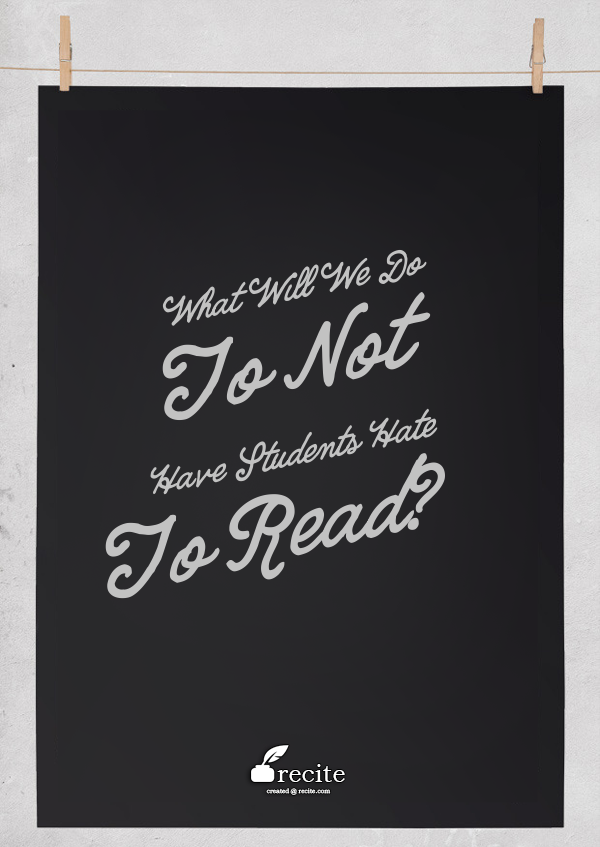
At Any Given Moment We Have the Power to Stop the Hatred of Reading

recite-io73x2

It used to astound me that my 4th graders would come to me and profess a hatred of reading.  It used to shock me to the core.  After all, these were the same kids that would ask for just one more page of our read aloud.  Who would ask me to read a picture book aloud the minute it came to our room.  Who had no problem confessing the love for the book we were sharing, but had none for the one they were reading alone.  I always thought that the next year’s teacher would surely get them on the right path even if I couldn’t.

Now I am the next year’s teacher, and their dismay of books has only grown further.  The group of children telling me that they never read outside of school has only grown.  And this is not a boy-reader problem, this is an any gender problem.  This is not something just caused by poverty, nor disengaged parents, nor reading difficulties.  I see the hatred of reading defended the most from my students who have had every opportunity to fall in love with reading.  I know I am not alone in this.  And I know I cannot wait for someone else to fix it.

So I started to dig a little deeper.  I get that they “hate” reading, but why?  What parts was it that caused so much emotion, or sometimes so little, that students would have a physical reaction to whenever we had independent reading time.  And their truths were not pretty, because the finger they pointed, pointed right at me.  Or us, as educators.

We may think that it is too easy to blame teachers for the systematic destruction of reading love in our schools, and it is, because there are forces beyond our control that have a huge part in this as well.  But part of the blame does lie with us, and that means we can do something about it.  Especially in the upper grades where reading is no longer treated as something magical, but instead merely something useful.

At any given moment, we have the power to stop ourselves from telling students what to read.  In our eagerness to shape well-rounded readers we are instead creating non-readers.  In our eagerness to make sure students are exposed to all types of books, we are limiting them from discovering their own reading identity.  Would we rather have a child that reads every single fantasy book they can come across, or a child that begrudgingly only reads a few books a year from other genres?

At any given moment, we have the power to make reading fun again.  Fun is a not a swear word in our schools.  There is nothing wrong with discovering a book that makes us laugh, or makes us wonder, or makes us think.  Reading does not always have to have a purpose.  It can be just to share a wonderful experience.

At any given moment, we have the power to stop interrupting children while we read.  To not point out every single detail.  To not have them do post-its for every thought they have.  To not have them turn-and-talk every few minutes.  Let them reach the reading zone as Nancie Atwell calls it.  And not just once in a while but most of the time.

At any given moment, we have the power to reclaim what reading should feel like in our classrooms.  To stop always using whole-class novels.  To stop furthering our own vision for what makes a reader a reader.  To stop hanging our own reading identities around the shoulders of students and wonder why it does not fit?

At any given moment, we have the power to create classrooms where reading is magical.  Where reading is celebrated.  Where reading is taught, but taught in a way that does not extinguish the love of the very thing we are trying to promote.  But we have to look at our own practices first, we have to stand up and change.  We have to ask our students what we are doing so that we can be better.  So that their love of reading does not have to survive our classrooms.  So that their hatred for reading does not have room to grow.  But it starts with us, not them.

If you like what you read here, consider reading my book Passionate Learners – How to Engage and Empower Your Students.  The 2nd edition and actual book-book (not just e-book!) comes out September 22nd from Routledge.

being me, books, Literacy, Reading

10 Picture Books that Spark Empathy

To find more information about the August 10 for 10 Picture Book and see all of the amazing posts go to the hosts’ sites: Cathy Mere at Reflect & Refine and Mandy Robek at Enjoy and Embrace Learning.

I had a hard time picking which type of list to make today.  Should I do one on laugh out loud picture books?  One on wordless?  How about those that make us cry?  Yet, I kept coming back to this list; the one that stuck with me the longest; the picture books that spark empathy.  These are the ones that leave my students speechless at times, other times eager to discuss.  The ones that stick with us throughout the year that push us to think about our actions and become better people.  Those were the ones I wanted to highlight today.

I have long loved The Other Side by Jacqueline Woodson for its straightforward story of two girls living on either side of a fence and yet many miles apart.  For some of my students this is territory they have not gone into yet, so the conversations about race, our history, and even what is happening now in our world abound.

I don’t remember how I came upon The Invisible Boy by Trudy Ludwig.  My guess is that someone shared it on their blog, so thank you to them.  This story so beautifully encapsulates what it means to feel invisible and every time I have used it with students it has led to deep conversations.  We read this more than once so we can pay attention to the illustrations as well.

Students  immediately fall in love with Pete & Pickles by Berkeley Breathed for the illustrations  but then come back again and again for the story of an unlikely friendship between a pig and an elephant.  This is a must read aloud at any age.  (ANd truly they all are).

It has been established already that Peter H. Reynolds is a creative genius.  I have loved all of his books since the first time I read them.  This book, I’m Here, is one that doesn’t get a lot of attention standing next to The Creatrilogy, but it should.  It’s eloquent story about a boy who feels so all alone is one that will settle into the hearts of students.

Thea, my kindergartner, came home and told me that I had to get this book about a big red crayon.  Okay…. I thought.  But she was right, Red – A Crayon’s Story by Michael Hall was one that I had to read aloud to my 7th graders.  And then we had to discuss what it meant staying true to one’s own nature as well as facing the pressures of others.  I swear this book was written for middle schoolers and not young children secretly.

It is a celebration in my life whenever the talented Ame Dyckman comes out with a new picture book and Wolfie the Bunny was definitely a cause for celebration.  This book about assumptions and what they can lead to has not only made my students laugh outloud, but more importantly, has led us to question our own assumptions about others.

I have Bluebird by Bob Staake on many favorite picture book lists, and there is a reason for that.  The shock on my students faces when we get to that page.  The questions, the discussion when I step out of the way are priceless.  This is a wordless picture book which also means that my students love interpreting the ending.

I cried when I read aloud The One and Only Ivan so it only seems fitting that I cried when I read out loud Ivan:  The Remarkable True Story of the Shopping Mall Gorilla by Katherine Applegate.  My students love to ask questions after this book, they love to talk about their own animals, what they would do to save others.

I read this book out loud to all 5 of my 7th grade classrooms.  It was astounding how similar the reaction was; disbelief, outrage, questions and perhaps a tear or two shed by me.  This story Malala, A Brave Girl from Pakistan/Iqbal, A Brave Boy from Pakistan by Jeanette Winter is one that will stay with you for a long time.  This is sure to elicit conversations and calls for action.

I always seem to cheat on these posts and never stick to just 10, so for my 10th pick I will give you several instead.  All of these are worthy of being read aloud and discussed.  We need more empathy in this world, I am so glad these authors give us a chance to do just that.

Each Kindness by Jacqueline Woodson

The Name Jar by Yanksook Choi (Having a name that no one pronounces correctly in the USA really makes me love this book even more).

One by Kathryn Otoshi 

Zero by Kathryn Otoshi

Chrysanthemum by Kevin Henkes.

Which ones would you add to the list?

If you like what you read here, consider reading my book Passionate Learners – How to Engage and Empower Your Students.  The 2nd edition and actual book-book (not just e-book!) comes out September 22nd from Routledge.  

being me, books, Literacy, Reading, students

My 10 Favorite Nonfiction Picture Books Right Now

I don’t remember reading much nonfiction as a child, perhaps I was too caught up in being a kid to notice.  I read biographies for a long time, but nonfiction picture books were not on my playlist.  Not so anymore.  The nonfiction picture books that are available to our students now are amazing and every year a few more settle into our library and hearts.  Here are the top ten favorites in our classroom library.

When Donalyn Miller recommends a picture book, I pay attention.  Tricky Vic – the Man Who Sold the Eiffel Tower by Greg Pizzoli is a masterpiece.  A page-turning read that makes you shake your head in wonder.   This is a picture book for all ages.

Kelly Milner Halls can do no wrong in my eyes and her book In Search of Sasquatch is a favorite read in our classroom library.  The reporting style of the book, the pictures, and the flow of the text makes this a book that students come back to again and again.  Check out all of her other nonfiction texts too, you will be glad you did.

Loved by many, any of Elise Gravel’s Disgusting Creatures series such as The Worm is sure to suck readers in.  With its whimsical illustrations surrounded by the facts about these animals, readers don’t even know how much they are learning as they devour the pages.

I don’t think it is possible to have a top 10 nonfiction picture book list without Ivan:  The Remarkable True Story of the Shopping Mall Gorilla by Katherine Applegate.  This beautiful book and story makes me cry every time I read it, but it is worth every sniveled tears.  This is also one of the most lost picture books in my classroom, I hope it finds much love in its new homes.

Anything by Seymour Simon deserves to be on this list, but Gorillas is one of our favorites.  With its stunning photography and accessible text, it provides my students with enough information to make them feel knowledgeable, as well as the desire to keep reading more.  Seymour Simon is a legend within the nonfiction universe, rightfully so.

I have mentioned Bad News for Outlaws:  The Remarkable Life of Bass Reeves, Deputy U.S. Marshall by Micheaux Nelson on many picture book lists and there is definitely a reason for that.  This book provides students with a different historical narrative about the 1800’s than most.  Students cannot believe the story is true and it is often discussed for a long time after.

I remember reading the newspaper articles about George, and yet when Galapagos George by Jean Craighead George showed up at my house I still read it aloud to Thea not putting two and two together.  George does not have a happy ending, which I knew, but had forgotten about.  The shocked look on Thea’s face as I got to the end told me I should have probably prepped her, however, the tale itself is hauntingly beautiful and completely worth the shock.

Every time I receive one of these Did You Know  books by Laura Lyn DiSiena and Hannah Eliot  I cannot wait to read them aloud to my own kids and then get them into the classrooms.  these whimsical fact-bursting books are for kids of all ages and is sure to leave even the most knowledgeable reader in awe.

Manfish by Jennifer Berne tells the childhood story of Jacques Costeau.  I love filling my students in on this ocean explorer, and the illustrations are gorgeous.  A simple tale told about one of the great explorers of our time.

And for spot number 10, I can’t pick, so here are a few more of my favorite reads.

On A Beam of Light  by Jennifer Berne.

Me…Jane by Patrick McDonnell

The Boy Who Loved Math  by Deborah Helligman

Viva Frida by Yuyi Morales

The Right Word: Roget and His Thesaurus by Jen Bryant.

The Noisy Paint Box by Barb Rosenstock

And finally, I just added these to my wish list

The Pilot and the Little Prince by Peter Sis.

Odd Boy Out by Don Brown

Star Stuff: Carl Sagan and the Mysteries of the Cosmos by Stephanie Roth Sisson

Mr. Ferris and His Wheel by Kathryn Gibbs David

If you like what you read here, consider reading my book Passionate Learners – How to Engage and Empower Your Students.  The 2nd edition and actual book-book (not just e-book!) comes out September 22nd from Routledge.  

assumptions, being me, books, Literacy, Reading, students

Can We Find A Better Term Than Struggling Readers?

image from icanread
image from icanread

To struggle means to contend with an adversary or opposing force.  To struggle means to advance with violent effort.  To struggle means to cope with an inability to perform well.  Despite its relationship with these definitions, the term “struggling reader” has become one of the favored way to label our learners as we discuss their needs.  A term that means to advance with violent effort is somehow now associated with developing as a reader, and I cringe every time I hear it.

It is not that I don’t see children fighting with words when they are learning to read.  I see the tremendous effort.  I see the hard work that goes into becoming a reader.  And I see my older students still fight, sometimes word for word, as they process the text.  They are in a struggle at times, yes.  But they are not struggling readers.  They are not battling an epic foe that will take them down somehow, because I can’t allow them to identify that way.  I can’t allow that definition to define them in my own eyes.  they are so much more than struggling readers.

When we allow a term like this to permeate our instruction, to permeate the conversations we have about students, we are viewing the children we teach only through one lens.  We allow this term to overtake any other information we have on the child and the effort that they put into learning.  When we label someone as struggling, we have, in essence, given them a box to place themselves in and for the rest of their lives they can choose to stay within that box knowing that no matter what they do, they will never stop struggling.  That label becomes part of their identity.  In our own minds as teachers, we also create a neat box to put them in as we plan our lessons and our own assumptions about what they can or cannot do taints their future path.

When we tell a child they are developing rather than struggling, then there is hope.  Then there is a chance for them to think that some day whatever they struggle with will not be as hard for them.  That they are developing their skills and working through the process.  And yes, that process may take years and years, but that there will be success, however small, and that this learning journey is one they will be on for the rest of their lives.  We don’t give them that chance for hope when we call them struggling readers.

In fact, why label them at all?  Why not just call all of our readers just that; readers?  Almost every child reads in some way.  I see it in my own children when they pick up a book and point to the pictures, too young to process that there are words on the page as well.  I see it in Thea, my 6 year-old, who is reading from memory and developing systems to figure out words.  I see it in my 7th graders that slowly work through a page of text, exhausted by the end of it.  They are readers.  And yet, their path toward becoming better readers may be one that has obstacles, may be one filled with struggles, but that does not mean that they are the ones struggling at all times.  That does not mean that one label will define who they are human beings, and nor should we let it.  But that change starts with the very language we use to speak about our students.  That change starts with us.

What do you think?

If you like what you read here, consider reading my book Passionate Learners – How to Engage and Empower Your Students.  The 2nd edition and actual book-book (not just e-book!) comes out September 22nd from Routledge.  

being a teacher, Literacy, Passion, Reading, student choice, student voice

Stop Feeding the Beast – The Reading Myths We Pass on As Truth

“This is not a “girl” book even if the cover makes you think it is, boys can love it too…”And I stop myself.  And I cringe inwardly.  And I want to rewind time for just 10 seconds and tell myself to stop.  A “girl” book?  What in the world is that?  And since when did I label our classroom books by gender?

The stereotypes of reading seems to be a beast in itself.  We feed the beast whenever we pass on hearsay as fact.  We feed the beast whenever we fall victim to one of these stereotypical sayings without actually questioning it.  Through our casual conversation we teach our students that there are books for girls and books for boys.  We teach our students that a strong reader looks one way, while a struggling reader (God, I hate that term) is something else.  We say these things as if they are the truth and then are surprised when our students adopt the very identities we create.

So what are the biggest myths that I know I have fed in my classroom?

11232142_10153492591360196_439666777097332585_o
Thank you Debbie Ridpath Ohi for this image

“This is a girl/boy book.”  I have said this many times as I try to book talk a book.  I say it when I think the boys, in particular, will not give a book a fair chance because of its cover.  I say it when I think the girls will find a book to be too violent, to have too much action.  And every time I say it, I am teaching these kids that certain books are only meant for certain genders.  What I forget is that I read all sorts of books.  That I, as a female reader, like a good violent book.  That I gravitate more toward “boy” books than “girl” books.  So why do I continue to pass this on to my students?  It stops now.

“This is an easy read.”  Another common statement I have made while book talking.  What I mean by it is that for most students the text will not prove difficult to understand, yet I know now that ease of reading looks very different from student to student.  That what I may think is easy, even when I pretend to be a 7th grader, is not easy at all.  That even if a book is short does not make it easy.  Even if a book has a manageable story line does not make it easy.  That “easy” means different things to different readers and therefore does not provide a good explanation to anyone.  It stops now.

“He/she is a low or high reader.”  Our obsession with classifying students based on their data does not help our students, it only helps the adults when we are discussing them.  There is an urge in education to group kids according to data points so that rather than take the time to discuss each student, we can discuss them as a group.  Yet the terms “low” or “high” make no sense when discussing readers.  They make sense when we are discussing data points, but is that really all our students are?  How many of us have taught students who were amazing readers, yet scored low on a test?  What would we call them?  We need to discuss students using their names and their actual qualities, not these shortened quantifiable terms that only box them in further.  It stops now.

“Most boys don’t really like to read.”  I don’t know how many years of teaching boys I need to finally stop saying this.  Many boys like to read – period – but when we say that most don’t, we are telling them that what they love is not a masculine thing to do.  That boys loving reading is something strange and different.  If we want this to come true, we should just keep repeating this over and over.  Our male readers will soon enough get the message that reading is for girls.  It stops now.

“The older they get, the less they love books.”  I used to believe this, until I started teaching middle school.  Then I realized that it is not because students want to read less as they get older, they read less because we have less time for independent reading, and we dictate more of their reading life.  Homework builds up as do other responsibilities outside of school.  Compare a 5th grader who has 30 minutes of independent reading most days to my 7th graders that get a luxurious 10 minutes – who do you think reads more in a year?  Also, I wonder if anyone would want to keep reading if they did not get time for it in school or had choice over what they read for several years?  Sometimes I think it nearly a miracle that students’ love of reading can survive what we do to them in some educational settings.  It stops now.

“But they are not really reading…”  I used to be the hawk of independent reading, watching every kid and making sure that for the entire time their eyes were on the text.  If they stopped I was there quickly to redirect.  Independent reading time was for independent reading and by golly would I make sure that they used every single second of it.  Yet I don’t read like that myself.  When I love a book, I pause and wonder.  When I love a book, I often look up to take a break, to settle my thoughts.  When I love a book, my mind does not wander but I still fidget.  That doesn’t need a redirection, that doesn’t need a conversation, that simply needs to be allowed to happen so I can get back to reading.  Our students are not robots, we should not treat them as such.  Re-direct when a child really needs it, not the moment they come up for air.  It stops now.

“They are too old for read alouds…picture books…choral reading…Diary of Wimpy Kid…”  Or whatever other thing we think our students are too old for.  No child is too old for a read aloud.  No child is too old for picture books.  No child is too old for choral reading.  No child is too old for books like Diary Of A Wimpy Kid.  Perhaps if we spent more time showcasing how much fun reading really is, kids would actually believe us.  It stops now.

The myths we allow ourselves to believe about reading will continue to shape the reading lives of those we teach.  We have to stop ourselves from harming the reading experience.  We have to take control of what we say, what we do, and what we think because our students are the ones being affected.  We have a tremendous power to destroy the very reading identity we say we want to develop.  It stops now.  It stops with us.

If you like what you read here, consider reading my book Passionate Learners – How to Engage and Empower Your Students.  The 2nd edition and actual book-book (not just e-book!) comes out September 22nd from Routledge.