I used to think picture books were best placed behind my desk, labeled for teaching use. Stowed away neatly so that they wouldn’t be lost, not the pages too creased. After all, picture books were for little kids and certainly not the big kids I was teaching. One day, a student asked me if he could borrow one of the books that were perched behind my desk fortress, I wanted to say no, but instead asked him why? Why did he want to read that book and not the mature books in our classroom library? Sheepishly he glanced at me and then muttered, “For fun….?” And so I handed him the book. It wasn’t long after that all of my students would ask for the picture books squared away and I soon realized what a fool I had been. Picture books were not for little kids. They were instead the perfect text to use in mini-lessons, to lead discussions, and to create a community of readers. I have never stored my picture books away from students since.
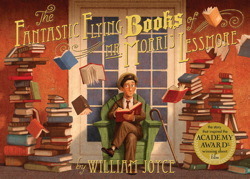
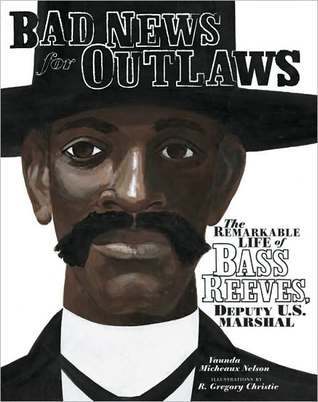
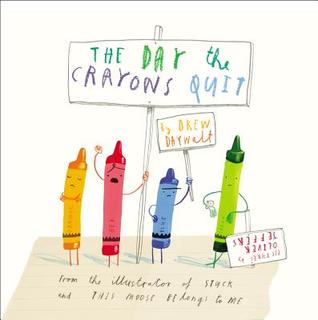
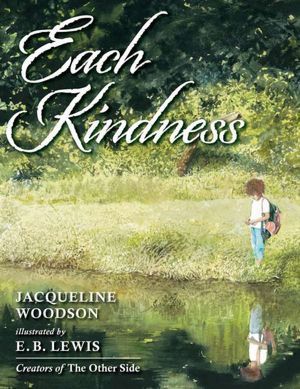
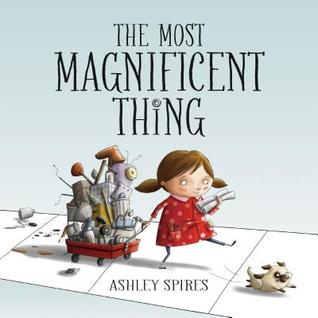
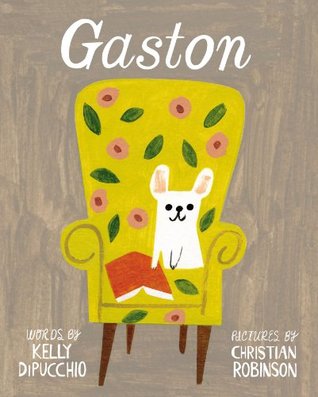
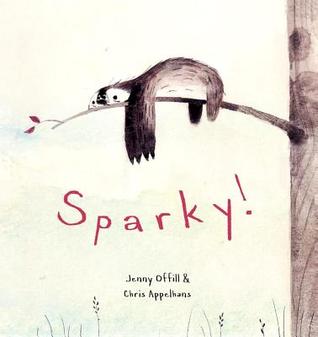
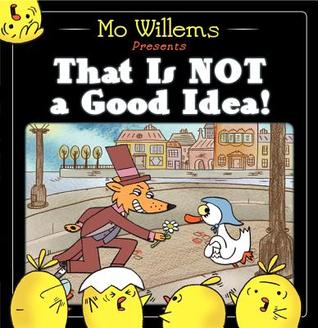
But what do you bring into the middle school classroom? Is there some sort of rule that applies for which books will work with these fantastically diverse years or does it not matter? It turns out that the only thing that matters is the quality of the picture book itself, once that is taken care of, the students will not stop reading them. If you are just adding picture books to your classroom library, pick wisely in the beginning, but don’t get too caught up in whether or not it will make a great mentor text, I have found that the most unlikely of books can always be used for something as long as the students are into the story. So the favorite picture books we have in our room, in no particular order, are…
And the list could go on and on, but at least this is start for those of you looking to add incredible picture books to your classroom library. And don’t start like me; let the kids read them whenever they want, even the big kids, especially the big kids. Which books would you recommend?
Anyone who enters our classroom immediately notices all of the books we have. It’s hard not to, they seem to be everywhere. While I have always believed in having as many books as possible in the classroom, I was not always sure on how to best organize it for optimal student access and interest. Now, seven years into having a library, there are a few things that have made my life easier.
No check out system
I have tried so many different check out systems, from a catalog system, to student librarians, to an electronic version, and all of them turned out the same; a ton of work for me and I still lost a lot of books. So a few years ago I abandoned the check out system. Now students know they can grab any book as long as they promise to return it. It is amazing to see the look on a students’ face when they hear that. Yet, I am not sure this is still the best way, I do lose a lot of books but for now replacing books is easier than spending all of that time checking them out.
“Return Your Books Here” Bin
I used to have students shelve the returned books but I always ended up having to remind them and then re-teach them how to get them in the right bin even though everything was marked. I now have a plastic tub with a “Return your books here” sign taped to it right by all of our bookshelves. Once a day I take the time myself to shelve all of the returned books because it gives me a way to see what is popular, look for books other students are wanting, and check on the conditions of some of our most beloved books. It takes me less than five minutes and all the books are in the right bin.
Bins for every genre and then some
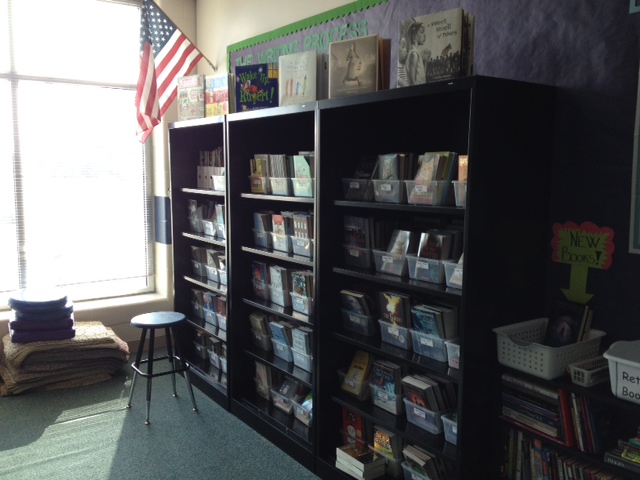
I have loved having book bins for many years. While they cost money and give you less shelf space, it has proven to be the easiest way for us to categorize books. Bins are grouped by genre and some by popular authors. Students suggest bins as well as they see a certain collection grow. Two such examples are our newly formed Cassandra Clare bins and military history bins when students pointed out that we had a collection now.
This Book Belongs to Mrs. Ripp Stamp
This inexpensive stamp purchased from Amazon several years ago has saved me so much time. All new books get stamped with “This book belongs to Mrs. Ripp. Please return when finished” on the inside cover and then the genre abbreviation (or author if they are in an author bin) is handwritten below it in black sharpie. I cannot tell you how many books are left behind in other classrooms around our school and this little inexpensive stamp means they all come back to me.
The Hardcover Post-It
The only exception I have to my no book check out system is that if a student is borrowing a hardcover book, I ask them to give me the book jacket and put their name on it with a post-it. I then save them all in a bin and ask students for them periodically. This has saved many hardcover books from disappearing as students see their name and then remember that they probably left in that one place. It also gives me a way to track a book down if someone else is looking for it.
The Gutter Picture Book Organizer
Someone long ago hung gutters all around my room under the white boards and I could not be more happy. Gutters make a perfect display rail for any amazing picture books we may have and ensure that all of the new ones get read right away as well. A very inexpensive way to get more display space indeed.
Beginning of the year book shleves
Printed and Laminated Bookmarks
We use Kylene Beers’ book Notice and Note throughout the year to give us a shared reading language, so it was natural for me to make some printed bookmarks reminding students of the strategies as they read. Bookmarks are i the same place next to post-its, which some kids prefer to use. They don’t have to ask for one, they take them as needed, and return them when they don’t if they feel like it.
“Our Favorite Books” Spinning Wire Rack
For a long time I had a wire rack where I placed all of my favorite books on for students to browse. Yet, it was not being used very much even though it was in a prime location. After inspiration by Nancie Atwell, I hung a sign above it declaring it a rack for the students to share their favorite books and then took all of my books off. I told the students its new purpose and have since watched it fill up with their favorite reads. This spinning rack has now become the first stop whenever they need a new book.
A Separate Book Case (Or Two) For Picture Books
While we have many of our favorite picture books out on display in the classroom (it’s amazing how many time students gravitate toward them in a day when they have a few minutes), I also have an entire book case just designated to picture books. I used to organize them and group them together and then realized it didn’t make the slightest difference to the students. They looked through a lot of books anyway whether they were organized or not. Since I don’t have these in bins, I gave up on organizing them and haven’t looked back since.
The Readers’ Notebook That Doesn’t Leave
I used to ask students to carry their readers’ notebook back and forth for some reason, which meant many days they left it in their locker, or at home, or didn’t know where it was. I also had to ask them to specifically leave them behind whenever I needed to assess them which meant the pressure was on to get them assessed so I could hand them back. Now I ask the students to leave all of their readers notebooks in the classroom. I have a bin for each class, I don’t care what name order they are in and at the start of each class all I have to do is grab the right bin off of my shelf and put it out for the students to grab. This is also how I do attendance these days, by seeing whose notebook has not been picked up.
Pre-printed Standard Comments Sheets
I assess my students readers notebooks every two weeks and while I often take the time to write in specific comments to them, I have also learned to pre-print address labels stickers with certain broad comments such as “Remember to use text evidence to support your thinking” or “Why do you think the author did this?.” Not only has it saved me a lot of time when I need to assess 120 readers notebooks, but it also allows me to focus on the comments they really need while covering all bases. The students do not mind (I have asked them) since they know it allows me to support them more often with my thoughts.
Learning to Let Go
This has been my biggest take away in having a classroom filled with books and readers. Sometimes you don’t have to have a perfect system for it to feel perfectly fine. The students make our book loving classroom their own so they change the organization of books, the shelving of them, and even how we read them. I don’t mind, I just have to let go sometimes and trust the students.
I knew moving to 7th grade from 5th that our read aloud was something I had to preserve. I knew that having a shared experience was something we needed as we built community, I knew we needed a read aloud so we could be a part of the Global Read Aloud and be a part of a global reading community, and I knew that no matter how old my students may feel like they are, a great read aloud has no age limit. What I didn’t know was just how hard it would be!
Between 45 minute class periods, students who groan at the slightest hint of silliness, and a broad curriculum that seems to never slow down; our read aloud was getting squeezed out almost every day. In fact, in one class, our very first read aloud took us nearly 5 months to finish. Talk about stretching out a story. So in this year of trial and error, I have discovered a few things that is bound to restore the read aloud as one of our main tenets next year.
Pick different books for each class. As much as I hate having to keep track of five different books, I made the mistake of reading the same amazing book aloud to three of my classes. My own apprehension and disdain for reading the same thing aloud thus created another barrier; I simply did not want to read aloud to my later classes because I had already read it aloud before. Now I honor the individuality of my students by having different texts for them all. We discover the books together and I want to see what happens next just as much as they do.
If you do read the same book; record your read aloud. If you can find an audio version of a book, find it and use that with the students. If you cannot, then make your own for example by reading it aloud to Voxer and then emailing the sound file to yourself. I plan on doing this for our Global Read Aloud books next year so that I won’t get sick of reading it aloud again and again.
Make your read aloud your mentor text. I did this in 5th grade and got away from it in 7th, but now I am going right back to it. This way, when we go through the strategies from Notice and Note we can search for them right in the text we are using, thus double-dipping into the time we have.
Read books in verse aloud. This year certainly has been the year of the verse book and these make for incredible read alouds. The story moves along at a fast pace, the students hear great poetry and like it, and it allows us to cover more books. I just finished The Crossover with two classes who loved the story.
Never underestimate a great picture book. If you know you will be hard-pressed for time one quarter or over a span of time, opt for reading aloud amazing picture books. We have read many Elephant & Piggie books, plus any of the other incredible picture books we have in here. What matters about the read aloud is that we have a shared text experience that we can grown from on many levels. That does not just have to come from a chapter book.
Even if just for a minute; read aloud. I used to think I should only read aloud when I coud afford to spend 10 minutes or more on it in class. The constraint of the 45 minutes that I teach in did not allow me the luxury of that often so we got further and further away from our stories. Now I know that even if I finish class with just a few minutes of read aloud at the end of class, it is better than not reading, because even a few minutes keep a story fresh and the action moving.
Today I said something I didn’t think I would say ever again. Something that I have told others to never say, in fact, I may have even pleaded with a few people. What came out of my mouth after lengthy consideration? “No more reading on devices this quarter.” Then I held my breath just a little bit and I waited for the reaction. Not just from my students, but from the reading police, for my better sense to come yelling. For someone to bust through my door and tell me that reading is all about choice and that reading on a device counts just as much as reading a paper book. That to get students to read we should allow them to read any thing they want, as long as they are reading. That fan fiction counts as fiction as well.
They would have been right, too. It is all about choice. It is all about getting them to read. About letting them pick whatever they want as long as they read, as long as they get their eyes on print. Yet for some of my students even that hasn’t worked, and so today, I took a drastic measure by outlawing devices. You see, because even with all of that choice some are still not reading. They may be skimming pages, they may be browsing various fan fiction sites like WattPad searching for a story, they may even be diving into a text now and then. But most of the time, every single day, the device in their hand has become one more tool to distract them from falling into a great story, or finding their reading zone to quote Nancie Atwell.
So today, I asked, or maybe even forced them a bit to find an amazing book to read. To feel the weight of the book in their hands, to browse through all of the books we have and find one that calls their name. To abandon a book if it doesn’t. To save their time to read the very best of books. To get sucked in, knowing that I will be ask them how their book is, what they love, if I should read it as well. And when they finish I will ask them to pass it on. To tell someone else to read it as well, to hopefully love it as much a they did.
As they book shopped, I saw something happen that I have waited for all year; my most reluctant readers actually ask about books. Yes it was because they had to but they were actually doing it. They browsed somewhat, they shuffled through pages, and they all left with a book that they were willing to try. Yes, some are still unhappy that I am asking them to read a paper book. Yes, some think I have lost my mind, but perhaps today is the beginning of a change in mind, of a seed being planted. Or not, but I am going to try it for a while because something had to change. That I have eight weeks left to try to get them to read at least one great book and so I had to change my tune a little bit. We shall see if it pays off. We shall see if it helps or harms. What do you think?
I am a passionate teacher in Oregon, Wisconsin, USA but originally from Denmark, who has taught 4th, 5th, and 7th grade. Proud techy geek, and mass consumer of incredible books. Creator of the Global Read Aloud Project, Co-founder of EdCamp MadWI, and believer in all children. I have no awards or accolades except for the lightbulbs that go off in my students’ heads every day. The second edition of my first book “Passionate Learners – Giving Our Classrooms Back to Our Students” will be published by Routledge in the fall. Second book“Empowered Schools, Empowered Students – Creating Connected and Invested Learners” is out now from Corwin Press. Join our Passionate Learners community on Facebook and follow me on Twitter @PernilleRipp.
I have been pondering the idea of the repeated whole class novel; a bastion of English classes everywhere. I have been pondering why this practice seems to flourish in English classes everywhere despite what it seems to be doing to some students’ love of reading. Frankly, I am starting to get upset about it, after all, it is hard not to when my incredible niece who seems to inhale books told me today that since she keeps being assigned books in school she hasn’t really been reading much else. Which means her grand total of books this year is about 10. Rather than the 50 or 60 she usually reads. From 50 to 10. Let that sink in. She also told me the only reason it’s so high is because over the holidays she read a few books of her own choice, ones she had been waiting to read and finally felt she had the energy to. But 10 books is not very high, not for her at least, so there seems to be a problem here. Her English class seems to be killing her joy of reading.
As someone who has not used whole class books for several years, I am trying to see the need for them. I am trying to take this post and turn it into a discussion, rather than a rant. Yet I keep returning to the question of why we continue to force students to read certain books when that is the number one thing ALL of my students report kill their love of reading?
I see reasons for assigning the classics, in her 8th grade class a few of the titles this year have been Johnny Tremain, Animal Farm, and The Diary of Anne Frank, but wonder why it has to be all classics all year? I also wonder who determines the books being read, when does a book become a classic, and does that list ever get updated? I read Animal Farm and The Dairy of Anne Frank in school as well and that was 20 years ago in another country. Are there really no new classics that can take their place?
I see reasons for having a shared text to discuss, analyze, and work with, but wonder if it can be done through a read aloud rather than an individual read? Or could it be just one part of the year rather than every unit and every book?
I see reasons for presenting students with great book choices but wonder if they all need to be reading the same one at the same time? Can the teaching purpose be reached in a different way?
PS: You know what is incredible though; my niece still loves her English teacher. She doesn’t see the curriculum as a flake in that teacher’s ability, which says a whole lot about that teacher and their ability to connect with students. So while she longs for the days where reading was just fun, she doesn’t hold it against the teacher. And bottom line, that matters too.
I am a passionate teacher in Oregon, Wisconsin, USA but originally from Denmark, who has taught 4th, 5th, and 7th grade. Proud techy geek, and mass consumer of incredible books. Creator of the Global Read Aloud Project, Co-founder of EdCamp MadWI, and believer in all children. I have no awards or accolades except for the lightbulbs that go off in my students’ heads every day. The second edition of my first book “Passionate Learners – Giving Our Classrooms Back to Our Students” will be published by Routledge in the fall. Second book“Empowered Schools, Empowered Students – Creating Connected and Invested Learners” is out now from Corwin Press. Join our Passionate Learners community on Facebook and follow me on Twitter @PernilleRipp.
I knew when I moved to 7th grade that book clubs would be one of the things that moved with me. That shared reading experience where students would get to just read and discuss is something I have loved having in the classroom the past few years. I knew it would be a different experience in the middle school classroom, after all their maturity would push their thinking, what I had not accounted for was also how my whole approach to the purpose of it would need to change to cater to a more critical mindset. So what do book clubs in the middle school classroom need to be successful?
An honest conversation. I would not have gotten student buy in if I had not had an honest conversation with them beforehand. They needed a chance to vent all of their frustrations with book clubs in order to see how this time around they might be different. They needed to know that their thoughts and yes, feelings, were validated and considered. While most would have invested themselves in the process simply because it was expected, I didn’t want that type of buy-in, I wanted a genuine desire to use this for good, to enjoy the 4 weeks or so it would last.
Choice in books. I know it is easier to have a small amount of pre-selected books for students to choose from so we can help facilitate the conversations, but with more than 100 students to cater to I knew I needed choice and lots of it. With the help of my amazing library team, bonus points from Scholastic, and the phenomenal Books4school, I was able to present the students with more than 50 different choices for titles. This way no group needed to share books and all students should be able to find something to agree on. I also told them that if they couldn’t find anything, to let me know, we would find the right book for them.
Choice in rules. While I may have an idea for how a book club should function, I needed student ownership over the reading, as well as how their discussions would unfold. All groups decided their own rules and posted them on the wall. It has been powerful to see them guide their conversations, and yes, also dole out consequences to members within their groups that have not read or are not participating.
Students self-made rules hang as a reminder on our wall
Choice in speed. All of my groups read at different paces, so they determine how many pages a night they need to read as well as when they would like to have the book finished by within our 4 week time frame. One group, in fact, has already finished a book.
Choice in conversation. Book clubs should not function around the teacher, in fact, I have noticed that when I do listen in to an otherwise lively conversation the students immediately get timid in most cases. I have learned to listen from a distance and only offer up solid small ideas to push their conversation further when they really needed it. Too often our mere presence will hijack a group and students don’t learn to trust their own opinions and analysis. Removing yourself from the process means students have to figure it out. For those groups that struggle we talk about in our private mini-lesson.
Choice in abandonment. I do not want students stuck with a book they hate, so some groups chose to abandon their books within a week and made a better choice. Rather than think of it as lost reading time, I cheered over the fact that my students know themselves as readers. All of my students are now reading a book that they at the very least like and that is an accomplishment in my eyes.
Choice in length and meeting time. Students are allotted time every other day to meet in their book clubs and have 28 minutes to discuss and read some more. While I have told student to try to push their conversations, I have also urged them to keep them under 10 minutes unless they are having a great discussion. Students vary the length of their book clubs depending on what their self-chosen topic of discussion is and figure out how their group works best in the process.
Choice in final product. While our true purpose of having book clubs is to have a shared reading experience, I am also asking the students to do a book talk of some sort when they finish. There are two reasons behind this; to assess the standards we are covering in the quarter but also for them to develop their critical thinking skills. If the book they read is not suited for future book clubs then I need to know why. I don’t want students to have a lengthy project because that is not what book clubs are about.
While my method for integrating book clubs may seem loose at best, I have found incredible buy-in from the students. They have been excited to read their books, they have been excited to share their thoughts, and the accountability that they feel toward one another is something I would not be able to produce through force. Middle schoolers need a framework to grow within, they need our purposes to be authentic as much as possible, and they need to have a voice in how things function within our classroom. Book clubs offer us a way to have these moments in reading that abound with deep reading conversations that I may not be able to have as a whole group, they allow even the quietest student to have a voice. They allow students to feel validated in their thoughts and they allow them to share their knowledge with each other. What have you done to create successful book clubs?















 Pernille Ripp