being me, student choice, student voice, voice

I Wrote This Post

recite-13iqtjc

I wrote this post three different ways, and none of them spoke my words well.  I wrote this post three different ways but none of them said what I really wanted to say.  I wrote this post three different ways all leading me to the same question; where are the students’ voices in our professional development?

Where are the voices of those we say we need to reach?

Because if they are not speaking to teachers as we prepare for yet another year.  If they are not on our committees.  If they are not at some of staff meetings.   If they are not there speaking to us throughout the year, then who are we really preparing for?

That’s it.

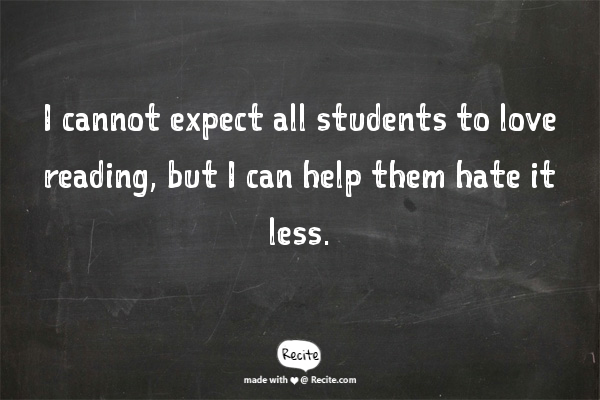
PS:  In my district today at our vision conference, we had a student-led panel for an hour and half talking about the good and bad in their education.  The whole afternoon was then spent reacting to what the students said.  I have learned more today about being a good teacher then I have at many conferences.  And that quote at the top came from one of our students today.

PPS:  To see all of the surveys I use with students and parents to get to know them better, go here.

If you like what you read here, consider reading my book Passionate Learners – How to Engage and Empower Your Students.  The 2nd edition and actual book-book (not just e-book!) comes out September 22nd from Routledge.  

being a teacher, new teacher, parents

A Few Ideas for Parent Engagement

recite-xt5ct

Parent engagement is a natural component of the elementary experience, after all, with class parties, whole school events, and weekly newsletter, parents have an easy time becoming involved in their child’s education.  Not only is parent involvement invited, it is expected and so schools and individual teachers create plenty of opportunities for parents to be involved.

Yet, with the gradual release of responsibility as students age, parent involvement becomes less and less of a focus.   We expect them to still be involved but not nearly as present.  Not nearly as informed.  After all, their children should be growing into responsible teens, which I agree with,  however, not all children are ready to be left to their own devices.  So rather than an expectation of parent involvement in the upper grades, how about an invitation instead?  Here are a few ideas to do just that.

The beginning of year parent survey.  Parents know their children best so we need to tap into that goldmine at every age.  It doesn’t have to be long, mine this year is 5 questions, but at least it gives parents a chance to communicate with us as we start the year.

The weekly newsletter.  This bastion of elementary classrooms does have a place in our older classes, but keep it short and to the point.  My team does a bullet point version of things parents can ask their child about and also an update on upcoming deadlines and projects.  If parents would like more information, they can access our website.

A beyond-the-homework website.  We have a website that yes lists homework, but it also gives team information, school announcements, helpful tips, as well as has a Google calendar where everything we are aware of for school is listed.  Parents can subscribe to it and get the news delivered via email.

Morning/Evening events.  This year I will be inviting parents along with their children in for literacy mornings or evenings where we will discuss books, view book trailers and such.  Perhaps none will show up but I want to create the opportunity either way.

The positive notes or phone calls.  It is hard to reach out to 120+ parents so split it up as a team if possible.  Keep a master list of who has had positive news about their child shared with them via email, phone call, or post card.

Go beyond the twice a year conference.  Every few months I invite parents to set up meetings with me to discuss the progress and goals of their child.  Not many take me up on it, however, they have the opportunity to come in if they would like.  And yes, that is me spending my time outside of hours to meet with parents but it is completely worth it in the end.

Weekly emails.  I send home a weekly email or so to parents discussing all things English, I keep it short and sweet and I post it on our blog too.  Parents can choose to delete it if they would like, I would rather have parents feel over-informed than under-informed.

Learn their names.  This is a not an event but a process.  I have a hard time keeping track of all of the names but I think it speaks volumes to know who it is I am speaking to.  When I don’t know I simply ask, I would rather admit it then pretend to know.

Keep learning transparent.  I try to post pictures and video from our classroom as much as possible so that parents can see what we are doing.  This year I plan on doing more of this as I feel more secure as a 7th grade teacher.  Again, they don’t have to view it, but at least it is there.

Open door policy.  I know that most parents are too busy to stop by but the point is; they can if they want to.  While I cannot stop teaching and speak to them, they can at least get a glimpse of what we are doing and how engaged their child is.

Staying connected and nice.  I know that we teach many students, I am up to 120 some I think, yet, for a parent you are only teaching their child.  So stay humble, stay nice, stay inviting, and if you mess up; admit it.  Having a teacher that truly cares about their child is on the wish list of every parent, even as they age.

What other ideas do you have?

If you like what you read here, consider reading my book Passionate Learners – How to Engage and Empower Your Students.  The 2nd edition and actual book-book (not just e-book!) comes out September 22nd from Routledge.  

being a teacher, community, parents

It Is Not Just Student Relationship We Should Worry About

Today our incoming 7th graders found out which teachers they will have.  I hope they are happy.  I hope they are excited.  I hope they have heard wonderful things about our team.  I know we can’t wait.  Today was also the day that Thea, my now 1st grader, found out her teacher, a moment that was exciting yet filled with questions as well.  Will her teacher “get” her?  Will she love school?  Will this be another incredible school year for her?  What will my role be as a parent of a 1st grader?

For years I have tried to create a welcoming environment for all the people that are attached to our classroom.  For years I have tried, along with my team, to create spaces where parents/guardians can feel like they have a voice, are welcome, and also can engage in tough dialogue with us when needed.  It is something that we pride ourselves on because it has not just happened, we have had to work at it knowing that parent/guardian relationship is vital to a child’s success.   So I was dumbfounded when I came across an article titled “Ten Types of Parents that Teachers Secretly Hate.”  I read it  (I won’t link it here because I don’t feel like giving it traffic) and I was so disappointed in it.  Is this really what we as educators want to tell parents?  That we secretly hate them when they are involved in their child’s education?  That if they don’t follow our rules for engagement then we will complain about them behind their backs?  Is this even what we want to be told as parents?  That teachers secretly label us and hate some of us?

Yet, it wasn’t just the labeling of the various types of parents that upset me, it was the complete disregard for the cause behind this behavior.  There was no discussion of why a parent might be over-involved, might be absent, might be going straight to the principal rather than us.  There was no acknowledgement of what can lead to these types of parental behavior that we “secretly hate.”  No discussion of what a poor school experience can do to future relationships.

I have worked alongside many types of parents and guardians.  Some have been wonderful interactions, others have been tough.  Some led me to tears while others led to great moments of joy.  I am thankful for every single interaction I have had, even if it was a hard one, because each one has made me grow as a teacher.  And sometimes the hardest ones have been the ones I have grown the most from.

So before we assume that parents are a certain way to annoy us, to discount us, to somehow make our workdays harder, how about we assume that all parents/guardians want what is best for their child?  How about we assume that the reason they approach us in a certain way is because that is what they have had to do in the past? How about we assume that they may be absent because circumstance is keeping them from our schools, not choices?  How about we afford them the benefit of the doubt and try to get o know them before we label them as being a certain way.

Much like we try to uncover the past of our students to find out how it affects them now, we should also be trying to uncover the pasts of the adults attached to them.  I am sure I will meet many of the archetypes of parents listed in the article in the coming year, but what I won’t do is assume that I know why.  What I won’t do is hate them.  What good will ever come from that?

We all know relationships matter most when it comes to a successful school year, so why not actively build a relationship with adults as well?  It starts now, not when something comes up, not when it is too late.  What will you do to reach out to them before they reach out to you?

PS:  I posted my welcome parent survey today, I cannot wait to read their answers.

If you like what you read here, consider reading my book Passionate Learners – How to Engage and Empower Your Students.  The 2nd edition and actual book-book (not just e-book!) comes out September 22nd from Routledge.  

being me, books, Literacy, Reading

10 Picture Books that Spark Empathy

To find more information about the August 10 for 10 Picture Book and see all of the amazing posts go to the hosts’ sites: Cathy Mere at Reflect & Refine and Mandy Robek at Enjoy and Embrace Learning.

I had a hard time picking which type of list to make today.  Should I do one on laugh out loud picture books?  One on wordless?  How about those that make us cry?  Yet, I kept coming back to this list; the one that stuck with me the longest; the picture books that spark empathy.  These are the ones that leave my students speechless at times, other times eager to discuss.  The ones that stick with us throughout the year that push us to think about our actions and become better people.  Those were the ones I wanted to highlight today.

I have long loved The Other Side by Jacqueline Woodson for its straightforward story of two girls living on either side of a fence and yet many miles apart.  For some of my students this is territory they have not gone into yet, so the conversations about race, our history, and even what is happening now in our world abound.

I don’t remember how I came upon The Invisible Boy by Trudy Ludwig.  My guess is that someone shared it on their blog, so thank you to them.  This story so beautifully encapsulates what it means to feel invisible and every time I have used it with students it has led to deep conversations.  We read this more than once so we can pay attention to the illustrations as well.

Students  immediately fall in love with Pete & Pickles by Berkeley Breathed for the illustrations  but then come back again and again for the story of an unlikely friendship between a pig and an elephant.  This is a must read aloud at any age.  (ANd truly they all are).

It has been established already that Peter H. Reynolds is a creative genius.  I have loved all of his books since the first time I read them.  This book, I’m Here, is one that doesn’t get a lot of attention standing next to The Creatrilogy, but it should.  It’s eloquent story about a boy who feels so all alone is one that will settle into the hearts of students.

Thea, my kindergartner, came home and told me that I had to get this book about a big red crayon.  Okay…. I thought.  But she was right, Red – A Crayon’s Story by Michael Hall was one that I had to read aloud to my 7th graders.  And then we had to discuss what it meant staying true to one’s own nature as well as facing the pressures of others.  I swear this book was written for middle schoolers and not young children secretly.

It is a celebration in my life whenever the talented Ame Dyckman comes out with a new picture book and Wolfie the Bunny was definitely a cause for celebration.  This book about assumptions and what they can lead to has not only made my students laugh outloud, but more importantly, has led us to question our own assumptions about others.

I have Bluebird by Bob Staake on many favorite picture book lists, and there is a reason for that.  The shock on my students faces when we get to that page.  The questions, the discussion when I step out of the way are priceless.  This is a wordless picture book which also means that my students love interpreting the ending.

I cried when I read aloud The One and Only Ivan so it only seems fitting that I cried when I read out loud Ivan:  The Remarkable True Story of the Shopping Mall Gorilla by Katherine Applegate.  My students love to ask questions after this book, they love to talk about their own animals, what they would do to save others.

I read this book out loud to all 5 of my 7th grade classrooms.  It was astounding how similar the reaction was; disbelief, outrage, questions and perhaps a tear or two shed by me.  This story Malala, A Brave Girl from Pakistan/Iqbal, A Brave Boy from Pakistan by Jeanette Winter is one that will stay with you for a long time.  This is sure to elicit conversations and calls for action.

I always seem to cheat on these posts and never stick to just 10, so for my 10th pick I will give you several instead.  All of these are worthy of being read aloud and discussed.  We need more empathy in this world, I am so glad these authors give us a chance to do just that.

Each Kindness by Jacqueline Woodson

The Name Jar by Yanksook Choi (Having a name that no one pronounces correctly in the USA really makes me love this book even more).

One by Kathryn Otoshi 

Zero by Kathryn Otoshi

Chrysanthemum by Kevin Henkes.

Which ones would you add to the list?

If you like what you read here, consider reading my book Passionate Learners – How to Engage and Empower Your Students.  The 2nd edition and actual book-book (not just e-book!) comes out September 22nd from Routledge.  

aha moment, being me, MIEExpert15, Passion, Student dreams

A Thought on Perspective – The Fish Tank

tumblr_nso3c6hBcF1qzr04eo1_500

I sat there watching the fish swim in place, barely noticing Augustine’s excited screams.  Amazing that a 19th month old toddler pointing, yelling, and even wanting so badly to hit the glass did not shake the fish.  They barely moved.  And Augustine stood in total awe, oblivious to the world around her.

The fish seemed content.  They had clean water, a few rocks, a few fish friends and obviously enough to eat.  And yet, they were clearly too large for their tank.  There was nowhere to hide, no trees except for the fake ones painted on the back wall.  No places to go except hovering right in the middle staring out at a retirement homes’ front entrance.  A completely average life for most goldfish I presume.

What if our classrooms are much like that fish tank?

What if that is how we teach out students?

What if we give them enough to just thrive, to be complacent, to be just fine?  What if we provide our students with just the necessities in our curriculum and care?  We will surely see them grow.  They will not wither away.  But will we notice when they become too large for our tanks?  When they long for more than the artificial experiences we are providing for them?  Will we notice when their dreams outgrow the space that we share, the needs we fulfill?  And not only will we notice, but what will we do with that knowledge?  What will we do to tear down a wall?  Give them the world so that the very tanks we keep them in don’t set them on a path toward creativity suffocation?

Sometimes I think that I am doing a just fine job, and I don’t take the time to step away from our room, from the tank to speak, and look at it from an outsiders perspective.  It is hard to do when you are the caretaker of a classroom community because you think that you are doing everything you should be doing.  Yet the dreams of our students are sometimes so big that we have to unleash them on the world, because if we don’t the dreams will die.  We have to be able to create spaces where our students can continue to thrive, not just survive, not just hovering in the middle of the only space they have.

What of our students don’t know that there is more to the world than what we offer them?  Then how can we ever expect them to want to change the world?

Who ever thought a too large goldfish would remind me of that?

If you like what you read here, consider reading my book Passionate Learners – How to Engage and Empower Your Students.  The 2nd edition and actual book-book (not just e-book!) comes out September 22nd from Routledge.  

Be the change, being me, choices

We May Not Be Perfect

recite-17vbkyd

For years it seems the headlines have been yelling at us in education.  The videos have been posted telling us that school is broken, that we have lost creativity, that students hate school and we, the educators, are to blame.  For years, we have heard the rallying cry to save education and we have tried.   We have pushed ourselves, we have dreamed, we have created, we have failed, and we have gotten back up.  Every day we are trying to change education.

So although we may not be perfect.  Although we may not be there yet; we are changing the narrative of education that  surrounds us.  We are changing the way students feel about school.  We are changing the way education is viewed.  We may not be perfect, but we are trying.

So before we focus on all of the negative, because we are all good at that, focus on all of the positive things that surround us.  Focus on the people that come to work every single day and give it their best.  Focus on the students who tell you their truth so we can make a change.  Focus on all of the people who are making a difference.  Scream those stories from the rooftops.  Share those stories on Facebook.  When people tell you that school is broken, speak up!  Because we are not all broken.  Not all students hate school.  Not all schools kill creativity  Some do, we are not perfect, but at least most of are trying to make a change.  So celebrate that.

If you like what you read here, consider reading my book Passionate Learners – How to Engage and Empower Your Students.  The 2nd edition and actual book-book (not just e-book!) comes out September 22nd from Routledge.