behavior, punishment, students

Before You Hang Up That Public Behavior Chart

What-if-we-assumed-that

I have written before about public behavior charts, how I feel about them, what they do to students in my opinion.  And while some seem to have found a way to make them work within their environments, I wonder; what if we assumed that all students would have a great day, a great year, and we started off our year without them?  No behavior chart prominently hanging greeting the students on the very first day of school?

I think of the message we send on the very first day of school and how it can frame the way a child sees us.  I used to go over my behavior chart as one of the very first things of the school year; how to act, what the expectations were and more importantly what the consequences would be.  I assumed that my students would need consequences.  I assumed they would need punishment.  I knew they needed a structure, all people do, but I framed that structure in a negative way hoping for a positive result  Why I didn’t see that oxymoron until a few years in, I am not sure.

I am not saying get rid of your behavior systems, not if you’re not ready, but perhaps re-think the assumption that they need to be present from the very first moment of the new year.  And while we are battling assumptions, maybe it is time to reconsider whether all children truly benefit from them.  Do we really need a behavior chart for every single student in our rooms?  I think of my own daughter who works so hard on being good every single day, proudly telling me whenever she gets a compliment from the teacher, and the devastating effect it would have on her if she had to be on “yellow” or “not so great” for the whole world to see.  She cares so much about others, sometimes to a fault, that it would wreck her if others thought she was “bad.” Some may say that that is exactly the intended response; for a child to be so mortified that they never do that behavior again.  Yet, I wonder if that mortification leads to a break down in relationship?

We all know that student behavior can get better if a child feels safe within our environment.  That means safe to learn, safe to try, and yes, safe to have a bad day.  When we publicly show the rest of the class that a child is having a bad day and then leave a reminder up, we limit the way a child can process through their actions.  Some students will obviously correct their behavior, whereas others will continue down the path of bad decisions since they have already been called out on it.  So instead of the public behavior chart, how about a private one?  That way a child can still know how they are doing, you can still have the conversations it may spur, but you cut out the public call out, the public humiliation.  And what if on the first day of school we didn’t speak of just our own rules, but had the students discuss their rules for the classroom?  How about instead of consequences, we spoke of the learning journey?

So before you hang up that public behavior chart, even though it may have room for both great behavior and bad, consider whether every child needs one?  Can we accomplish the same privately?  Can a compliment mean more to a child than moving their clip?  Can a hushed conversation be a better consequence for a child who is making bad choices?  Can the same benefits that some see in the charts be reached in a kinder, quieter way?  I don’t think it hurts to ask the question.

PS:  If you want to read more about what I do now in my classrooms, read here 

I am a passionate teacher in Oregon, Wisconsin, USA,  who has taught 4th, 5th, and 7th grade.  Proud techy geek, and mass consumer of incredible books. Creator of the Global Read Aloud Project, Co-founder of EdCamp MadWI, and believer in all children. I have no awards or accolades except for the lightbulbs that go off in my students’ heads every day.  First book “Passionate Learners – Giving Our Classrooms Back to Our Students” can be purchased now from Powerful Learning Press.   Second book“Empowered Schools, Empowered Students – Creating Connected and Invested Learners” is out now from Corwin Press.  Follow me on Twitter @PernilleRipp.

being a teacher, being me, reflection

What I Take For Granted

image from icanread

I know I have a lot to be thankful for.  And yet, it seems to get lost in the every day.  The hustle and bustle we call life.  I try to be thankful, I try to give thanks, but some of the things I take the most for granted are the things that I forget about.  The things that if I didn’t have them in my life, my life would not be a happy one.  So why is it that we take so many things for granted when really we should be aware of how different our lives would be without them?

I think of the last few days in the aftermath of the not guilty verdict out of Ferguson and how I take for granted that my white son will never be accosted by police, unless he deserves to be.  It’s amazing what you take for granted when you are white.

I think of the millions of children who go to schools that are underfunded, falling apart, and riddled with inequities, and how I take for granted the incredible school my daughter goes to.

The couples who fight to pay their bills every day, whereas my husband and I certainly have to save and budget and not buy, but we are never faced with the choice of heat or water or which one we should pay.

I take that for granted.

Family and friends who get mad when you can’t see them enough because life is too busy and it has been too long.

Ugly mini-vans that are safe to drive in winter and can fit all of our crazy lives.

7th graders who are invested in our classroom, who think I am ok, who don’t hate everything we do.

Colleagues who actually like you and think you have worth.

Plenty of food to eat, to fit even the pickiest 2 year old’s appetite.

Health insurance that doesn’t stop, even when faced with more than $500,000 in medical bills because a baby decided to come 10 weeks early.

I take that for granted.

So today, I am thankful, but not for those big incredible things I get to do, but those essential ones that make my life my life.  Those tings I take for grated even though they should be the first in line whenever thanks is given out.  What are you thankful for?

administration, being me

Dear Administrators, I Only Have One Question

Dear Administrators,

I only have one question;

Does your staff trust you?

If yes; how do you know?

If no; why not?

If you don’t know; how will you find out?

Best,

Pernille

I am a passionate teacher in Oregon, Wisconsin, USA,  who has taught 4th, 5th, and 7th grade.  Proud techy geek, and mass consumer of incredible books. Creator of the Global Read Aloud Project, Co-founder of EdCamp MadWI, and believer in all children. I have no awards or accolades except for the lightbulbs that go off in my students’ heads every day.  First book “Passionate Learners – Giving Our Classrooms Back to Our Students” can be purchased now from Powerful Learning Press.   Second book“Empowered Schools, Empowered Students – Creating Connected and Invested Learners” is out now from Corwin Press.  Follow me on Twitter @PernilleRipp.

aha moment, being a teacher, being me

When Was the Last Time You Stopped Talking?

image from icanread

I didn’t know how much expertise I needed to stop talking until I switched districts.  Having to start over again, being brand new and friendless, I started listening better, quieting myself, and tuning in.  I started asking for help, recognizing that not only was I in a new district, but also in a new school, in a new grade level, on a new team.  Amazing what changes does to your listening skills.

What I heard was astounding; it is quite remarkable when you stop talking about your own ideas and listening to those of others, what you learn.  I couldn’t believe the varied experience of people, the things they knew, the ideas they had.   Sure, I knew I had been surrounded by greatness before but I hadn’t paid much attention to it, I was usually too busy forging my own path, sharing my own thoughts, touting my own expertise, when I should have been listening.

In fact, now that I think about it, I wonder when I stopped listening to others as much.  When did I become the supposed veteran or expert in the room?  When did I start to feel that I had more to teach than to learn?   I feel like all of those labels that people so graciously bestow upon me due to this blog has sometimes plugged my ears.  But not anymore.  Thank you 7th grade!

So my challenge this year is to stop talking so much.  To start listening more.  To actively learn from others.  Not just those that I adore online, but those I get to call colleagues every day.  Teaching shouldn’t just be about teaching others, it should be about our own learning journeys.  hOw we are listening to the genius that surrounds us.  I know we all have amazing things to share, but for a moment, allow others in so they can share.  So ask yourself; who are you learning from tomorrow?  Who are you listening to?  If it is yourself, then you’re probably doing it wrong, just like I was.

I am a passionate teacher in Oregon, Wisconsin, USA,  who has taught 4th, 5th, and 7th grade.  Proud techy geek, and mass consumer of incredible books. Creator of the Global Read Aloud Project, Co-founder of EdCamp MadWI, and believer in all children. I have no awards or accolades except for the lightbulbs that go off in my students’ heads every day.  First book “Passionate Learners – Giving Our Classrooms Back to Our Students” can be purchased now from Powerful Learning Press.   Second book“Empowered Schools, Empowered Students – Creating Connected and Invested Learners” is out now from Corwin Press.  Follow me on Twitter @PernilleRipp.
aha moment, Be the change, Passion, student choice, student voice

5 Rules We Impose on Students that Would Make Adults Revolt

Before-you-ask-students

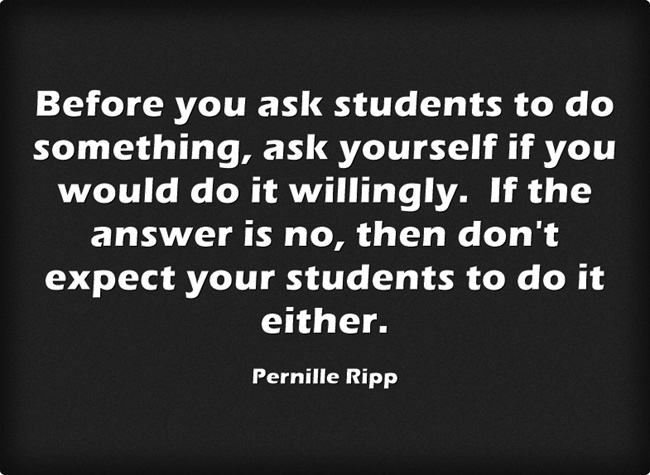
I remember the first time I walked through a silent school, the quiet hallways, the shut doors.  You would think it was testing season, but no, simply a school going about its day. At first I felt in awe; what order, what control, what focus!  Yet that night, as I shared my story with my husband, I realized something; schools aren’t mean to be silent.  They are filled with kids after all.  Quiet sure, but silent, no.  Yet here this school was; silent, and all I could think about was; why?  So what things are we expecting students to do that we would probably not submit to as adults?

Expect them to work hard all day with few breaks.  I could not do the schedule of my 7th graders; five 45 minute classes, then 30 minute lunch, then 3 more classes.  In between those classes?  3 minutes to get from one place to the next.  And high expectations everywhere they go.  We assume that they can just do it because we were subjected to the same, because the classes are all different, because this is not that bad, but as adults we would never be asked to sit focused, giving our best, and problem-solving for such long periods without taking small brain breaks, stretches, or in some other way reigniting our focus.  I know we do it so that we can fit everything in, but it still amazes me that we think it is is a good system.

Silent hallways.  Or most of the times we force silence when it is not for studying.  Of course, there needs to be quiet in the hallways while learning happens, but silent hallways – not needed.  Neither are silent lines, silent lockers, or silent lunch rooms.  Quiet and respectful can include talking.  Once, when I asked why my 5th graders had to be silent while they got ready for lunch, I was told it was in order to speed them up, apparently talking slows them down.  On the surface that may be a great reason, we want them to get to lunch sooner.  BUT.  These kids have just spent how many hours being told when to speak, not being allowed to speak to their friends, and now we tell them they have to be silent for longer?  As adults, we speak to our colleagues as we walk down the hallway, in fact, sometimes more loudly than the students.  We get to where we need to go just fine, often with a better focus because we got to relax for a minute.

Only go to the bathroom during breaks.  I remember telling my students that they had better use their lunch breaks to go to the bathroom because we didn’t have time the rest of the day.  Then I got pregnant and the whole idea of planned bathroom breaks imploded.  Yes, there are good times to leave the classroom and bad times, and yes, some kids will use the bathroom to get out of class because they are bored, tired, or want to simply get out.  So what?  To ask students to only go certain times, serves little purpose other than to establish teacher control.  Going to the bathroom can be just  the brain break a child needs to come back awake.  We use it all of the time as adults, why need trust students to do the same?

Do hours of homework.  I have long been an opponent of meaningless homework.  My severe distaste is based on many things, but one of them is that we have just asked students to put in a full day of hard work with us in the classroom.  Now, we are asking them to work even more outside of school.  Yes, some jobs require work outside of work hours, hello teaching, but not all, and often those jobs are by choice.  However, when we ask students for several hours more of their time, no matter our intentions, after they have gives us their best in class, we are treading on dangerous territory.  Why would students want to give us their best in school if we simply ask them to do more after?  I expect my students to work hard, use their time well, and get work done with me.  Yes, there is sometimes homework, no I am not perfect either, but I do think long and hard before I assign anything.

Be ready to show mastery on the same day.  This one took a while for me to realize.  You see, it doesn’t matter that you taught the concept at the same time; kids learn at different rates.  We know this intimately as adults; what may take our friend a day to understand, may take us a week or more.  Nowhere is that more apparent than in college where some students seem to study for weeks, while others breeze through the same material, ready for the test.  So why we expect our students to show mastery on the same day I will never understand.  Obviously it makes sense from a management perspective; it is hard to manage 113 students on different learning journeys.  It is also coming from a completion standpoint; the end of the quarter is the end of the quarter.  Yet research upon research shows us just how crazy this notion is, so why do we keep pushing it for it?  We need fluid mastery to serve our students best.

What other rules have you encountered?  Why do we do this to kids?

I am a passionate teacher in Oregon, Wisconsin, USA,  who has taught 4th, 5th, and 7th grade.  Proud techy geek, and mass consumer of incredible books. Creator of the Global Read Aloud Project, Co-founder of EdCamp MadWI, and believer in all children. I have no awards or accolades except for the lightbulbs that go off in my students’ heads every day.  First book “Passionate Learners – Giving Our Classrooms Back to Our Students” can be purchased now from Powerful Learning Press.   Second book“Empowered Schools, Empowered Students – Creating Connected and Invested Learners” is out now from Corwin Press.  Follow me on Twitter @PernilleRipp.

books, Literacy, Reading

10 Favorite Books from 7th Grade So Far – 2015

The books have been flying off the shelves in our classroom library, sometimes to be read and other times to be forgotten at the back of lockers.  But one thing is for sure, I have a lot of readers in my life.  I was worried about not having the right books for my 7th graders, however, I should have known; many of my favorites are also the favorites of the students.  So what have the 7th graders been reading and passing on?  Note the varying levels of maturity!

Loot: How to Steal A Fortune by Jude Watson was on heavy rotation this year.

Can’t Look Away by Donna Cooner was a favorite for many.

Gae Polisner’s The Summer of Letting Go was voraciously read by many.

The Shiver Trilogy by Maggie Stiefwater made reluctant readers read again.

With the movie out, The Fault In Our Stars by John Green remained in heavy rotation.

Even in 7th grade, students still love The Diary of A Wimpy Kid series by Jeff Kinney, as they should.

Everybody seemed to start the year by reading If I Stay by Gayle Forman.

Many eagerly waited for their turn to read Sisters by Raina Telgemaier.

The Raft by S.A. Boden was a page turner for many students.

Someone is always reading Amulet by Kazu Kibuishi.